Work record
West Virginia State Board of Education v. Barnette
1943 · Early 20th Century · Court Decision · English
Abstract
Question Presented. Does a state board violate the First and Fourteenth Amendments when it makes saluting the flag and pledging allegiance mandatory in every public classroom, expelling objectors and threatening their parents with prosecution?
Arguments. West Virginia pointed to the 1940 precedent: a uniform patriotic exercise, neutral among faiths, serves the vital aim of national cohesion, and choosing how to instill loyalty is a legislative task. The Witness families contended that officials may not force children to make a declaration their faith forbids, nor punish their households for that refusal.
Holding. Six justices affirmed the injunction and overruled Gobitis. The salute is expression, Jackson reasoned, and the state has no authority to command it from any citizen, religious or not; unity built on coercion fails, and fundamental freedoms are not subject to elections. Roberts and Reed stood by the earlier ruling, and Frankfurter argued that courts must defer unless a statute is plainly unreasonable.
Significance. Announced on Flag Day during the war, the ruling reversed a precedent only three years old. Its orthodoxy passage became a cornerstone of free-speech law, cited in decisions on student armbands in 1969 and license-plate mottoes in 1977. Jackson's reframing of the salute as expression, rather than as a matter of religious exemption, shaped the modern doctrine against compelled speech.
Key figures
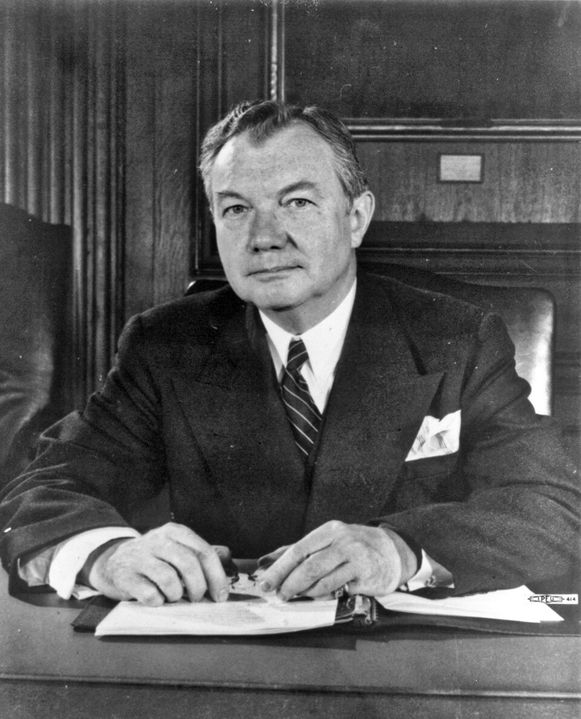
- Robert H. Jackson: Wrote the majority opinion overruling the 1940 flag decision
- Felix Frankfurter: Dissenter defending legislative judgment and his own earlier opinion
- Walter Barnette: Witness parent who sued to protect his daughters' schooling
- Harlan Fiske Stone: Chief Justice whose 1940 dissent the majority vindicated

Summary
West Virginia State Board of Education v. Barnette, 319 U.S. 624, decided on Flag Day, 14 June 1943, held that no state may compel public school pupils to salute the flag and recite the pledge of allegiance. After Minersville School District v. Gobitis (1940), the West Virginia legislature required instruction in history and civics, and on 9 January 1942 the State Board of Education, quoting heavily from Gobitis, made the salute mandatory for all teachers and pupils. A refusing child was treated as insubordinate and expelled, could be proceeded against as a delinquent, and exposed his parents to fines and jail. Jehovah's Witness families, among them Walter Barnette, sued on behalf of their children, and a three-judge district court enjoined the regulation despite Gobitis. The board relied on Gobitis: the salute was a reasonable civic exercise, applied to every pupil without regard to creed, and the means of teaching loyalty belonged to legislators and educators rather than judges. The families answered that the regulation compelled religious dissenters to profess a belief against conscience, punishing children and parents alike for silence. The Court affirmed by a vote of six to three, overruling Gobitis. Justice Robert H. Jackson wrote for the majority and reframed the case: the salute is a form of utterance, and the question is not whether believers deserve an exemption but whether the state has power to compel anyone to declare a belief. Censorship is tolerated only to prevent a clear and present danger, he reasoned, and compelled affirmation would need even stronger grounds. He then answered the Gobitis premises one by one, holding that individual freedom of mind is a source of national strength, that school boards are bound by the Bill of Rights, that the very purpose of that Bill was to place certain subjects beyond the reach of majorities, and that coercive attempts at unity have historically ended in failure. His opinion closes with the fixed star passage forbidding officials to prescribe orthodoxy in politics, nationalism or religion. Justices Roberts and Reed noted that they adhered to Gobitis. Justice Felix Frankfurter dissented, insisting that his personal sympathies were irrelevant to the judicial task, that judges may set aside only legislation no reasonable legislature could pass, and that religious freedom secures equality rather than exemption from general civic duties. The library text contains Jackson's opinion, the Roberts and Reed notation, and an excerpt of Frankfurter's dissent; the concurrences of Black and Douglas and of Murphy, together with the footnotes, are not included. The Barnett children's surname was misspelled in the record. Barnette has remained a leading authority on compelled speech, relied on in Wooley v. Maynard (1977) and in later cases on student expression.
Virtues in this work
- Fortitude: Witness families endured expulsion of their children and threats of prosecution rather than perform a ritual they believed was forbidden.
- Humility: Black, Douglas and Murphy publicly acknowledged that they had erred in joining Gobitis and changed their votes.
- Justice: Jackson's opinion protects the conscience of every citizen against officials high or petty who would prescribe orthodoxy.
- Honor: Frankfurter held to his considered view of the judicial role at the cost of being on the losing side of a celebrated decision.
Plot or Argument
- West Virginia's statute and regulation
Jackson describes the 1941 statute requiring civics instruction, the board resolution of January 1942 that borrowed Gobitis's language, the objections of parent and civic groups to the stiff-arm salute, and the penalties of expulsion, delinquency proceedings and parental prosecution.
- The salute as speech and the question of power
Calling symbolism a short cut from mind to mind, Jackson treats the salute as an affirmation of belief. He holds that the case turns not on the sincerity of the Witnesses' faith but on whether any state may compel such an affirmation, a question Gobitis assumed rather than decided.
- Clear and present danger and compelled affirmation
Because suppression of speech requires a clear and present danger, a command to speak should require at least as much. Passive refusal during a ceremony presents no such danger.
- Answering the four premises of Gobitis
Jackson takes up Lincoln's dilemma of strength and liberty, the claim that local boards deserve deference, the claim that courts lack competence in this field, and the national-unity rationale, rejecting each and observing that coercive unification has historically ended only in the unanimity of the graveyard.
- The fixed star and the overruling of Gobitis
No official may prescribe orthodoxy in politics, nationalism, religion or other matters of opinion. Gobitis and the per curiam decisions that followed it are overruled and the injunction affirmed; Roberts and Reed note their adherence to the earlier case.
- Frankfurter's dissent
Writing personally, Frankfurter separates private conviction from judicial duty, recalls Holmes's view that legislatures are guardians of liberty, reviews the framers' rejection of a Council of Revision, and argues that religious freedom means equality and freedom from establishment, not immunity from general laws.
Characters
- Robert H. Jackson, author of the opinion of the Court
Recently appointed Justice who wrote the majority opinion, including the fixed star passage.
- Felix Frankfurter, dissenter
Author of Gobitis, who dissented at length in defense of judicial restraint.
- Walter Barnette, appellee
Jehovah's Witness father in West Virginia whose daughters were expelled for refusing the salute.
- Harlan Fiske Stone, Chief Justice
Gobitis's lone dissenter in 1940, now presiding and joining the majority.
- Owen Roberts and Stanley Reed, dissenters by notation
Justices who stated briefly that they adhered to the reasoning of Gobitis.
- West Virginia State Board of Education, appellant
State body that adopted the January 1942 resolution making the salute compulsory.
Lessons
Changing the question
Gobitis had asked whether religious objectors deserved an exemption from a valid requirement. Jackson asked a prior question: whether the state could require the salute of anyone at all. By reframing the issue as one of compelled speech, the majority made the case about every citizen's freedom of mind rather than one group's faith.
- Why does Jackson say it is unnecessary to decide whether religious beliefs exempt the Witnesses?
- How does treating the salute as speech change the legal analysis?
- Would the case have come out differently if a non-religious student had objected?
Rights withdrawn from the vote
Jackson writes that the very purpose of a Bill of Rights was to remove certain subjects from political controversy and place them under the protection of courts. This directly answers Frankfurter's view in Gobitis that remedies should be sought at the ballot box, and it remains one of the clearest statements of why written guarantees exist.
- Which rights does Jackson say may not be submitted to vote?
- How does this passage respond to Frankfurter's closing argument in Gobitis?
- Is there a danger in placing too many questions beyond the reach of majorities?
Unity by persuasion or by force
Jackson does not doubt the value of national unity; he doubts that compulsion produces it. He surveys efforts from Rome's campaign against Christianity to the totalitarian regimes then at war with America, and concludes that coercion fails. Frankfurter, in turn, warned that judges who substitute their own views for a legislature's endanger democratic self-government.
- What historical examples does Jackson give of compulsory unification?
- Why might a wartime audience have found these examples persuasive?
- Is loyalty that is freely given worth more than loyalty that is commanded?
The judge's private views and public duty
Frankfurter opens his dissent by acknowledging his own background as a Jewish immigrant and his sympathy with the majority's libertarian views, then insists that judges must set such sympathies aside. His dissent is a classic statement of the distinction between what a judge would prefer and what the Constitution permits him to do.
- Why does Frankfurter mention his membership in a persecuted minority?
- What test does he believe judges should apply to legislation?
- Can a judge ever fully separate personal conviction from legal judgment?
Context
The Gobitis decision of June 1940 was followed by a wave of reported assaults on Jehovah's Witnesses and by new compulsory flag regulations, including West Virginia's. By 1942 public and scholarly criticism had grown, three justices had publicly recanted in Jones v. Opelika, and the country was at war with regimes that demanded ritual displays of allegiance. Congress in 1942 codified the pledge and flag customs while leaving civilian observance voluntary.
Composition
The case was argued on 11 March 1943 and the decision was announced on 14 June 1943, Flag Day. Jackson wrote for six justices; Black and Douglas wrote a joint concurrence explaining their change of view, and Murphy concurred separately. The library text, from the U.S. Reports via Wikisource, gives Jackson's opinion, the brief notation of Roberts and Reed, and the first portion of Frankfurter's dissent, without footnotes or the concurrences.
Reception
Barnette is one of the few cases in which the Court overruled itself within three years. Its fixed star passage is among the most quoted sentences in American constitutional law. The Court relied on Barnette in Tinker v. Des Moines (1969) on student expression and in Wooley v. Maynard (1977), which held that New Hampshire could not punish a driver for covering the state motto on his license plate.
Comparisons
- minersville-school-district-v-gobitis
The case Barnette overruled; Jackson answers each of Frankfurter's 1940 premises, and Frankfurter's 1943 dissent restates them.
- tinker-v-des-moines
The 1969 armband case cites Barnette for the principle that students do not leave their constitutional rights at the schoolhouse gate.
- virginia-statute-for-religious-freedom
Frankfurter's dissent appeals to Jefferson and Madison for the view that religious liberty means equality before the law, while Jackson reads the same tradition as forbidding compelled profession.
- the-founding-documents
Jackson grounds the decision in the First Amendment's speech guarantee rather than the Free Exercise Clause alone, making the Bill of Rights the center of the opinion.
- on-liberty
Mill's defense of individuality and dissent anticipates Jackson's claim that intellectual diversity is worth the price of occasional eccentricity.
- wisconsin-v-yoder
Both cases weigh the state's interest in civic education against the convictions of a religious community; Yoder turns on free exercise rather than compelled speech.
Quotes
Frequently cited
“If there is any fixed star in our constitutional constellation, it is that no official, high or petty, can prescribe what shall be orthodox in politics, nationalism, religion, or other matters of opinion or force citizens to confess by word or act their faith therein.”
Frequently cited
“The very purpose of a Bill of Rights was to withdraw certain subjects from the vicissitudes of political controversy, to place them beyond the reach of majorities and officials and to establish them as legal principles to be applied by the courts.”
“Those who begin coercive elimination of dissent soon find themselves exterminating dissenters. Compulsory unification of opinion achieves only the unanimity of the graveyard.”
“But freedom to differ is not limited to things that do not matter much. That would be a mere shadow of freedom. The test of its substance is the right to differ as to things that touch the heart of the existing order.”
“But as judges we are neither Jew nor Gentile, neither Catholic nor agnostic.”
“The constitutional protection of religious freedom terminated disabilities, it did not create new privileges. It gave religious equality, not civil immunity.”
For Students
A reading companion for classical Christian high school students. See the student guide.
Reading Guide
Watch for
- The penalties West Virginia attached to refusal, for both children and parents.
- Jackson's description of symbolism as a short cut from mind to mind.
- The numbered answers to the four premises of Gobitis.
- The fixed star sentence and the sentence that follows it.
- Frankfurter's opening paragraph about his own background and the judge's duty.
Key terms and names
- Compelled speech
- Government requiring a person to express a message; Jackson holds that the salute is such a requirement.
- Overrule
- To declare that an earlier decision of the same court is no longer good law, as the Court does to Gobitis here.
- Clear and present danger
- The test, from Schenck v. United States, under which speech may be restricted only to prevent serious and imminent harms.
- Orthodoxy
- Officially approved opinion; Jackson forbids any official to prescribe it in politics, nationalism or religion.
- Per curiam
- An unsigned decision by the Court as a whole; Jackson also overrules the brief per curiam rulings that had followed Gobitis.
- Judicial self-restraint
- Frankfurter's principle that judges should overturn legislation only when no reasonable legislature could have enacted it.
Seminar Questions
- Comprehension What did the January 1942 resolution require, and what happened to pupils who refused?
- Comprehension What was the vote, and which justices dissented?
- Comprehension What are the four Gobitis premises Jackson answers?
- Interpretation Why does Jackson think the importance of the flag makes the case harder, not easier?
- Interpretation How does Frankfurter's view of the judge's role lead him to a different result even though he shares the majority's sympathies?
- Interpretation Why might the Court have announced its decision on Flag Day in the middle of a world war?
- Big Question Can a free society teach its young to love their country without requiring them to say so?
Faith Connections
- Acts 5:27-29 (Scripture)
Peter and the apostles answer the council that they must obey God rather than men, the conviction that sustained the Witness families.
- Matthew 22:15-22 (Scripture)
Render unto Caesar the things that are Caesar's, and unto God the things that are God's; both opinions are, in effect, debates about where that line falls.
- Lactantius, Divine Institutes V.19 (Church Fathers)
Lactantius argued that religion must be defended by persuasion, not compulsion, because worship that is forced is not worship.
Logic and Rhetoric
Central argument: Because the salute is a form of speech, because compelling speech requires even stronger justification than suppressing it, and because the Bill of Rights places freedom of mind beyond the reach of majorities, no official may require citizens to profess a prescribed belief, and Gobitis must be overruled.
Rhetorical device: historical catalogue leading to aphorism. Jackson lists Rome, the Inquisition and the Siberian exiles before compressing the lesson into two sentences about exterminating dissenters and the unanimity of the graveyard (quote 2).
Debate: Resolved: that public schools should have no power to require any student to recite the pledge of allegiance.
Memory Work
If there is any fixed star in our constitutional constellation, it is that no official, high or petty, can prescribe what shall be orthodox in politics, nationalism, religion, or other matters of opinion or force citizens to confess by word or act their faith therein.
The very purpose of a Bill of Rights was to withdraw certain subjects from the vicissitudes of political controversy, to place them beyond the reach of majorities and officials and to establish them as legal principles to be applied by the courts.
Writing Prompts
Essay: Explain how Jackson reframes the flag-salute question from one of religious exemption to one of governmental power, and assess whether Frankfurter's dissent successfully answers that reframing.
Comparison with Minersville School District v. Gobitis: Compare Frankfurter's majority opinion in Gobitis with his dissent in Barnette and Jackson's majority, and explain what changed and what stayed the same in the arguments.
Medical Lens
The opinions address compelled speech, religious liberty and judicial review in public schools and contain no medical material.
Creative Prompts
- Classroom
Divide the class into the Jackson majority and the Frankfurter dissent and hold a conference of the justices in which each side tries to win one vote from the other.
- Essay
Write the brief the West Virginia board might have filed in 1943, relying on Gobitis, and then explain which of its arguments Jackson found weakest.
- Dialogue
Imagine a conversation on Flag Day 1943 between a Witness pupil returning to school and a classmate whose father is serving overseas.
- Fiction
Tell the story of a West Virginia school principal in 1942 who receives the board's new resolution and must enforce it.
Further Reading
- Judging Jehovah's Witnesses: Religious Persecution and the Dawn of the Rights Revolution, Shawn Francis Peters
History of the Witnesses' legal campaigns that culminated in Barnette.
- Render unto Caesar: The Flag-Salute Controversy, David R. Manwaring
Scholarly study of the flag-salute litigation through 1943.
- Scorpions: The Battles and Triumphs of FDR's Great Supreme Court Justices, Noah Feldman
Group biography that narrates the split between Jackson and Frankfurter.
- America's Advocate: Robert H. Jackson, Eugene C. Gerhart
Mid-century biography of the author of the majority opinion.
Verification notes
Each of the six quotations was matched by Grep against content/texts/west-virginia-v-barnette.txt. The vote, the overruling language, the Roberts-Reed notation and the January 1942 resolution all appear in the stored text. The library text omits the Black-Douglas and Murphy concurrences, the footnotes, and the latter part of Frankfurter's dissent. Web search was unavailable during writing; the argument date, the spelling of the family name and the details of later cases come from general knowledge and are flagged below.
- Confirm the argument date of 11 March 1943.
- Confirm that the Barnett family's name was misspelled Barnette in the court record.
- Confirm that the three-judge district court's opinion was written by Judge John J. Parker.