Work record
Mutiny on the Bounty
1932 · Early 20th Century · Novel · English
Abstract
Background. Two American veterans of the wartime air service, settled in Papeete, worked from Admiralty papers to reimagine the 1789 rising aboard a Royal Navy transport. They wrote it as the opening of a three-part cycle.
Plot. Assigned to the breadfruit voyage to learn the island tongue, Byam watches his commander and Christian grow into enemies. A dawn rising casts Bligh adrift, and Byam, kept aboard for lack of room in the launch, settles with a Tahitian family. Seized by a punitive frigate, shipwrecked and tried at Portsmouth, he is sentenced to death and saved only when a missing boy from Bligh's boat comes forward.
Narration. Byam writes in old age, with a naval officer's precision and a lover's memory of the islands, so that the book reads as testimony and elegy at once.
Themes. The burden of command, loyalty when two duties collide, how courts weigh appearances, friendship across cultures, and the price paid by those who keep faith with the law.
Significance. The novel and the 1935 Best Picture made from it fixed the popular image of Bligh and Christian, an image historians have since examined and in part revised. Its sequels follow the launch to Timor and the mutineers to Pitcairn, completing the story from both sides of the rising.
Main characters
- Roger Byam: Midshipman-narrator compiling a Tahitian lexicon
- William Bligh: Lieutenant commanding the breadfruit expedition
- Fletcher Christian: Master's mate who leads the seizure of the ship
- George Stewart: Fellow midshipman and Byam's friend
- Hitihiti: Chief who becomes Byam's bond-friend
- Tehani: Tahitian noblewoman who becomes Byam's wife
- Tinkler: Lost witness whose return turns the trial

Summary
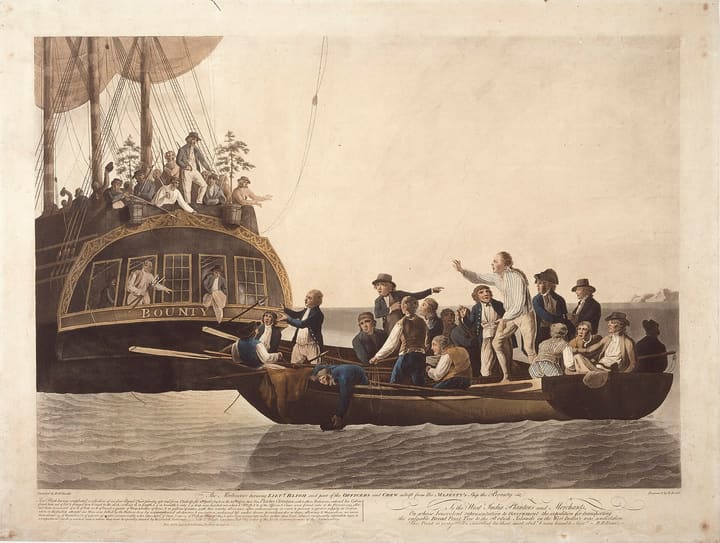
Mutiny on the Bounty retells the famous rising of April 1789 through the memories of Roger Byam, a fictional midshipman loosely modeled on the real Peter Heywood. Byam, a young English gentleman, joins His Majesty's armed vessel Bounty late in 1787 under Lieutenant William Bligh, whose mission is to carry breadfruit plants from Tahiti to the West Indies as cheap food for plantation laborers. Sir Joseph Banks gives Byam a task of his own: to compile a dictionary and grammar of the Tahitian language. On the long voyage round Cape Horn and the Cape of Good Hope, Bligh shows himself an able seaman and navigator but a quick-tempered, suspicious commander, sharp with his officers, especially the master's mate Fletcher Christian, and close with ship's stores. At Tahiti the crew spend some six months ashore gathering plants. Each man takes a taio, or bond-friend; Byam lives with the chief Hitihiti and studies the language, while Christian forms an attachment to Maimiti and Byam's friend George Stewart to a woman the sailors call Peggy. Several men desert and are flogged when recaptured. Soon after the ship sails for home, Bligh publicly accuses Christian of stealing coconuts from the ship's store, and Christian, humiliated, plans to leave the ship on a raft. Instead, in the early morning, he seizes the Bounty with a group of seamen and sets Bligh and eighteen loyal men adrift in the ship's launch. Byam, Stewart and several others who wished to go with Bligh are kept aboard because the boat is full. Christian returns to Tahiti, then sails away with his followers to find a hidden island. Byam stays, marries Tehani, a woman of rank, and has a daughter. About eighteen months later the frigate Pandora arrives; Bligh, who has reached England, has named the men left behind as mutineers, and they are chained in a small deck cell called Pandora's Box. The frigate is wrecked on the Great Barrier Reef, Stewart is drowned, and the survivors reach Timor in open boats. At the court-martial in England Byam is found guilty and condemned to hang, until the midshipman Tinkler, believed lost, appears and gives testimony that clears him. Three seamen are hanged. Byam returns to the navy, rises to command, and visits Tahiti again in 1810, where he sees his grown daughter but does not reveal himself. Little, Brown published the novel in October 1932 as the first part of a trilogy.
Virtues in this work
- Fortitude: Byam endures months in irons in Pandora's Box, the wreck on the reef and a long wait for trial without abandoning his account of the truth.
- Honor: Byam asks to go into the overcrowded launch with Bligh rather than stay with the mutineers.
- Friendship: Hitihiti receives Byam into his household as taio and shelters him during his island years.
- Temperance: At the end Byam restrains his longing to speak to his daughter so as not to disturb her life in Tahiti.
Plot or Argument
- Joining the Bounty
Byam is appointed midshipman through the influence of Sir Joseph Banks, with orders to study the Tahitian language. The ship leaves England in late 1787; Byam meets Bligh, Christian, Stewart and the crew, and learns the hard discipline of a small ship far from any port.
- The voyage out
Storms off Cape Horn force Bligh to turn east around the Cape of Good Hope. Short rations, punishments and Bligh's outbursts against his officers build resentment, and the tension between the commander and Christian becomes the center of the ship's life.
- Tahiti
Months ashore while the breadfruit plants are gathered. Byam lives with his taio Hitihiti, works on his dictionary and comes to love the island's people; the sailors form attachments, and an attempted desertion ends in flogging.
- The mutiny
After departure, the quarrel over the coconuts drives Christian to despair. He plans to slip away on a raft, then instead leads a rising at dawn. Bligh and eighteen men go into the launch; Byam is kept aboard against his wish because there is no room.
- Christian's Bounty and Byam's island years
Christian brings the ship back to Tahiti, where the crew divides. Christian sails off with the mutineers and their Tahitian companions, while Byam stays, marries Tehani and becomes a father.
- The Pandora
HMS Pandora arrives and takes the men who stayed behind as prisoners, without distinguishing loyal men from mutineers. Chained in Pandora's Box, they survive the frigate's wreck on the reef, where Stewart dies, and an open-boat passage to Timor.
- Court-martial
In England Byam's mother dies while he waits for trial. The court condemns him with several mutineers; the unexpected return of Tinkler brings evidence of Christian's intention and Byam's innocence, and he is cleared while three men are hanged.
- Return to Tahiti
Byam rises in the navy through the wars with France and its allies. In 1810 he returns to Tahiti as a captain, finds much changed and Tehani long dead, sees his daughter with her own child, and leaves without making himself known.
Characters
- Roger Byam, narrator
Young midshipman and student of the Tahitian language, loyal to his duty yet caught on the wrong side of the mutiny; modeled loosely on Peter Heywood.
- Lieutenant William Bligh, commander
Skilled navigator trained under Captain Cook, presented as harsh, suspicious and quick to humiliate his officers.
- Fletcher Christian, master's mate and leader of the mutiny
Proud, sensitive officer and friend of Byam, driven by Bligh's insults to seize the ship.
- George Stewart, midshipman
Byam's close friend, who stays at Tahiti and drowns in the wreck of the Pandora.
- Hitihiti, Tahitian chief
Byam's taio and host, who teaches him the language and ways of the island.
- Tehani, Byam's wife
Tahitian woman of rank whom Byam marries and must leave when the Pandora arrives.
- Maimiti, Christian's companion
Tahitian woman who goes with Christian when he leaves the island.
- Sir Joseph Banks, patron
Naturalist and promoter of the breadfruit voyage who sets Byam his task as a lexicographer.
- Tinkler, witness
Young member of Bligh's launch party, thought dead, whose late testimony saves Byam.
- Captain Edwards, commander of the Pandora
Stern officer who treats the men taken at Tahiti as mutineers and confines them in irons.
Lessons
Command and its limits
Bligh is no fool: he is a fine seaman and keeps his crew healthy on a long voyage. Yet the novel shows how public humiliation, suspicion and meanness over small things wear away an officer's loyalty. Christian's rising grows out of personal insult as much as general hardship.
- What qualities of good command does Bligh possess, and which does he lack?
- Why does the accusation about the coconuts matter so much to Christian?
- Could Christian have answered Bligh's injustice in another way?
Innocent and guilty in one net
Byam wished to go with Bligh, but the law sees only that he stayed aboard the Bounty. His long imprisonment, the Pandora's Box and the court-martial show how hard it is to prove innocence when appearances, absent witnesses and a commander's report all point the other way.
- Why does Bligh's report treat all the men left behind as mutineers?
- What does Tinkler's testimony prove, and why is it decisive?
- Is it just that Byam is condemned before his innocence is known, given the evidence the court had?
Two homes
Byam comes to love Tahiti, its language and his family there, but his duty and his country call him back. His final visit in 1810, when he chooses not to disturb his daughter's life, shows a man accepting the cost of the course his life has taken.
- What does Byam gain from his study of the Tahitian language?
- Why does Byam decide not to reveal himself to his daughter?
- Which place does Byam think of as home at the end of the novel?
History and the novelist
Nordhoff and Hall followed the records of the voyage and the court-martial closely, but they invented a narrator and changed details of his family to shape the story. The book shows how a historical novel can give life to documents while presenting one interpretation of the people in them.
- Why might the authors have invented Byam instead of telling the story as Peter Heywood?
- How does seeing events through Byam's eyes shape our view of Bligh and Christian?
- What questions would you want to ask of the historical record after reading the novel?
Context
HMS Bounty sailed from England in December 1787 to collect breadfruit plants at Tahiti for the British West Indies, a project promoted by Sir Joseph Banks. On 28 April 1789, near Tofua in the Tonga islands, Fletcher Christian and part of the crew seized the ship and set Bligh and eighteen men adrift in the launch; Bligh navigated about 3,600 miles to Timor. Some mutineers settled on Pitcairn Island; the men who stayed at Tahiti were taken by HMS Pandora in 1791, and after the frigate was wrecked on the Great Barrier Reef the survivors were tried at Portsmouth in 1792. Peter Heywood and James Morrison were condemned and then pardoned by the king, William Muspratt was released on a legal point, and three seamen were hanged. Historians have long debated Bligh's character: the older picture of a brutal tyrant, strengthened by this novel and its films, has been questioned by writers who point to his record of relatively few floggings and his care for his crew's health, while others stress his abusive tongue.
Composition
Nordhoff and Hall, living in Tahiti, obtained copies of Admiralty records, the court-martial minutes and Bligh's published narrative, and planned a trilogy from the start, as Hall later recounted. They invented the narrator Roger Byam, based on Heywood, and altered his family circumstances. Little, Brown and Company published the novel in October 1932, followed by Men Against the Sea (1933), on Bligh's open-boat voyage, and Pitcairn's Island (1934), on the mutineers' settlement.
Reception
The novel was a best-seller and became the basis of the 1935 film starring Charles Laughton as Bligh and Clark Gable as Christian, which won the Academy Award for Best Picture, and of the 1962 film with Trevor Howard and Marlon Brando. Its portrait of Bligh shaped the popular image of him for decades. Under United States law the novel remains in copyright through the end of 2027 and enters the public domain on 1 January 2028.
Comparisons
- treasure-island
Both are told by a young man who sails among a crew that turns against lawful authority; Jim Hawkins faces a pirate mutiny led by Long John Silver, while Byam is caught between a harsh captain and a mutineer he admires.
- captains-courageous
Kipling's Harvey Cheyne is also formed by life aboard ship under a commanding master, but Disko Troop's firm fairness is the opposite of the command style that drives the Bounty to mutiny.
- robinson-crusoe
Defoe's castaway and Byam both live for years on a distant island and learn from its people, but Crusoe builds a solitary English order while Byam enters a Tahitian household and language.
- billy-budd-and-other-stories
Melville's Billy Budd is set in 1797, the year of the great fleet mutinies, and also turns on a naval court that must judge a sympathetic young sailor by the strict letter of the Articles of War.
Quotes
For Students
A reading companion for classical Christian high school students. See the student guide.
Reading Guide
Watch for
- Each public clash between Bligh and Christian on the voyage out, building to the accusation about the coconuts.
- How Byam's work on the Tahitian dictionary draws him into the life of Hitihiti's household.
- The moment Byam tries to join Bligh in the launch and why he is kept aboard.
- The conditions in Pandora's Box and the behavior of the Pandora's officers during the wreck.
- Byam's choice at the end of the novel, when he sees his daughter in 1810.
Key terms and names
- Breadfruit
- A starchy Pacific fruit; the Bounty's mission was to carry young plants from Tahiti to the British West Indies.
- Taio
- A sworn bond-friend in Tahitian custom; each sailor gains one, and Byam's is Hitihiti.
- Master's mate
- Christian's rank aboard the Bounty, made acting lieutenant by Bligh during the voyage; he is second in command when the mutiny breaks out.
- Launch
- The Bounty's largest boat, into which Bligh and eighteen men are put, so crowded that others who wished to go are left behind.
- Pandora's Box
- The cramped wooden cell built on the Pandora's deck to hold the prisoners taken at Tahiti.
- Court-martial
- The naval court at Portsmouth that tries the prisoners under the Articles of War, where remaining aboard a mutinous ship counts against a man.
Seminar Questions
- Comprehension What was the Bounty's mission, and what special task did Byam receive from Sir Joseph Banks?
- Comprehension Why does Byam remain aboard the Bounty after the mutiny?
- Comprehension How is Byam saved after the court sentences him to death?
- Interpretation How does the novel make the reader feel about Bligh, and is that picture entirely unfair to him?
- Interpretation Why do Nordhoff and Hall make their narrator a student of the Tahitian language?
- Interpretation What does Byam's final visit to Tahiti suggest about how he judges his own life?
- Big Question When, if ever, may a subordinate rightly resist a lawful commander who abuses his authority?
- Big Question Should the law judge a person by his intentions or by where he was found standing?
Faith Connections
- Romans 13:1-4 (Scripture)
Paul's teaching that governing authorities bear the sword for order frames the court-martial's case against the mutineers and the hard question of Christian's act.
- Colossians 3:21; Ephesians 6:9 (Scripture)
Paul tells those in authority not to provoke or threaten those under them; Bligh's public insults to his officers show what such provocation can do.
- Psalm 107:23-30 (Scripture)
The psalm of those who go down to the sea in ships, crying out in the storm and brought to their haven, fits the passages around Cape Horn, the Pandora's wreck and the open boats.
- Thomas Aquinas, Summa Theologiae II-II, q. 104 (Great Conversation)
Aquinas discusses obedience and its limits, holding that subjects are bound to obey superiors within the scope of their authority; the question helps students weigh the duty of the men aboard the Bounty.
Logic and Rhetoric
Central argument: A commander's harshness and humiliation of his officers can provoke a mutiny, yet the law must judge actions, not provocations; and a man of good will caught between them, like Byam, may suffer for appearances until truth is brought to light.
Rhetorical device: retrospective first-person narration. Byam tells the story as an old officer looking back, so his judgments of Bligh and Christian come with the weight of later knowledge, and the final 1810 visit closes the frame he opened as a youth.
Debate: Resolved: that Fletcher Christian was justified in seizing the Bounty.
Writing Prompts
Essay: Compare Bligh and Christian as leaders: what does each do well, and where does each fail the men under him?
Comparison with Billy Budd and Other Stories: Compare Byam's court-martial with Billy Budd's drumhead court: how does each novel set the strictness of naval law against a young sailor's innocence?
Medical Lens
Medicine is part of the background of 18th-century naval life rather than a subject of the novel. The voyage reflects the era after Captain Cook's voyages, when commanders like Bligh worked to prevent scurvy through diet and cleanliness; the floggings show the physical cost of naval discipline; and the Pandora chapters describe prisoners chained in a cramped deck cell in tropical heat, the wreck, and an open-boat passage on short water. The Pandora's surgeon, Dr. Hamilton, is remembered in the novel for his kindness to crew and prisoners. Historically the Bounty's own surgeon, Thomas Huggan, was known for heavy drinking and died at Tahiti in 1788; how the novel portrays him should be checked against the text.
- Voyage out and Tahiti chapters
Floggings ordered for offenses aboard and for the recaptured deserters, described from Byam's point of view.
- Pandora chapters
The prisoners' confinement in Pandora's Box, the wreck on the reef and the passage to Timor in open boats, with the surgeon Hamilton's care.
Creative Prompts
- Dialogue
Write the conversation between Byam and Christian on the night before the mutiny, when Christian speaks of leaving the ship on a raft.
- Essay
Was Fletcher Christian's mutiny a rebellion against tyranny or a crime against lawful authority? Weigh the events aboard as Byam reports them.
- Classroom
Hold a mock court-martial for one of the men left aboard the Bounty, assigning students as prosecutor, defense, witnesses and the court, using only facts from the novel.
- Fiction
Tell Byam's 1810 return to Tahiti from the point of view of his daughter, who sees a stranger captain looking at her and does not know why.
Further Reading
- Men Against the Sea, Charles Nordhoff and James Norman Hall
The second book of the trilogy, on Bligh's open-boat voyage to Timor.
- Pitcairn's Island, Charles Nordhoff and James Norman Hall
The third book, on the mutineers' settlement and its violent early years.
- Mr Bligh's Bad Language: Passion, Power and Theatre on the Bounty, Greg Dening
A historian's study of Bligh's command and the meaning of the mutiny.
- The Bounty: The True Story of the Mutiny on the Bounty, Caroline Alexander
A modern narrative history giving particular attention to the court-martial and to Peter Heywood.
Verification notes
No quotations are given: the novel is under US copyright and I could not confirm exact wording of any line from a reliable source. Plot details were checked against the summary at https://www.ebsco.com/research-starters/literature-and-writing/mutiny-bounty-charles-nordhoff and the Wikipedia article on the novel (publication by Little, Brown, October 1932; Byam modeled on Heywood; trilogy order). The historical outcomes of the 1792 court-martial are standard. The detail of the first floggings and the exact sequence of the court's verdicts in the novel should be checked against the text.
- Text is under copyright; check quotations against an authorized edition before publication.
- Confirm the novel's handling of the Bounty's surgeon and of the earliest flogging scenes.