Work record
Pollock v. Farmers' Loan & Trust Co.
1895 · 19th Century · Court Decision · English
Abstract
Question Presented. Is the 1894 federal levy on income drawn from land, bonds, stocks and other investments a direct tax that Article I requires to be divided among the states according to population?
Arguments. Opponents of the levy said that taxing what property yields is taxing property, that apportionment was a founding guarantee to the states, and that the 1796 carriage ruling settled far less than claimed. Federal lawyers answered that Congress and the justices had long understood direct taxes to mean only head taxes and land taxes.
Holding. On rehearing, five justices struck down the levy. Fuller classed the yield of real estate and invested personal property with the property itself and called apportionment's unevenness a bargain the framers made deliberately. Since the invalid portion was central, he voided the whole plan, including taxes on wages and business profits. Harlan, Brown, Jackson and White dissented.
Significance. The ruling halted a peacetime federal income levy for nearly two decades and prompted the Sixteenth Amendment of 1913, which authorizes such taxes from any source without apportionment. Fuller himself had pointed toward that remedy in his opinion.
Text. Fuller's rehearing opinion appears whole; the Harlan and White dissents are shortened, and those of Brown and Jackson are absent.
Key figures
- Charles Pollock: Shareholder who sued to block payment of the levy
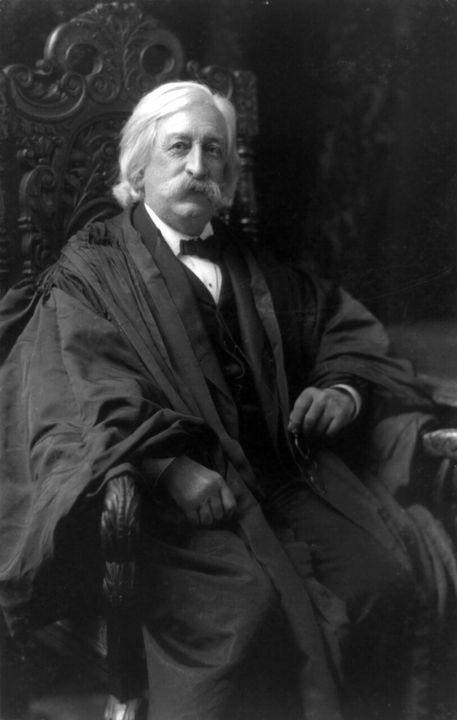
- Melville W. Fuller: Chief Justice who wrote for five members
- John Marshall Harlan: Dissenter relying on a century of precedent
- Edward Douglass White: Dissenter who restated his first-hearing views
- Joseph H. Choate: Counsel who argued against the 1894 levy

Summary
The Wilson Tariff Act of 28 August 1894, which became law without President Cleveland's signature, lowered tariff rates and imposed a two percent tax on incomes above $4,000 a year, including rents, interest, dividends and business profits, for the years 1895 through 1899. Charles Pollock, a shareholder of the Farmers' Loan and Trust Company of New York, sued to stop the company from paying the tax, a form of suit that allowed the question to reach the courts before collection. The Constitution requires that any direct tax be apportioned among the states by population; the 1894 tax was not apportioned. At the first hearing, in April 1895, the Court held that a tax on income from land was in effect a tax on the land itself, and so a direct tax, and that the federal government could not tax income from state and municipal bonds. With Justice Jackson absent, the eight justices divided equally on the remaining questions. A rehearing before the full Court followed in May. Those challenging the tax argued that a tax on the income of property is a tax on the property, that the framers required apportionment to protect the states and owners of accumulated wealth from unequal federal burdens, and that Hylton v. United States (1796) had decided only that a carriage tax was an excise. The government argued that for a century Congress and the Court had treated only capitation taxes and land taxes as direct, as Veazie Bank v. Fenno had confirmed, and that an income tax was a duty or excise that need only be uniform. On 20 May 1895 the Court ruled five to four that the tax was void. Chief Justice Fuller held that a tax on the whole income of real estate and of invested personal property is a direct tax, read the Convention's compromise linking representation and direct taxation as a deliberate protection, and explained that any inequality from apportionment was an inequality stipulated for. Because the tax on property income was the larger part of a single scheme, sections 27 to 37 fell entirely, including the tax on wages and business profits. If the Constitution ought to allow such a tax, Fuller wrote, it provides the means of its own amendment. Justice Harlan dissented at length from history and precedent and objected to striking down the whole scheme; Justice White, in a statement of points, defended the settled meaning of direct taxes. The library text contains Fuller's rehearing opinion with excerpts from the Harlan and White dissents, without footnotes; the dissents of Justices Brown and Jackson are not included. Congress proposed an income-tax amendment in 1909, and the Sixteenth Amendment, ratified in February 1913, permits taxes on incomes from whatever source derived without apportionment.
Virtues in this work
- Justice: Fuller holds the government to the terms of a bargain the states made in 1787, however inconvenient its results.
- Prudence: Harlan warns against taking the entire income revenue from the government because one provision failed.
- Humility: Fuller directs those who want a different rule to the people's power of amendment rather than to judicial reinterpretation.
Plot or Argument
- Two classes of federal taxes
Fuller begins from the Constitution's division of taxes into direct taxes, which must be apportioned by population, and duties, imposts and excises, which must be uniform, and widens the inquiry from rents to the entire income of property.
- The framers' compromise
Reviewing the Convention, the ratification debates and Madison's correspondence, Fuller argues that apportionment was a deliberate safeguard for the states, linked to representation in the House just as equal suffrage in the Senate was a guarantee to small states.
- Hamilton and the Hylton case
Fuller reexamines Hamilton's argument and the justices' opinions in Hylton v. United States, concluding that the carriage tax was upheld as an excise and that the case did not settle the full meaning of direct taxes.
- Income from property is property taxed
A tax on the annual receipts of property falls in the same class as a tax on the property itself; English authorities and political economists alike classify income taxes as direct.
- The whole scheme falls
Because the property tax provisions were a vital part of a single plan of taxation, Fuller holds that Congress would not have enacted the remainder alone, and declares sections 27 to 37 wholly void, adding that amendment is the proper remedy.
- The dissents of Harlan and White (excerpts)
Harlan restates his objection to voiding the entire income tax and surveys the practice of the government and the opinions in Hylton; White, in numbered points, answers the charge of a century of error and defends the long-settled reading of direct taxes.
Characters
- Charles Pollock, appellant
Massachusetts shareholder of the Farmers' Loan and Trust Company who sued to prevent the company from paying the tax.
- Farmers' Loan and Trust Company, appellee
New York trust company whose payment of the income tax Pollock sought to enjoin.
- Chief Justice Melville W. Fuller, author of the opinion of the Court
Illinois lawyer who held the income tax on property to be an unapportioned direct tax.
- Justice John Marshall Harlan, dissenter
Kentuckian who argued that a century of practice treated only land and head taxes as direct.
- Justice Edward Douglass White, dissenter
Louisianan who had written the main dissent at the first hearing and restated his points on rehearing.
- Joseph H. Choate, counsel against the tax
New York lawyer whose argument against the tax was among the most noted of the period.
Lessons
Defining a direct tax
The Constitution never defines direct taxes. Fuller reasons from the purpose of apportionment and from the economic nature of income from property; the dissenters rely on a century of practice and precedent limiting the term to head and land taxes. The case shows how a single undefined word can carry great consequences.
- How does Fuller connect a tax on income from property with a tax on the property itself?
- What earlier decisions does the government rely on for a narrow meaning of direct taxes?
- Should a century of practice settle the meaning of a constitutional term?
A compromise built into the Constitution
Fuller treats apportionment as one of the bargains of 1787, like equal representation of the states in the Senate. Even if it produced inequality, he argues, it was an inequality the states had agreed to, and the Court must enforce it.
- Why does Fuller compare apportionment of direct taxes to equal suffrage in the Senate?
- Whose interests did the framers protect, according to Fuller, by requiring apportionment?
When part of a law falls
After deciding that the tax on property income was invalid, the Court had to decide whether the rest of the income tax could stand. Fuller concluded that Congress would not have enacted it alone; Harlan replied that the Court should not take from the government the entire revenue because one part failed.
- What test does Fuller use to decide whether the valid parts of the act can survive?
- Why does Harlan think striking down the whole income tax goes beyond the Court's province?
- When a court finds part of a law invalid, how should it decide what Congress would have wanted?
Amendment as the remedy
Fuller wrote that if the Constitution should permit an unapportioned income tax, the instrument defines the way for its amendment. Eighteen years later the people took that path in the Sixteenth Amendment, an example of the constitutional system responding to a judicial decision through its own procedures.
- What does Fuller suggest those who favor an income tax should do?
- How did the Sixteenth Amendment change the effect of Pollock?
- Is amendment a better response to a disputed decision than waiting for a court to change its mind?
Context
The federal government had levied an income tax during the Civil War, which expired in 1872, and the Court upheld it in Springer v. United States (1881). In the depression of 1893 Populists and Democrats from the South and West pressed for an income tax to shift revenue away from tariffs, which they regarded as burdening consumers and farmers. Opponents in the Northeast, where most large incomes were concentrated, saw the tax as sectional and as an attack on accumulated property.
Composition
The tax was attached to the Wilson-Gorman tariff bill of 1894. Pollock's suit, together with a companion case, was argued in March 1895 and decided on 8 April; Justice Jackson, ill with tuberculosis, did not take part. The rehearing was argued in early May with Jackson present, and the decision was announced on 20 May 1895. Because Jackson voted to uphold the tax, one of the justices who had been undecided at the first hearing evidently voted against it on rehearing; historians have long debated which one.
Reception
Pollock became a political issue in the elections of 1896, and the Democratic platform criticized it. Supporters praised the decision as a defense of the Constitution's structure and of property. Congress proposed the Sixteenth Amendment in 1909, the states ratified it in 1913, and a federal income tax was enacted the same year; Brushaber v. Union Pacific Railroad (1916) upheld that tax. Pollock's reasoning about direct taxes has continued to appear in later debates over the taxing power.
Comparisons
- veazie-bank-v-fenno
Chase's 1869 conclusion that direct taxes meant only head and land taxes was the chief precedent relied on by the government and the Pollock dissenters.
- the-federalist-papers
Hamilton's discussion of the taxing power and of apportionment in Federalist Nos. 21 and 36 is among the founding sources both sides read in Pollock.
- the-wealth-of-nations
Smith's maxims of taxation and his treatment of taxes on rent and profit belong to the political economy that Fuller cites and the dissenters set aside.
- nfib-v-sebelius
In 2012 the Court again had to decide whether a federal exaction was a direct tax requiring apportionment, citing the line of cases that includes Pollock.
- standard-oil-v-united-states
Edward Douglass White, a Pollock dissenter, later wrote as Chief Justice for the Court in the 1911 Standard Oil case, another landmark of federal economic power.
Quotes
Frequently cited
“A tax upon one's whole income is a tax upon the annual receipts from his whole property, and as such falls within the same class as a tax upon that property, and is a direct tax, in the meaning of the constitution.”
Frequently cited
“If it be true that the constitution should have been so framed that a tax of this kind could be laid, the instrument defines the way for its amendment.”
“If, in the changes of wealth and population in particular states, apportionment produced inequality, it was an inequality stipulated for, just as the equal representation of the states, however small, in the senate, was stipulated for.”
“It is appropriate now to say that, however objectionable the law would have been, after the provision for taxing incomes arising from rents was stricken out, I did not then, nor do I now, think it within the province of the court to annul the provisions relating to incomes derived from other specified sources, and take from the government the entire revenue contemplated to be raised by the taxation of incomes, simply because the clause relating to rents was held to be unconstitutional.”
“Whence the 'century of error' is evolved, unless the cases relied on decided that the word 'direct' was not to be considered in its economic sense, does not appear from the argument.”
For Students
A reading companion for classical Christian high school students. See the student guide.
Reading Guide
Watch for
- Fuller's statement that the Constitution divides federal taxes into two great classes.
- The comparison between apportionment and equal suffrage in the Senate.
- Fuller's reexamination of Hamilton's brief in the Hylton carriage-tax case.
- The reasons Fuller gives for striking down the whole income tax, not only part of it.
- White's reply to the phrase a century of error.
Key terms and names
- Direct tax
- A tax the Constitution requires to be apportioned among the states by population; Pollock held that a tax on income from property is one.
- Apportionment
- Dividing the total of a tax among the states in proportion to their population.
- Rule of uniformity
- The requirement that duties, imposts and excises be the same throughout the United States.
- Severability
- The question whether the valid parts of a statute can stand after other parts are held unconstitutional.
- Rehearing
- A second argument and decision of a case by the same court.
- Sixteenth Amendment
- The 1913 amendment permitting Congress to tax incomes from whatever source derived without apportionment.
Seminar Questions
- Comprehension What did the Court decide at the first hearing in April 1895, and what was left undecided?
- Comprehension Which parts of the 1894 act does Fuller declare void, and why does he include the tax on business income?
- Interpretation How does Fuller read the Hylton case differently from Harlan?
- Interpretation Why does Fuller treat apportionment as a protection for the states?
- Interpretation What does White mean by questioning where the century of error came from?
- Big Question When a court and the people disagree about the meaning of the Constitution, is amendment the best way to settle the matter?
Faith Connections
- Romans 13:7 (Scripture)
Render therefore to all their dues: tribute to whom tribute is due, custom to whom custom, a verse about the duty to pay taxes that leaves open how they are to be laid.
- 1 Samuel 8:15-17 (Scripture)
Samuel warns Israel that a king will take a tenth of their seed, vineyards and flocks, an ancient caution about the power of taxation.
- Adam Smith, The Wealth of Nations, Book V, Chapter 2 (Great Conversation)
Smith's four maxims of taxation, including equality and certainty, informed nineteenth-century debates over whether an income tax was just.
Logic and Rhetoric
Central argument: Fuller reasons that the Constitution divides taxes into apportioned direct taxes and uniform indirect ones, that the framers designed apportionment to protect the states, that a tax on the income of property is in substance a tax on the property and therefore direct, and that the invalid part of the 1894 act is so central that the whole income tax must fall. Harlan and White reply that a century of practice and precedent limited direct taxes to head and land taxes.
Rhetorical device: analogy. Fuller compares the inequality of apportionment to the equal representation of small states in the Senate, both stipulated for by the framers (quote 0).
Debate: Resolved: that a tax on income from property is in substance a tax on the property itself.
Memory Work
If it be true that the constitution should have been so framed that a tax of this kind could be laid, the instrument defines the way for its amendment.
A tax upon one's whole income is a tax upon the annual receipts from his whole property, and as such falls within the same class as a tax upon that property, and is a direct tax, in the meaning of the constitution.
Writing Prompts
Essay: Explain why Fuller concluded that a tax on income from property is a direct tax, and evaluate the dissenters' reliance on a century of practice.
Comparison with Veazie Bank v. Fenno: Compare Chase's 1869 definition of direct taxes with Fuller's 1895 definition, and explain how each uses the Hylton carriage-tax case.
Medical Lens
The opinions address the constitutional classification of an income tax and the apportionment of direct taxes; there is no medical subject matter.
Creative Prompts
- Classroom
Reenact the May 1895 rehearing: one team argues for Pollock that income from property is property, another for the government that a century of precedent says otherwise, and the student bench must vote with one undecided justice.
- Essay
Draft the text of a constitutional amendment that would answer Fuller's opinion, then compare your draft with the wording of the Sixteenth Amendment.
- Dialogue
Write a conversation in 1895 between a Kansas farmer who favors the income tax and a New York investor who opposes it, each explaining what the Court's decision means for him.
- Essay
Using a simple example of a farm in a populous state and a farm of equal value in a thinly settled one, show how an apportioned income tax would fall unequally, and explain why Fuller thought that result was acceptable.
Further Reading
- The Income Tax: A Study of the History, Theory, and Practice of Income Taxation at Home and Abroad, Edwin R. A. Seligman
Economist's account, written before the Sixteenth Amendment, of the American and foreign income taxes and of the Pollock litigation.
- Melville Weston Fuller: Chief Justice of the United States, 1888-1910, Willard L. King
Biography of the Chief Justice who wrote the Pollock opinion.
- Making the Modern American Fiscal State: Law, Politics, and the Rise of Progressive Taxation, 1877-1929, Ajay K. Mehrotra
Study of the movement for income taxation from the Gilded Age through the 1920s.
Verification notes
Three quotations from Fuller and one each from Harlan and White were found by Grep as exact substrings of content/texts/pollock-v-farmers-loan-and-trust.txt. The act's date, the $4,000 threshold, the voiding of sections 27 to 37 and Harlan's account of the earlier equal division all appear in the stored text. White's dissent in the stored text is brief and is followed by stray citation lists from the source page. Pollock's residence, the two percent rate, Choate's role, the argument dates and Jackson's illness come from standard histories.
- Confirm the argument dates of the first hearing (March 1895) and the rehearing (early May 1895).
- Confirm that Charles Pollock was a Massachusetts resident and that Joseph H. Choate argued against the tax at both hearings.
- Confirm the name of the companion case decided with Pollock (Hyde v. Continental Trust Co.).