Work record
Reynolds v. United States
1879 · 19th Century · Court Decision · English
Abstract
Question Presented. May someone who took a second wife because his church taught that God required it be convicted under a federal ban on bigamy, or does the First Amendment shield conduct undertaken as religious obligation?
Arguments. The defense contended that free exercise is empty unless it covers what conscience commands, that Reynolds acted without criminal intent because he obeyed what he took to be divine revelation, and that Congress had no warrant to police the faith of territorial residents. Federal prosecutors responded that the guarantee secures worship and opinion while leaving outward acts subject to general laws protecting the social order.
Holding. The justices unanimously sustained the conviction on the constitutional question. Waite read the amendment through Madison's and Jefferson's Virginia writings, held that legislatures may not punish opinions but may punish deeds, treated monogamous marriage as a foundation of civil society long protected by statute, and also rejected the procedural objections concerning jurors and the missing witness.
Significance. Reynolds was the first major ruling construing the Free Exercise Clause and introduced the 'wall of separation' phrase into constitutional law. Its distinction between opinion and conduct shaped religious-liberty doctrine into the late twentieth century, and its ruling on the absent witness founded the doctrine of forfeiture by wrongdoing.
Key figures
- George Reynolds: Latter-day Saint convicted under the 1862 statute
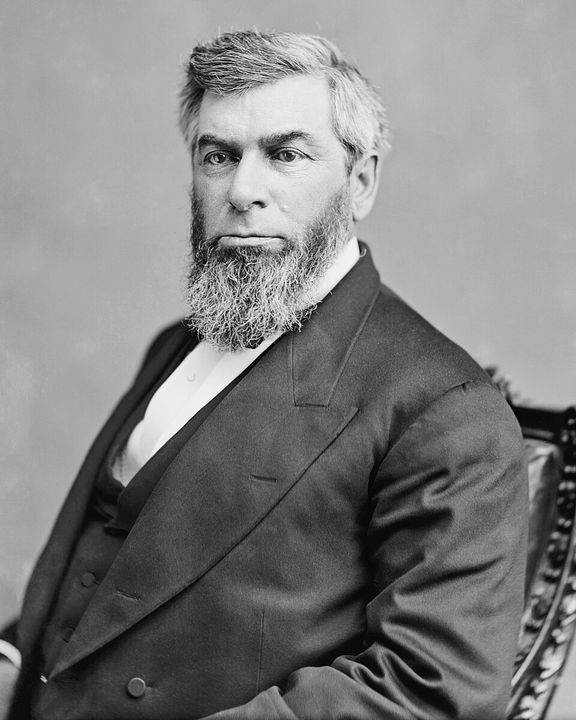
- Morrison R. Waite: Chief Justice delivering the ruling
- Stephen J. Field: Justice who differed on one evidentiary issue
- Thomas Jefferson: Founder whose Danbury letter guided the opinion

Summary
In 1862 Congress passed the Morrill Anti-Bigamy Act, making it a crime in the federal territories to marry a second spouse while the first was living. The law was aimed at plural marriage as taught by the Church of Jesus Christ of Latter-day Saints in Utah Territory, but was seldom enforced for a decade. In the 1870s church leaders agreed to a test case, and George Reynolds, a secretary in the office of church president Brigham Young and husband of Mary Ann Tuddenham, was indicted for marrying Amelia Jane Schofield. A first conviction was set aside because of a defect in the grand jury; at a second trial in 1875 he was convicted and sentenced to two years' imprisonment at hard labor and a fine of five hundred dollars, and the territorial supreme court affirmed. Of Reynolds's six objections, the religious one mattered most. He proved at trial that his church taught that male members had a duty, when circumstances permitted, to practice plural marriage, and that refusing would bring condemnation in the life to come; he asked that the jury be told to acquit if he had married in obedience to that belief. The trial judge refused. Before the Supreme Court his counsel argued that the First Amendment's guarantee of the free exercise of religion protects conduct required by sincere faith, and that Congress had no power to punish a religious practice. The government answered that the amendment secures belief and worship but not acts that the law forbids for the good order of society. On 6 January 1879 the Court affirmed. Chief Justice Waite, observing that the Constitution does not define religion, turned to the history of its adoption: the Virginia struggle over religious assessments, Madison's Memorial and Remonstrance, the Virginia Statute for Religious Freedom, and Jefferson's 1802 letter to the Danbury Baptists describing a wall of separation between church and state. From these he concluded that Congress may not legislate over opinion but may reach actions in violation of social duties or subversive of good order. Because marriage is a civil contract on which society is built, and plural marriage had long been an offence in English and American law, Congress could forbid it in the territories; to excuse it because of religious belief would make each citizen a law unto himself. Waite also upheld the grand jury, the juror rulings, the jury charge and the use of Schofield's earlier testimony, reasoning that an accused who wrongfully keeps a witness away cannot invoke his right of confrontation. Justice Field disagreed only on that evidentiary point. The library text gives Waite's full opinion, without Field's brief separate opinion or the footnotes. Congress followed with the Edmunds Act of 1882 and the Edmunds-Tucker Act of 1887. In 1890 church president Wilford Woodruff issued the Manifesto advising members against plural marriage, and Utah entered the Union in 1896 with a constitution prohibiting it. Its belief-action distinction and its quotation of Jefferson's metaphor are still regularly cited.
Virtues in this work
- Justice: Waite holds that a man who keeps a witness away cannot invoke the right of confrontation to profit from his own wrong.
- Piety: Reynolds stood trial twice rather than renounce what he believed to be a duty enjoined on him by God.
- Prudence: The Court draws on the founders' own words to mark where civil authority over religion begins and ends, rather than defining religion by its own preferences.
Plot or Argument
- Six questions, beginning with the grand jury
Waite lists the assignments of error and takes them in order. The territorial statute fixing grand juries at fifteen, rather than the federal minimum of sixteen, governs territorial district courts, so the grand jury's charge stands.
- Jurors challenged on both sides
Jurors who had formed opinions from rumor and newspaper reports but could judge fairly on the evidence were properly seated, and the government's challenges to jurors living in plural marriage were properly sustained because they had a stake in the question.
- The absent witness
Amelia Jane Schofield, the alleged second wife, could not be found for the second trial, and the evidence showed Reynolds had kept her away. Her testimony from the first trial was therefore admissible, under the old maxim that no one may profit by his own wrong.
- What religious freedom means
Because the Constitution does not define religion, Waite consults the history of the First Amendment: Virginia's taxes for religious teachers, Madison's Memorial and Remonstrance, Jefferson's statute, and Jefferson's letter to the Danbury Baptists. He concludes that Congress has no power over mere opinion but may reach actions that violate social duties.
- Belief and action
Marriage, a sacred obligation but also a civil contract regulated by law, has always been a subject of government. Plural marriage was an offence under English statute and the laws of every state. Laws govern actions; they may not touch belief but may restrain practices, and a religious motive cannot exempt a person from a valid general law.
- Criminal intent and the jury charge
Reynolds knew his first wife was living and that the law forbade a second marriage, so he intended to break it; ignorance of law is no excuse. The trial judge's remarks on the consequences of polygamy were not an improper appeal to passion, and the judgment is affirmed.
Characters
- George Reynolds, plaintiff in error
English-born Latter-day Saint and secretary to Brigham Young, who agreed to serve as defendant in a test case.
- Morrison R. Waite, Chief Justice; author of the opinion
Ohioan who led the Court from 1874 to 1888.
- Stephen J. Field, justice disagreeing on one point
Concurred in the religious-liberty holding but thought Schofield's earlier testimony should not have been admitted.
- Amelia Jane Schofield, witness
The plural wife named in the charge, whose testimony from the first trial was read at the second.
- Thomas Jefferson, authority cited
His 1802 letter to the Danbury Baptist Association supplied the Court's account of the First Amendment's scope.
- James Madison, authority cited
Author of the Memorial and Remonstrance (1785), cited for the view that religion is not within the cognizance of civil government.
Lessons
Belief and conduct
Waite's central distinction is that government may not touch belief or opinion but may regulate actions. The line gives religious liberty a firm core while preserving the authority of general laws, and it has framed every later debate over religious exemptions.
- In Waite's view, what exactly does the Free Exercise Clause protect?
- Can religious worship be separated cleanly from religious action? Give an example either way.
- Does the belief-action distinction protect enough of what religion means to believers?
History as a dictionary
Finding no definition of religion in the Constitution, Waite turned to the Virginia controversy of the 1780s and to the words of Madison and Jefferson. The opinion is an early and influential example of the Court using founding-era history to give content to the religion clauses.
- Why does Waite treat Jefferson's letter as almost an authoritative declaration of the amendment's scope?
- Is it sound to interpret a national amendment chiefly through the history of one state?
A law unto himself
The Court reasoned that if religious belief could excuse a violation of law, every citizen could become a law unto himself and government would exist only in name. Reynolds's counsel answered that a guarantee of free exercise means little if it protects only what the law already permits.
- What examples does Waite use to show the danger of exempting religious practices from law?
- How might Reynolds have replied to the charge that he made himself a law unto himself?
- Should a sincere religious duty ever excuse a person from a general criminal law?
No profit from one's own wrong
Less famous than the religious holding, the ruling on Schofield's testimony established that a defendant who wrongfully keeps a witness away forfeits his right to confront that witness in person. The principle is still applied in criminal courts.
- What is the right of confrontation, and why does the Court say Reynolds lost it?
- Why did Justice Field disagree on this point?
Context
Latter-day Saints settled the Great Basin from 1847, and church leaders publicly announced the doctrine of plural marriage in 1852. In 1856 the Republican Party platform called polygamy and slavery the twin relics of barbarism, and Congress, which governed the territories directly, passed the Morrill Act in 1862 and the Poland Act in 1874, the latter giving federal courts in Utah greater control over juries and prosecutions.
Composition
Reynolds was indicted in 1874, convicted twice, and appealed after the Supreme Court of Utah Territory affirmed his second conviction. The case was argued in Washington in November 1878 and decided on 6 January 1879. The library text, from the Legal Information Institute's transcription of 98 U.S. 145, contains Waite's opinion for the Court.
Reception
The decision was welcomed by federal officials in Utah and opposed by church leaders, who maintained that the law violated their religious liberty. Congress intensified enforcement in the 1880s, and the Court upheld these measures in cases such as Davis v. Beason (1890). In the twentieth century Everson v. Board of Education (1947) took up Jefferson's wall-of-separation phrase from Reynolds, and Employment Division v. Smith (1990) relied on Reynolds in holding that neutral, generally applicable laws need not exempt religious conduct, a holding Congress responded to in the Religious Freedom Restoration Act of 1993.
Comparisons
- virginia-statute-for-religious-freedom
Waite quotes Jefferson's statute, including its provision that civil officers may intervene when principles break out into overt acts against peace and good order, as the source of the belief-action line.
- madison-selected-writings
Madison's Memorial and Remonstrance, which Waite cites, argued that religion, the duty we owe to our Creator, lies outside the cognizance of civil government.
- jefferson-selected-writings
Jefferson's letter to the Danbury Baptists, with its wall of separation, enters constitutional law through this opinion.
- wisconsin-v-yoder
In 1972 the Court exempted Amish families from compulsory schooling laws, giving religious practice more protection than Reynolds's belief-action distinction had allowed.
- minersville-school-district-v-gobitis
Gobitis relied on reasoning like Reynolds's to uphold a general flag-salute requirement against religious objectors in 1940, a ruling reversed three years later.
- the-founding-documents
The case turns on the First Amendment's two religion clauses and on Congress's Article IV power to govern the territories.
Quotes
Frequently cited
“Believing with you that religion is a matter which lies solely between man and his God; that he owes account to none other for his faith or his worship; that the legislative powers of the government reach actions only, and not opinions,—I contemplate with sovereign reverence that act of the whole American people which declared that their legislature should 'make no law respecting an establishment of religion or prohibiting the free exercise thereof,' thus building a wall of separation between church and State.”
Frequently cited
“Congress was deprived of all legislative power over mere opinion, but was left free to reach actions which were in violation of social duties or subversive of good order.”
Frequently cited
“Laws are made for the government of actions, and while they cannot interfere with mere religious belief and opinions, they may with practices.”
“Can a man excuse his practices to the contrary because of his religious belief? To permit this would be to make the professed doctrines of religious belief superior to the law of the land, and in effect to permit every citizen to become a law unto himself.”
“The word 'religion' is not defined in the Constitution. We must go elsewhere, therefore, to ascertain its meaning, and nowhere more appropriately, we think, than to the history of the times in the midst of which the provision was adopted.”
“The Constitution gives the accused the right to a trial at which he should be confronted with the witnesses against him; but if a witness is absent by his own wrongful procurement, he cannot complain if competent evidence is admitted to supply the place of that which he has kept away.”
For Students
A reading companion for classical Christian high school students. See the student guide.
Reading Guide
Watch for
- The six assignments of error and the order in which Waite answers them.
- The rule that a defendant who keeps a witness away cannot complain when her earlier testimony is read.
- Waite's turn to Virginia history to define religious freedom.
- The sentence from Jefferson's letter that Waite treats as almost authoritative.
- How Waite connects marriage to the structure of civil society and government.
Key terms and names
- Free Exercise Clause
- The First Amendment's guarantee that Congress shall make no law prohibiting the free exercise of religion.
- Establishment Clause
- The First Amendment's guarantee that Congress shall make no law respecting an establishment of religion.
- Morrill Anti-Bigamy Act
- The 1862 federal law making bigamy a crime in the territories, under which Reynolds was convicted.
- Right of confrontation
- The Sixth Amendment right of an accused person to face the witnesses against him at trial.
- Test case
- A lawsuit brought or accepted deliberately to obtain a court ruling on a disputed legal question.
- Territory
- A region governed directly by Congress before admission as a state, as Utah was until 1896.
Seminar Questions
- Comprehension What did Reynolds prove at trial about his church's teaching, and what instruction did he ask the judge to give?
- Comprehension Why did the Court allow Amelia Jane Schofield's testimony from the first trial to be read at the second?
- Interpretation How does Waite use the history of Virginia in the 1780s to define the religious freedom the First Amendment protects?
- Interpretation Why does Waite think that exempting religious practices from law would make every citizen a law unto himself?
- Interpretation Does Jefferson's letter actually support the distinction between belief and action that Waite draws from it?
- Big Question When God's law, as a believer understands it, and the civil law conflict, what should the believer do, and what should the state do?
Faith Connections
- Acts 5:29 (Scripture)
Peter's reply that we ought to obey God rather than men expresses the conviction of conscience that Reynolds claimed, and that Christians have long honored in other settings.
- Matthew 22:21 (Scripture)
Christ's command to render to Caesar what is Caesar's and to God what is God's frames the question of where civil authority ends.
- Matthew 19:4-6 (Scripture)
Christ's appeal to the creation of male and female and the two becoming one flesh is the traditional Christian account of marriage that shaped the laws Waite surveys.
- James Madison, Memorial and Remonstrance against Religious Assessments (1785) (Great Conversation)
Madison argued that the duty we owe to our Creator can be directed only by reason and conviction, not by force; Waite cites the Memorial as background to the First Amendment.
Logic and Rhetoric
Central argument: Because the history of the First Amendment shows that it withdrew from Congress power over opinion but not over actions that violate social duties or disturb good order, and because marriage is a civil institution long regulated by law, Congress may punish plural marriage in the territories even when it is practiced as a religious duty.
Rhetorical device: rhetorical question. Waite asks, 'Can a man excuse his practices to the contrary because of his religious belief?' and answers by showing that an affirmative reply would put belief above the law of the land (quote 3).
Debate: Resolved: that the Free Exercise Clause should protect religiously required conduct as well as belief, unless a compelling public interest forbids it.
Memory Work
Laws are made for the government of actions, and while they cannot interfere with mere religious belief and opinions, they may with practices.
Congress was deprived of all legislative power over mere opinion, but was left free to reach actions which were in violation of social duties or subversive of good order.
Writing Prompts
Essay: Evaluate Chief Justice Waite's distinction between religious belief and religious practice, using his own examples and at least one later case on the religion clauses.
Comparison with The Virginia Statute for Religious Freedom: Compare Jefferson's Virginia Statute for Religious Freedom with Waite's opinion, and explain whether the Statute's protection of opinion supports Waite's limit on protection for conduct.
Medical Lens
In discussing criminal intent, Waite cites the English case Regina v. Wagstaff, in which parents who, from religious conviction, did not call medical help for a sick child were held not guilty of manslaughter, an early judicial reference to religious objections to medical care.
Creative Prompts
- Classroom
Hold a moot court in November 1878 on the fifth question only: one team argues for Reynolds that the Free Exercise Clause protects conduct required by faith, the other for the United States that it protects belief alone.
- Essay
Write a brief explaining how Waite uses Madison's Memorial and Remonstrance and Jefferson's Virginia Statute, then add a paragraph showing how Reynolds's counsel might have read the same documents differently.
- Dialogue
Write a conversation between a Utah juror and a Washington lawyer in 1879 about whether a law can respect a man's faith while punishing what that faith commands.
- Classroom
Make a timeline of the religion clauses from the Virginia Statute (1786) through Reynolds (1879), Gobitis (1940), Barnette (1943), Yoder (1972) and Smith (1990), noting how each treats belief and conduct.
Further Reading
- The Mormon Question: Polygamy and Constitutional Conflict in Nineteenth-Century America, Sarah Barringer Gordon
Legal history of the federal campaign against plural marriage, with a full account of the Reynolds case.
- Separation of Church and State, Philip Hamburger
Study of the history of the separation idea, including Jefferson's letter and its later use by the Court.
- Thomas Jefferson and the Wall of Separation between Church and State, Daniel L. Dreisbach
Close study of the Danbury Baptist letter and its interpretation from Reynolds onward.
Verification notes
Every quotation was located by Grep as an exact string in content/texts/reynolds-v-united-states.txt; the first is Jefferson's letter as quoted in the opinion and is labelled accordingly. The six questions, the grand jury of fifteen and the Schofield ruling come from the opinion itself. Web searches were unavailable while this record was written, so the decision date (6 January 1879), the sentence, the history of the first conviction and the alignment of Justice Field should be confirmed.
- Confirm the decision date of 6 January 1879 and the November 1878 argument.
- Confirm that the first conviction was set aside for a defect in the grand jury and that the sentence was two years at hard labor and a 500-dollar fine.
- Confirm that Justice Field's separate opinion addressed only the admission of Schofield's former testimony.