Work record
Robinson Crusoe
1719 · 18th Century · Novel · English
Abstract
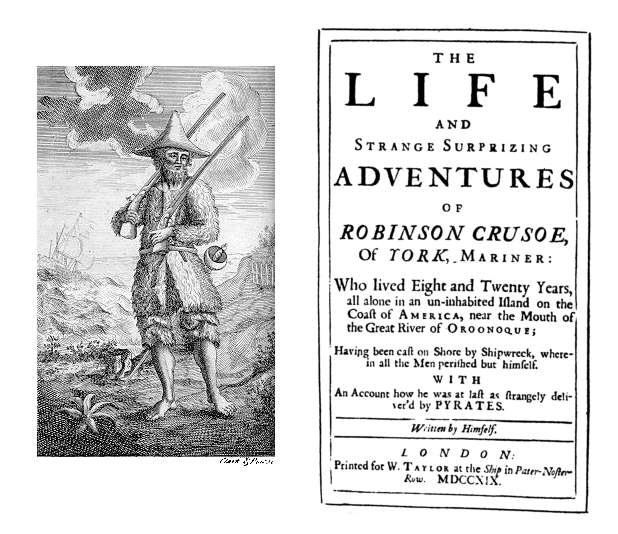
Background. Defoe, a merchant, pamphleteer and Dissenter nearing sixty, drew partly on the reported marooning of Alexander Selkirk on Juan Fernández. The title page offered the book as written by Crusoe himself.
Narrative. Defying his father, Crusoe sails from Hull in 1651, is enslaved by Moorish corsairs, escapes, and prospers as a planter in Brazil. A slaving voyage ends in shipwreck, and he alone reaches land. From the wreck he salvages tools, guns and a Bible, builds a fortified dwelling, tames goats, grows barley and rice, and makes pottery and a canoe. Fever brings a dream of judgment and a conversion. A single footprint in the sand terrifies him; years later he rescues Friday, and finally an English ship carries him home after twenty-eight years.
Structure. Retrospective narration is interrupted by Crusoe's journal, kept until his ink runs low, and by ledgers weighing evil against good. The pace shifts from rapid voyages to a slow, itemized record of island years, then quickens again with the mutineers.
Themes. Providence and repentance, labour as order, solitude and fear, and the obligations of mastery and friendship.
Significance. Often called the first English novel, it spawned sequels, countless imitations known as Robinsonades, and a lasting image of self-reliance studied by Rousseau, economists and novelists alike.
Main characters
- Robinson Crusoe: York-born narrator, a wanderer who survives twenty-eight years as a castaway
- Crusoe's father: Merchant who urges the contentment of the middle station of life
- Xury: Boy who escapes slavery in Sallee with Crusoe
- The Portuguese captain: Honest seaman who rescues Crusoe and later guards his Brazilian estate
- Friday: Young man saved from captors, who becomes Crusoe's servant, pupil and companion
- The Spaniard and Friday's father: Captives rescued from a cannibal feast who join the island company
- The English captain: Officer put ashore by mutineers, whose ship Crusoe helps recover

Summary
Daniel Defoe’s Robinson Crusoe (1719) follows a restless young Englishman who ignores his father’s counsel, goes to sea, and after storms and slavery is cast alone on an island where industry, improvisation, and providence remake his life. The novel invented a lasting modern myth of solitude: journal-keeping, goat pens, canoe failures, fear of footprints, and the arrival of Friday. Chart Crusoe’s first month of tools beside his first recorded thanks after the wreck. Friday’s arrival turns inventiveness into a test of justice toward a companion. The ignored parental counsel at the start remains the hinge that makes island industry a repentance. His early adventures move quickly: a storm off Yarmouth nearly ends his first voyage, a later trading trip ends in capture by a Sallee rover, and after two years of slavery he escapes in a small boat with a boy named Xury and is picked up by a Portuguese captain who carries him to Brazil. Prosperous but restless, he joins a voyage to buy slaves in Africa, and the ship is wrecked near the mouth of the Orinoco. On the island he makes repeated trips to the wreck for supplies, marks the days on a wooden post, and slowly learns to bake bread, weave baskets and build a boat too heavy to launch. A severe illness leads him to read the Bible he saved and to pray in earnest for the first time. After years alone he finds signs that cannibals visit the shore, and when a captive escapes them he rescues the man, names him after the day of the week, and teaches him English and the Christian faith. Later the two free Friday's father and a Spaniard, and help an English captain retake his ship from mutineers; that ship finally carries Crusoe back to England, where he learns that his Brazilian estate has made him rich.
Virtues in this work
Plot or Argument
- Disobedience and voyage
Crusoe rejects settled advice and meets maritime disaster and captivity.
- Island industry
Alone, he builds tools, shelter, and a rhythm of work and prayer.
- Companionship and return
Friday’s arrival and rescue reopen human society and homeward motion.
Characters
- Robinson Crusoe, protagonist
Castaway who remakes life by work and faith.
- Friday, companion
Rescue and companion who shares the island’s later years.
Lessons
Counsel refused
Crusoe’s first fault is restless contempt for wise limits.
- What does his father advise?
- How do early scrapes warn him?
Work as repentance
Island labor becomes thanksgiving and ordered stewardship.
- What does he build first?
- How does the journal shape him?
Mastery and neighbor
Friday’s coming tests justice, teaching, and friendship in power.
- How does Crusoe treat Friday?
- What does deliverance cost and give?
Context
Early English novel of solitude at sea and on an island, commerce, and Protestant self-examination. It remains a formative English-language classic for school and home in the public domain.
Composition
Published 1719; presented as a true autobiographical account.
Reception
Perpetual school classic of adventure and self-reliance.
Comparisons
- treasure-island
Island ordeal and resourcefulness.
- around-the-world-in-eighty-days
Travel ordeal under different clocks.
Quotes
“I was born in the year 1632, in the city of York, of a good family, though not of that country, my father being a foreigner of Bremen, who settled first at Hull.”
“I was born in the year 1632”
For Students
A reading companion for classical Christian high school students. See the student guide.
Reading Guide
Watch for
- Father’s counsel and Crusoe’s refusal.
- Shipwreck and first island days.
- Journal, calendar, and crops.
- The footprint and fear.
- Friday’s arrival and teaching.
Key terms and names
- Castaway
- One left alone after shipwreck.
- Providence
- God’s governing care Crusoe learns to read in events.
- Journal
- Crusoe’s written record of days and conscience.
- Industry
- Steady skilled work that remakes survival into culture.
Seminar Questions
- Comprehension Why does Crusoe go to sea?
- Comprehension What does he do in the first weeks on the island?
- Comprehension Who is Friday according to the text?
- Interpretation Is solitude mainly punishment or education?
- Interpretation How does work relate to prayer?
- Interpretation What moral risks come with mastery?
- Big Question What must a person rebuild first when everything familiar is gone?
Faith Connections
- Psalm 107:23-24 (Scripture)
They that go down to the sea in ships see the Lord’s works.
- Luke 15:18 (Scripture)
I will arise—repentance after restless disobedience.
- Protestant providence narratives (Great Conversation)
Journaling deliverance into thanksgiving.
Logic and Rhetoric
Central argument: Restless disobedience leads to exile that industry and faith can redeem.
Rhetorical device: realistic detail. Tools and journals make survival believable.
Debate: Resolved: that hard work can become thanksgiving.
Memory Work
I was born in the year 1632, in the city of York, of a good family, though not of that country, my father being a foreigner of Bremen, who settled first at Hull.
Writing Prompts
Essay: Trace one tool Crusoe invents and what virtue it trains.
Comparison with Treasure Island: Compare Crusoe’s solitude with the Swiss Family’s shared island labor.
Medical Lens
Isolation and fear are narrative, not clinical case study.
Listen to the book
Public-domain audiobook from LibriVox, read by Denny Sayers (d. 2015). Recording: Robinson Crusoe on LibriVox (Internet Archive).
LibriVox recordings are volunteer readings released into the public domain. The reading may follow a different edition from the text in this library.
Creative Prompts
- Classroom
Keep a three-day castaway journal of tasks and thanks.
- Essay
How does the footprint change Crusoe’s solitude?
- Fiction
A tool that fails twice before it works.
Further Reading
- The Swiss Family Robinson, Johann David Wyss
Family counterpart to solitary island life.
Verification notes
Plot, characters, and publication facts for Robinson Crusoe follow standard sources. Quotes verified against the attached Gutenberg text.
No verification flags recorded.