Work record
The Swiss Family Robinson
1812 · 19th Century · Novel · German
Abstract
Background. A Bernese Reformed pastor composed the tale for his four boys as a Christian household answer to Robinson Crusoe. His son prepared it for the press in Zurich, and later French and English adapters, Kingston among them, extended the material and its ending.
Narrative. Deserted by the crew after a long storm, a pastor, his wife and their sons Fritz, Ernest, Jack and Franz reach shore in a craft of tubs lashed together. They raise a dwelling high in an enormous fig tree, Falconhurst, then hollow a salt cavern into Rockburg, ferrying powder, seed and a dismantled pinnace from the wreck. A decade later a message tied to an albatross leads Fritz to Jenny Montrose, and the Unicorn at last anchors in the bay. Several settlers choose to stay, while Fritz, Franz and Jenny take the journal home to England.
Structure. The father records events episode by episode, and almost every find of a plant, animal or useful mechanism becomes a lesson for the boys.
Themes. Providence and thanksgiving, Sabbath rest, patient labour, the training of contrasting temperaments, and the making of a home out of wilderness.
Significance. Endlessly reprinted, abridged and filmed, it ranked among the most widely read nineteenth-century children's books, and its tree house became an emblem of family adventure.
Main characters
- The father: Swiss pastor, narrator and teacher whose journal forms the book
- The mother: Resourceful manager of the household, famed for her well-stocked bag
- Fritz: Eldest son, about fifteen, a bold hunter and sailor
- Ernest: Second son, studious naturalist reluctant to exert himself
- Jack: Third son, rash and cheerful tamer of animals
- Franz: Youngest son, whose questions prompt many of the lessons
- Jenny Montrose: English officer's daughter found living alone on a volcanic islet
- Captain Littlestone: Commander of the English ship Unicorn that ends the family's isolation

Summary
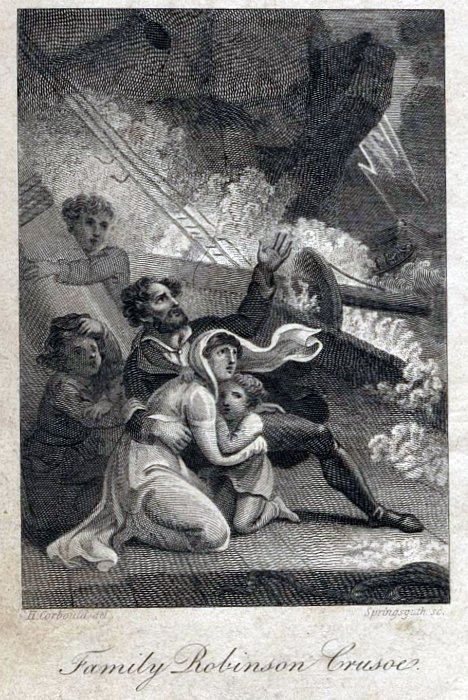
The Swiss Family Robinson is told by a Swiss pastor who, with his wife and four sons, emigrates by sea toward a new settlement and is shipwrecked after a week-long storm. The crew abandons the ship in the boats, leaving the family alone on a wreck lodged among rocks near an unknown tropical coast. The father keeps his household steady by prayer and plain work: they build a floating craft of cut-down tubs, bring off tools, livestock and provisions, and land in a sheltered bay where they pitch a tent and give thanks. Each son has a temperament the narrative uses: Fritz, the eldest, is bold, skilled with a gun and sometimes too quick with his brothers; Ernest is studious and slow to exert himself; Jack is rash and cheerful; little Franz is gentle and eager to learn. The mother, practical and unflappable, produces needles, thread and seeds from what the boys call her magic bag. The book then becomes a long chronicle of a household turning a wilderness into a home. The family builds a tree house in a great fig tree and calls it Falconhurst, later carves a winter dwelling, Rockburg, out of a cliff after discovering a salt cave, and returns to the wreck again and again for gunpowder, a pinnace in pieces, carpentry tools and seed grain. Nearly every chapter turns an encounter with nature into a lesson: the principle of the lever, the uses of the calabash, the habits of animals they tame, hunt or fear. They name the coast and its landmarks and come to call their country New Switzerland. Ten years after the wreck, Fritz finds an albatross bearing a note asking rescue for an Englishwoman at a smoking rock. He finds Jenny Montrose, shipwrecked on a volcanic islet, and brings her to the family, where she becomes a daughter of the house. Soon after, the English ship Unicorn under Captain Littlestone reaches the bay. Some of the family choose to stay; Fritz, Franz and Jenny sail for England, carrying the father's journal so that other boys may read it. The book closes with the father's blessing on the colony and on the home they have made under God's care.
Virtues in this work
- Industry: The family turns a wreck and a wilderness into a farm, a tree house and a cliff dwelling by years of steady, planned labor.
- Piety: The father begins and ends each venture with prayer and keeps the Sabbath as a day of rest and teaching even in the first weeks.
- Prudence: The father tests unknown foods, plans for the rainy season and makes repeated careful trips to salvage the wreck.
- Friendship: Four very different brothers learn to depend on each other's gifts, which the father names as the book's chief blessing.
- Fortitude: Fritz sails alone to the smoking rock to rescue a stranger on the strength of a single note.
Plot or Argument
- Storm and wreck (Ch. I)
After seven days of storm the crew deserts the ship; the family prays, builds a tub-boat with a lever and rollers, and lands with tools, animals and the first provisions.
- Exploring the coast (Ch. II-III)
Father and Fritz search for the lost crew and find instead coconuts, gourds, sugar cane and monkeys; the mother organizes camp, and the boys begin learning by doing.
- Falconhurst (Ch. III-IV)
The family moves to a giant fig tree, builds a platform house reached by a rope ladder and later an inner stair, and keeps the Sabbath with a day of rest and teaching.
- Salvage and husbandry (Ch. V-IX)
Repeated trips to the wreck yield powder, carpentry tools and a pinnace that they assemble and launch; they plant, tame animals and lay in stores against the rainy season.
- Rockburg and the years of work (Ch. X-XV)
A salt cavern becomes a winter home; the family names New Switzerland's landmarks, fights off dangerous animals, and grows from survival into settled industry.
- The smoking rock (Ch. XVI-XVII)
Ten years after the wreck, Fritz finds a note on an albatross, sails alone, and returns with Jenny Montrose, whom the family receives as a daughter.
- The Unicorn (Ch. XVIII)
An English ship arrives; some families choose to settle, Fritz, Franz and Jenny sail for England with the journal, and the father blesses the new colony.
Characters
- The father (narrator), narrator and head of the family
A Swiss pastor whose prayers, practical science and patient teaching hold the household together; the whole book is his journal.
- The mother, mother and manager of the household
Calm, resourceful and practical; her bag of seeds, needles and thread repeatedly supplies what the men forgot.
- Fritz, eldest son
About fifteen at the wreck; a strong hunter and sailor whose growing skill and self-command carry him to the rescue of Jenny.
- Ernest, second son
Bookish and reflective, slow to physical effort but quick with names and facts of natural history.
- Jack, third son
Lively, rash and good-hearted; tames a buffalo and an ostrich and is happiest on horseback.
- Franz, youngest son
A small child at the wreck whose questions draw out many lessons; at the end he chooses to go to school in Europe.
- Jenny Montrose, rescued castaway
Daughter of an English officer, shipwrecked and living alone on a volcanic islet until Fritz finds her.
- Captain Littlestone, English naval captain
Commander of the Unicorn, sent to search for shipwrecked survivors, who reconnects the family with the wider world.
Lessons
A father teaches as he works
Almost every task on the island becomes a lesson: the lever, the properties of plants, the habits of animals, the reasons for Sabbath rest. Wyss wrote the book for his own sons, and it shows a home where instruction and labor are the same activity.
- Which lesson does the father give while launching the tub-boat?
- How do the boys learn differently from one another?
- What does the father do when a son is unkind to a brother?
Providence and diligence together
The family prays before and after every venture and also works from dawn to dark. The book never treats faith as a reason to wait idly or skill as a reason to forget God.
- How does Fritz answer Franz's question about whether God will help soon?
- Why does the father insist on morning prayer before the first expedition?
Making a wilderness into a home
The family names landmarks, builds Falconhurst and Rockburg, plants gardens and keeps holidays. Home is shown as something a household builds and orders, not just a place it finds.
- Why do they name places after events and after Switzerland?
- What makes Rockburg a better home than the tree house in the rainy season?
- Why do some characters decide to stay at the end?
Brothers in unity
Four very different sons learn to rely on one another's gifts. The father's closing wish quotes the psalmist's praise of brethren dwelling together in unity.
- What does each son contribute that the others cannot?
- How does Fritz change between the wreck and the rescue of Jenny?
Context
The book belongs to the wave of 'Robinsonades' that followed Defoe's Robinson Crusoe and to the eighteenth-century tradition, encouraged by Rousseau's praise of Crusoe in Emile, of using an island story to teach children natural history and self-reliance. Wyss, a Reformed pastor, changes Crusoe's solitary penitent into a whole Christian household, and the island's improbable mix of animals and plants from many continents serves the encyclopedic teaching rather than geography.
Composition
Johann David Wyss told and wrote the story for his sons in the 1790s; Johann Rudolf Wyss edited and published it in Zurich in 1812-1813. French versions by Isabelle de Montolieu added episodes, and many English versions combined and extended the material. W. H. G. Kingston's 1879 version, used here, adds Jenny Montrose and the Unicorn ending in its familiar form.
Reception
The story became one of the most widely printed children's books of the nineteenth century in Europe and America, a staple of school prizes and family reading. It has been abridged, extended and adapted for stage, television and film many times, and its tree house became an enduring image of family adventure.
Comparisons
- robinson-crusoe
Defoe's single castaway learns repentance alone; Wyss's household shares labor, worship and teaching from the first night.
- treasure-island
Both send boys to a tropical island, but Stevenson's is a scene of greed and mutiny while Wyss's is a schoolroom and a farm.
- the-odyssey
Odysseus longs to leave his islands for home; the Swiss family turns its island into home and some choose never to leave.
Quotes
“For many days we had been tempest-tossed. Six times had the darkness closed over a wild and terrific scene”
“You silly little thing," said Fritz, my eldest son, sharply, "don't you know that we must not settle what God is to do for us? We must have patience and wait his time”
“We are only too ready, amid the cares and pleasures of this life, to forget the God to whom we owe all things”
“With God's help, let us endeavor to live here contentedly, thankful that we were not cast upon some bare and inhospitable island”
“Save an unfortunate Englishwoman from the smoking rock”
“The whole earth is the Lord's, and where, as in his sight, you lead good and useful lives, there is your home”
“how blessed are the results of patient continuance in well-doing, what benefits arise from the thoughtful application of knowledge and science, and how good and pleasant a thing it is when brethren dwell together in unity, under the eye of parental love”
For Students
A reading companion for classical Christian high school students. See the student guide.
Reading Guide
Watch for
- Chapter I: how the father answers fear on the wreck with prayer, a plan and the lever lesson, and how he corrects Fritz's harshness to Franz.
- The mother's bag: each time it produces something, notice what the household would have lacked without her foresight.
- The building of Falconhurst in the fig tree and the Sunday of rest that follows, where the father teaches through a parable.
- The move to Rockburg after the salt cave is found, and how the family plans for the rainy season.
- Fritz's secret voyage to the smoking rock and his choice to confide first in his father.
Key terms and names
- Robinsonade
- A story of castaways modeled on Defoe's Robinson Crusoe; Wyss's title announces the book as a Swiss family's version of it.
- Falconhurst
- The family's tree house in a giant fig tree, their summer home and first secure dwelling.
- Rockburg
- The dwelling the family cuts into a cliff after discovering a salt cavern, used through the rainy seasons.
- New Switzerland
- The name the family gives to its country after years of settled life there.
- Pinnace
- A small sailing vessel the family finds in pieces on the wreck, assembles and launches.
- Providence
- God's care and governance; the father reads each rescue and discovery as a gift that calls for thanks and work.
Seminar Questions
- Comprehension How does the family get from the wreck to the shore, and what do they bring with them?
- Comprehension Why do they move from Falconhurst to Rockburg, and what discovery makes Rockburg possible?
- Comprehension How does Fritz learn about Jenny Montrose, and what does he do about it?
- Interpretation The father praises what Fritz says to Franz but corrects how he says it. Why does the manner of speaking matter as much as the truth spoken?
- Interpretation The four sons have very different temperaments. Does the book want them to become alike, or to use their differences for one another?
- Interpretation Crusoe is alone and the Swiss family is together. How does company change what the island means?
- Big Question Is home a place you are given or a place you build, and can it be both?
Faith Connections
- Psalm 133:1 (Scripture)
"Behold, how good and how pleasant it is for brethren to dwell together in unity!" The father's last words to his sons echo this psalm, which names the book's hope for the four brothers.
- Psalm 24:1 (Scripture)
"The earth is the Lord's, and the fulness thereof." The father uses this truth to release Franz to Europe: wherever they live faithfully is home.
- Deuteronomy 6:6-7 (Scripture)
Israel's parents are to teach God's words when they sit in the house and walk by the way. The father teaches as the family walks, builds and rests, exactly as this passage pictures.
Logic and Rhetoric
Central argument: A family that prays, works and learns together can turn disaster into blessing. The father orders each day by worship and labor, and each danger becomes an occasion for teaching. Over ten years the island becomes New Switzerland. Therefore the book argues that patient well-doing, applied knowledge and brotherly unity, under parental care and God's providence, make a home anywhere.
Rhetorical device: didactic dialogue. Scenes repeatedly pause for a question from a son and an answer from the father, as when Ernest asks how the capstan bar lets one man move what four boys cannot and the father explains the lever.
Debate: Resolved: that the family members who stay in New Switzerland chose more wisely than those who sail for Europe.
Memory Work
The whole earth is the Lord's, and where, as in his sight, you lead good and useful lives, there is your home
how blessed are the results of patient continuance in well-doing, what benefits arise from the thoughtful application of knowledge and science, and how good and pleasant a thing it is when brethren dwell together in unity, under the eye of parental love
Writing Prompts
Essay: Choose one son, Fritz, Ernest, Jack or Franz, and trace how the island years shape his character. Use at least two episodes and explain what the father does to guide him.
Comparison with Robinson Crusoe: Crusoe survives alone and learns repentance through solitude; the Swiss family survives together and learns through shared work. Compare a tool or shelter each builds and argue what the difference shows about the place of family in a good life.
Medical Lens
The book is not medical, but it is a steady picture of household care in isolation: the mother's management of food and clothing, the father's cautious testing of unknown plants and foods, and Mr. Wolston's convalescence after arrival. Readers interested in the history of domestic health can note how diet, shelter from the rainy season and rest are treated as matters of the family's survival.
- Chapter II-III
The father tests unfamiliar fruits and foods before letting the children eat them, a practical lesson in caution with unknown plants.
- Chapter XVIII
Mr. Wolston, an invalid passenger from the Unicorn, rests at Rockburg and revives in the island's air and quiet.
Listen to the book
Public-domain audiobook from LibriVox, read by Kara Shallenberg (1969-2023). Recording: Swiss Family Robinson (Version 2) on LibriVox (Internet Archive).
LibriVox recordings are volunteer readings released into the public domain. The reading may follow a different edition from the text in this library.
Creative Prompts
- Classroom
Have students list every salvage trip to the wreck and what each one brings, then rank the items by how much they change the family's life.
- Essay
Compare Falconhurst and Rockburg as homes: what does each provide, and what does the move between them show about planning for seasons?
- Fiction
Write Jenny Montrose's journal from her years alone on the smoking rock, up to the day she sees Fritz's canoe.
- Classroom
Map New Switzerland from the place names in the book and explain the event behind each name.
Further Reading
- Robinson Crusoe, Daniel Defoe
The model the Wyss family's story answers.
- Masterman Ready, Frederick Marryat
Written in 1841 as a more realistic response to Wyss.
- The Coral Island, R. M. Ballantyne
Verification notes
Plot follows the Kingston version attached here, which differs from other English versions in later episodes and names (for example Jenny Montrose and the Unicorn). Composition history is standard. Quotes are verified against the attached Gutenberg text.
No verification flags recorded.