Work record
San Antonio Independent School District v. Rodriguez
1973 · Postwar Contemporary · Court Decision · English
Abstract
Question Presented. When a state lets each school district supplement a guaranteed minimum with its own property taxes, so that spending varies with local wealth, must the arrangement survive strict scrutiny under the Fourteenth Amendment, and does it?
Arguments. The Edgewood families maintained that Texas sorted pupils by the riches of their district and burdened an interest, schooling, on which speech and the ballot depend. The state responded that no identifiable group of the poor went wholly without instruction, that the Constitution nowhere secures education, and that community control of schools was a reasonable aim shared by almost every state.
Holding. Five justices reversed the lower court. Powell ruled that district wealth is not a suspect category and that education, however vital, is not a fundamental right, so only a rational basis was required, and local autonomy supplied one. Stewart joined while calling the scheme chaotic. White would have struck it down even under deferential review; Marshall proposed a flexible standard tied to the interest at stake.
Significance. The ruling closed the federal courts to most school-funding challenges and sent reformers to state constitutions; Texas's own high court invalidated the system in 1989, prompting a wealth-sharing plan among districts.
Text. The library offers portions of Powell's, White's and Marshall's opinions and all of Stewart's, notes excluded.
Key figures
- Demetrio P. Rodriguez: Edgewood father who led the parents' class action
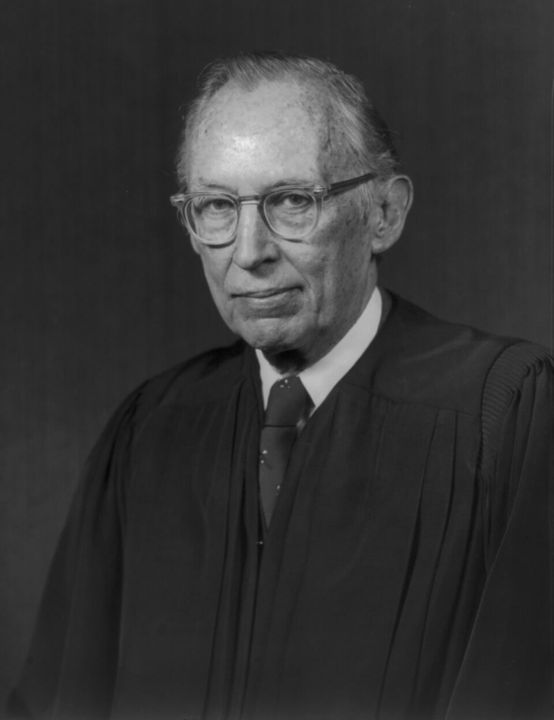
- Lewis F. Powell Jr.: Virginian who held education outside the Constitution's guarantees
- Potter Stewart: Concurring justice who found the funding scheme unjust but lawful
- Byron R. White: Dissenter who called local choice illusory for property-poor districts
- Thurgood Marshall: Dissenter urging a sliding scale of judicial review

Summary
Texas financed its public schools through a Minimum Foundation Program that combined state money with a required local share, and allowed each district to raise more by taxing property within its borders. Because property values differed widely, so did spending. In 1968 Demetrio Rodriguez and other Mexican-American parents in the Edgewood district of San Antonio filed a class action on behalf of poor and minority children in districts with low property wealth. The opinion's figures for 1967-1968 tell the story: Edgewood, with about $5,960 in assessed property per pupil and the highest tax rate in the area, spent $356 per pupil, while neighboring Alamo Heights, with more than $49,000 per pupil and a lower rate, spent $594. A three-judge federal court held the system unconstitutional in December 1971, and Texas appealed. The parents argued that the system classified children by the wealth of their district, that education is a fundamental right because it underlies free speech and voting, and that the state therefore had to justify the disparities under strict scrutiny. Texas, represented by Charles Alan Wright, answered that no definable class of poor persons was absolutely deprived of education, that education is not a right guaranteed by the Constitution, and that local control of schools was a legitimate reason for a system used in nearly every state. On 21 March 1973 the Court reversed, five to four. Justice Powell held that the system did not operate to the disadvantage of a suspect class, since there was no showing that the poorest families lived in the poorest districts or that any child was denied an education altogether. Education, though of grave importance, is not explicitly or implicitly protected by the Constitution, and the Court may not create substantive rights in the name of equal protection. Applying rational-basis review, Powell found the system rationally related to local control and warned that the justices lacked expertise in taxation and educational policy. Justice Stewart concurred, describing the system as chaotic and unjust but not unconstitutional. Justice White, joined by Douglas and Brennan, dissented on the ground that local control meant little to districts whose tax base could not yield more money at any rate. Justice Marshall, joined by Douglas, argued for a sliding scale of review and called the right of every American to an equal start in life too vital to be left to the political process. The library text gives an excerpt of Powell's opinion, Stewart's full concurrence and excerpts of the White and Marshall dissents, without notes; Brennan's brief dissent is not included. After Rodriguez, school-finance challenges moved to state courts. In Edgewood Independent School District v. Kirby (1989) the Texas Supreme Court held the system invalid under the state constitution's requirement of an efficient school system, and the legislature later adopted a plan sharing property wealth among districts. Plyler v. Doe (1982) reaffirmed that education is not a fundamental right under the federal Constitution.
Virtues in this work
- Humility: Powell acknowledges that judges lack the expertise of legislators and educators in the persistent and difficult questions of school finance.
- Justice: Marshall insists that a child's start in life should not depend on the taxable property of the district where the family happens to live.
- Prudence: Stewart distinguishes his judgment that a policy is unwise from the narrower question whether it violates the Constitution.
Plot or Argument
- Texas's dual system of school finance
Powell traces school finance from the 1845 constitution through the Gilmer-Aikin laws of 1949, explains the Minimum Foundation Program and Local Fund Assignment, and compares the Edgewood and Alamo Heights districts.
- Is there a suspect class?
The Court examines three ways of defining the disadvantaged class, poor persons, relatively poorer persons and residents of poorer districts, and finds none that warrants strict scrutiny, partly because the evidence did not show that the poorest families live in the poorest districts.
- Is education a fundamental right?
Powell affirms the importance of education, quoting Brown, but holds that importance alone does not make a right fundamental; education is not guaranteed by the Constitution, and the link between education and speech or voting does not change that.
- Rational basis, taxation and local control
Under the traditional standard, the system is upheld as a reasonable way to combine a basic state guarantee with local control, and the Court stresses its lack of expertise in fiscal and educational policy and the federal implications of ruling otherwise.
- Stewart's concurrence
Stewart calls the Texas system chaotic and unjust but explains that the Equal Protection Clause measures classifications rather than creating substantive rights, and finds no invalid classification here.
- White's dissent
White argues that local control is an illusory justification for districts like Edgewood, which could not raise Alamo Heights' revenue even at much higher tax rates, so the system fails even rational-basis review.
- Marshall's dissent
Marshall documents the funding gaps, rejects the claim that money does not affect educational quality by citing Sweatt v. Painter, and proposes that the level of scrutiny should vary with the importance of the interest and the character of the classification.
Characters
- Demetrio P. Rodriguez, appellee
Edgewood parent and sheet-metal worker at Kelly Air Force Base whose name headed the class action.
- Justice Lewis F. Powell Jr., author of the opinion of the Court
Former school-board chairman who wrote that education is not a right guaranteed by the federal Constitution.
- Justice Potter Stewart, concurring
Agreed the system was not unconstitutional while calling it chaotic and unjust.
- Justice Byron R. White, dissenter
Joined by Douglas and Brennan, argued that local control was meaningless for property-poor districts.
- Justice Thurgood Marshall, dissenter
Joined by Douglas, wrote that the right to an equal start in life could not depend on district property wealth.
- Charles Alan Wright, counsel for the Texas appellants
University of Texas law professor and leading scholar of federal procedure who argued for the state.
Lessons
Importance and constitutional right
Every justice agreed that education is vital. The disagreement was whether that importance makes it a fundamental right that triggers strict scrutiny. Powell answered that rights are fundamental only when the Constitution explicitly or implicitly guarantees them, while Marshall argued that interests closely tied to constitutional rights deserve heightened protection.
- Why does Powell say that comparing education with housing or welfare does not decide the question?
- How does Marshall connect education to speech and voting?
- Should a court's protection of an interest depend on how important it is to people's lives?
Defining a class of the disadvantaged
Powell observed that the plaintiffs had not shown that poor families were concentrated in property-poor districts, and that no child was absolutely denied schooling. This made the claim different from earlier cases about indigent defendants or filing fees. The dissenters responded that the class was defined by district wealth and that relative disadvantage should count.
- What three possible definitions of the disadvantaged class does Powell consider?
- Why does it matter to Powell whether any child receives no education at all?
- Is a relative shortfall in resources a form of unequal treatment?
Local control and its price
Texas defended its system as preserving local control, which Powell described as the freedom to devote more money to one's children's schools and to shape their programs. White replied that this freedom was real for wealthy districts but nearly empty for districts like Edgewood. The case shows how one value can look different from different places in the same state.
- What advantages of local control does Powell describe?
- Why does White say the Texas system gives Edgewood almost no meaningful option?
- Can a state preserve local control while also reducing the gaps between districts?
Which branch should fix school finance?
Powell stressed that judges lack expertise in taxation and educational policy and that reform should come from legislatures; Stewart agreed. Marshall replied that the political process had proved unsuited to remedying the problem. Afterward, reformers turned to state constitutions, and the Texas Supreme Court eventually required change under the state's own charter.
- What reasons does Powell give for judicial caution in this case?
- Why did Marshall doubt that the political process would provide a remedy?
- Is a state court enforcing a state constitution in a better position than a federal court to decide school finance?
Context
Nearly every state relied heavily on local property taxes to fund schools, producing large differences in spending between districts. In the late 1960s scholars such as John Coons, William Clune and Stephen Sugarman argued that such disparities violated equal protection, and the California Supreme Court accepted a version of the argument in Serrano v. Priest (1971). The Court had recently applied strict scrutiny to classifications affecting voting, criminal appeals and interstate travel, and litigants hoped to extend that approach to education.
Composition
The complaint was filed in the summer of 1968 and a three-judge court was convened in January 1969; it delayed ruling to give the legislature time to act before holding against the system in December 1971. The Court noted probable jurisdiction in 1972, and a large number of states, along with several wealthy school districts, supported Texas as amici. Arthur Gochman argued for the Edgewood parents. Powell came to the case after years on the Richmond and Virginia school boards, and his biographer John Jeffries describes local control of schools as one of his firm convictions.
Reception
Advocates of school-finance reform regarded the decision as closing an important federal avenue, while supporters praised it for respecting federalism and the limits of judicial competence. Litigation shifted to state courts, beginning with Robinson v. Cahill in New Jersey (1973), and over the following decades many state supreme courts ruled on funding systems under their own education clauses, reaching varied results. In Texas, Edgewood v. Kirby (1989) led to repeated legislative revisions. Scholars continue to debate whether Rodriguez reflects judicial restraint or a missed opportunity, and whether a minimum-adequacy right left open by Powell exists.
Comparisons
- brown-v-board-of-education
Powell quoted Brown's statement that education is perhaps the most important function of state and local government, then explained why that importance did not make it a fundamental right.
- sweatt-v-painter
Marshall, who had argued Sweatt as counsel, quoted its comparison of two Texas law schools to argue that resources do affect educational quality.
- plyler-v-doe
Nine years later Brennan's majority accepted Rodriguez's holding that education is not a fundamental right yet still struck down a Texas law denying schooling to a class of children.
- democracy-in-america
Tocqueville's praise of the New England township and local self-government illuminates the value of local control on which Powell relied.
Quotes
Frequently cited
“Education, of course, is not among the rights afforded explicit protection under our Federal Constitution. Nor do we find any basis for saying it is implicitly so protected.”
Frequently cited
“The method of financing public schools in Texas, as in almost every other State, has resulted in a system of public education that can fairly be described as chaotic and unjust. It does not follow, however, and I cannot find, that this system violates the Constitution of the United States.”
Frequently cited
“In my judgment, the right of every American to an equal start in life, so far as the provision of a state service as important as education is concerned, is far too vital to permit state discrimination on grounds as tenuous as those presented by this record.”
“It is not the province of this Court to create substantive constitutional rights in the name of guaranteeing equal protection of the laws.”
“The difficulty with the Texas system, however, is that it provides a meaningful option to Alamo Heights and like school districts but almost none to Edgewood and those other districts with a low per-pupil real estate tax base.”
“The Court today decides, in effect, that a State may constitutionally vary the quality of education which it offers its children in accordance with the amount of taxable wealth located in the school districts within which they reside.”
For Students
A reading companion for classical Christian high school students. See the student guide.
Reading Guide
Watch for
- The side-by-side figures for Edgewood and Alamo Heights in Part I.
- Powell's three possible definitions of a disadvantaged class.
- The sentence holding that education is not explicitly or implicitly protected.
- Powell's description of the advantages of local control.
- White's calculation of what tax rate Edgewood would need to match other districts.
Key terms and names
- Strict scrutiny
- The most demanding standard of review, requiring a state to show that a law is necessary to a compelling interest.
- Rational-basis review
- The ordinary standard, upholding a law if it bears a rational relationship to a legitimate state purpose.
- Suspect class
- A group, such as one defined by race, whose classification by law triggers strict scrutiny.
- Ad valorem tax
- A tax based on the assessed value of property, the main local source of Texas school revenue.
- Minimum Foundation Program
- The Texas plan, adopted in 1949, guaranteeing a basic level of school funding through combined state and local contributions.
Seminar Questions
- Comprehension How did the Texas Minimum Foundation Program combine state and local money?
- Comprehension How did Edgewood and Alamo Heights differ in property value, tax rate and spending per pupil?
- Comprehension Why does Powell conclude that the Texas system does not disadvantage a suspect class?
- Interpretation How can Stewart call the system chaotic and unjust and still join the majority?
- Interpretation How does Marshall use Sweatt v. Painter to answer the claim that money may not determine educational quality?
- Big Question What does a community owe to the education of children who live in its poorer neighborhoods?
Faith Connections
- 2 Corinthians 8:13-15 (Scripture)
Paul's appeal for the Corinthians' abundance to supply the want of others, so that there may be equality, has been read in discussions of sharing resources across communities.
- 1 Timothy 5:8 (Scripture)
The teaching that each must provide for his own household bears on Powell's account of local control as parents' freedom to spend more on their own children.
Logic and Rhetoric
Central argument: Powell reasons that strict scrutiny applies only to suspect classes or fundamental rights, that the Texas system involves neither because district wealth is not a suspect class and education is not a constitutionally guaranteed right, and that under rational-basis review local control justifies the system; the dissenters reply that the disparities are severe, that local control is illusory for poor districts, and that the importance of education calls for closer review.
Rhetorical device: concessio. Powell grants the grave significance of education and the reality of the disparities before denying that they establish a constitutional violation, and Stewart concedes the system is chaotic and unjust in his opening sentence (quote 2).
Debate: Resolved: that the federal Constitution should be read to guarantee children a substantially equal public education.
Memory Work
Education, of course, is not among the rights afforded explicit protection under our Federal Constitution. Nor do we find any basis for saying it is implicitly so protected.
In my judgment, the right of every American to an equal start in life, so far as the provision of a state service as important as education is concerned, is far too vital to permit state discrimination on grounds as tenuous as those presented by this record.
Writing Prompts
Essay: Explain how the majority and the dissenters each understand local control, and evaluate whether it is a sufficient reason for the spending differences shown in the opinion.
Comparison with Plyler v. Doe: Compare how Rodriguez and Plyler treat the claim that education is a fundamental right, and explain why the Court upheld one Texas school law and struck down the other.
Medical Lens
The opinions deal with property taxes and school spending in Texas and contain no medical subject matter.
Creative Prompts
- Classroom
Using the opinion's figures for Edgewood and Alamo Heights, hold a mock legislative hearing in Austin in 1973 where students propose and debate a school-finance reform after the Court's decision.
- Essay
Write a brief for either the Edgewood parents or the State of Texas, organized around the two questions Powell poses: suspect class and fundamental right.
- Dialogue
Write a conversation between an Edgewood parent and an Alamo Heights parent at a San Antonio school-board meeting about what local control means to each family.
- Essay
Compare Stewart's judgment that a system can be unjust yet constitutional with Marshall's view that the Constitution requires a remedy, and explain what each implies about the role of judges.
Further Reading
- Private Wealth and Public Education, John E. Coons, William H. Clune III and Stephen D. Sugarman
The 1970 study whose equal-protection theory shaped the Serrano and Rodriguez litigation.
- Justice Lewis F. Powell, Jr.: A Biography, John C. Jeffries Jr.
Biography by Powell's former clerk, with a chapter on the Rodriguez deliberations and Powell's views on local schools.
Verification notes
The six quotations (two from Powell, one from Stewart, one from White, two from Marshall) were each found by Grep as exact substrings of content/texts/san-antonio-isd-v-rodriguez.txt. The district figures for 1967-1968 are taken from Powell's opinion. Powell's opinion and the two dissents are excerpts in the stored text, while Stewart's concurrence is complete. Details about Demetrio Rodriguez, counsel and amicus support come from secondary sources.
- Confirm that Demetrio Rodriguez worked as a sheet-metal worker at Kelly Air Force Base.
- Confirm the number of states that filed or joined amicus briefs supporting Texas.
- Confirm that Arthur Gochman argued for the appellees and Charles Alan Wright for Texas.
- Confirm that the three-judge court deferred its ruling to allow the Texas legislature time to act.