Work record
The Communist Manifesto
1848 · 19th Century · Political Theory · German
Abstract
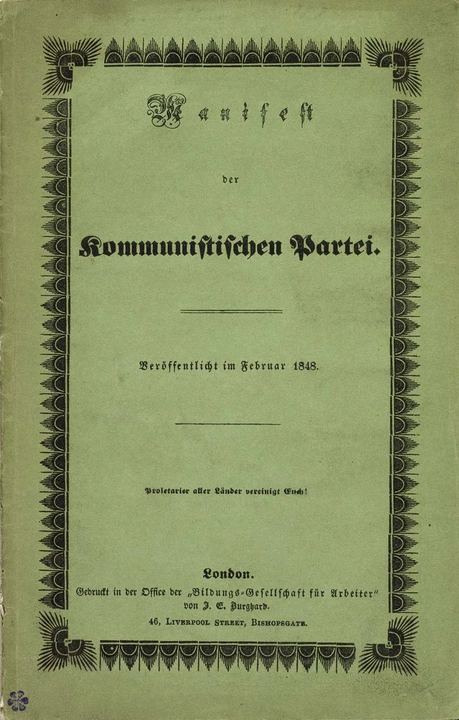
Background. Meeting in London in late 1847, the Communist League asked Marx and Engels for a statement of principles. Marx completed it in Brussels, drawing on Engels's catechism draft, and it appeared anonymously in February 1848 as revolution broke out in Paris.
Argument. Section I, 'Bourgeois and Proletarians', reads all recorded history as class struggle. It credits the bourgeoisie with revolutionizing production and creating a world market, then argues that the same class has called into existence the wage-workers who will overthrow it. Section II rebuts objections to abolishing bourgeois property, family and nationality and lists ten measures, among them a heavy progressive income tax, abolition of inheritance and free education for all children in public schools.
Structure. Section III sorts rival socialisms into feudal, petty-bourgeois, German 'true', conservative and critical-utopian kinds; Section IV relates the communists to opposition parties from the English Chartists to the Polish democrats and closes with the call for workers of all countries to unite.
Key Concepts. Class struggle, the material basis of law and ideas, commercial crises of overproduction, and the conquest of political power by the proletariat.
Significance. Translated into scores of languages, it became the most widely circulated socialist text, shaping labour movements, revolutionary parties and later arguments linking health to economic conditions.
Key figures
- Karl Marx: Principal drafter, writing in Brussels exile
- Friedrich Engels: Co-author whose draft 'Principles of Communism' preceded the text; oversaw the 1888 edition
- The Communist League: Workers' association whose London congress of 1847 commissioned the programme
- Saint-Simon, Fourier and Owen: Founders of the 'critical-utopian' socialism assessed in Section III
- Samuel Moore: English translator of the authorized 1888 version

Summary
The Communist Manifesto presents modern history as the history of class struggle and casts the bourgeoisie as both revolutionary and exploitative. Marx and Engels argue that capitalism has dissolved feudal relations, expanded world markets, concentrated production, remade family and nation, and subjected older loyalties to cash exchange. Their admiration for the bourgeoisie's transformative power is inseparable from their claim that the same system produces its own antagonist, the proletariat. The pamphlet moves from sweeping historical narrative to political program. It describes workers made vulnerable by wage labor, machinery, competition, crises, and the concentration of property, then defines communists as the party that clarifies the common interests of the proletariat. The famous demands include progressive taxation, abolition of inheritance rights, centralization of credit and transport, free public education, and changes to property relations. Later sections attack rival forms of socialism, and the conclusion calls workers of all countries to unite. The medical relevance lies in social medicine rather than individual diagnosis. The Manifesto treats suffering as produced by labor conditions, urbanization, poverty, family disruption, exploitation, and class power. It belongs to the nineteenth-century world in which industrial disease, malnutrition, overcrowding, injury, and public health became political questions. Marx and Engels do not offer clinical remedies, but their account helped shape later arguments that health cannot be separated from economic structure. The pamphlet's rhetoric is compressed, prophetic, and polemical. It turns economic analysis into revolutionary summons, often reducing religion, law, nation, and family to expressions of material class relations. Its historical importance is immense, and reading it carefully requires separating its diagnosis of industrial capitalism from the later state regimes that claimed its inheritance. The Communist Manifesto matters because it gives one of the most influential accounts of modernity as a system of production, class conflict, expropriation, and revolutionary possibility. Its power comes from compressing social theory, historical drama, and political command into one urgent form.
Plot or Argument
- Bourgeois and proletarians
History is narrated as conflict between classes transformed by capitalist production.
- Communists and demands
The program calls for abolition, centralization, and revolutionary solidarity.
- Rivals and conclusion
Other socialist movements are dismissed before the famous international appeal.
Key claims
The main steps of the argument, in order, and how they fit together.
- All recorded history is the history of struggles between oppressing and oppressed classes.How it is supported: A sweeping survey of history from ancient slavery through feudalism to modern society.
- Modern industry has simplified society into two great opposing classes, the bourgeoisie and the proletariat.How it is supported: Description of how capitalism dissolves feudal ties and older loyalties into cash exchange.
- The bourgeoisie has revolutionized production, creating world markets and transforming family, nation and every older social relation.How it is supported: Historical narrative crediting the bourgeoisie with unprecedented productive power.
- Capitalism produces recurring commercial crises of overproduction that the ruling class cannot control.How it is supported: Reasoning from the periodic economic crises of the nineteenth century.
- The same system creates a concentrated, impoverished working class with nothing to lose, which becomes its own gravedigger.How it is supported: Account of wage labor, machinery, competition and factory concentration.
- Law, morality and ideas reflect the material and property relations of the ruling class.How it is supported: Rebuttal of objections to abolishing bourgeois property, family and nationality.
- Because the proletariat cannot free itself without abolishing class property, its victory will end class society altogether.How it is supported: Reasoning that the lowest class has no property of its own to protect.
- Rival forms of socialism are inadequate because they misunderstand class struggle or seek to preserve older social orders.How it is supported: Classification and critique of feudal, petty-bourgeois, German, conservative and utopian socialisms.
Argument map
Supported by
- 1All recorded history is the history of struggles between oppressing and oppressed classes.
which rests on
- 6Law, morality and ideas reflect the material and property relations of the ruling class.
- 2Modern industry has simplified society into two great opposing classes, the bourgeoisie and the proletariat.
which rests on
- 3The bourgeoisie has revolutionized production, creating world markets and transforming family, nation and every older social relation.
- 5The same system creates a concentrated, impoverished working class with nothing to lose, which becomes its own gravedigger.
which rests on
- 4Capitalism produces recurring commercial crises of overproduction that the ruling class cannot control.
- 7Because the proletariat cannot free itself without abolishing class property, its victory will end class society altogether.
which rests on
- 8Rival forms of socialism are inadequate because they misunderstand class struggle or seek to preserve older social orders.
Therefore
Plain-language summaries of the author's argument, not quotations.
Lessons
Communist Manifesto: formed attention
The Communist Manifesto teaches students to slow down before judgment. twelfth-grade readers can compare its rhetoric and anthropology with Aristotle, Aquinas, Catholic social teaching, and liberal rights traditions
- Where does The Communist Manifesto reward patient attention?
- Which early impression in The Communist Manifesto has to be revised?
Communist Manifesto: order and disorder
The Communist Manifesto makes order visible by showing what damages it. the pamphlet moves from sweeping historical narrative to class analysis, communist demands, rival socialist movements, and a final summons
- What kind of disorder is most dangerous in The Communist Manifesto?
- Does The Communist Manifesto restore order, expose its fragility, or both?
Communist Manifesto: body and soul
The Communist Manifesto gives the medical lens a human scale. its medical relevance lies in social medicine: labor conditions, poverty, urbanization, family disruption, and the political diagnosis of suffering
- How does bodily vulnerability change the argument of The Communist Manifesto?
- Where should a reader avoid reducing moral or spiritual suffering to diagnosis?
Context
The Communist Manifesto stands at a historically important crossing point for 19th century study. It should be read with attention to its original language, audience, institutional setting, and later classroom life.
Composition
The Communist Manifesto is dated 1848; the record uses the date as a teaching anchor while recognizing that transmission, translation, and publication history may be more complicated than a single year suggests.
Reception
The Communist Manifesto has remained teachable because later readers found in it more than antiquarian interest: it continues to frame arguments about truth, order, suffering, imagination, and the moral life.
Comparisons
- a-modest-proposal
The Communist Manifesto can be compared with a-modest-proposal to test how different periods handle authority, suffering, formation, and the shape of a good life.
- centesimus-annus
The Communist Manifesto can be compared with centesimus-annus to test how different periods handle authority, suffering, formation, and the shape of a good life.
Quotes
Frequently cited
“The history of all hitherto existing societies is the history of class struggles”
For Students
A reading companion for classical Christian high school students. See the student guide.
Reading Guide
Where it fits: In the 12th-grade year on Society and Politics, the Manifesto is the modern era's most influential argument that property, family, and religion are products of class conflict, and it should be read with Aristotle's Politics on the household and property and with Centesimus Annus, which answers it after 1989.
Watch for
- The opening image of a spectre haunting Europe, which all the powers of old Europe have allied to exorcise. Notice how the preamble turns a small, newly founded League into a force feared by pope and police.
- The long passage in Section I praising the bourgeoisie for railways, world markets, and the subjection of nature's forces. Marx and Engels admire the class they mean to overthrow.
- The image at the end of Section I of the bourgeoisie producing its own gravediggers in the proletariat.
- Section II, where the authors answer objections one by one: that communists would abolish property, the family, nations, religion, and eternal truths. Then come the ten measures.
- Section III's classification of rival socialisms, feudal, petty-bourgeois, German or true, conservative, and critical-utopian, each dismissed in turn.
Key terms and names
- Bourgeoisie
- The class of modern capitalists who own the means of social production and employ wage labour. In Section I it is the most revolutionary class in history, which has dissolved every older bond into cash payment.
- Proletariat
- The class of modern wage workers who own no means of production and live only so long as they find work. The Manifesto argues that the growth of industry concentrates them, unites them, and makes them the class that will abolish class rule.
- Class struggle
- The conflict between owning and labouring classes that the Manifesto's first sentence makes the content of all recorded history, from freeman and slave and patrician and plebeian to bourgeois and proletarian.
- Means of production
- The land, tools, machinery, and factories by which a society produces its goods. Section II argues that communism will abolish bourgeois property in them, not personal property won by one's own labour.
- The Communist League
- The small international association of workers, many of them German emigrés, that commissioned Marx and Engels to write the Manifesto at its congress in London in 1847. It was published in February 1848, on the eve of that year's revolutions.
- Critical-utopian socialism
- Section III's name for the systems of Saint-Simon, Fourier, and Owen. Marx and Engels credit their criticism of society but reject their hope of reforming it by model communities and appeals to all classes.
Seminar Questions
- Comprehension According to Section I, what has the bourgeoisie accomplished, and what older relationships has it destroyed?
- Comprehension What objections to communism do Marx and Engels raise in Section II, and how do they answer the charge that communists want to abolish the family?
- Comprehension List several of the ten measures proposed at the end of Section II. Which of them have since been adopted by non-communist governments?
- Interpretation Why do Marx and Engels spend so much of Section I praising the bourgeoisie? How does that praise serve their argument?
- Interpretation The Manifesto claims that law, morality, and religion are bourgeois prejudices behind which bourgeois interests lurk. If that is true of all ideas, what happens to the authority of the Manifesto's own ideas?
- Interpretation What does the image of the bourgeoisie producing its own gravediggers claim about how history moves, and how much room does it leave for human choice?
- Big Question Is human history fundamentally a story of class struggle, or are there goods, such as family, worship, friendship, and truth, that cannot be explained by economic interest?
Faith Connections
- Acts 2:44-45 and 4:32-35 (Scripture)
The first Christians in Jerusalem held all things in common and distributed to each as any had need. Readers have often compared this with communism, but Acts presents a voluntary sharing within a worshipping community, as Peter's words to Ananias in Acts 5:4 make clear, rather than the abolition of property by the state.
- James 5:1-6 (Scripture)
James warns the rich that the wages of the labourers who mowed their fields, kept back by fraud, cry out to the Lord of hosts. Scripture shares the Manifesto's anger at the defrauding of workers while locating the wrong in the injustice of persons rather than in the existence of property.
- Exodus 20:15-17 (Scripture)
The commandments against stealing and coveting presume that a neighbour's house and goods rightly belong to him. They give a measure for Section II's argument that private property has already been done away with for nine-tenths of the population.
- Leo XIII, Rerum Novarum (1891) (Great Conversation)
Leo XIII's encyclical on capital and labour answered the socialist movement the Manifesto helped launch. He agreed that workers suffered grave injustice, but defended private property as a natural right and called for just wages, workers' associations, and cooperation between classes in place of class war.
Logic and Rhetoric
Central argument: All recorded history is the history of class struggles. Modern industry has simplified society into two great classes, bourgeoisie and proletariat, and the bourgeoisie, by revolutionising production, has created both recurring crises it cannot control and a concentrated working class with nothing to lose. Since the proletariat cannot free itself without abolishing the property relations on which every class rule rests, its victory will end class society altogether. Therefore communists should organise workers of all countries to overthrow bourgeois rule and centralise production in the hands of the state.
Rhetorical device: hypophora (raising an objection and answering it). Section II is built as a string of objections the bourgeois reader is imagined to make, that communists would abolish property, the family, nationality, and eternal truths, each followed by a sharp reply that turns the charge back on the accuser.
Debate: Resolved: Marx and Engels were right that modern commerce dissolves traditional loyalties to family, place, and faith.
Memory Work
The history of all hitherto existing societies is the history of class struggles
Writing Prompts
Essay: Section II answers the charge that communists would abolish the family by arguing that the bourgeois family is already being destroyed by industry. Evaluate this argument, using the Manifesto's own account of factory labour and its proposals for public education.
Comparison with Centesimus Annus: John Paul II wrote Centesimus Annus in 1991, a century after Rerum Novarum and two years after the fall of the Berlin Wall. Compare his account of why socialist regimes failed, especially his claim that they misunderstood the human person, with the Manifesto's account of human nature and history, and argue which better explains the condition of workers.
Medical Lens
its medical relevance lies in social medicine: labor conditions, poverty, urbanization, family disruption, and the political diagnosis of suffering
- Bourgeois and proletarians
The Communist Manifesto gives this tag concrete force through its medical relevance lies in social medicine: labor conditions, poverty, urbanization, family disruption, and the political diagnosis of suffering
- Communists and demands
The Communist Manifesto gives this tag concrete force through its medical relevance lies in social medicine: labor conditions, poverty, urbanization, family disruption, and the political diagnosis of suffering
- Rivals and conclusion
The Communist Manifesto gives this tag concrete force through its medical relevance lies in social medicine: labor conditions, poverty, urbanization, family disruption, and the political diagnosis of suffering
Listen to the book
Public-domain audiobook from LibriVox, read by Jon Ingram, translated by Samuel Moore. Recording: Communist Manifesto on LibriVox (Internet Archive).
LibriVox recordings are volunteer readings released into the public domain. The reading may follow a different edition or translation from the text in this library.
Creative Prompts
- Essay
Write a class essay on how The Communist Manifesto defines maturity without reducing maturity to success.
- Dialogue
Stage a dialogue between a defender and a critic of The Communist Manifesto's central moral claim.
Further Reading
Verification notes
Core bibliographic and interpretive claims are stable; quotations should be drawn only from the attached public-domain text when one is present.
No verification flags recorded.