Work record
Atlanta Exposition Address
1895 · 19th Century · Oratory · English
Abstract
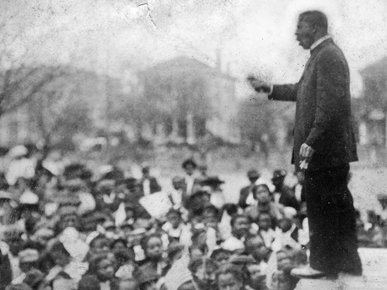
Background. Thirty years after emancipation, Atlanta's boosters staged a world's fair to advertise Southern industry. They asked the head of an Alabama industrial school to speak for Black Southerners before a large and largely white crowd.
Content. A tale of sailors perishing from thirst while floating in a great river's fresh outflow becomes the address's governing figure. Washington urges freedpeople to remain, cultivate neighborly goodwill, and win standing through farming, crafts, and business. He asks white employers to prefer workers they already know over newcomers from abroad and to invest in their schooling. He accepts separation in private life, claims equal standing before the courts, and closes with a petition for justice and lawful order. Along the way he lists the skilled goods his people now make, from buggies and steam-engines to newspapers and paintings, as proof of steady advance.
Themes. Work as the ground of dignity, the shared fate of neighbors, patience under hardship, and the hope that usefulness will earn respect run through the address.
Significance. Applause and national press coverage turned Washington overnight into the country's leading Black spokesman. Within a year the Supreme Court approved segregated railway cars, and in 1903 Du Bois mounted a sustained critique. Their disagreement framed African American strategy until the civil rights era.
Key figures
- Booker T. Washington: Principal of Tuskegee Institute and the speaker
- Rufus Bullock: Former governor of Georgia who introduced him
- The Exposition directors: Atlanta businessmen addressed as Mr. President and Gentlemen
- Grover Cleveland: President who wrote to congratulate Washington
- W. E. B. Du Bois: Scholar who later named it the Atlanta Compromise and disputed it

Summary
On 18 September 1895 the Cotton States and International Exposition opened in Atlanta, a fair meant to display the industrial recovery of the South thirty years after the Civil War. Its organizers, who had included a Negro Building among the exhibits, invited Booker T. Washington, principal of Tuskegee Institute, to speak at the opening ceremonies. No Black speaker had addressed so prominent a mixed Southern audience on such an occasion, and Washington later wrote that he felt the weight of both races watching him. He opens by noting that one third of the South's people are Black and that no plan for the region's welfare can succeed without them. He thanks the managers for their recognition and admits that in the first years of freedom his people began at the top, seeking office before land and skill. The center of the speech is a parable. A ship lost at sea signals a passing vessel for water and is told four times to cast down its bucket where it is; the captain finally does, and draws up fresh water from the mouth of the Amazon. Washington applies the lesson twice. To Black Southerners tempted to emigrate, he says to make friends with their white neighbors and to cast down their buckets in farming, trades, commerce, domestic service, and the professions, learning the dignity of labor. To white Southerners looking to immigrant workers, he says to cast down their buckets among the Black people they already know, and to educate them in head, hand, and heart. He then offers the image that became the speech's best-known line: in purely social matters the races may be as separate as the fingers, yet one as the hand in mutual progress. He warns that the South's Black population will either help pull the load upward or drag it down, describes thirty years of progress with gratitude for Northern and Southern help, and calls agitation for social equality folly, while affirming that the full protection of the law should be theirs. He ends with a prayer for justice, obedience to law, and a new heaven and a new earth in the South. The audience cheered, and President Grover Cleveland wrote to congratulate him. W. E. B. Du Bois later named the speech the Atlanta Compromise and challenged its program in The Souls of Black Folk (1903).
Virtues in this work
- Industry: Washington urges his people to dignify and glorify common labor and to put brains and skill into the common occupations of life.
- Prudence: He measures what can be won before a Southern audience in 1895 and stresses footholds in work and property that can be built on.
- Humility: He asks the audience not to expect overmuch from the exhibit and counts progress from a few quilts, pumpkins, and chickens.
- Hope: He closes by praying that God will bring the blotting out of racial animosities and a new heaven and a new earth to the South.
Plot or Argument
- Exordium: one third of the South (Paragraphs 1-2)
Washington reminds the audience that one third of the South's population is Black, thanks the Exposition's managers for their recognition, and admits that the freedmen first sought politics before property and skill.
- The parable of the bucket (Paragraphs 3-4)
The story of a ship dying of thirst in fresh water leads to his counsel to Black Southerners: stay, make friends with neighbors, and cast down the bucket in agriculture, trades, and the professions, beginning at the bottom of life and dignifying common labor.
- The appeal to white Southerners (Paragraph 5)
He urges employers not to look to immigrant labor but to the Black workers who built the South's fields, forests, and railroads, promising loyalty and offering the image of the fingers and the hand.
- Common destiny and progress (Paragraphs 6-8)
Washington argues that the security of all depends on the development of all, quotes a stanza on changeless justice binding the races to one fate, warns that sixteen million hands will pull the load either up or down, and describes three decades of progress since emancipation.
- Equality, law, and the closing prayer (Paragraphs 9-10)
He calls agitation for social equality folly but affirms that every legal right should be theirs and that readiness to use those rights matters more. He pledges his race's help and prays for justice, obedience to law, and a new heaven and a new earth in the South.
Key claims
The main steps of the argument, in order, and how they fit together.
- One third of the South's people are Black, so no plan for the region's prosperity can succeed without them.How it is supported: Appeal to population figures and the Exposition's own aim of Southern progress.
- In the first years of freedom, the freedpeople mistakenly sought political office before gaining land, skill, and property.How it is supported: Candid admission offered as a lesson from recent history.
- Black Southerners should stay where they are, befriend their neighbors, and build dignity through farming, trades, business, and the professions.How it is supported: The parable of sailors told to cast down their bucket where they are and finding fresh water.
- White Southerners should employ and educate the Black workers they already know rather than seek immigrant labor.How it is supported: The same parable applied to employers, citing the loyalty of those who built the South's fields and railroads.
- The two races can remain separate in social life while working together like the fingers of one hand for mutual progress.How it is supported: The image of the hand and fingers.
- The security and progress of all Southerners depends on the development of all, since both races share one destiny.How it is supported: A verse on changeless justice and the warning that millions of hands will pull the load up or down.
- Thirty years of steady advance since emancipation prove that Black Southerners are ready to contribute through useful work.How it is supported: A list of goods produced, from buggies and steam engines to newspapers and paintings.
- Legal rights belong to all, but readiness to use those rights through usefulness matters more than agitating for social equality.How it is supported: Appeal to patience, lawful order, and a closing prayer for justice.
Argument map
Supported by
- 6The security and progress of all Southerners depends on the development of all, since both races share one destiny.
which rests on
- 1One third of the South's people are Black, so no plan for the region's prosperity can succeed without them.
- 7Thirty years of steady advance since emancipation prove that Black Southerners are ready to contribute through useful work.
- 3Black Southerners should stay where they are, befriend their neighbors, and build dignity through farming, trades, business, and the professions.
which rests on
- 2In the first years of freedom, the freedpeople mistakenly sought political office before gaining land, skill, and property.
- 4White Southerners should employ and educate the Black workers they already know rather than seek immigrant labor.
which rests on
- 5The two races can remain separate in social life while working together like the fingers of one hand for mutual progress.
- 8Legal rights belong to all, but readiness to use those rights through usefulness matters more than agitating for social equality.
Therefore
Plain-language summaries of the author's argument, not quotations.
Lessons
Beginning where you are
The parable of the bucket teaches that help is often nearer than we think, and that progress begins with the work at hand rather than in a distant place. Washington applies this to a people only thirty years out of slavery, urging the patient building of skill, property, and character.
- What does the thirsty ship fail to realize about the water around it?
- Why does Washington apply the parable both to Black and to white Southerners?
- Where in your own life might casting down your bucket where you are apply?
The dignity of labor
Washington insists that there is as much dignity in tilling a field as in writing a poem and that a people must learn to put brains and skill into the common occupations of life. This conviction shaped Tuskegee, where students built the buildings in which they studied.
- What does Washington mean by beginning at the bottom of life rather than at the top?
- Why does he contrast earning a dollar in a factory with spending one in an opera-house?
- Is manual work given the honor it deserves in your community?
Strategy and principle in a hard time
Washington spoke to a white Southern audience as segregation and disfranchisement were spreading. He chose to stress economic partnership and to set aside the demand for social equality, while still claiming the full rights of the law. Du Bois answered that rights deferred would not be granted. Students can weigh both men's reasoning within their circumstances.
- Which sentences in the speech claim rights, and which counsel patience?
- Why might Washington have thought this approach wise in Atlanta in 1895?
- How would you decide when to press for justice at once and when to build toward it gradually?
Context
By 1895 Reconstruction had ended, and Southern states were narrowing Black voting rights and writing segregation into law; Mississippi's 1890 constitution had led the way, and South Carolina was drafting a similar one that autumn. Frederick Douglass had died in February 1895. Atlanta's business leaders, champions of a New South built on industry, organized the Exposition to attract Northern and foreign investment, and they included Black exhibits partly to show regional harmony.
Composition
Washington wrote the address himself and described its preparation and delivery in Up from Slavery (1901), Chapter XIV, where he printed the text stored here. He was introduced by former governor Rufus Bullock. The four verse lines on the laws of changeless justice come from John Greenleaf Whittier's poem At Port Royal (1862), and the phrase on blessing him that gives and him that takes echoes Portia's speech on mercy in The Merchant of Venice.
Reception
Clark Howell of the Atlanta Constitution and many Northern and Southern papers praised the speech, and President Cleveland sent a letter of congratulation. It made Washington a national figure and the chief spokesman white leaders consulted on race for twenty years. The following year, Plessy v. Ferguson upheld segregation. In The Souls of Black Folk (1903), W. E. B. Du Bois called the speech the Atlanta Compromise and argued that it had accepted too much; the debate between the two men shaped Black political thought for decades.
Comparisons
- narrative-and-fourth-of-july
Douglass, who died months before Atlanta, rebuked the nation openly in 1852; Washington, his successor as the most prominent Black leader, chose conciliation and economic self-help before a Southern audience.
- i-have-a-dream
King's 1963 speech claims at once the full equality Washington set aside in 1895, and the two are often read as poles in the long American debate over civil rights.
- citizenship-in-a-republic
Theodore Roosevelt, who invited Washington to dine at the White House in 1901, also prized the doer of hard, practical work over the critic, and both speeches praise effort as the root of civic worth.
- twelve-years-a-slave
Northup's account of slavery in Louisiana shows the conditions from which Washington measured thirty years of progress in quilts, pumpkins, and chickens.
- the-souls-of-black-folk
In Of Mr. Booker T. Washington and Others, Du Bois discusses this 1895 address, which he called the Atlanta Compromise, and sets out his own case for the right to vote, civic equality and higher education.
Quotes
Frequently cited
“The answer from the friendly vessel at once came back, “Cast down your bucket where you are.””
Frequently cited
“In all things that are purely social we can be as separate as the fingers, yet one as the hand in all things essential to mutual progress.”
“No race can prosper till it learns that there is as much dignity in tilling a field as in writing a poem. It is at the bottom of life we must begin, and not at the top.”
“Nor should we permit our grievances to overshadow our opportunities.”
“There is no defence or security for any of us except in the highest intelligence and development of all.”
“It is important and right that all privileges of the law be ours, but it is vastly more important that we be prepared for the exercises of these privileges.”
“The opportunity to earn a dollar in a factory just now is worth infinitely more than the opportunity to spend a dollar in an opera-house.”
For Students
A reading companion for classical Christian high school students. See the student guide.
Reading Guide
Watch for
- The parable of the thirsty ship in Paragraph 3, and how its key phrase is repeated to different audiences.
- The list of trades and professions in which Washington tells his people to cast down their buckets.
- The image of the fingers and the hand in Paragraph 5.
- The either-or of Paragraph 7, where the South's Black population will pull the load upward or downward.
- The closing prayer that ends with the biblical new heaven and new earth.
Key terms and names
- Cotton States and International Exposition
- The 1895 world's fair in Atlanta's Piedmont Park that showcased the industry of the New South.
- Tuskegee Institute
- The Alabama normal and industrial school Washington founded in 1881, training teachers and skilled workers.
- Industrial education
- Training in agriculture, trades, and practical skills, which Washington saw as the foundation for economic independence.
- New South
- The vision, promoted by editors such as Henry Grady, of a South rebuilt on manufacturing, railroads, and commerce.
- Atlanta Compromise
- Du Bois's later name for the speech, referring to its acceptance of social separation in exchange for economic opportunity.
- Social equality
- In 1890s usage, full social mixing of the races, which Washington called a question not worth agitating.
Seminar Questions
- Comprehension Whom does Washington address in the bucket parable, and what does he ask each group to do?
- Comprehension What evidence of progress since emancipation does Washington describe in Paragraph 8?
- Interpretation Why does Washington begin by saying his people started at the top instead of at the bottom?
- Interpretation What does the image of the fingers and the hand grant, and what does it hold back?
- Interpretation How does Washington use gratitude and promises of loyalty to persuade his white listeners?
- Big Question Is it better to press for every right at once or to build the means of securing rights over time? Can both be done?
- Big Question Washington's audience cheered the speech, and Du Bois rejected it. How should we judge a speech that was praised by one audience and criticized by another?
Faith Connections
- Revelation 21:1 (Scripture)
John sees a new heaven and a new earth; Washington's closing borrows the vision for a South healed of sectional and racial enmity.
- Isaiah 35:1 (Scripture)
The desert shall blossom as the rose; Washington promises that Black workers will make blossom the waste places in the South's fields.
- Romans 7:24 (Scripture)
Paul cries out to be delivered from the body of this death; Washington uses the phrase for what a neglected people would become to the body politic.
- 1 Corinthians 12:12-26 (Scripture)
Paul's body with many members, none able to say to another I have no need of you, stands behind the image of the fingers and the hand.
Logic and Rhetoric
Central argument: The South's prosperity depends on the development of its Black third; Black Southerners should build skill and property where they are, and white Southerners should employ and educate them rather than seek outside labor; social separation may continue for now, but legal rights and mutual progress will follow from usefulness, and both races share one destiny.
Rhetorical device: Parable with refrain. The command to the thirsty ship, Cast down your bucket where you are, is repeated four times in the story and then reapplied, first to Black and then to white listeners.
Debate: Resolved: Booker T. Washington's strategy in the Atlanta Exposition Address was the wisest course open to Black Southerners in 1895.
Memory Work
No race can prosper till it learns that there is as much dignity in tilling a field as in writing a poem. It is at the bottom of life we must begin, and not at the top.
Nor should we permit our grievances to overshadow our opportunities.
Writing Prompts
Essay: Washington tells both his own people and white Southerners to cast down their buckets where they are. Analyze how the parable organizes the whole speech, and evaluate what his program promised and what it postponed.
Comparison with I Have a Dream: Compare Washington's address with King's I Have a Dream speech. How does each speaker use biblical imagery, describe the future of the races in America, and decide what to ask of his audience?
Creative Prompts
- Classroom
Hold a mock 1903 debate in which one student speaks for Washington from this address and another for Du Bois from The Souls of Black Folk, each answering the other's strongest point.
- Essay
Trace the bucket parable through the speech: how many times does the phrase recur, to whom is it addressed each time, and how does its meaning shift?
- Fiction
Write a scene in which a Tuskegee student who traveled to Atlanta describes the speech and the audience's response to classmates back in Alabama.
Further Reading
- Up from Slavery, Booker T. Washington
Washington's autobiography; Chapter XIV recounts the Atlanta address and prints its text.
- The Souls of Black Folk, W. E. B. Du Bois
Chapter III, Of Mr. Booker T. Washington and Others, is the classic reply to the speech.
- Booker T. Washington: The Making of a Black Leader, 1856-1901, Louis R. Harlan
- Up from History: The Life of Booker T. Washington, Robert J. Norrell
A sympathetic reassessment that reads the speech within the dangers of the 1890s South.
Verification notes
Date, place, and reception are well documented, and Washington's own printed text in Up from Slavery is stored here; newspaper versions of 1895 differ slightly. The four verse lines are from Whittier's At Port Royal (1862). The stored text uses curly quotation marks and British spellings such as neighbour, labour, and defence, which are quoted as stored. Paragraph numbers count from One-third of the population, after the salutation, and treat the verse lines as part of Paragraph 6.
No verification flags recorded.