Work record
The Call of the Wild
1903 · Early 20th Century · Novella · English
Abstract
Background. Written within months of London's return from his own Yukon winter, the story turns the gold-rush demand for sled dogs into a tale of one dog's transformation.
Plot. Kidnapped from a judge's comfortable home and broken in Seattle, Buck is put to work hauling the Canadian mail. He studies the old wheel dogs, defeats the savage leader Spitz, and drives the team to record runs, then suffers near death under three ignorant newcomers who starve and beat the dogs. Rescued by Thornton, he repays him with total loyalty: a rescue in white water, a bar-room attack on an assailant, a famous sled pull for a bet. When raiders kill Thornton at a remote placer camp, Buck leaves human company for good.
Structure. Seven chapters follow Buck through a sequence of owners, each stage stripping away a layer of domestic habit; ancestral visions of a hairy fire-tending man mark his deepening memory.
Themes. Heredity and environment, survival through adaptation, the character of masters, devotion, and the pull of gold on men. The animal point of view lets London show human greed and kindness from below, through the dogs who pay for both.
Significance. London's breakthrough bestseller, never out of print, it remains the best-known American dog story and a standard middle-school novel; its counterpart White Fang reverses the journey.
Main characters
- Buck: Stolen California estate dog who masters the trail and joins the wolves
- John Thornton: Prospector whose kindness wins Buck's complete devotion
- Spitz: Husky lead dog and Buck's deadly rival
- François and Perrault: Canadian mail couriers who teach Buck to pull
- Dave: Wheel dog who dies insisting on his place in harness
- Hal, Charles and Mercedes: Inexperienced travelers who ruin the team
- The man in the red sweater: Dog breaker who rules by the club

Watch the summary
The Call of the Wild in 115 seconds · 1:55
Summary
The Call of the Wild follows Buck, a huge St. Bernard and Scotch shepherd cross, through one terrible and transforming year of the Klondike gold rush. Buck lives as the lord of Judge Miller's estate in the Santa Clara Valley of California until Manuel, a gardener's helper who needs money for his lottery gambling, sells him to dog traders. Shipped north in a crate, starved and enraged, Buck is beaten into submission by a man in a red sweater and learns his first lesson: a man with a club must be obeyed. On the beach at Dyea he watches the gentle Newfoundland Curly torn to pieces by a pack of huskies, and learns that a dog who goes down does not get up. Bought by the French-Canadian government couriers François and Perrault, he is harnessed into a dog team, taught by the veteran wheel dogs Dave and Sol-leks, and quickly learns to steal food, sleep in a hole in the snow, and break ice from his toes. His growing pride brings him into a long feud with Spitz, the cruel and experienced lead dog. After a night chase of a snowshoe rabbit, Buck kills Spitz in a fight to the death while the team waits in a ring, and he forces the drivers to make him leader; under him the team makes record time. Sold to a Scottish half-breed's mail outfit, the dogs haul heavy loads until they are worn out. The faithful Dave, sick with some inner injury, begs to die in harness and is finally shot. The broken team is then sold to three greenhorns from the States: Hal, his sister Mercedes, and her husband Charles. Overloaded, quarrelling and ignorant, they overfeed and then starve the dogs, beat them, and press on across rotten spring ice. At John Thornton's camp at the mouth of the White River Buck refuses to rise under Hal's club; Thornton cuts him free, and minutes later the sled and its three owners break through the ice and vanish. Under Thornton's care Buck learns love for the first time. He saves Thornton from the man Burton and from rapids on the Forty-Mile, and wins Thornton a $1,600 wager by starting a sled loaded with a thousand pounds of flour. On a journey east in search of a fabled Lost Cabin, the partners find gold, and Buck, drawn more and more by a call from the forest, runs with a timber wolf and hunts alone for days. He returns to find Thornton and his partners killed by Yeehat raiders, kills several of the attackers, and answers the call at last, leading a wolf pack and passing into Yeehat legend as the Ghost Dog. London wrote the book in late 1902 and early 1903; it was serialized in The Saturday Evening Post in the summer of 1903 and published in book form by Macmillan that July.
Virtues in this work
- Fortitude: Buck endures the club, the cold and the starvation trail of Chapter V and is beaten without being broken.
- Friendship: Buck leaps into the Forty-Mile rapids to save Thornton, and Thornton refuses a fortune rather than sell him.
- Industry: Dave would rather die pulling in his place at the wheel than run free behind the sled.
- Charity: Thornton risks Hal's anger to cut the beaten Buck free and nurses him back to health.
Plot or Argument
- Chapter I: Into the Primitive
Buck is stolen from Judge Miller's estate by Manuel and shipped north through Seattle; the man in the red sweater beats him with a club, and he is sold to Perrault and François for the government mail.
- Chapter II: The Law of Club and Fang
On the Dyea beach Buck sees Curly killed by huskies, is put into harness between Dave and Sol-leks, and learns the practical arts of the trail, from stealing bacon to digging a sleeping hole under the snow.
- Chapter III: The Dominant Primordial Beast
The rivalry with Spitz grows through the starving huskies' raid, the mad dog Dolly, and Buck's open defiance; after a moonlit chase of a rabbit, Buck kills Spitz while the pack watches.
- Chapter IV: Who Has Won to Mastership
Buck refuses any place but lead, outwits François's club until the drivers yield, and makes the team the fastest on the trail; the mail outfit's grinding work wears the dogs down and Dave dies in the traces.
- Chapter V: The Toil of Trace and Trail
Hal, Charles and Mercedes buy the exhausted team, overload the sled, waste food, beat and starve the dogs, and ignore Thornton's warning; Thornton rescues Buck just before the three greenhorns go through the ice.
- Chapter VI: For the Love of a Man
Buck recovers beside Thornton and his dogs Skeet and Nig, attacks Black Burton in Thornton's defence, pulls him from the Forty-Mile rapids at the cost of three broken ribs, and breaks out the thousand-pound sled for the Eldorado Saloon wager.
- Chapter VII: The Sounding of the Call
On the quest for the Lost Cabin, Buck runs with a wild wolf brother and hunts a bull moose; returning, he finds Thornton killed by the Yeehats, avenges him, and joins the wolf pack, remembered afterward as the Ghost Dog.
Characters
- Buck, protagonist
Powerful St. Bernard and shepherd cross stolen from California who becomes leader of the trail and finally of a wolf pack.
- John Thornton, Buck's master
Gold seeker with frozen feet who saves Buck from Hal and earns his whole devotion.
- Spitz, rival lead dog
Experienced, cruel husky leader whose feud with Buck ends in a fight to the death.
- François and Perrault, government couriers
French-Canadian mail carriers, firm but fair, who train Buck and run record trips.
- Dave, wheel dog
Veteran sled dog who lives for the traces and begs to die in harness.
- Sol-leks, wheel dog
One-eyed husky, the Angry One, who teaches Buck alongside Dave.
- Curly, Newfoundland
Good-natured dog whose death on the Dyea beach teaches Buck the trail's first law.
- Hal, Charles and Mercedes, greenhorn owners
Inexperienced siblings and husband whose waste and cruelty destroy the team on the spring trail.
- Manuel, gardener's helper
Gambler who sells Buck to pay his lottery debts.
- The man in the red sweater, dog breaker
Seattle dog breaker who teaches Buck the rule of the club.
- Skeet and Nig, Thornton's dogs
A little Irish setter and a big black dog who welcome and nurse the injured Buck.
- Hans and Pete, Thornton's partners
Thornton's companions on the raft, the river and the Lost Cabin quest.
Lessons
Adapt or perish
Buck survives because he learns quickly: how to sleep under snow, how to break ice from his feet, how to obey the club without fawning. London shows endurance as intelligent adjustment, not mere toughness, and contrasts Buck with Curly, who did not know the rules, and with Hal, Charles and Mercedes, who would not learn them.
- Which of Buck's lessons in Chapter II would also help a person in a new and hard place?
- Why do the three greenhorns in Chapter V fail where Buck succeeds?
- Is there anything Buck gives up in order to survive?
Masters good and bad
The book is a study of masters: the kindly Judge, the brutal dog breaker, the just couriers, the careless greenhorns, and Thornton, who treats his dogs as if they were his children. The dogs' work and lives depend on the character of the person holding the reins.
- What makes François and Perrault good masters even though they use the whip?
- How is Thornton different from every master Buck has had before?
- What does the book suggest a person owes to an animal in his care?
Love that answers love
Buck's devotion to Thornton is the one thing strong enough to hold him back from the wild. He risks his life in the rapids and against Burton, and Thornton refuses a fortune for him at the Eldorado Saloon.
- Why does Thornton weep and refuse to sell Buck after the sled pull?
- Would Buck have answered the call if Thornton had lived?
Pride in work
Dave and Sol-leks change completely in harness, and Dave would rather die pulling than be cut out of the team. London shows the dignity of work done well even under hardship.
- Why do the drivers let the dying Dave go back into the traces?
- Where else in the book does a dog take pride in its work?
Context
The story is set during the Klondike gold rush of 1897-1898, when tens of thousands of fortune seekers landed at Dyea and Skagway, climbed the passes to Lake Bennett, and floated down the Yukon to Dawson. Dogs were the only winter transport, and big, strong-coated dogs were stolen and sold from the American West for the trade. London drew on his own winter on the Stewart River in 1897-1898 and on the naturalistic ideas of heredity and environment, struggle and survival, that ran through his reading of Darwin, Spencer and others.
Composition
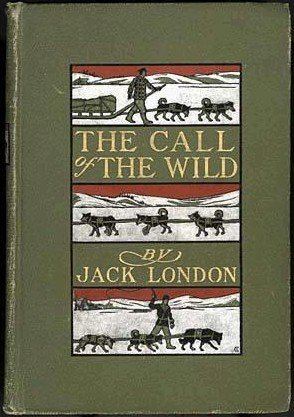
London began the story in late 1902 meaning it as a short companion to his earlier dog story Batard, and it grew to novella length within weeks. He sold the serial rights to The Saturday Evening Post, which ran it in five installments in June and July 1903, and sold the book rights outright to Macmillan, which published it in July 1903 with illustrations by Philip R. Goodwin and Charles Livingston Bull.
Reception
The book was an immediate bestseller and made London one of the most famous writers in America. It has remained continuously in print, has been translated into many languages, and has been filmed several times. London answered it with White Fang (1906), in which a wild wolf-dog travels the opposite road toward domestic life.
Comparisons
- the-jungle-book
Kipling's Mowgli stories and London's novella both imagine the law of the wild from inside an animal community; Mowgli leaves the pack for men, while Buck leaves men for the pack.
- black-beauty
Both are told from an animal's point of view and pass the animal through a series of good and bad masters; Sewell argues for humane treatment, while London shows how ill-treatment hardens Buck.
- on-the-origin-of-species
London's chapter titles and his talk of the primordial beast draw on popular Darwinism; Darwin's account of struggle and adaptation is the scientific background to Buck's survival on the trail.
- where-the-red-fern-grows
Both are stories of fierce mutual devotion between dogs and a master, and both end with grief at a death in the wilderness.
- my-side-of-the-mountain
Sam Gribley chooses the wild and learns to live in it by skill and patience, while Buck is thrown into it by force; both books respect hard-won practical knowledge.
Quotes
Frequently cited
“Buck did not read the newspapers, or he would have known that trouble was brewing, not alone for himself, but for every tide-water dog, strong of muscle and with warm, long hair, from Puget Sound to San Diego.”
Frequently cited
“They were savages, all of them, who knew no law but the law of club and fang.”
Frequently cited
“his great throat a-bellow as he sings a song of the younger world, which is the song of the pack.”
“He was beaten (he knew that); but he was not broken.”
“a man with a club was a lawgiver, a master to be obeyed, though not necessarily conciliated.”
“There is an ecstasy that marks the summit of life, and beyond which life cannot rise.”
“Love, genuine passionate love, was his for the first time.”
For Students
A reading companion for classical Christian high school students. See the student guide.
Reading Guide
Watch for
- Each new master Buck serves, from Judge Miller to the man in the red sweater, François and Perrault, the Scottish mail driver, Hal, and Thornton, and how Buck behaves under each.
- The club: where it appears in Chapter I, why Buck circles out of its reach in Chapter IV, and why Thornton never needs one.
- Buck's flashes of memory of a hairy primitive man crouching by a fire, which grow stronger in Chapters IV and VII.
- The contrast between the skilled couriers and the greenhorns in Chapter V, especially the overloaded sled and the wasted food.
Key terms and names
- Klondike
- The gold region near Dawson in Canada's Yukon, where a strike in 1896 set off the rush that creates the demand for dogs like Buck.
- Dyea
- The Alaskan beach town where Buck first meets the North and sees Curly killed.
- Wheel dog
- The dog harnessed nearest the sled, who takes the hardest strain; Dave's position, which he will not give up even when dying.
- Law of club and fang
- London's name for the rule of the North, where only strength and watchfulness keep a dog alive.
- Greenhorn
- A newcomer who does not know the country; Hal, Charles and Mercedes, whose ignorance kills the team.
- Yeehats
- The native people who raid Thornton's camp and later tell of the Ghost Dog that runs at the head of the wolf pack.
Seminar Questions
- Comprehension How does Buck come to be in the North, and what does the man in the red sweater teach him?
- Comprehension What happens to Curly on the Dyea beach, and what does Buck learn from watching it?
- Comprehension How does Buck win Thornton's wager at the Eldorado Saloon, and why does Thornton refuse to sell him afterward?
- Interpretation London writes that Buck was beaten but not broken. What is the difference, and where else in the book does it matter?
- Interpretation Why does London give such a long chapter to Hal, Charles and Mercedes? What do they show that no other characters show?
- Interpretation Is Buck's final return to the wild a victory, a loss, or both? Look at the last two paragraphs of Chapter VII.
- Big Question Is the law of club and fang the true law of nature, or only the law of a gold rush? What would a different kind of master, like Thornton, say?
Faith Connections
- Proverbs 12:10 (Scripture)
Solomon makes the way a man treats his animals a test of righteousness. Hal, who flogs a starving team onto rotten ice, and Thornton, who nurses Buck by the river, stand on either side of that test in Chapters V and VI.
- Genesis 2:19-20 (Scripture)
Adam names the animals, a picture of dominion as care and knowledge. London's masters show both the abuse of that dominion and, in Thornton, something closer to its proper form.
- 1 Timothy 6:9-10 (Scripture)
Paul warns that those who desire to be rich fall into many hurtful lusts. Buck's whole ordeal begins with Manuel's gambling debts and the rush for yellow metal, and ends in a valley where the gold rots in moose-hide sacks.
- Augustine, City of God XIX (Great Conversation)
Augustine describes a peace that is the tranquility of order, and a disordered peace held together by force. The law of club and fang is the second kind; Buck's life with Thornton gives a glimpse of the first.
Logic and Rhetoric
Central argument: A creature's nature is shaped both by inheritance and by surroundings. Buck carries old instincts from his wild ancestors, and the harsh conditions of the Klondike awaken them; each lesson of the club, the fang and the trail strips away the habits of the Santa Clara Valley. Only love for Thornton holds him to men. Therefore when Thornton dies, nothing remains to keep Buck from the life his ancestors lived, and he answers the call.
Rhetorical device: antithesis. In Chapter I, London sets beaten against broken in a single balanced sentence, the first of the book's quotes, to mark the line between outward submission and inward spirit.
Debate: Resolved: Buck is better off at the end of the book than he was at Judge Miller's place.
Memory Work
He was beaten (he knew that); but he was not broken.
his great throat a-bellow as he sings a song of the younger world, which is the song of the pack.
Writing Prompts
Essay: Trace the role of the club through Chapters I, IV and V, and argue what London is saying about authority that rests on force alone.
Comparison with The Jungle Book: Mowgli and Buck both live between the world of men and the world of the pack. Compare the Law of the Jungle with the law of club and fang, and argue which book sees the wild more truly.
Medical Lens
The medical content concerns animals and the hardships of the trail rather than human medicine, but several episodes are vivid. Dave's case in Chapter IV reads like a frontier consultation: the drivers press and prod him by the fire, find no broken bones, and conclude that something is wrong inside; they then judge it kinder to let him die in the traces, a small debate about mercy and the will to work. Chapter V is a study of starvation, as the greenhorns overfeed and then ration the dogs until they are skin and bone, feed them frozen horse-hide, and beat them when they fall. Dolly's sudden madness in Chapter III is described in terms that suggest rabies, though London does not name it. John Thornton's frozen feet, Buck's three broken ribs after the rapids, and London's own scurvy in the Klondike give the period's frontier context of cold injury and malnutrition. Any reading of the dogs' states in modern veterinary terms is interpretive.
- Chapter III
Dolly goes suddenly mad on the trail, chases Buck in a frenzy, and is killed by François with an axe.
- Chapter IV
Dave's inward injury: the drivers examine him at the fire, cannot locate the trouble, and let him return to harness before he is shot.
- Chapter V
Hal and Charles halve the dogs' rations, then feed them frozen horse-hide; the dogs die one by one of exhaustion and hunger.
- Chapter VI
Thornton, still limping from frozen feet, nurses Buck back to health; later Buck is found to have three broken ribs after the Forty-Mile rapids.
Listen to the book
Public-domain audiobook from LibriVox, read by Phil Chenevert. Recording: Call of the Wild (version 4) on LibriVox (Internet Archive).
LibriVox recordings are volunteer readings released into the public domain. The reading may follow a different edition from the text in this library.
Creative Prompts
- Fiction
Retell Thornton's rescue of Buck in Chapter V from the point of view of Mercedes, in the minutes before the ice gives way.
- Classroom
Map Buck's route from Dyea over the pass to Lake Bennett and down the Yukon to Dawson, marking where each major event takes place.
- Essay
Rank Buck's masters from best to worst and defend the order using evidence from at least four chapters.
- Dialogue
Write the conversation among the drivers at the fire as they decide whether to let Dave back into the traces.
Further Reading
- White Fang, Jack London
London's companion novel of a wolf-dog's road from the wild to domestic life.
- To Build a Fire and Other Stories, Jack London
- Wolf: The Lives of Jack London, James L. Haley
- Klondike: The Last Great Gold Rush, 1896-1899, Pierre Berton
Verification notes
All seven quotes were checked with Grep against content/texts/the-call-of-the-wild.txt (Project Gutenberg #215) and appear verbatim (whitespace collapsed). Plot details, names and chapter titles were checked against the same text. Composition and serial details are well established in London scholarship.
- Five Saturday Evening Post installments in June-July 1903 and the exact Macmillan publication month.
- That London first intended the story as a companion piece to Batard.
- Illustrators of the 1903 Macmillan edition (Philip R. Goodwin and Charles Livingston Bull).