Work record
The Eagle of the Ninth
1954 · Postwar Contemporary · Novel · English
Abstract
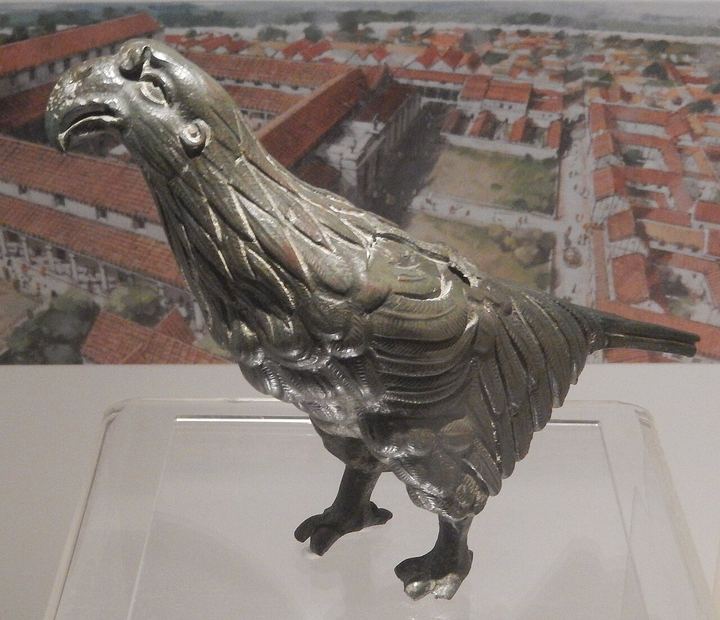
Background. Sutcliff built the story on two puzzles: the legion that seemed to vanish from British records under Trajan or Hadrian, and a wingless bronze bird unearthed in the forum at Silchester in Victorian excavations.
Plot. A centurion crippled in a Druid-inspired rising recovers at his uncle's house, wins the life of a captive gladiator at the arena, and later sets him free. Told that the lost standard may be serving as a totem for northern war bands, the two go beyond the frontier posing as an eye-doctor and his servant. A Roman survivor of the massacre guides them to a Highland tribe, from whose sanctuary they carry off the eagle and escape a long manhunt.
Structure. Three movements: soldiering at a remote fort, convalescence in a southern market town, and a spy's journey through the north, each widening the hero's view of Britain.
Themes. Filial honor, friendship freely chosen across the line of conquest, recovery from disabling injury, and a Roman's discovery that the province has become home.
Significance. Sutcliff's first major success, it opened her sequence of novels tracing one family's ring through Roman and early medieval Britain and remains a standard school novel on the period. Radio and television serials followed in 1957 and 1977, and a loose feature film in 2011.
Main characters
- Marcus Flavius Aquila: Wounded young centurion seeking his father's lost standard
- Esca: Brigantian captive, freed, who becomes Marcus's companion
- Uncle Aquila: Retired officer and historian of sieges at Calleva
- Cottia: Iceni girl next door, later Marcus's intended wife
- Guern the Hunter: Survivor of the Ninth who stayed among the tribes
- Claudius Hieronimianus: Legate who reports the eagle rumour
- Cradoc: British hunting friend turned enemy in the rising

Summary
Around AD 117 the Ninth Legion, the Hispana, marched north from Eboracum into Caledonia to put down a rising of the tribes and was never seen again; its bronze eagle standard was lost with it. Some years later Marcus Flavius Aquila, whose father commanded the legion's First Cohort and vanished with it, arrives as a young centurion to command a cohort of auxiliaries at the frontier fort of Isca Dumnoniorum in the far southwest of Britain. He makes a friend of Cradoc, a local British chieftain with whom he hunts, but a rising stirred up by the Druids breaks over the fort. Marcus holds it, and in a sortie to save a relief column against a charge of war chariots he is badly wounded in the leg. The wound ends his military career. He convalesces at Calleva with his Uncle Aquila, a retired soldier writing a book on siege warfare, attended by the old servant Stephanos. At the games in the town's amphitheatre Marcus moves the crowd to spare a defeated young gladiator, Esca, son of a chieftain of the Brigantes taken in war, and Esca becomes his body-slave. A second painful operation on the leg succeeds, Marcus tames a wolf cub he names Cub, and he befriends Cottia, a spirited girl of the Iceni being raised by Romanized guardians next door. He frees Esca, who chooses to stay with him as a friend. When the Legate Claudius Hieronimianus, visiting with the young tribune Placidus, mentions rumours that the Ninth's eagle has been seen in a tribal temple in the north and could become a rallying sign for a new war, Marcus resolves to recover it and restore his father's name. With Esca he travels beyond Hadrian's Wall disguised as a wandering Greek oculist, Demetrius of Alexandria, selling eye salves. In the wild country they meet Guern the Hunter, once a soldier of the Ninth, who has married among the tribes and tells how the legion, weakened by desertion and ill-feeling, was surrounded and destroyed. The trail leads to the Epidaii, the Seal People of the western Highlands, whose chieftain's household Marcus has treated as a healer. At the Feast of New Spears they see the eagle, stripped of its wings, in their holy place; at night Marcus and Esca steal it and flee. Pursued across the hills, they are helped at the last by Guern, and they bring the eagle home. The authorities decide not to re-form the Ninth, so the eagle is quietly buried at Calleva; Marcus receives a grant of land in Britain, Esca is made a Roman citizen, and Marcus looks forward to a life in Britain with Cottia and Esca. Oxford University Press published the novel in 1954 with illustrations by C. Walter Hodges. Sutcliff's foreword ties the story to the wingless bronze eagle dug up at Silchester, the site of Calleva, in the nineteenth century.
Virtues in this work
- Piety: Marcus risks his life beyond the Wall to recover the eagle his father died beside and to learn the truth about his father's legion.
- Friendship: Freed by Marcus, Esca chooses to stay and goes north with him into the country of tribes who would kill them both.
- Magnanimity: Marcus pleads for the life of the defeated gladiator Esca at the Calleva games and later gives him his freedom.
- Fortitude: Lame from his chariot wound, Marcus endures a second painful operation and later the long flight south with the stolen eagle.
Plot or Argument
- Chapters I–IV: The frontier fort
Marcus takes command at Isca Dumnoniorum, hunts with Cradoc, and holds the fort against a Druid-led rising; his sortie against the chariots ends with a crippling leg wound.
- Chapters V–IX: Calleva
Convalescing with Uncle Aquila, Marcus spares Esca at the games and takes him as his slave, tames the wolf cub, and meets Cottia; a second operation on his leg succeeds, and he frees Esca.
- Chapters X–XI: The mission
The Legate Claudius Hieronimianus and Placidus bring word of the eagle in the north; Marcus decides to go after it with Esca, disguised as a Greek oculist.
- Chapters XII–XV: Beyond the Wall
Selling eye salves through Valentia and Caledonia, they meet Guern the Hunter, once of the Ninth, and learn how the legion died and who holds the eagle.
- Chapters XVI–XIX: Among the Seal People
With the Epidaii, Marcus treats a chieftain's household, witnesses the Feast of New Spears, and steals the eagle from the holy place by night.
- Chapters XX–XXIV: Flight and homecoming
Hunted south through the hills, Marcus and Esca are saved with Guern's help, the eagle is laid to rest at Calleva, and Marcus is granted land and Esca citizenship.
Characters
- Marcus Flavius Aquila, protagonist
Young Roman centurion, invalided by a wound, who seeks his father's lost legion and its eagle.
- Esca Mac Cunoval, friend and companion
Brigantian chieftain's son, captured, enslaved and freed by Marcus, who shares the journey north as a free man.
- Uncle Aquila, Marcus's uncle
Retired soldier at Calleva, gruff and scholarly, writing a history of siege warfare.
- Cottia, neighbor and friend
Fiery Iceni girl raised by Romanized guardians, who befriends Marcus and Esca.
- Cradoc, British chieftain
Marcus's hunting friend at Isca who fights against him in the rising.
- Claudius Hieronimianus, Legate
Commander of the Sixth Legion who brings news of the eagle and supports the mission.
- Placidus, tribune
Elegant, patronizing young officer who accompanies the Legate.
- Guern the Hunter, former legionary
Survivor of the Ninth living among the northern tribes, who tells the legion's fate and helps Marcus.
- Stephanos, servant
Uncle Aquila's elderly Greek servant.
- Dergdian and Liathan, men of the Epidaii
Members of the Seal People's chieftain's household who host the false oculist and then pursue him.
- Cub, wolf
Wolf cub raised by Marcus, who chooses to come back to him when set free.
Lessons
A son's duty to his father's name
Marcus cannot bring his father back, but he can recover the standard his father died beside and learn the truth about the legion. His quest is an act of filial piety, undertaken at real risk, with no promise of reward.
- Why does the lost eagle matter so much to Marcus, when the legion itself is gone?
- Is Marcus seeking his father's honor, his own, or Rome's? Can these be separated?
- What does Marcus learn about the Ninth from Guern that he did not want to hear, and how does he respond?
From master and slave to friends
Esca begins as a captive bought for Marcus, and the turning point comes when Marcus gives him his freedom and Esca stays by choice. The journey north reverses their places, for in Caledonia it is Esca who knows the tribes and the land.
- Why does Esca stay with Marcus after he is freed?
- How does the journey north change who depends on whom?
- What does each of them have to give up to keep the friendship?
Seeing the other side
Sutcliff writes from inside Roman Britain but lets the British tribes keep their own dignity, gods and grievances. Cradoc, Esca, Cottia and Guern's adopted people show that the conquered are not simply enemies, and Marcus ends by choosing Britain as his home.
- How do Cradoc and Esca each feel about Rome, and why?
- Why does Guern choose to stay with the tribes rather than return to Roman life?
- Why does Marcus decide to make his home in Britain rather than in Italy?
Courage after injury
Marcus's wound takes away the career he was born for, and much of the middle of the book is about his discouragement and slow recovery. His later courage is that of a man who has lost something and found a new purpose, not a young soldier's untested daring.
- How does Marcus feel when he learns he can never return to the legion?
- Who helps him through his recovery, and how?
- How does the journey north use the very limits his wound forced on him?
Context
The Legio IX Hispana is last securely recorded in Britain in the early second century, and its disappearance from the records after about AD 108–120 long fed the belief, current when Sutcliff wrote, that it was destroyed in northern Britain. Later inscriptions and tile stamps from the Rhine have led many historians to think the legion was transferred and lost elsewhere, but the British tradition gave Sutcliff her premise. The book's world is Hadrianic Britain: the Wall newly built, the Second Legion's country in the southwest, the Romanized town of Calleva Atrebatum (Silchester), and the unconquered tribes of the north that Tacitus had described in the Agricola.
Composition
Sutcliff took the idea from the bronze eagle, missing its wings, found at Silchester in 1866 during the excavations of the Reverend J. G. Joyce and now in Reading Museum; her foreword imagines how a legionary eagle might have come to be buried there. Archaeologists now think the bronze is probably not from a legionary standard. Oxford University Press published the novel in 1954 with illustrations by C. Walter Hodges.
Reception
It established Sutcliff's reputation and has remained in print for seventy years, often taught in British and American schools alongside study of Roman Britain. The BBC adapted it for radio in 1957 and as a television serial in 1977, and it was loosely filmed as The Eagle in 2011. Its family signet ring, carved with a dolphin, reappears across later novels as the Aquila line passes from Roman to British hands.
Comparisons
- the-agricola-and-the-germania
Tacitus's account of his father-in-law's campaigns in Caledonia, with the speech of Calgacus against Rome, is the main ancient picture of the northern Britain beyond the Wall that Marcus and Esca enter.
- the-aeneid
Marcus's quest for his father's honor and his final settling in a new land echo Roman pietas as Virgil drew it in Aeneas carrying his father from Troy and founding a home far from it.
- kidnapped
Both are flights across the Scottish Highlands by a pair of unlike companions, one a stranger to the country and one at home in it, whose friendship is tested by hunger, pursuit and pride.
- the-bronze-bow
Speare's Galilee and Sutcliff's Britain are both provinces under Roman occupation; Daniel's hatred of Rome and Esca's growing friendship with a Roman make an instructive contrast.
- black-ships-before-troy
Sutcliff's late retelling of the Iliad shares this novel's interest in honor, comradeship and the cost of war, told in the same vivid, physical prose.
- the-conquest-of-gaul
Caesar's invasion of Britain and his description of British chariot warfare stand behind the chariot charge at Isca that cripples Marcus.
Quotes
“The honours were all to win—perhaps during his command.”
For Students
A reading companion for classical Christian high school students. See the student guide.
Reading Guide
Watch for
- Marcus's friendship with Cradoc at Isca, and how the rising turns a friend into an enemy.
- The games at Calleva, where Marcus's thumb-signal for mercy saves Esca, and what that choice leads to.
- The moment Marcus frees Esca, and the parallel with the wolf cub he also sets free.
- Guern's account of the Ninth's last march, and how it changes Marcus's picture of his father's legion.
- The Feast of New Spears among the Epidaii and the state in which Marcus finds the eagle.
Key terms and names
- Legion and eagle
- A Roman legion was a unit of about five thousand soldiers; its eagle standard was its sacred emblem, and losing it was a deep disgrace. The Ninth's eagle vanished with the legion.
- Isca Dumnoniorum
- The Roman frontier station in the southwest of Britain, modern Exeter, where Marcus has his first command.
- Calleva
- Calleva Atrebatum, a Romanized British town (modern Silchester) where Uncle Aquila lives and where the eagle is finally buried.
- Hadrian's Wall
- The stone frontier built across northern Britain in the 120s, beyond which Marcus and Esca travel in disguise.
- Oculist
- A doctor of the eyes. Marcus poses as a wandering Greek oculist named Demetrius of Alexandria, selling salves for sore eyes.
- Epidaii
- The Seal People of the western Highlands, who hold the eagle in their holy place.
- Manumission
- The formal freeing of a slave in Roman law. Marcus gives Esca his freedom before they go north.
- Feast of New Spears
- The Epidaii festival at which young men are made warriors, where Marcus first sees the eagle.
Seminar Questions
- Comprehension How is Marcus wounded at Isca Dumnoniorum, and why does the wound end his career in the army?
- Comprehension How does Esca come to be Marcus's slave, and when and why does Marcus free him?
- Comprehension What does Guern the Hunter tell Marcus about the end of the Ninth Legion?
- Interpretation Marcus frees both Cub and Esca, and both choose to come back. What does Sutcliff suggest about the difference between loyalty that is owned and loyalty that is given?
- Interpretation Why does Guern refuse to return to Rome, and is his choice a betrayal or a kind of faithfulness?
- Interpretation The eagle is buried rather than restored to a new legion. Is that a disappointing ending or a fitting one?
- Big Question Can honor be restored to someone who has died? What did Marcus actually achieve for his father?
- Big Question Can genuine friendship grow between a conqueror and one of the conquered, and what must each give up for it?
Faith Connections
- Exodus 20:12 (Scripture)
Honor thy father and thy mother. Marcus's whole quest is undertaken for a father he barely remembers, to restore the honor of his name and the legion he served.
- John 15:15 (Scripture)
Jesus tells his disciples he no longer calls them servants but friends. Marcus's freeing of Esca turns a master and slave into companions who choose each other.
- Ruth 1:16 (Scripture)
Ruth the Moabite binds herself to Naomi's people. Esca, a Briton, goes north into danger for a Roman's cause, and Marcus in turn makes Britain his home.
- Augustine, City of God V (Church Fathers)
Augustine discusses the Romans' love of glory and praise, which he says drove their virtues and their empire. Marcus's desire to restore the legion's honor is a fine example of that Roman love of glory, and of its limits when the Senate decides the Ninth will not be re-formed.
Logic and Rhetoric
Central argument: The Ninth's lost eagle is a disgrace to Rome and to Marcus's father, and a danger if the tribes use it as a war sign. Only someone who can pass among the tribes, which Marcus can do with Esca's help and a healer's disguise, can recover it. Marcus succeeds, but learns that the legion's end was less glorious than he hoped and that Rome will not restore it. Therefore the novel argues that the worth of the deed lies in the faithfulness of the one who does it and the friendship it forges, not in public glory.
Rhetorical device: parallelism. The freeing of the wolf cub and the freeing of Esca in the Calleva chapters mirror each other: in each case Marcus lets go, and the one he frees chooses to return.
Debate: Resolved: Marcus was right to accept the decision not to re-form the Ninth Legion and to bury the eagle in secret.
Writing Prompts
Essay: Trace how the relationship between Marcus and Esca changes from the games at Calleva to the return from the north, and explain which single event you think matters most in that change.
Comparison with The Agricola and the Germania: Compare Tacitus's picture of the Caledonian tribes and of Roman rule in Britain with Sutcliff's picture of the Epidaii and of Esca's people. Where does the modern novelist agree with the ancient historian, and where does she go beyond him?
Medical Lens
Three strands may interest a historian of medicine. First, Marcus's chariot wound: the first treatment at Isca leaves the leg crippled and painful, and at Calleva a surgeon reopens it to remove what was left in the wound, a plausible picture of Roman military surgery, which could clean, probe and close wounds but not prevent long disability. Second, the disguise: Marcus travels as a Greek oculist with a box of eye salves. Itinerant eye doctors were real in the Roman provinces, and small inscribed stone stamps naming oculists and their collyria (eye ointments) have been found in Britain and Gaul. Marcus's success with common eye complaints gives him entrance to the Epidaii. Third, the book's long middle section on convalescence, discouragement and adapting to lameness is often read in light of Sutcliff's own lifelong disability from Still's disease; that connection is a reading, not something the novel states.
- Chapters IV–V
Marcus is wounded under the chariot charge at Isca and learns that the leg will keep him from serving again.
- Calleva chapters (around Chapters VII–VIII)
A surgeon at Calleva reopens and cleans the badly healed wound in a painful operation that finally lets it mend.
- Chapters XI–XVII
Marcus works his way north as the oculist Demetrius of Alexandria, treating eye ailments with salves among the tribes.
Creative Prompts
- Classroom
Draw a map of Roman Britain marking Isca Dumnoniorum, Calleva, Eboracum, Hadrian's Wall, Valentia and the country of the Epidaii, and trace Marcus and Esca's journey.
- Fiction
Retell the theft of the eagle from the Seal People's holy place from Esca's point of view, including what he thinks of the gods he is robbing.
- Dialogue
Write the conversation between Marcus and Guern on the night Guern tells what happened to the Ninth, showing why Guern will not come home.
- Essay
Was Marcus right to keep the truth about the Ninth's last days quiet, and to bury the eagle rather than display it? Argue from the events at the end of the book.
Further Reading
- The Silver Branch, Rosemary Sutcliff
Sequel set in the later third century, following Marcus's descendants.
- Frontier Wolf, Rosemary Sutcliff
- The Lantern Bearers, Rosemary Sutcliff
Carnegie Medal novel set at the end of Roman rule in Britain.
- Blue Remembered Hills: A Recollection, Rosemary Sutcliff
Sutcliff's memoir of her childhood and early life.
- Agricola, Tacitus
The ancient account of Roman campaigns in Caledonia.
Verification notes
Plot, main characters, the oculist disguise as Demetrius of Alexandria, Guern the Hunter, the Epidaii and the ending (the Ninth not re-formed, the eagle buried at Calleva, land for Marcus, citizenship for Esca) were checked against the Wikipedia article (https://en.wikipedia.org/wiki/The_Eagle_of_the_Ninth), the EBSCO Research Starter on the novel, the Sutton Elms BBC radio cast list (https://suttonelms.org.uk/articles29.html), and a published book-to-DVD essay (http://andrewdarlington.blogspot.com/2013/06/book-into-dvd-eagle-of-ninth-by.html). The Silchester eagle and its Reading Museum location are from the Wikipedia article. Chapter groupings in plotOrArgument are approximate. The sentence was checked against the Library of Congress sample text for the novel at https://catdir.loc.gov/catdir/enhancements/fy1106/93007952-s.html and a retailer's first-chapter excerpt.
- Text is under copyright; check quotations against an authorized edition before publication.
- Exact chapter numbers for the groupings in plotOrArgument and the medicalLens passages.
- The surgeon's name (possibly Rufrius Galarius) and the details of the second operation at Calleva.
- Whether the eagle is buried in Uncle Aquila's house (one summary says in the hypocaust) or elsewhere in Calleva.
- The exact year in which the story is set and the Second Legion connection of Marcus's command at Isca.
- How Guern helps in the final pursuit, and the circumstances in which Marcus recognizes his father's signet ring.
- Whether The Eagle of the Ninth was itself commended for the Carnegie Medal.
- The 1866 date and J. G. Joyce attribution for the Silchester eagle's discovery, and its exact findspot.
- That Claudius Hieronimianus is Legate of the Sixth Legion in the novel, and the number of chapters.