Work record
Richard III
c. 1592-93 (published 1597) · Renaissance Early Modern · Drama · English (Early Modern)
Abstract
Background. Concluding the sequence of the three Henry VI plays, Shakespeare built his tyrant from Hall's and Holinshed's chronicles, which inherited Thomas More's hostile portrait of the last Yorkist king.
Plot. Gloucester confides his scheme to the audience, then courts Anne over Henry VI's bier, has Clarence stabbed in the Tower, and after Edward IV's death removes Rivers, Grey and Hastings. With Buckingham's stage management he takes the throne, orders Tyrrel to smother his nephews, and loses Buckingham. Ghosts of his victims curse him on the eve of Bosworth, where Richmond slays him and pledges to join York and Lancaster in marriage.
Structure. The first three acts follow a rising curve of successful plots narrated in asides; after the coronation Richard's control slips, and choral laments by three bereaved queens punctuate the decline toward a symmetrical night of dreams in two opposing camps.
Themes. Seductive villainy, Scripture turned into a disguise, crime breeding crime, conscience, prophecy fulfilled, and providential deliverance under the Tudors. The mourning of mothers and widows gives the victims of ambition a collective voice that the plotter cannot silence.
Significance. Burbage, Cibber's adapted version, Olivier and McKellen made the role a star vehicle for four centuries, and the 2012 discovery of the king's skeleton in Leicester revived debate over history and legend.
Main characters
- Richard, Duke of Gloucester: Scheming younger brother of Edward IV who becomes King Richard III
- Clarence: Richard's brother, murdered in the Tower after a dream of drowning
- Lady Anne: Lancastrian widow whom Richard marries and later discards
- Queen Elizabeth: Edward IV's wife, mother of the princes in the Tower
- Queen Margaret: Henry VI's widow, whose curses come true
- Duchess of York: Richard's mother, who curses him before Bosworth
- Buckingham: Richard's chief accomplice, later rebel and victim
- Hastings: Lord Chamberlain beheaded for loyalty to Edward's heirs
- Richmond: Lancastrian claimant who defeats Richard and becomes Henry VII
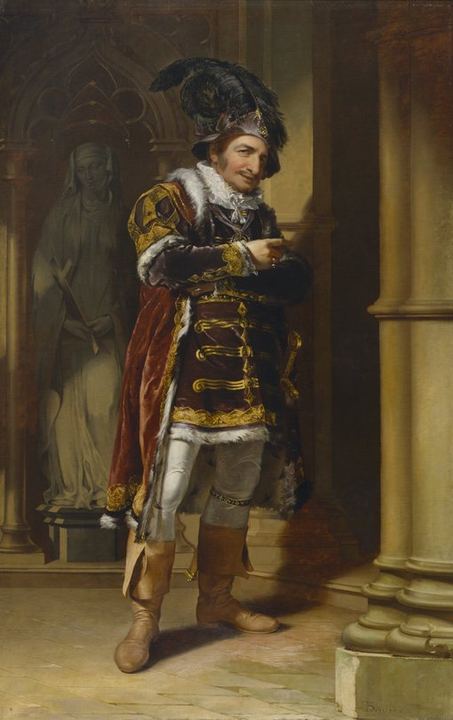

Summary
Richard III follows Richard, Duke of Gloucester, youngest brother of the Yorkist King Edward IV, from his first soliloquy to his death at Bosworth Field in 1485. The Wars of the Roses are over and peace has come, but Richard, born misshapen and unfit for courtship, tells the audience he has determined to prove a villain and win the crown. He has already turned the sick King Edward against their brother George, Duke of Clarence, with a prophecy that someone whose name begins with G will murder the king's heirs. Clarence is taken to the Tower. Richard then woos Lady Anne over the coffin of King Henry VI, whom he killed, along with her husband, and wins her in a single scene. At court he quarrels with Queen Elizabeth and her kinsmen Rivers, Grey and Dorset, while old Queen Margaret, widow of Henry VI, curses them all. In the Tower, Clarence wakes from a dream of drowning and of the souls he wronged in the wars; Richard's hired murderers stab him and drown him in a butt of malmsey wine. King Edward, having just reconciled the factions, hears of Clarence's death and soon dies himself. With the Duke of Buckingham as his partner, Richard arrests the queen's kinsmen and has them beheaded at Pomfret, lodges the boy king Edward V and his brother in the Tower, and has Lord Hastings executed on the spot for doubting his claim, charging that witchcraft has withered his arm. Buckingham stages a show of popular demand, and Richard, appearing piously between two bishops, accepts the crown with feigned reluctance. Once king, he asks Buckingham to have the princes killed; when Buckingham hesitates, Richard hires James Tyrrel, who reports the boys smothered in their sleep. Richard spreads word that Anne is sick, and she dies; he plans to marry his niece Elizabeth, and in a long scene he presses the widowed queen to woo her daughter for him. The grieving women, Margaret, Elizabeth and Richard's own mother, the Duchess of York, gather to lament and curse. Buckingham rebels and is executed on All Souls' Day. Henry, Earl of Richmond, lands in Wales and marches against Richard. On the night before battle the ghosts of Richard's victims appear in turn, bidding Richard despair and die and blessing Richmond. Richard wakes in terror of his own conscience, then rallies his army. Unhorsed on the field, he cries for a horse; Richmond kills him, is crowned Henry VII by Lord Stanley, and promises to unite the white rose and the red by marrying Elizabeth of York. The play was printed in quarto in 1597 and appeared, in a longer text, in the First Folio of 1623.
Virtues in this work
- Hope: Richmond marches on Bosworth trusting that true hope flies with swallow's wings and prays before the battle.
- Justice: The fulfillment of Margaret's curses and Richard's defeat show the moral order the play upholds against tyranny.
- Piety: Richmond commends himself to God as his captain before sleeping, in contrast to Richard's counterfeit devotion between two bishops.
- Fortitude: Queen Elizabeth answers Richard's long suit for her daughter in Act 4, Scene 4 by naming each of his murders to his face, and the daughter is later promised to Richmond.
Plot or Argument
- Act 1: The plotter reveals himself
Richard opens with the winter of our discontent, sends Clarence to the Tower, wins Anne over Henry VI's corpse, provokes the queen's family while Margaret curses, and has Clarence murdered after his dream of drowning.
- Act 2: The death of a king
Edward IV reconciles the court, learns of Clarence's death and dies; Richard and Buckingham seize the queen's kinsmen as the young prince is brought to London; Elizabeth flees to sanctuary with her younger son.
- Act 3: The road to the crown
The princes are lodged in the Tower; Rivers, Grey and Vaughan die at Pomfret; Hastings is condemned at the council table over the withered arm; Buckingham stages the citizens' petition and Richard accepts the crown between two bishops.
- Act 4: Murder of the princes
Richard is crowned, breaks with Buckingham, has Tyrrel kill the princes, disposes of Anne, faces the curses of his mother and the queens, and presses Elizabeth for her daughter's hand as Richmond's invasion begins.
- Act 5: Bosworth
Buckingham is executed; on the eve of battle the ghosts visit both camps; Richard wakes to his conscience; he is killed fighting on foot, and Richmond becomes Henry VII and unites York and Lancaster.
Characters
- Richard, Duke of Gloucester, later King Richard III, protagonist and villain
A brilliant, witty, deformed schemer who confides in the audience as he murders his way to the throne.
- George, Duke of Clarence, Richard's brother
A perjured but repentant Yorkist lord, murdered in the Tower after a prophetic dream.
- King Edward IV, Richard's eldest brother
A sick king who tries to make peace among his courtiers before he dies.
- Queen Elizabeth, Edward's wife
Mother of the princes in the Tower, who loses her brother, her sons and her husband to Richard's rise.
- Queen Margaret, widow of Henry VI
A Lancastrian exile whose curses in Act 1 are fulfilled one by one.
- Duchess of York, Richard's mother
Mourns her sons and curses the son who survived.
- Lady Anne, Richard's wife
Widow of Henry VI's son, won by Richard over her father-in-law's coffin and later disposed of.
- Duke of Buckingham, Richard's ally
Richard's partner in the seizure of power, who balks at killing the princes and is executed.
- Lord Hastings, Lord Chamberlain
A loyal follower of Edward's line, beheaded after refusing to support Richard's claim.
- Lord Stanley, Earl of Derby, Richmond's stepfather
A cautious nobleman who secretly favors Richmond and crowns him at the end.
- Henry, Earl of Richmond, Richard's opponent
The Lancastrian heir who prays before Bosworth, kills Richard and becomes Henry VII.
- Sir James Tyrrel, hired murderer
Arranges the killing of the princes and reports it to Richard.
Lessons
The seduction of the audience
Richard speaks directly to us from the first line, sharing his plots and jokes, and his wit draws spectators into enjoying what follows. The play teaches how charm and confidence can win assent to evil, and how the audience must learn to see through the man it enjoys.
- Why does Richard tell us his plans in the opening soliloquy?
- At what point in the play do you stop enjoying his company, if ever?
- How does Richard's wooing of Anne in Act 1, Scene 2 show the power of persuasion?
Religion as a mask
Richard boasts that he clothes his villainy in scraps of Holy Writ and appears to the citizens with a prayer book between two bishops. The play shows the special wickedness of using piety as a tool of ambition.
- What does Buckingham's staging of Act 3, Scene 7 require the citizens to believe?
- Why is false piety especially damaging to a community?
Sin that pulls on sin
Each crime makes the next one necessary: Clarence's death leads to the princes', the princes' to Anne's, Anne's to the plan to marry Elizabeth. Richard admits he is so far in blood that sin will pluck on sin. The play traces the logic of a soul trapped by its own choices.
- Which of Richard's crimes is the turning point after which he cannot stop?
- How does Buckingham's fate show the same pattern?
Conscience and judgment
Clarence's murderers argue with their consciences, Clarence dreams of judgment, and Richard himself wakes before Bosworth to a conscience with a thousand tongues. Margaret's curses come true, and the ghosts bless Richmond. The play presents history as answerable to a moral order.
- What does the Second Murderer's conversation about conscience in Act 1, Scene 4 reveal?
- Does Richard repent after his dream in Act 5, Scene 3? Why or why not?
- Are Margaret's curses the cause of what happens, or only a prophecy of it?
Context
The play covers events from 1478, when Clarence was put to death, to 1485, compressing years into weeks. Edward IV died in April 1483; Richard, named Protector, took the throne that summer, and his nephews Edward V and Richard of York disappeared in the Tower. Henry Tudor, Earl of Richmond, defeated and killed Richard at Bosworth on 22 August 1485 and married Elizabeth of York, ending the Wars of the Roses. Shakespeare's Elizabethan audience lived under Henry's granddaughter, Queen Elizabeth I.
Composition
Shakespeare drew on the chronicles of Edward Hall (1548) and Raphael Holinshed (1587), which drew in turn on Thomas More's unfinished History of King Richard III; the portrait of Richard as a deformed tyrant comes from this Tudor tradition. The play was written about 1592-93, printed in quarto in 1597 and reprinted several times, and given in a longer, revised form in the First Folio of 1623. It is among Shakespeare's longest plays.
Reception
Richard was a famous role for Richard Burbage in Shakespeare's lifetime. From 1700 Colley Cibber's adaptation, which added lines such as Off with his head, so much for Buckingham, held the stage for well over a century. Laurence Olivier's film of 1955 and Ian McKellen's 1930s-style film of 1995 made the role widely known. The discovery of Richard's remains in Leicester in 2012 renewed debate about the historical king, who has long had defenders in the Richard III Society.
Comparisons
- macbeth
Both plays follow a usurper who murders for a crown and is haunted before his final battle; Macbeth is tormented by guilt from the first murder, while Richard enjoys his crimes until the ghosts come.
- the-prince
Richard boasts in 3 Henry VI of setting the murderous Machiavel to school, and here he practices the arts Machiavelli analyzed: feigned piety, swift cruelty, and the show of popular demand.
- utopia
Thomas More, author of Utopia, also wrote the unfinished History of King Richard III that shaped the Tudor chronicles behind the play, so his portrait of a dissembling tyrant lies under Shakespeare's.
- henry-v
Henry V is the second tetralogy's ideal king, who gives his victory to God; Richard is the first tetralogy's tyrant, who mocks piety and dies alone, and both stories end with a royal marriage that seals peace.
- henry-iv-part-1
Prince Hal, like Richard, takes the audience into his confidence in an early soliloquy, but Hal hides virtue under a wild exterior while Richard hides villainy under a pious one.
Quotes
Frequently cited
“Now is the winter of our discontent Made glorious summer by this son of York”
Frequently cited
“I am determined to prove a villain”
Frequently cited
“Was ever woman in this humour wooed? Was ever woman in this humour won?”
Frequently cited
“My conscience hath a thousand several tongues, And every tongue brings in a several tale, And every tale condemns me for a villain.”
Frequently cited
“A horse! A horse! My kingdom for a horse!”
“Cheated of feature by dissembling nature, Deformed, unfinished, sent before my time Into this breathing world scarce half made up”
“And thus I clothe my naked villany With odd old ends stol’n forth of Holy Writ, And seem a saint when most I play the devil.”
“O Lord, methought what pain it was to drown”
“So far in blood that sin will pluck on sin.”
“True hope is swift, and flies with swallow’s wings”
For Students
A reading companion for classical Christian high school students. See the student guide.
Reading Guide
Watch for
- Richard's soliloquies and asides, and how they change after he becomes king in Act 4.
- Queen Margaret's curses in Act 1, Scene 3, and the way each victim remembers them before dying.
- The two wooing scenes: Anne in Act 1, Scene 2 and Queen Elizabeth in Act 4, Scene 4.
- Buckingham's staging of Richard between two bishops in Act 3, Scene 7.
- The parallel speeches and dreams of Richard and Richmond on the night before Bosworth.
Key terms and names
- Wars of the Roses
- The civil wars between the houses of York (white rose) and Lancaster (red rose); the play ends them with Richmond's marriage to Elizabeth of York.
- Soliloquy
- A speech alone on stage revealing thought; Richard's opening soliloquy makes the audience his confidants.
- Lord Protector
- The title Richard holds as guardian of the boy king Edward V before seizing the crown.
- The Tower
- The fortress in London where Clarence is murdered and the young princes are held and killed.
- Bosworth Field
- The battle of 22 August 1485 where Richard is killed and Richmond becomes Henry VII.
- Vice
- The witty tempter of the old morality plays; Richard compares himself to the formal Vice, Iniquity, who moralizes two meanings in one word.
- Sanctuary
- The right of refuge in a church; Queen Elizabeth flees there with her younger son in Act 2, Scene 4.
Seminar Questions
- Comprehension How does Richard arrange the imprisonment and death of his brother Clarence?
- Comprehension Why is Hastings executed, and what pretext does Richard use at the council table?
- Comprehension What does each ghost say to Richard and to Richmond on the night before Bosworth?
- Interpretation Why does Anne accept Richard's ring in Act 1, Scene 2? Is it his skill, her weakness, or something else?
- Interpretation How does Richard's speech after waking in Act 5, Scene 3 differ from every other speech he has made?
- Interpretation Why does Buckingham, who helped Richard to every crime so far, hesitate at the murder of the princes?
- Big Question Is a man's character his fate, or does Richard choose villainy when he says he is determined to prove a villain?
- Big Question Why do audiences enjoy a villain, and is there any danger in that enjoyment?
Faith Connections
- Matthew 4:1-11 (Scripture)
In the temptation in the wilderness the devil quotes Psalm 91 to Christ. Richard boasts of clothing his villainy in odd old ends stolen from Holy Writ, the same misuse of Scripture.
- Psalm 7:14-16 (Scripture)
The wicked man digs a pit and falls into it himself, and his violence comes down on his own head. Buckingham's and Richard's ends show exactly this pattern, and both men recall their own words as they fall.
- Romans 12:19 (Scripture)
Vengeance belongs to God. Margaret's curses seem fulfilled, but the play gives the final judgment to the ghosts' blessing on Richmond and his prayer before battle rather than to her hatred.
- Augustine, City of God IV.4 (Church Fathers)
Augustine's tale of the pirate who tells Alexander that only the size of their fleets divides them fits Richard, a murderer who seizes a whole kingdom. Richmond's closing speech asks God to restore the justice and peace that make a realm more than plunder.
Logic and Rhetoric
Central argument: Richard believes that wit, will and ruthlessness can master any situation and that conscience is a word cowards use. He wins the crown by these means. But every crime requires another, his allies desert him, his own conscience speaks in his sleep, and Providence raises up Richmond. Therefore the play argues that tyranny founded on murder destroys itself and that a moral order governs history.
Rhetorical device: stichomythia. In the wooing of Anne in Act 1, Scene 2, Richard and Anne trade single lines, each catching and turning the other's word, until his wit wears down her curses.
Debate: Resolved: that Lady Anne is morally responsible for accepting Richard.
Memory Work
Now is the winter of our discontent Made glorious summer by this son of York
My conscience hath a thousand several tongues, And every tongue brings in a several tale, And every tale condemns me for a villain.
Writing Prompts
Essay: Trace Richard's relationship with the audience from his opening soliloquy to his speech after the dream in Act 5, Scene 3, and argue what Shakespeare wants us to feel about him at the end.
Comparison with Macbeth: Richard and Macbeth both murder for a crown. Compare how each responds to his own conscience and argue which play gives the more searching account of guilt.
Medical Lens
Richard's body is central to the play. He calls himself deformed, unfinished and sent before his time, and his enemies call him a bunch-backed toad and an elvish-marked, abortive hog, reading bodily shape as a sign of moral nature in the Tudor manner. The Duchess of York speaks of his birth as a grievous burden. The history of medicine has added a coda: the skeleton found in Leicester in 2012 and identified as Richard's showed a marked spinal curvature, described in The Lancet in 2014 as adolescent-onset idiopathic scoliosis that would have raised one shoulder above the other but would not have produced a hunchback or a limp, and there was no sign of a withered arm. In the play, Richard's charge at the council table that witchcraft has withered his arm is a pretext to kill Hastings. The play is also full of sleep and dreams: Clarence's dream of drowning, Stanley's dream of the boar, Anne's report that Richard's timorous dreams broke his sleep, and the procession of ghosts before Bosworth. King Edward is described as sickly, weak and melancholy, his physicians fearing for him. Any modern reading of Richard's psychology should remain a reading.
- Act 1, Scene 1
Richard's opening soliloquy describes his deformity and premature birth; Hastings reports that the king is sickly and his physicians fear for him.
- Act 1, Scene 4
Clarence's dream of drowning and of judgment by the souls of Warwick and Prince Edward, followed by his murder and drowning in a malmsey butt.
- Act 3, Scene 4
Richard bares his arm before the council and claims it was withered by witchcraft, condemning Hastings.
- Act 4, Scene 1; Act 4, Scene 4
Anne says Richard's timorous dreams kept waking her; the Duchess of York recalls his birth and infancy as a grievous burden.
- Act 5, Scene 3
The ghosts of Richard's victims visit his tent; he wakes in a sweat to the trembling and terror of conscience.
- Act 5, Scenes 4-5
Richard fights on foot after his horse is killed and dies in single combat with Richmond.
Listen to the book
Public-domain audiobook from LibriVox, read by Various volunteers. Recording: Richard III on LibriVox (Internet Archive).
LibriVox recordings are volunteer readings released into the public domain. The reading may follow a different edition from the text in this library.
Creative Prompts
- Classroom
Stage Act 1, Scene 2 twice, once with Anne genuinely persuaded and once with her too exhausted to resist, and discuss which the text better supports.
- Essay
Compare the curses of Queen Margaret in Act 1, Scene 3 with what actually happens to each person she curses, and argue what the play says about providence.
- Fiction
Write the story of the princes' last day in the Tower from the point of view of the young Duke of York.
- Dialogue
Write a conversation between Buckingham and Stanley on the night Buckingham decides to flee Richard's court.
Further Reading
- The History of King Richard III, Thomas More
The unfinished Tudor history behind the chronicle portrait.
- Henry VI, Part 3, William Shakespeare
Richard's first great soliloquies and the killing of Henry VI.
- The Daughter of Time, Josephine Tey
A detective novel in which a hospitalized inspector investigates the case against Richard.
- Richard III, Charles Ross
Verification notes
Plot, sources, dating and stage history are standard. Act and scene locators follow the attached Gutenberg text. The 2014 Lancet scoliosis findings were checked against press reports of the University of Leicester study (https://www.medievalists.net/2014/05/richard-iii-severe-scoliosis-hunchback-researchers-find/). The play's portrait of Richard follows Tudor sources and is not offered as the historical verdict. Quotes were checked against the attached text.
No verification flags recorded.