Work record
The Wise Woman (A Double Story)
1875 · 19th Century · Novella · English
Abstract
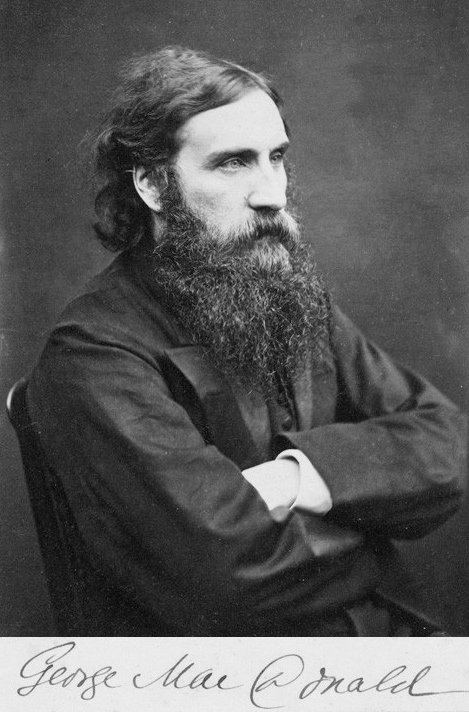
Background. Written in the years of the Curdie books, this short parable by the Scottish minister and fantasist was first printed in a family magazine before its London book edition of 1875. Its subtitle points to two parallel cases of childish self-worship.
Plot. A mysterious cloaked guardian takes a raging princess and a smug shepherd girl from their doting homes. Each is set household work, shown her true face in a mirror, and tempted through a painting into the other's life. The princess, schooled by a sheepdog and by hunger, falls and rises, endures trials of mood, and comes home able to rule herself. The shepherd girl refuses every lesson, informs on her own parents to win royal favour, and is sent home in disgrace, while her father follows the guardian away.
Themes. Self-conceit and temper as twin forms of selfishness, the gap between a passing feeling and a changed will, duty as daily habit, the failure of indulgent parents, and a fearsome love that disciplines because it has already forgiven.
Significance. Less famous than MacDonald's goblin stories, the tale is valued by Christian readers for its plain moral psychology. Its ageless, many-shaped lady anticipates figures in Lewis, who called MacDonald his master, and its openly instructive narrator makes it a natural read-aloud for discussion.
Main characters
- The wise woman: Cloaked, shape-changing guardian who tests and heals both girls
- Rosamond: Hot-tempered princess indulged in every wish
- Agnes: Shepherd's daughter, quietly certain of her own importance
- The king and queen: Rosamond's foolish, proud parents
- The shepherd and shepherdess: Agnes's flattering parents, who shelter the lost princess
- Prince: Sheepdog who keeps Rosamond in order

Summary
The Wise Woman is George MacDonald's fairy-tale parable of two spoiled little girls in an odd country where everyone wants what he has not got. Princess Rosamond, whose name means Rose of the World, has been given everything she cried for, including a silver disc to stand in for the moon, and has grown into a raging, greedy child who beats her pets and has nearly killed her nurse. Far to the north, Agnes, a shepherd's only child, has been praised for every word she says until she is quietly and completely sure that she is Somebody. A tall woman in a black cloak, the wise woman, is called to the palace, tells the king and queen they have treated their daughter badly, and carries Rosamond off under her cloak. On the heath she leaves the princess to her terrors until she knocks at a cottage that seems to have no door. Inside, Rosamond must sweep, dust, keep the fire and water the heather bed; she sulks, lets the fire die, hears the beast-birds at night, and smashes the little mirror that shows her ugliness. Only hunger drives her to work. Then she steps through a picture of a green hillside and finds herself in the very country of the shepherd's family. Meanwhile the wise woman, disguised as a beggar, takes Agnes, who drinks up the milk her mother gave the visitor, and shuts her in a bluish sphere where her only companion is a pale, simpering double of herself. Agnes is shamed, but soon grows conceited again, and steps through a picture of the king's city, where a proclamation promises a welcome to every stray child. The two girls have changed places. The shepherdess takes in Rosamond, and the sheepdog Prince becomes her stern tutor, while Agnes is sent to the palace scullery. Rosamond improves, falls back after Prince is taken away, refuses the help of a poor woman carrying heather, and is lost in a black bog until that woman, the wise woman again, carries her out. Back at the cottage she fails two trials in the mood-chambers, one in her old nursery and one in a garden where she drowns a little boy in a vision, then succeeds in a third, in a forest where a child makes flowers grow. Sent home in rags, she finds her foster-parents brought as prisoners before the throne on Agnes's information, defends them, and is at last recognized by her parents. The wise woman strikes the king and queen blind until their better eyes are opened, sends the shepherdess home with Agnes, and leads the shepherd away. The story ran as A Double Story in the magazine Good Things in 1874-75 and appeared as a book, The Wise Woman: A Parable, from Strahan & Co. in London in 1875; the library text is the American edition titled A Double Story.
Virtues in this work
- Temperance: In the forest trial Rosamond masters her envy of the flower-child's pony and blesses the child's gift instead.
- Humility: Rosamond admits that the pony hurt her no more than she deserved, because she had taken liberties with him.
- Industry: Driven at first by hunger, Rosamond dusts, sweeps, waters the heather bed and washes herself before the food appears.
- Fortitude: Trusting the wise woman's promise, Rosamond runs straight through the pack of wolves and hyenas to reach the cottage.
- Justice: In the throne room Rosamond runs between the soldiers and the shepherd's family and calls the shepherdess her good, kind mistress.
Plot or Argument
- Chapters I-II: Two Somebodies and the black cloak
The births of Rosamond and Agnes in a country of uncertainties; Rosamond's rages and the silver moon; the wise woman rebukes the king and queen, carries the princess off, kills the wolf in the fir-wood and leaves her outside the doorless cottage.
- Chapters III-V: The cottage, the mirror and the hole in the wall
Rosamond knocks and is let in, grows proud of a passing mood, neglects her work, hears the beast-birds at night, breaks the mirror, works only from hunger, and steps through the hillside picture.
- Chapters VI-VIII: Agnes in the blue sphere
The shepherd's daughter drinks the visitor's milk and is carried into a hollow sphere with her ugly double; ashamed for a while, she becomes conceited again and runs through the picture of the king's city.
- Chapters IX-X: The changed places
The shepherdess shelters Rosamond and Prince the sheepdog trains her; Agnes reaches the city, is thrown into the palace scullery, and betrays her parents to the queen to win favour.
- Chapters XI-XII: The bog and the first two trials
Rosamond, turned out for her temper, scorns the poor woman's warnings, is carried through the bog by night, runs back through the wolves to the cottage, and fails the nursery and garden trials.
- Chapter XIII: The child with the flowers
In the forest trial Rosamond learns from a child who makes flowers grow, blesses another's gift instead of envying it, and sees the wise woman as a lady neither old nor young.
- Chapter XIV: The throne room
Rosamond returns in rags, defends the shepherd and shepherdess before the throne, and is recognized; the wise woman blinds the king and queen and judges the shepherd's family.
Characters
- The wise woman, guide
A tall, cloaked woman of great power who appears as a beggar, a poor heather-carrier, a sheep and a radiant lady.
- Princess Rosamond, protagonist
A king's only daughter, ruled by tempers and greed, who slowly learns to rule herself.
- Agnes, second protagonist
A shepherd's daughter, calm, flattered and deeply conceited, who grows worse after every lesson she refuses.
- The king and queen, Rosamond's parents
Indulgent, quarrelsome rulers who judge children by their looks and never recognize their own daughter at once.
- The shepherd, Agnes's father
A tall, gentle man who is kind to Rosamond and is led away by the wise woman at the end.
- The shepherdess, Agnes's mother
A sharp-tongued woman, wiser about other people's children than her own, who takes Rosamond in.
- Prince, sheepdog
The wise woman's dog, lent to the shepherd, who becomes Rosamond's first real teacher.
Lessons
A mood is not a change of heart
Rosamond feels good for an hour by the cottage fire and decides she has become good. MacDonald shows that real change is proved in doing the next task when one does not feel like it, and that a passing mood can leave the self exactly as it was.
- Why does Rosamond think she has grown good as soon as she gets inside the cottage?
- What happens to the fire while she is admiring herself?
- How can you tell the difference between feeling better and being better?
Two kinds of selfishness
The princess is selfish loudly, with rages and broken toys; the shepherd's daughter is selfish quietly, with a smile of satisfaction. MacDonald calls the story double because both girls need the same cure, and he warns that the quiet kind can be the harder to heal.
- How is Agnes's selfishness different from Rosamond's?
- Why is Agnes worse after the blue sphere than before it?
- Which kind of selfishness is easier for other people to see?
Hard love
The wise woman leaves Rosamond alone on the heath, lets her go hungry, and sends a dog to knock her down, yet she also kills the wolf, carries her through the bog, and nurses Agnes at night without her knowing. The book teaches that punishment given in love aims at healing, not revenge.
- Why does the wise woman walk away when Rosamond is rude to her?
- What does the wise woman say about why she punished Rosamond?
- How do the king and queen and the shepherd's family each fail as parents?
A princess over herself
Before the trials the wise woman explains that a real princess is one who makes herself do right in a bad mood. Rosamond fails twice, but passes when she blesses the flower-child's pony instead of envying it. Self-rule, not birth or clothes, makes a person royal.
- What two things does the wise woman say Rosamond must always do?
- Why does Rosamond fail in the nursery and in the garden?
- What does she do in the forest that she could not do before?
Context
MacDonald, a Scottish minister turned author, wrote fairy tales that carry his Christian convictions about repentance, the slow growth of the soul, and a love that refuses to leave a child as it is. The Wise Woman belongs to the decade of his best children's books, after At the Back of the North Wind (1871) and The Princess and the Goblin (1872), and its wise woman is a near relation of the old princess in the Curdie books. Its sharp comments on parents who indulge and flatter their children speak to Victorian debates about upbringing, but the story is set in a timeless fairy-tale country.
Composition
The tale appeared as A Double Story in the magazine Good Things from December 1874 to July 1875 and was published in London by Strahan & Co. in 1875 as The Wise Woman: A Parable. American printings kept the serial title A Double Story, and the story was later reissued as The Lost Princess. The library's Project Gutenberg text (#5676) carries the title A Double Story and a New York imprint line.
Reception
The story has been read less often than the Curdie books, partly because its narrator lectures more openly, but it has been steadily reprinted, often as The Lost Princess, for Christian families and schools. Readers who know Lewis's Narnia books have noticed in the wise woman, who is fearsome and tender at once, an early form of the holiness Lewis gave to Aslan.
Comparisons
- the-princess-and-curdie
The old princess and the wise woman are both ageless ladies who change shape, use painful tests to heal, and judge a royal court that has gone wrong.
- the-secret-garden
Mary Lennox, like Rosamond, is a contrary child spoiled by neglectful indulgence, and both girls are changed by outdoor work, animals and a household that refuses to flatter them.
- the-pilgrims-progress
The wise woman's hall of pictures and her rooms of trial recall the Interpreter's House, where Christian is led from room to room to see pictures that teach him about his own heart.
- through-the-looking-glass
Rosamond and Agnes step through picture frames into other countries as Alice steps through the mirror, but MacDonald's frames lead to moral tests rather than to a chess game.
- the-lion-the-witch-and-the-wardrobe
Lewis, who learned from MacDonald, gives Aslan the wise woman's double face: a presence that frightens the selfish child and comforts the repentant one.
Quotes
“People are so ready to think themselves changed when it is only their mood that is changed!”
“But there is very little indeed to be done when we will not do that which we have to do.”
“But the man who will do his work in spite of his fear is a man of true courage.”
“Until our duty becomes to us common as breathing, we are poor creatures.”
“There is but one true way, however, of getting out of any position we may be in, and that is, to do the work of it so well that we grow fit for a better”
“Whoever does what she is bound to do, be she the dirtiest little girl in the street, is a princess, worshipful, honorable.”
“Every time you feel you want me, that is a sign I am wanting you.”
“If I had not forgiven you, I would never have taken the trouble to punish you.”
For Students
A reading companion for classical Christian high school students. See the student guide.
Reading Guide
Watch for
- The cottage with no door in Chapter II and what Rosamond must do to get in.
- The little mirror the wise woman holds up, first to Rosamond in Chapter V and later to Agnes in Chapter VIII.
- The two pictures in the great hall: a green hillside with a girl building a bridge, and a marble palace with a golden proclamation.
- Prince the sheepdog and how Rosamond behaves while he is with her and after he leaves.
- The three trials in the round hall in Chapters XII and XIII, and what is different about the third.
Key terms and names
- Somebody
- MacDonald's word for the self each girl thinks is the only one that matters. Agnes meets her own Somebody as an ugly double in the blue sphere.
- The hole in the wall
- The place in the cottage where food appears, but only when the work is done and the child is truly hungry.
- The blue sphere
- A hollow, doorless ball of pale light where Agnes is shut up with nobody but herself until she is ashamed.
- Beast-birds
- Creatures of the air that howl and scratch around the cottage at night when the fire is let go out and the work is left undone.
- Mood-chambers
- Rooms off the round hall of the wise woman's house, each holding a mood that Rosamond must master instead of obeying.
- Proclamation
- The king's notice in gold letters ordering that every stray child be brought to the palace; it tempts Agnes to run away.
Seminar Questions
- Comprehension Why does the wise woman tell the king and queen that they have treated Rosamond badly?
- Comprehension What jobs must Rosamond do in the cottage, and what happens when she leaves them undone?
- Comprehension Who is the strange child sitting beside Agnes in the blue sphere?
- Interpretation Why does Rosamond come to love Prince the sheepdog before she can love any person?
- Interpretation Agnes is ashamed after the blue sphere, yet she ends up worse than before. Why?
- Interpretation In the forest trial, why do the flowers wither when Rosamond touches them at first, and why do they grow when she touches them later?
- Big Question Can someone love you and still let you be hungry, frightened or punished? When is that real love?
Faith Connections
- Hebrews 12:5-11 (Scripture)
The Lord disciplines those he loves, and discipline that hurts for the moment yields the peaceful fruit of righteousness. The wise woman says she would not have taken the trouble to punish Rosamond if she had not already forgiven her.
- Proverbs 16:32 (Scripture)
He that rules his spirit is better than he that takes a city. The wise woman tells Rosamond that no one is a real princess until she is a princess over herself.
- Matthew 7:7-8 (Scripture)
Knock, and it shall be opened to you. Rosamond cannot enter the cottage until she knocks and asks to come in, and the door appears only when she does.
- C. S. Lewis, preface to George MacDonald: An Anthology (1946) (Great Conversation)
Lewis wrote that he regarded MacDonald as his master and that reading him baptized his imagination; the wise woman, both frightening and loving, shows the kind of holiness Lewis learned from him.
Logic and Rhetoric
Central argument: A child given everything, or praised for everything, comes to think she alone is Somebody. Such a child cannot be cured by comfort or by argument, but only by being made to see herself and to do what is right against her mood. Rosamond accepts the hard lessons and learns to rule herself; Agnes refuses them and grows worse. Therefore goodness is not a feeling or a birthright but a habit of obedience freely chosen.
Rhetorical device: parallelism. The whole tale is built in parallel: each girl is carried off under the cloak, shown the mirror, sent through a picture into the other's home, and judged before the throne, so that the reader compares them at every step.
Debate: Resolved: that Agnes's quiet conceit was a worse fault than Rosamond's rages.
Memory Work
Every time you feel you want me, that is a sign I am wanting you.
Until our duty becomes to us common as breathing, we are poor creatures.
Writing Prompts
Essay: Explain how Rosamond changes from the girl who throws a rabbit in her mother's face to the girl who defends the shepherd and shepherdess before the throne, using three scenes.
Comparison with The Princess and Curdie: Compare the wise woman with the old princess in The Princess and Curdie. How does each one test a child, and how does each one show love?
Medical Lens
This is a moral fairy tale, not a medical one, but it is unusually observant about children's tempers and moods. Rosamond's early rages end in fits, she has nearly killed her nurse and all but hanged herself before her parents act, and the queen goes into hysterics when the child vanishes; these are Victorian household words, used without clinical intent. The narrator's real interest is in mood: Rosamond is called the puppet of her moods, Agnes's self-conceit is called a disease that eats away the good in her, and the wise woman builds mood-chambers in which each mood must be mastered. MacDonald also treats the face as the surface of the mind, so that the girls' faces change as their hearts do. Care is shown in bodily ways: the wise woman feeds the sleeping Agnes with milk each night, the shepherdess bathes and feeds the starving princess, and the poor woman with the heather kneads a sprained ankle until it is sound. A modern reader may think of temper tantrums, emotional regulation or the effects of indulgent parenting, but those are readings brought to a parable.
- Chapter I
Rosamond's rages, the fit after she loses her silver moon, and the narrator's note that she had nearly killed her nurse and all but hanged herself.
- Chapter III
Rosamond's dream that she is the old cold woman in the sky, wandering forever over blue sand.
- Chapter VII
Agnes in the bluish sphere loses all sense of time and is nursed and fed by the wise woman each night while she sleeps.
- Chapter XI
The poor woman feels Rosamond's joints, finds the sprain, and strokes and presses the ankle until the girl can walk.
Listen to the book
Public-domain audiobook from LibriVox, read by Nathan. Recording: Wise Woman on LibriVox (Internet Archive).
LibriVox recordings are volunteer readings released into the public domain. The reading may follow a different edition from the text in this library.
Creative Prompts
- Classroom
Make two columns, one for Rosamond and one for Agnes, and list what each girl does at the cottage, in the other girl's home, and in front of the throne.
- Fiction
Tell the night of Chapter V from the point of view of Prince the sheepdog, who has been ordered to keep the princess in sight of the cottage.
- Dialogue
Write the conversation between the shepherd and the wise woman as she leads him away at the end of Chapter XIV.
- Essay
MacDonald says the story is double and leaves the reader to find out how. Explain two ways the story is double.
Further Reading
- The Princess and the Goblin, George MacDonald
- At the Back of the North Wind, George MacDonald
- George MacDonald: An Anthology, C. S. Lewis (ed.)
Lewis's preface describes how MacDonald baptized his imagination.
- George MacDonald and His Wife, Greville MacDonald
Verification notes
Plot details, names and chapter numbers follow the attached Project Gutenberg text (#5676), which is titled A Double Story and has fourteen numbered chapters without titles. The 1875 Strahan & Co. first edition under the title The Wise Woman: A Parable was checked against Wikipedia's article The Lost Princess and a dealer listing at worksofmacdonald.com; the serialization in Good Things, December 1874 to July 1875, follows a search summary drawing on the Victorian fiction database at victorianresearch.org. Medical readings are interpretive. All quotes were found in the attached text.
- Confirm the date and publisher of the first American edition titled A Double Story (often given as Dodd, Mead, 1876).
- Confirm the year and publisher of the first edition titled The Lost Princess (an 1895 illustrated edition is reported).