Work record
Unbroken: A World War II Story of Survival, Resilience, and Redemption
2010 · Postwar Contemporary · Biography · English
Abstract
Background. After her success with a racehorse's history, Hillenbrand spent years interviewing an elderly veteran and combing archives on two continents to reconstruct his life, checking his memories against the written record.
Scope. The book moves from a Californian boyhood and a 1936 Olympic race through Pacific combat flights and captivity in Japan to the long struggle of a damaged veteran to rebuild his life.
Content. Central episodes include the ditching of a bomber far south of Oahu, a castaway ordeal of seven weeks with sharks and gunfire, interrogation at a secret camp near Yokohama, persecution by a sadistic corporal at camps near Tokyo and on the Sea of Japan coast, and liberation in 1945. A tent revival in 1949 and a journey to a Tokyo prison to forgive his captors resolve the postwar torment.
Method. Hillenbrand writes suspenseful, novelistic prose grounded in diaries, letters, military records and Japanese testimony, and explains technical and historical context for general readers.
Significance. A long-running best seller and later a film, it brought renewed attention to Pacific prisoners of war and to the place of faith and forgiveness in recovery from war. Teachers often use it, or its young-adult version, to introduce the Pacific theater to students who know little of it.
Key figures
- Louis Zamperini: Olympian, airman, prisoner of war and later Christian speaker
- Russell Allen Phillips: Pilot and fellow castaway
- Francis McNamara: Tail gunner who died on the raft
- Mutsuhiro Watanabe: Camp guard known to prisoners as the Bird
- Pete Zamperini: Older brother and first coach
- Cynthia Applewhite Zamperini: Wife who brought him to the 1949 revival
- Billy Graham: Evangelist of the Los Angeles crusade

Summary
Unbroken is Laura Hillenbrand's biography of Louis Zamperini, an American runner and Army Air Forces bombardier who survived a plane crash, weeks adrift in the Pacific and more than two years as a prisoner of war in Japan. The book begins with Louie as the restless, thieving son of Italian immigrants in Torrance, California, in the 1920s. His older brother Pete steers him into running, and Louie becomes a champion high-school miler known as the Torrance Tornado. At nineteen he makes the 1936 Olympic team, finishes eighth in the 5,000 meters in Berlin with a fast last lap that draws attention, and hopes to win at the 1940 Games, which the war cancels. Joining the Army Air Forces, he trains as a bombardier and is posted to Hawaii with the crew of a B-24 Liberator nicknamed Super Man, flown by his friend Russell Allen Phillips, called Phil. After a raid on Nauru, the badly damaged plane barely returns. On 27 May 1943 the crew takes a worn-out B-24 called the Green Hornet on a search mission; it crashes into the ocean, and only Louie, Phil and the tail gunner Francis McNamara, called Mac, survive. On two small rafts they endure thirst, hunger, sharks, a strafing Japanese bomber and storms, catching rainwater, birds and fish. Mac dies after about a month. After forty-seven days Louie and Phil reach the Marshall Islands and are captured by the Japanese. They are held at Kwajalein, then taken to Ofuna, a secret interrogation camp in Japan, and Louie is later moved to Omori near Tokyo, where a guard named Mutsuhiro Watanabe, whom the prisoners call the Bird, singles him out for cruel and humiliating treatment. Watanabe follows him to a camp at Naoetsu. The prisoners suffer hunger, disease and forced labor, and many are sustained by small acts of defiance and friendship. Back home, Louie is declared dead and then found alive. Liberated after Japan's surrender in 1945, he returns a hero, marries Cynthia Applewhite in 1946, but is tormented by nightmares of the Bird and falls into heavy drinking and plans for revenge. In 1949 Cynthia persuades him to attend Billy Graham's Los Angeles crusade, where he recalls his promises to God on the raft and turns to Christian faith. The nightmares end. He returns to Japan in 1950 to meet former guards at Sugamo Prison and forgive them, founds a camp for troubled boys, and in 1998 carries the Olympic torch at Nagano near the old Naoetsu camp. The book was published by Random House in November 2010 and spent years on best-seller lists; a film directed by Angelina Jolie followed in 2014.
Virtues in this work
- Fortitude: Louie endures forty-seven days on a raft and more than two years of cruelty from the Bird without breaking.
- Hope: On the raft he keeps planning meals and future races with Phil, refusing to believe they will die.
- Friendship: Louie and Phil hold each other together through the raft and the camps at Kwajalein and Ofuna.
- Charity: In 1950 he goes to Sugamo Prison to forgive and embrace the guards who had abused him.
- Faith: At the 1949 crusade he remembers his promises to God on the raft and turns his life over to Christ.
Plot or Argument
- Prologue and Part I: The Torrance Tornado
After a brief opening on the raft, the story returns to Louie's troubled boyhood in Torrance, his brother Pete's training, his record-setting high-school running and the 1936 Berlin Olympics.
- Part II: The bombardier
Louie enlists, trains as a bombardier, joins Phil's crew in Hawaii, and flies combat missions, including the Nauru raid that nearly destroys Super Man; on a search mission the Green Hornet crashes into the Pacific.
- Part III: Adrift
Louie, Phil and Mac survive on the rafts, fighting sharks, thirst and hunger and enduring an air attack; Louie keeps their minds alive with talk and memory; Mac dies, and on the forty-seventh day the two survivors reach the Marshall Islands.
- Part IV: Prisoners of war
Captured, they are held at Kwajalein and the interrogation camp at Ofuna; Louie is moved to Omori and Naoetsu, where the Bird torments him and the prisoners survive by courage, friendship and quiet sabotage, until Japan's surrender.
- Part V and Epilogue: Homecoming and redemption
Louie comes home, marries Cynthia and sinks into nightmares and drinking; at the 1949 Billy Graham crusade he turns to God, forgives his captors, revisits Japan in 1950, works with troubled boys, and runs with the Olympic torch in 1998.
Characters
- Louis Zamperini, subject
Olympic runner, bombardier and prisoner of war whose endurance and later faith frame the book.
- Pete Zamperini, brother
Louie's older brother, who turned him toward running and discipline.
- Russell Allen Phillips (Phil), pilot and friend
Gentle pilot of Super Man and the Green Hornet who survives the raft and prison with Louie.
- Francis McNamara (Mac), tail gunner
Third survivor of the crash, who dies on the raft.
- Mutsuhiro Watanabe (the Bird), prison guard
Corporal at Omori and Naoetsu who singles out Louie for cruelty.
- Cynthia Applewhite Zamperini, wife
Marries Louie after the war and leads him to Billy Graham's crusade.
- Billy Graham, evangelist
Preacher whose 1949 Los Angeles crusade marks Louie's turning point.
- Louise and Anthony Zamperini, parents
Italian-born parents who refuse to believe their son is dead.
Lessons
Discipline built in youth
Pete's patient training turns a boy headed for trouble into a champion runner. Hillenbrand shows that the habits of endurance and self-command Louie learned on the track helped him survive the raft and the camps. Discipline formed early becomes strength in a crisis.
- How did Pete help Louie change direction as a boy?
- Which skills from running helped Louie on the raft?
- What habits are you building now that might help you in a hard time later?
Keeping the mind alive
On the raft Louie and Phil quiz each other, describe meals in detail, sing and plan for the future, and Hillenbrand presents this as part of why they survived. In the camps, prisoners keep up their spirits through humor, friendship and small acts of resistance. The book teaches that hope and a disciplined mind matter as much as physical strength.
- What did Louie and Phil do to keep their minds sharp on the raft?
- Why do you think Mac lost hope sooner than the others?
- How did the prisoners help one another hold on to their dignity?
Dignity under cruelty
The guards at Ofuna, Omori and Naoetsu try to humiliate the prisoners as well as hurt them, and Hillenbrand argues that dignity is as necessary to life as food and water. Louie's refusal to let the Bird break him is shown as an act of inner resistance. The book honors the courage of ordinary prisoners who kept their self-respect.
- Why does the Bird single out Louie?
- What does Hillenbrand mean when she says losing dignity can be as deadly as hunger?
- How can someone keep his dignity when he cannot control what is done to him?
Forgiveness and redemption
After the war Louie survives his captors but is held captive by rage, nightmares and drink. At the 1949 Billy Graham crusade he remembers his prayers on the raft and turns to God, and his nightmares end. In 1950 he goes to Sugamo Prison in Tokyo to forgive former guards face to face. The book's subtitle names redemption as the end of the story.
- What troubled Louie most after he came home?
- What did he remember during Billy Graham's sermon?
- Why do you think forgiving his guards freed Louie?
Context
Zamperini's story spans Depression-era California, the Olympic Games held in Berlin in 1936, the air war in the Pacific and the Japanese prisoner-of-war camps, where Allied prisoners suffered high death rates from starvation, disease and abuse. Air crews in the Pacific faced enormous distances over open water, and many more planes were lost to accidents and mechanical failure than to combat. After the war, the Allied occupation of Japan tried many camp guards as war criminals; Mutsuhiro Watanabe hid until the amnesty of the early 1950s and was never tried. Billy Graham's 1949 Los Angeles crusade, which brought him national fame, is part of the history of American revivalism in the postwar years.
Composition
Hillenbrand spent about seven years researching and writing the book, interviewing Zamperini dozens of times, interviewing other veterans and their families, and drawing on Louie's diaries, letters, newspaper clippings, government records and Japanese sources. Because of her illness she did most of the work from home by telephone and correspondence. Unbroken was published by Random House on 16 November 2010 in five parts with a prologue and epilogue.
Reception
Unbroken became one of the longest-running nonfiction best sellers, with more than four years on the New York Times list, and was praised for its research and storytelling. Hillenbrand also published a young-adult adaptation in 2014. A film directed by Angelina Jolie appeared in 2014, focusing on the war years; a later film, Unbroken: Path to Redemption (2018), told the postwar story of faith and forgiveness. Zamperini died in July 2014 at the age of 97.
Comparisons
- the-hiding-place
Corrie ten Boom, also a prisoner in the Second World War, describes meeting a former guard after the war and forgiving him by God's help, the same turn that ends Zamperini's story.
- mans-search-for-meaning
Frankl's account of the camps argues that inner freedom and meaning keep prisoners alive; Hillenbrand's emphasis on dignity and hope in the Japanese camps makes a natural pairing.
- the-odyssey
Odysseus, adrift and delayed for years, comes home to find himself presumed dead and must fight to reclaim his life; Louie's raft, captivity and troubled homecoming follow a similar arc.
- metaxas-bonhoeffer
Another twentieth-century biography of a Christian imprisoned in the Second World War, though Bonhoeffer was a pastor who chose resistance and Zamperini a soldier who came to faith after the war.
Quotes
Frequently cited
“Dignity is as essential to human life as water, food, and oxygen.”
“In bewilderment, the men who had abused him watched him come to them, his hands extended, a radiant smile on his face.”
For Students
A reading companion for classical Christian high school students. See the student guide.
Reading Guide
Watch for
- How Pete changes Louie's direction as a boy, and how running prepares him for later trials.
- What Louie and Phil do on the raft to keep their minds and spirits alive.
- The promises Louie makes to God on the raft and when he remembers them again.
- How the Bird treats Louie at Omori and Naoetsu, and how Louie resists.
- What changes in Louie after the 1949 crusade and his 1950 visit to Sugamo Prison.
Key terms and names
- B-24 Liberator
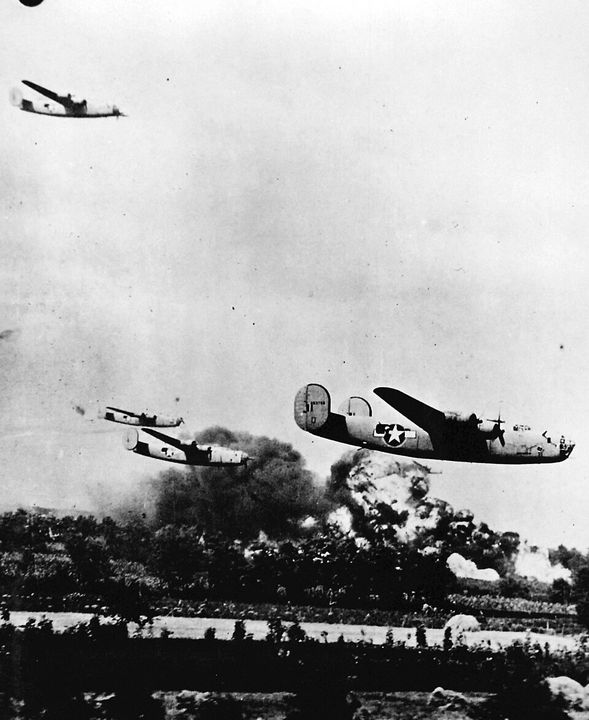
- The large four-engine American bomber Louie flew in as bombardier; Super Man and the Green Hornet were both B-24s.
- Bombardier
- The crew member who aims and releases a bomber's bombs; Louie's job on Phil's crew.
- Ofuna
- A secret Japanese interrogation camp where captured airmen were held without being registered as prisoners of war.
- The Bird
- The prisoners' nickname for Corporal Mutsuhiro Watanabe, the guard who persecuted Louie.
- Prisoner of war (POW)
- A soldier captured and held by the enemy; Louie was a POW from 1943 until 1945.
- Sugamo Prison
- The Tokyo prison where Japanese war criminals were held after the war, and where Louie went in 1950 to forgive former guards.
Seminar Questions
- Comprehension What kind of boy was Louie in Torrance, and how did running change him?
- Comprehension How did Louie, Phil and Mac survive on the raft, and what happened to Mac?
- Comprehension What happened to Louie at Billy Graham's crusade in 1949?
- Interpretation Why does the Bird single out Louie, and why does Louie refuse to give in?
- Interpretation Why does Louie's suffering continue after he is free and home?
- Interpretation Why does Hillenbrand compare dignity to food, water and air?
- Big Question Is it possible to forgive someone who has done great evil to you? What does forgiveness require?
Faith Connections
- Psalm 107:23-31 (Scripture)
Sailors in a storm cry to the Lord, who calms the sea and brings them to harbor. Louie's prayers on the raft and his later thanksgiving echo this psalm.
- Matthew 18:21-35 (Scripture)
Jesus tells Peter to forgive seventy times seven and warns against the servant who will not forgive. Louie's visit to Sugamo shows forgiveness offered to men who had wronged him.
- Romans 12:17-21 (Scripture)
Paul forbids revenge and urges overcoming evil with good. Louie's dream of killing the Bird gives way to a letter of forgiveness.
- Corrie ten Boom, The Hiding Place (Great Conversation)
Ten Boom tells of meeting a former Ravensbrück guard after the war and forgiving him only by God's help, a close parallel to Louie's experience.
Logic and Rhetoric
Central argument: Louie survived the raft and the camps through discipline, hope and dignity, but those strengths could not free him from hatred after the war. Only when he turned to God and forgave his captors was he truly free. Therefore, Hillenbrand's story suggests, survival is not the same as redemption.
Rhetorical device: foreshadowing. The prologue opens on the raft in 1943 before going back to Louie's childhood, and his promises to God on the raft look ahead to the 1949 crusade.
Debate: Resolved: that forgiving an enemy does more good for the one who forgives than for the one forgiven.
Writing Prompts
Essay: Louie survived the raft and the camps but nearly lost himself afterward. Explain what held him together during the war and what finally freed him after it.
Comparison with The Hiding Place: Compare how Louie Zamperini and Corrie ten Boom each came to forgive a former guard. What did forgiveness cost each of them, and what did it give them?
Medical Lens
Unbroken is a detailed account of survival medicine and its aftermath. On the raft the men face dehydration, starvation, exposure, salt-water sores and extreme weight loss; Hillenbrand describes how they rationed water and collected rain, ate raw birds and fish, and how Mac, who had eaten the emergency chocolate, declined and died. In the Japanese camps prisoners suffered from malnutrition, beriberi, dysentery and other diseases, beatings and forced labor; Hillenbrand also describes medical experiments on prisoners at Kwajalein, where Louie and Phil were injected with unknown substances, in restrained terms. After the war she shows Zamperini and other veterans struggling with what was then called combat fatigue: recurring nightmares of the Bird, flashbacks, rage and heavy drinking, with marital strain. In current terms this resembles post-traumatic stress disorder, though the diagnosis did not exist until 1980 and any retrospective label is interpretive. Hillenbrand presents his recovery after the 1949 crusade as a spiritual turning, with the nightmares ceasing; she reports this as his experience rather than a clinical claim.
- Part III (the raft)
Thirst, rain-catching, rationing, raw food, shark attacks and the men's physical decline over forty-seven days.
- Part IV (Kwajalein)
Injections given to the captured airmen in what appear to have been medical experiments.
- Part IV (Omori and Naoetsu)
Hunger, dysentery, beatings and forced labor in the prisoner-of-war camps.
- Part V (homecoming)
Recurring nightmares of the Bird, flashbacks, drinking and despair before the 1949 crusade.
Creative Prompts
- Classroom
Trace Louie's journey on a map of the Pacific and Japan: Torrance, Berlin, Hawaii, the crash site, the Marshall Islands, Ofuna, Omori, Naoetsu and Sugamo.
- Fiction
Write Phil's journal entry for one day on the raft, describing what he and Louie did to keep hope alive.
- Essay
The subtitle names survival, resilience and redemption. Explain which part of Louie's story shows each, and argue which was hardest for him.
Further Reading
- Unbroken: An Olympian's Journey from Airman to Castaway to Captive (Young Adult Adaptation), Laura Hillenbrand
- Devil at My Heels, Louis Zamperini with David Rensin
Zamperini's own memoir.
- Seabiscuit: An American Legend, Laura Hillenbrand
- Prisoners of the Japanese: POWs of World War II in the Pacific, Gavan Daws
Verification notes
Main facts (Berlin 1936 eighth place in the 5,000 m; the Green Hornet crash of 27 May 1943 with eight of eleven killed; Mac's death after about 33 days; capture in the Marshall Islands after 47 days; Ofuna, Omori and Naoetsu; Watanabe; marriage to Cynthia Applewhite; Billy Graham 1949; Sugamo 1950; Nagano 1998; publication 16 November 2010 by Random House) were checked at https://en.wikipedia.org/wiki/Unbroken_(book), https://www.history.com/articles/8-things-you-may-not-know-about-louis-zamperini and https://news.va.gov/68125/louis-zamperini-from-olympic-track-star-to-pow/. Both quotations were checked against the Books & Culture review at https://www.booksandculture.com/articles/webexclusives/2010/november/wonderfullife.html; the dignity line also appears on LitCharts. Part assignments in plotOrArgument and quote locators are approximate. Kwajalein medical experiments are recounted from the book's general content and should be confirmed.
- Text is under copyright; check quotations against an authorized edition before publication.
- Exact chapter and part for each quotation (the dignity passage is often cited as Chapter 18).
- The division of the book into five parts and the chapters each covers.
- Details of the injections given to Louie and Phil on Kwajalein.