Work record
United States v. Nixon
1974 · Postwar Contemporary · Court Decision · English
Abstract
Question Presented. Can a federal court compel a sitting President to hand over recorded White House conversations needed as evidence in the prosecution of his former aides, over his objection that such materials are confidential? A preliminary issue was whether the dispute, pitting the President against a prosecutor within his own branch, was one courts could hear at all.
Arguments. Nixon's lawyers said a clash between the Chief Executive and his own subordinate lay outside judicial power, and that the constitutional independence of the Presidency, together with the need for frank counsel, made his judgment on confidentiality final. Jaworski responded that his office held delegated independence under binding regulations, that a fair trial depends on access to all relevant proof, and that interpreting the Constitution belongs to judges.
Holding. Eight to nothing, Justice Rehnquist not participating, the Court affirmed Judge Sirica's order. Presidential confidentiality has constitutional roots and merits deference, yet when invoked only in general terms it gives way to particularized need in a pending prosecution, with the trial judge screening the recordings privately.
Significance. The President obeyed, and the release of a June 1972 recording preceded his resignation on 9 August 1974. The opinion remains the leading authority on both the existence and the limits of executive confidentiality. Later disputes over civil immunity and subpoenas from prosecutors and Congress have turned to its reasoning.
Key figures
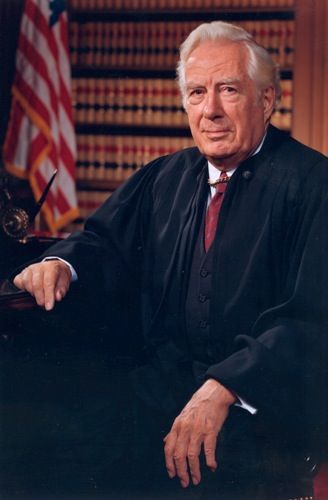
- Warren E. Burger: Chief Justice and author of the unanimous opinion
- Richard M. Nixon: President who resisted the subpoena
- Leon Jaworski: Special Prosecutor who sought the recordings
- James D. St. Clair: Lawyer who argued for the President

Summary
United States v. Nixon, decided on 24 July 1974, resolved a confrontation between President Richard Nixon and the federal courts that grew out of the Watergate affair, the June 1972 break-in at the Democratic National Committee offices and the efforts that followed to conceal it. On 1 March 1974 a grand jury indicted seven former officials and aides, including former Attorney General John Mitchell, and privately named the President an unindicted coconspirator. Special Prosecutor Leon Jaworski obtained a subpoena from Judge John J. Sirica requiring the President to produce tape recordings and documents of specific White House conversations for the coming trial. The President released edited transcripts of some conversations, moved to quash the subpoena, and claimed executive privilege. Sirica ordered the materials delivered for private inspection, and the Court agreed to hear the case directly, before the court of appeals ruled. The President's counsel, James D. St. Clair, advanced two main positions. First, the dispute was an internal quarrel within the executive branch, between the President and a subordinate prosecutor, and so not a matter courts could decide. Second, the separation of powers gave the President an absolute executive privilege: advisers will not speak candidly if their words may be exposed, and each branch must judge its own powers, so the courts could not override his claim. The Special Prosecutor answered that Justice Department regulations gave him independent authority to contest such claims, that the evidence was needed for a fair criminal trial, and that the courts, not the President, decide what the law requires. Chief Justice Burger wrote for a unanimous Court of eight. He held that the case was justiciable because the Attorney General's regulation, while in force, bound the executive branch and created a genuine adversary controversy, and that the subpoena met the standards of Federal Rule of Criminal Procedure 17(c). Citing Marbury v. Madison, he held that the judiciary must decide the scope of executive privilege. He recognized a presumptive confidentiality for Presidential communications rooted in the separation of powers, worthy of great deference, but held that a generalized interest in confidentiality, unconnected to military, diplomatic or national security secrets, must yield to the demonstrated need for evidence in a criminal trial. The District Court was to examine the materials privately and release only what was relevant and admissible. The library text gives the Chief Justice's opinion; its notes are left out. On 5 August 1974 the White House released the transcript of a recording from 23 June 1972. Nixon announced his resignation on 8 August and left office the next day, sixteen days after the decision. President Gerald Ford pardoned him on 8 September 1974, and Mitchell and two other former aides were convicted at trial in January 1975. Later cases on Presidential immunity and subpoenas, such as Nixon v. Fitzgerald (1982) and Trump v. Vance (2020), have relied on this opinion.
Virtues in this work
- Justice: The Court insisted that the twofold aim of criminal justice, convicting the guilty and protecting the innocent, requires all relevant evidence, whoever holds it.
- Prudence: Rather than strip the Presidency of confidentiality, Burger directed private review in chambers so only admissible material would leave the President's control.
- Humility: Justice Rehnquist withdrew because of his earlier service in the administration, leaving the decision to colleagues without that connection.
Plot or Argument
- Statement of the case: grand jury charges and the subpoena
Burger recounts the grand jury's charges of March 1974 against seven men, the naming of the President as an unindicted coconspirator, the April subpoena for tapes of identified meetings, the President's release of edited transcripts, and Judge Sirica's order for in camera inspection.
- Part I: jurisdiction
Although the court of appeals had not yet ruled, the Court takes the case before judgment there and explains why the District Court's order was appealable without forcing the President into contempt.
- Part II: justiciability of an intra-branch dispute
The President calls the quarrel internal to the executive branch. The Court answers that the Attorney General's regulation gave the Special Prosecutor explicit power to contest claims of executive privilege, and that so long as it remains in force it binds the executive, producing a real controversy of a kind courts traditionally resolve.
- Part III: Rule 17(c)
The Special Prosecutor showed that the subpoenaed conversations were relevant, likely admissible, and specifically identified, satisfying the rule for pretrial production of evidence.
- Part IV A-B: who decides, and the claim of absolute confidentiality
Relying on Marbury v. Madison, the Court holds that it must say what the law is on executive privilege. It credits the need for candor among advisers and the independence of each branch, but finds neither sufficient to support an unqualified immunity from judicial process.
- Part IV C-E: balancing confidentiality and criminal justice
The twofold aim of criminal justice, that guilt shall not escape nor innocence suffer, requires all relevant evidence. A generalized claim of executive privilege must yield to a specific need in a pending trial. The District Court is to examine the materials with great care, returning everything not admissible to the President, and recalls Chief Justice Marshall's handling of the Burr subpoena.
Characters
- Warren E. Burger, Chief Justice; author of the opinion
Wrote for the eight participating Justices, holding that the President must surrender the subpoenaed tapes for judicial inspection.
- Richard M. Nixon, President of the United States; party resisting the subpoena
Claimed an absolute executive privilege over recorded conversations and resigned sixteen days after the ruling.
- Leon Jaworski, Special Prosecutor
Houston lawyer who succeeded Archibald Cox in November 1973 and sought the tapes for the Watergate cover-up trial.
- James D. St. Clair, counsel for the President
Boston trial lawyer who argued that the courts lacked power to compel production of Presidential conversations.
- John J. Sirica, Chief Judge, U.S. District Court for the District of Columbia
Issued the subpoena, rejected the motion to quash, and ordered the materials delivered for review in chambers.
- John N. Mitchell, defendant in the underlying trial
Former Attorney General whose prosecution, United States v. Mitchell, was the case for which the tapes were sought.
Lessons
Saying what the law is, again
Burger quotes Marbury's most famous sentence to answer the President's claim that each branch interprets its own powers. One hundred seventy-one years after Marshall, the Court used his reasoning to decide a dispute with a sitting President.
- Why did the President's lawyers argue that the courts could not review his claim?
- How does the Court use Marbury v. Madison to answer them?
- What would follow if each branch were the final judge of its own powers?
Confidentiality is real but not unlimited
The opinion does not dismiss executive privilege; it calls the confidentiality of Presidential advice fundamental to government and rooted in the separation of powers. What it rejects is an absolute version that would override a criminal court's need for specific evidence.
- What reasons does the Court give for protecting the President's conversations with advisers?
- Which kinds of secrets does the Court suggest might receive stronger protection?
- Why does the need of a criminal trial weigh so heavily in the balance?
Separateness and interdependence
The Court describes the Constitution as diffusing power to secure liberty while expecting the branches to work together. The President's independence and the courts' duty to do justice are both constitutional values that the opinion tries to reconcile rather than rank.
- What does the Court mean by separateness but interdependence?
- How does in camera inspection protect both the President and the trial?
A unanimous Court in a divided moment
Three of the eight Justices had been appointed by Nixon, and Justice Rehnquist, another appointee, stepped aside. The Chief Justice circulated drafts so that the Court could speak with one voice on a question of the highest political consequence.
- Why might unanimity have mattered so much in this case?
- Why do judges sometimes withdraw from cases, as Justice Rehnquist did?
- What did the President's response to the decision show about respect for the courts?
Context
Five men were arrested inside the Watergate office complex in Washington on 17 June 1972. Investigations by reporters, a federal grand jury and a Senate select committee gradually connected the burglary and its concealment to the President's campaign committee and senior White House aides. In July 1973 a former aide, Alexander Butterfield, told the Senate committee that the President had recorded conversations in his offices, and the tapes became the center of the struggle.
Composition
Special Prosecutor Archibald Cox subpoenaed tapes in 1973 and was dismissed on 20 October 1973. His successor, Leon Jaworski, sought additional recordings in April 1974. The Court granted review before the court of appeals acted, heard argument on 8 July 1974 and announced its decision on 24 July. Chief Justice Burger wrote the opinion, drawing on drafts and suggestions from other Justices.
Reception
The President complied with the ruling. The recordings released on 5 August 1974 led him to announce his resignation on 8 August, effective on 9 August. The House Judiciary Committee had approved articles of impeachment at the end of July. The decision is widely taught as a statement that no officer is above the law and also as the Court's first full recognition of a constitutional basis for executive privilege; scholars continue to discuss how far its reasoning reaches beyond criminal trials, as in later cases involving civil suits and congressional subpoenas.
Comparisons
- marbury-v-madison
Burger quotes Marshall's claim that the judicial department must say what the law is; both cases concern the courts' authority over the executive branch, though Marshall declined to order Madison to act.
- youngstown-sheet-and-tube-v-sawyer
Two decades earlier the Court refused President Truman's seizure of the steel mills; together the cases are the central modern limits on Presidential power.
- the-federalist-papers
Hamilton's defense of an energetic executive in Federalist No. 70 and Madison's account of checks and balances in No. 51 frame both sides of the confidentiality argument.
- the-founding-documents
The Constitution says nothing explicit about executive privilege; the Court derived it from Article II and the separation of powers while relying on Article III's judicial power.
- the-anti-federalist-papers
Anti-Federalist writers warned that the new Presidency might escape accountability, a fear the tapes case tested in a concrete setting.
- magna-carta
The charter's insistence that even a king proceed by the law of the land is an ancient root of the principle that the chief magistrate answers to legal process.
Quotes
Frequently cited
“Many decisions of this Court, however, have unequivocally reaffirmed the holding of Marbury v. Madison, 1 Cranch 137 (1803), that "[i]t is emphatically the province and duty of the judicial department to say what the law is."”
Frequently cited
“However, neither the doctrine of separation of powers nor the need for confidentiality of high-level communications, without more, can sustain an absolute, unqualified Presidential privilege of immunity from judicial process under all circumstances.”
Frequently cited
“The generalized assertion of privilege must yield to the demonstrated, specific need for evidence in a pending criminal trial.”
“These are the considerations justifying a presumptive privilege for Presidential communications. The privilege is fundamental to the operation of Government, and inextricably rooted in the separation of powers under the Constitution.”
“While the Constitution diffuses power the better to secure liberty, it also contemplate that practice will integrate the dispersed powers into a workable government. It enjoins upon its branches separateness but interdependence, autonomy but reciprocity.”
For Students
A reading companion for classical Christian high school students. See the student guide.
Reading Guide
Watch for
- The phrase unindicted coconspirator in the statement of the case.
- How the Court treats the Attorney General's regulation creating the Special Prosecutor's office.
- The two grounds the President offers for an absolute executive privilege.
- The Court's appeal to the twofold aim of criminal justice.
- The instructions for in camera review and the reference to Chief Justice Marshall in the Burr trial.
Key terms and names
- Executive privilege
- The President's claimed right to keep certain communications with advisers confidential.
- Subpoena duces tecum
- A court order requiring a person to produce documents or other evidence.
- In camera
- Examined privately by the judge in chambers rather than in open court.
- Justiciable
- Suitable for decision by a court because it presents a real legal controversy between adverse parties.
- Special Prosecutor
- An attorney given independent authority by Justice Department regulation to investigate and prosecute Watergate offenses.
- Separation of powers
- The constitutional division of authority among legislative, executive and judicial branches.
Seminar Questions
- Comprehension What evidence did the Special Prosecutor's subpoena demand, and for what trial?
- Comprehension What two reasons did the President's counsel give for an absolute executive privilege?
- Comprehension What did the Court order the District Court to do with the subpoenaed materials?
- Interpretation Why does the Court say that a dispute between the President and a prosecutor in his own branch is still one courts can decide?
- Interpretation Why might the Court have suggested that military or diplomatic secrets would receive more protection?
- Big Question What does it mean for a free people that even the highest officer must answer to the law, and why is that principle so hard to keep?
Faith Connections
- 2 Samuel 12:1-7 (Scripture)
Nathan confronts King David with the words thou art the man; Israel's prophets held even the king answerable to a law above him.
- Luke 12:2-3 (Scripture)
Jesus teaches that what is spoken in private rooms will be proclaimed on the housetops, a sober reminder of accountability for hidden words.
- Samuel Rutherford, Lex, Rex (1644) (Great Conversation)
The Scottish divine argued that the law is king and the ruler stands under it, an older statement of the principle the case applied.
Logic and Rhetoric
Central argument: Because the courts must say what the law is, because Presidential confidentiality, though constitutionally grounded, is a presumption rather than an absolute, and because a criminal trial needs every relevant piece of evidence, a general claim of executive privilege must yield to a specific, demonstrated need, subject to careful judicial review in chambers.
Rhetorical device: concession and limitation. Burger first grants that confidential advice is fundamental and rooted in the separation of powers (quote 2), then limits it with the phrase without more (quote 1), so the ruling reads as balancing rather than rejecting the President's interest.
Debate: Resolved: that a President's confidential conversations with his advisers should be wholly immune from criminal subpoenas.
Memory Work
The generalized assertion of privilege must yield to the demonstrated, specific need for evidence in a pending criminal trial.
While the Constitution diffuses power the better to secure liberty, it also contemplate that practice will integrate the dispersed powers into a workable government. It enjoins upon its branches separateness but interdependence, autonomy but reciprocity.
Writing Prompts
Essay: Explain how Chief Justice Burger reconciles the President's need for confidential advice with the courts' duty in criminal trials, and assess whether the balance would apply equally outside a criminal case.
Comparison with Marbury v. Madison: Compare how Marshall in 1803 and Burger in 1974 each asserted judicial authority in a confrontation with the executive branch, and what each Court actually ordered.
Medical Lens
The opinion addresses subpoenas, executive confidentiality and the separation of powers and contains nothing bearing on medicine or health.
Creative Prompts
- Classroom
Reenact the 8 July 1974 oral argument, with one team for the Special Prosecutor, one for the President, and eight student Justices who must try to reach a single opinion.
- Essay
Write a one-page brief for the President defending executive privilege as candidly as St. Clair might have, then a one-page reply for Jaworski.
- Dialogue
Write a conversation between two law clerks on the evening of 23 July 1974 about why the Chief Justice wants the Court to speak unanimously.
- Essay
Explain how a rule that protects the President's advisers can still be consistent with the principle that no one is above the law, using the Court's in camera procedure.
Further Reading
- All the President's Men, Carl Bernstein and Bob Woodward
The two Washington Post reporters' account of their investigation of the Watergate break-in and its aftermath.
- The Brethren: Inside the Supreme Court, Bob Woodward and Scott Armstrong
Journalistic account of the Burger Court whose chapters on 1974 describe the drafting of the Nixon opinion; based on anonymous sources.
- The Wars of Watergate: The Last Crisis of Richard Nixon, Stanley I. Kutler
Detailed scholarly history of the scandal, the investigations and the constitutional confrontation.
- Executive Privilege: A Constitutional Myth, Raoul Berger
A 1974 study by a legal historian arguing against a broad Presidential confidentiality power, useful for the debate the case settled in part.
Verification notes
All five quotations were found by Grep in content/texts/united-states-v-nixon.txt. The text contains only the opinion of the Court, which had no separate opinions; the companion cross-petition (Nixon v. United States, concerning the grand jury's naming of the President) was dismissed and is not discussed here. One quotation preserves the library text's reading contemplate, which appears to be a transcription slip for contemplates. Dates (grand jury charges, argument, decision, transcript release, resignation and pardon) come from the opinion and standard histories; web confirmation was not available during drafting.
- Confirm that Mitchell, Haldeman and Ehrlichman were convicted on 1 January 1975.
- Confirm that the House Judiciary Committee approved its articles of impeachment between 27 and 30 July 1974.