Work record
Chronicle of the Fourth Crusade and the Conquest of Constantinople
c. 1207-1213 · Medieval · Memoir · French
Abstract
Background. A senior officer of the count of Champagne, who helped negotiate the shipping contract and sat in the war councils, composed this account in the vernacular while serving the new Latin regime in the East.
Content. An expedition meant for the Holy Land falls into debt to its Venetian carriers, takes a Christian port on the Adriatic to pay what it owes, and accepts a Byzantine pretender's bargain. After two assaults on the imperial capital, a coup inside the walls and a final capture, the victors divide its wealth, elect a Flemish count as emperor, and then struggle against Greek risings and a Bulgarian king until the narrative stops in 1207.
Perspective. The narrator defends the leaders, blames deserters and broken promises, and judges the Greek rulers harshly; Byzantine witnesses such as Niketas Choniates tell of the same months as a calamity for their city, and the two accounts are best read together.
Themes. Oaths and their keeping, the cohesion of an army, wonder at a great city, greed after victory, and divine favor won and lost.
Significance. It stands among the earliest major works of French prose history and remains the principal Western source for 1204 and for the debate over how the expedition was diverted.
Key figures
- Geoffrey de Villehardouin: Marshal of Champagne, envoy, commander and narrator
- Enrico Dandolo: Aged, sightless Doge of Venice
- Boniface of Montferrat: Leader of the host, later lord of Salonika
- Baldwin of Flanders: First Latin emperor, captured in 1205
- Henry of Flanders: Baldwin's brother and successor
- Isaac II and the young Alexius: Deposed Byzantine emperor and his son, briefly restored
- Mourzuphles: Byzantine courtier who seized the throne in 1204
- Johannizza (Kaloyan): Bulgarian ruler, victor at Adrianople
- Abbot of Vaux: Cistercian who opposed the diversion

Summary
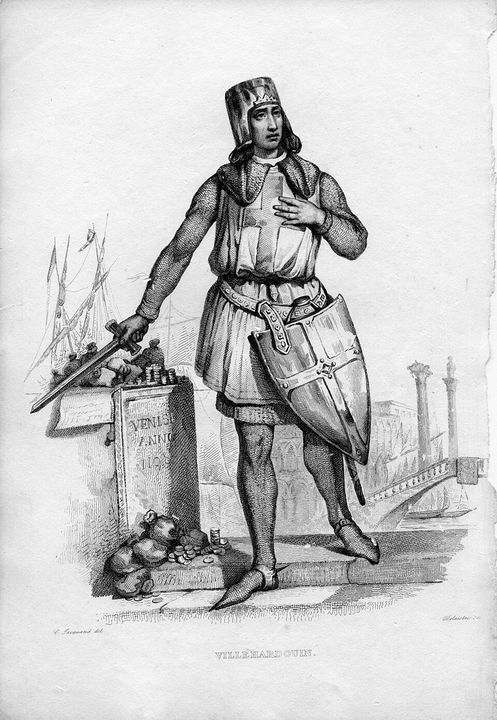
Villehardouin's chronicle is the eyewitness account of the Fourth Crusade by one of its leaders. It opens in 1198-99 with the preaching of Fulk of Neuilly and the indulgence proclaimed by Pope Innocent III, and with a tournament at Écry in Champagne where Count Thibaut of Champagne and Count Louis of Blois take the cross, soon joined by Count Baldwin of Flanders. Villehardouin is one of six envoys sent to Venice in 1201, where the aged and sightless Doge Enrico Dandolo agrees to transport 4,500 knights, 9,000 squires and 20,000 foot soldiers for 85,000 marks; the envoys kneel weeping before the people in St. Mark's, and the Venetians cry that they consent. Thibaut dies, Boniface of Montferrat is chosen leader, and in 1202 the host gathers at Venice, but many crusaders sail from other ports and those who come cannot pay. The Doge proposes that they settle the debt by helping Venice recover Zara on the Dalmatian coast, and he himself takes the cross in St. Mark's. At Zara the abbot of Vaux forbids the attack in the Pope's name because its people are Christians; the city is taken anyway in November 1202, and the host winters there. Envoys arrive from young Alexius, son of the deposed and blinded Emperor Isaac II, offering money, troops and the union of the Greek Church with Rome if the crusaders will restore his father. The host divides bitterly; Simon of Montfort and others leave for Syria or Hungary, and at Corfu the leaders fall weeping at the feet of the dissenters to keep the army together. In June 1203 the fleet sights Constantinople, whose walls, palaces and churches astonish the westerners. They seize Galata and the harbor, assault the walls by land and sea while the blind Doge leads the Venetians ashore, and Alexius III flees. Isaac is restored and his son crowned co-emperor, but the promised payments fail, fire devastates the city, and in early 1204 the courtier Mourzuphles imprisons and strangles young Alexius and takes the throne. The crusaders and Venetians agree on terms of division, storm the city on 12 April 1204, and take immense booty, some of which is hidden from the common stock. Baldwin of Flanders is elected and crowned the first Latin emperor, and Boniface receives Salonika. The last part narrates the hard years that followed: quarrels between Baldwin and Boniface, Greek risings, the war with Johannizza (Kaloyan), king of the Bulgarians and Vlachs, the disaster at Adrianople in April 1205 where Louis of Blois is killed and Baldwin captured, Villehardouin's own command of the rearguard in the retreat, Dandolo's death, the rule of Baldwin's brother Henry, and the death of Boniface in an ambush in 1207, where the chronicle breaks off. The library text is Frank T. Marzials's English translation, published by J. M. Dent in 1908.
Virtues in this work
- Fortitude: Villehardouin rallies the fugitives and commands the rearguard in the night retreat from Adrianople in 1205, leaving none of the wounded behind.
- Magnanimity: The aged, sightless Doge takes the cross and has himself set ashore under the standard of St. Mark to lead the assault.
- Justice: The abbot of Vaux forbids the attack on Zara because its people are fellow Christians.
- Temperance: Villehardouin condemns the covetousness of those who kept back booty from the common stock after the conquest.
Plot or Argument
- The preaching and the treaty with Venice (1198-1201)
Fulk of Neuilly preaches the crusade; the counts of Champagne, Blois and Flanders take the cross; six envoys, Villehardouin among them, bargain with Doge Enrico Dandolo for a fleet and win the people's consent in St. Mark's.
- The gathering at Venice and the debt (1201-1202)
Count Thibaut dies and Boniface of Montferrat becomes leader. Many crusaders sail from other ports, and those at Venice cannot pay; the Doge takes the cross and proposes that the host help Venice recover Zara.
- Zara and the offer of young Alexius (1202-1203)
The abbot of Vaux forbids the attack in the Pope's name, but Zara is taken. Envoys of the young Alexius promise money, men and church union if his father is restored; the host divides, and the leaders plead with the dissenters at Corfu to stay.
- The first siege of Constantinople (1203)
The fleet reaches the city, takes Galata and the harbor, and assaults the walls; Dandolo is set ashore beneath the standard of St. Mark. Alexius III flees, Isaac is restored, and his son is crowned co-emperor.
- Broken promises and the usurpation of Mourzuphles (1203-1204)
Payments lag, a great fire burns the city, the Greeks send fireships against the fleet, and Mourzuphles seizes the throne and has young Alexius strangled.
- The conquest and division (April-May 1204)
After a repulsed attack, the city falls on 12 April. Villehardouin records the vast booty, the covetousness of those who held back spoils, the election and coronation of Baldwin, and the grant of Salonika to Boniface.
- Adrianople and the Bulgarian war (1204-1205)
Baldwin and Boniface quarrel and reconcile. Johannizza allies with rebellious Greeks; at Adrianople the Comans rout the crusaders, Louis of Blois dies, Baldwin is captured, and Villehardouin leads the retreat to Rodosto. Dandolo dies and is buried in St. Sophia.
- Henry's reign and the death of Boniface (1205-1207)
Henry of Flanders governs as regent and then emperor, relieves besieged towns, fights Theodore Lascaris and Johannizza, and meets Boniface, who is killed by a Bulgarian ambush in 1207.
Characters
- Geoffrey de Villehardouin, author and narrator
Marshal of Champagne, envoy to Venice and commander, who speaks of himself in the third person.
- Enrico Dandolo, Doge of Venice
Aged, sightless and great-hearted leader who takes the cross and leads the Venetians ashore.
- Boniface of Montferrat, leader of the host
Italian marquis chosen to lead the crusade, later king of Salonika.
- Baldwin of Flanders, crusade leader and first Latin emperor
Count of Flanders and Hainault, crowned emperor in 1204 and captured at Adrianople.
- Alexius, son of Isaac, Byzantine claimant
Young prince whose offer turns the crusade to Constantinople and who cannot keep his promises.
- Mourzuphles (Alexius V Doukas), Byzantine usurper
Courtier who seizes the throne, resists the crusaders, and is later executed.
- Johannizza (Kaloyan), king of the Bulgarians and Vlachs
Formidable opponent of the Latin Empire, victor at Adrianople.
- Henry of Flanders, Baldwin's brother and successor
Capable soldier who holds the Latin Empire together after 1205.
- The abbot of Vaux, Cistercian dissenter
Forbids the attack on Zara in the Pope's name and leaves the host.
Lessons
Debts can steer a great purpose
The crusade was contracted for an army larger than the one that came to Venice, and the shortfall in payment led first to Zara and then to Constantinople. Villehardouin blames those who sailed from other ports. Historians still debate whether the diversion was a chain of accidents or a plan, but the chronicle itself shows how a financial obligation shaped decisions at every step.
- Why could the crusaders not pay the Venetians in 1202?
- How does Villehardouin explain the decision to attack Zara?
- When is it right to change a sworn plan because circumstances have changed?
Keeping the host together
Villehardouin values above all the unity of the army and the keeping of oaths. He condemns those who left and praises the leaders who knelt weeping before the dissenters at Corfu. He also records that the abbot of Vaux and others left out of conscience, so the reader can weigh loyalty to companions against the call of conscience.
- What arguments do the abbot of Vaux and his party give for going to Syria?
- How do the leaders persuade the dissenters at Corfu to remain?
- Is Villehardouin fair to those who left the host?
Wonder and plunder
The crusaders stare at Constantinople as the richest city in the world, and a year later Villehardouin boasts that no city ever yielded so much booty. He also writes that covetousness, the root of all evil, made some hide their spoils, and that God began to love the host less. The book records both the soldiers' pride and the narrator's sense of moral danger.
- How do the crusaders react when they first see Constantinople?
- What does Villehardouin say about those who hid booty, and why?
- Why might one eyewitness describe the same event as a triumph and as a temptation?
Reading an eyewitness
Villehardouin was in the councils he describes, so his chronicle is precious, but he writes as a leader explaining decisions he helped make. Byzantine writers such as Niketas Choniates described the same events as a catastrophe. A careful reader honors the witness while asking what each side saw.
- Where does Villehardouin speak of himself, and how does he present his own role?
- What does he say about the Greeks and their emperors?
- How would a citizen of Constantinople have told the story of 1204?
Context
The Fourth Crusade was called by Pope Innocent III in 1198 to recover Jerusalem, lost to Saladin in 1187. Western knights and the Republic of Venice had long dealings with the Byzantine Empire, whose capital was the largest and richest Christian city; relations had been strained by the schism of 1054, the massacre of Latins in Constantinople in 1182, and rivalry over trade. Byzantium itself was troubled by palace coups, including the blinding of Isaac II by his brother in 1195. The crusade's diversion to Christian Zara and then Constantinople ended in the sack of April 1204 and the founding of a Latin Empire that lasted until 1261. Innocent III had forbidden attacks on Christians and, after the sack, rebuked the crusaders in his letters. Greek writers, above all the courtier and historian Niketas Choniates, mourned the plunder of churches and homes and the suffering of the city's people, and Byzantine successor states at Nicaea, Epirus and Trebizond carried on the empire. Historians have long debated whether the diversion was planned, by Venice or by others, or resulted from a series of accidents and unpaid debts; recent scholarship tends to stress the latter, while acknowledging Venetian interests. In 2001 Pope John Paul II expressed sorrow for the sack, and in 2004 the Ecumenical Patriarch Bartholomew accepted that expression.
Composition
Villehardouin dictated his chronicle in Old French prose, probably between about 1207 and his death, making it one of the earliest works of French historical prose. He refers to himself in the third person as the one who makes or dictates the book. It breaks off with the death of Boniface in 1207, and was later continued by Henri de Valenciennes. Frank T. Marzials's English translation appeared in 1908 in Everyman's Library, together with Joinville's life of St. Louis, under the title Memoirs of the Crusades.
Reception
The chronicle has been read for centuries as the principal Western source for the Fourth Crusade and a model of plain, vivid narration. Its account of the decision-making has been both trusted for its detail and questioned for its defense of the leaders, and modern historians read it beside the French knight Robert de Clari, who saw events from the ranks, and Niketas Choniates, who saw them from inside the city.
Comparisons
- the-song-of-roland
The epic of Charlemagne's rearguard expresses the crusading ideals of knighthood that Villehardouin's barons professed; his own command of the rearguard after Adrianople reads like a historical echo.
- two-lives-of-charlemagne
Einhard and Notker give earlier models of the Frankish ruler and his campaigns; Villehardouin writes not a life but a soldier-statesman's record of a single expedition.
- the-travels-of-marco-polo
Venice's commercial reach underlies both books; Polo's travels began a few generations after the Venetian fleet carried the crusaders east and Venice gained trading posts across the former Byzantine lands.
- ivanhoe
Scott's romance is set among returning knights of the Third Crusade, a decade before Villehardouin's expedition; comparing them shows how a nineteenth-century novelist imagined the crusading age that the chronicle records firsthand.
- personal-memoirs
Grant's memoir and Villehardouin's chronicle are both campaign narratives by commanders who were in the councils they describe, and both explain decisions with restraint and an eye to vindication.
- bede-ecclesiastical-history
Bede's history of the English church is an earlier Christian chronicle that reads events as signs of God's favor or judgment, a habit Villehardouin shares when he writes that God began to love the host less.
Quotes
Frequently cited
“he was an old man, and albeit his eyes were unclouded, yet he saw naught, having lost his sight through a wound in the head. He was of a great heart.”
Frequently cited
“Lords, I forbid you, on the part of the Pope of Rome, to attack this city; for those within it are Christians, and you are pilgrims.”
Frequently cited
“for they never thought there could be in all the world so rich a city”
Frequently cited
“never, since the world was created, had so much booty been won in any city.”
“cried with one voice, and lifted up their hands, saying: “We consent, we consent!””
“no man there was of such hardihood but his flesh trembled: and it was no wonder, for never was so great an enterprise undertaken by any people since the creation of the world.”
“because covetousness, which is the root of all evil, let and hindered them.”
“But full oft do the good suffer for the sins of the wicked.”
For Students
A reading companion for classical Christian high school students. See the student guide.
Reading Guide
Watch for
- The scene in St. Mark's where the envoys kneel and the Venetians shout their consent.
- Each point where part of the army leaves or threatens to leave, and how Villehardouin judges them.
- The debate at Zara over young Alexius's offer, and the arguments on both sides.
- The first sight of Constantinople and, a year later, the account of the booty.
- How Villehardouin speaks of himself in the third person, especially in the retreat from Adrianople.
Key terms and names
- Taking the cross
- Vowing to go on crusade, marked by a cloth cross sewn on the clothing.
- Indulgence
- The remission of the temporal penalty of confessed sins, offered by Innocent III to those who served a year in the host.
- Doge
- The elected chief magistrate of Venice; here Enrico Dandolo.
- Marshal of Champagne
- Villehardouin's office, a senior military and household post under the count of Champagne.
- Romania
- The crusaders' name for the Byzantine lands and for the Latin Empire founded there in 1204.
- Greeks and Latins
- The common names for Byzantine Christians of the Eastern church and Western Christians in communion with Rome.
- Comans
- Nomadic horsemen of the steppe who fought as allies of Johannizza.
Seminar Questions
- Comprehension What did the crusaders agree to pay Venice, and why could they not pay it?
- Comprehension What did young Alexius promise the crusaders in return for restoring his father?
- Comprehension What happened at Adrianople in 1205, and what part did Villehardouin play?
- Interpretation How does Villehardouin explain the turn from the Holy Land to Zara and Constantinople, and whom does he blame?
- Interpretation Why does he describe the Doge's courage and blindness so carefully?
- Interpretation What does the passage on covetousness reveal about his moral judgment of the conquest?
- Big Question Can a holy purpose justify means that its own leaders, such as the Pope, forbade?
- Big Question How should we read a history written by one of the people responsible for the events it describes?
Faith Connections
- 1 Timothy 6:10 (Scripture)
Villehardouin quotes this verse, that covetousness is the root of all evil, to explain why some crusaders kept back their spoils.
- Ecclesiastes 5:4-5 (Scripture)
Better not to vow than to vow and not pay. The chronicle is full of vows, covenants and oaths sworn on relics, and of the troubles that follow when they cannot be kept.
- John 17:20-23 (Scripture)
Christ prays that his followers may be one. The quarrel of Latin and Greek Christians, which the abbot of Vaux invokes at Zara, stands in painful contrast to this prayer.
- Augustine, City of God XIX.7 (Church Fathers)
Augustine says that even a just war should be waged with grief. Readers may ask how far Villehardouin's account of the sack shows that grief, and where it shows pride.
Logic and Rhetoric
Central argument: The host swore a covenant with Venice and was bound in honor to keep it. Because many who had taken the cross failed to come, the army could not pay, and it was kept together only by accepting Venice's terms and then young Alexius's offer. Therefore, Villehardouin argues, the loyal leaders acted rightly to hold the host together, and the blame for the turn from Jerusalem falls chiefly on those who broke faith.
Rhetorical device: appeal to eyewitness testimony. Villehardouin repeatedly writes that Geoffrey the Marshal, who makes this book, bears witness, as when he vouches that never since the world was created was so much booty won in any city.
Debate: Resolved: that the leaders of the Fourth Crusade were justified in accepting young Alexius's offer at Zara.
Memory Work
Lords, I forbid you, on the part of the Pope of Rome, to attack this city; for those within it are Christians, and you are pilgrims.
But full oft do the good suffer for the sins of the wicked.
Writing Prompts
Essay: Villehardouin presents the Fourth Crusade as a story of covenants kept and broken. Argue whether this framing explains the turn to Constantinople, using the treaty of Venice, the debate at Zara and the division of the spoil.
Comparison with The Song of Roland: Compare the ideal of the crusading knight in The Song of Roland with the knights and barons of Villehardouin's chronicle. Where does history match the epic ideal, and where does it fall short?
Medical Lens
The chronicle's medical interest lies chiefly in wounds, blindness and death in a medieval army. Doge Dandolo, whom Villehardouin describes as sightless though his eyes looked clear, from a wound to the head, leads in person; the translator notes that the cause and degree of his blindness are disputed. Blinding as a political mutilation recurs: Isaac II was blinded by his brother, and later Mourzuphles is blinded by Alexius III. Villehardouin records deaths from sickness, such as Count Thibaut's before the expedition and Isaac's after his son's fall, without medical detail, and Dandolo's death in 1205. The arrow wound beneath the shoulder from which Boniface bleeds to death in 1207 is described plainly. The carrying of all the wounded on the night retreat from Adrianople shows the practical care a crusading host could offer its own.
- The Doge and a Number of Venetians Take the Cross
Description of Dandolo's sight lost through a wound in the head; translator's note on the uncertainty.
- Message of Alexius, the Son of Isaac
The blinding of Emperor Isaac by his brother.
- Retreat of the Crusaders
The host leaves Adrianople by night, taking all its wounded with it.
- Boniface Is Killed in a Battle Against the Bulgarians
Boniface's arrow wound beneath the shoulder and his death from loss of blood.
Creative Prompts
- Dialogue
Stage the debate at Zara over young Alexius's offer, giving the abbot of Vaux and the abbot of Loos each their strongest case as Villehardouin reports it.
- Essay
Was the diversion of the Fourth Crusade a plan or a chain of accidents? Argue from what Villehardouin records and what he leaves out.
- Fiction
Write a letter from a resident of Constantinople in April 1204 to a relative in Nicaea, describing the same days Villehardouin narrates.
- Classroom
Map the route of the fleet from Venice to Zara, Corfu, Abydos and Constantinople, marking the decisions made at each stop.
Further Reading
- The Conquest of Constantinople, Robert de Clari
The same events from a knight in the ranks.
- O City of Byzantium: Annals of Niketas Choniates, Niketas Choniates (trans. Harry J. Magoulias)
The Byzantine eyewitness account of 1204.
- The Fourth Crusade: The Conquest of Constantinople, Donald E. Queller and Thomas F. Madden
- The Fourth Crusade and the Sack of Constantinople, Jonathan Phillips
- Memoirs of the Crusades, Villehardouin and Joinville (trans. Frank T. Marzials)
The 1908 volume in which this translation first appeared, with Joinville's life of St. Louis.
Verification notes
Contents, names, section titles and the dates supplied in Marzials's text (Écry tournament 28 November 1199, departure from Zara April 1203, arrival at St. Stephen 23 June 1203, the Mourzuphles coup January 1204, the assault of April 1204, Dandolo's death before Pentecost 1205, Boniface's death 1207) were checked against the attached Gutenberg text. Locators use the section headings of the translation, which has no numbered chapters. The 85,000-mark price, the 12 April 1204 date of the fall, the Adrianople battle of 14 April 1205, and the 2001 and 2004 statements of Pope John Paul II and Patriarch Bartholomew are standard facts from the secondary literature. Villehardouin's dates of birth and death are approximate. Quotes were checked against the attached text.
- The composition date range (c. 1207-1213) and Villehardouin's date of death (sources give c. 1212 to c. 1218).
- That Marzials's version first appeared in the 1908 Everyman's Library volume titled Memoirs of the Crusades.