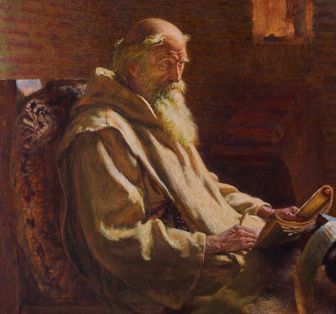
The Venerable Bede, as imagined by James Doyle Penrose (1902). Source · Public domain
About Bede
Bede (c. 673-735), called the Venerable Bede, was a monk and priest of the twin monastery of Wearmouth and Jarrow in Northumbria, given into the care of Abbot Benedict Biscop at the age of seven and later taught under Abbot Ceolfrid. He was ordained deacon at nineteen and priest at thirty by Bishop John of Hexham, and he spent nearly his whole life in the monastery, writing commentaries on Scripture, works on grammar, poetry, natural science and the calculation of time, saints' lives and history. His use of the reckoning from the birth of Christ helped to spread the anno Domini dating in western Europe. His pupil Cuthbert described his death on the eve of Ascension Day, 735, while finishing an English translation of part of the Gospel of John.
Frequently Cited
“For if history relates good things of good men, the attentive hearer is excited to imitate that which is good”
“The sparrow, flying in at one door and immediately out at another, whilst he is within, is safe from the wintry tempest; but after a short space of fair weather, he immediately vanishes out of your sight, passing from winter into winter again.”
“I wholly applied myself to the study of Scripture; and amidst the observance of monastic rule, and the daily charge of singing in the church, I always took delight in learning, or teaching, or writing.”
Bede's Ecclesiastical History of the English People, finished in 731 at the monastery of Jarrow, tells how the peoples of Britain received the Christian faith. A dedication to King Ceolwulf of Northumbria explains that history offers good examples to imitate and bad ones to shun, and names his informants, chief among them Abbot Albinus of Canterbury and the priest Nothelm, who searched the papal archives in Rome.