Work record
Ecclesiastical History of the English People
731 · Medieval · History · Latin
Abstract
Background. Writing in a Northumbrian monastery famous for its library, Bede set out to record how his nation came to Christ, drawing on papal letters, earlier chronicles and reports he solicited from abbots and bishops in each kingdom.
Content. After the Roman centuries and the Germanic settlements, the narrative follows the Kentish mission, Northumbrian royal conversions, Irish monks from Iona, the debate over the Paschal reckoning, the organizing archbishopric of a Greek from Tarsus, abbesses, hermits and a cowherd poet, healing bishops, and English missionaries crossing to Frisia.
Method. Bede cites documents verbatim, dates by the Incarnation, identifies informants, and interweaves miracle accounts with royal genealogies, so that kings' reigns and saints' lives together carry the story.
Edition. Sellar's Edwardian English, revised from an early Victorian version, keeps the dignified cadence of Bede's Latin; her apparatus summarizes each book, prints the moving eyewitness letter on Bede's last days, and supplies more than a thousand explanatory notes drawn from Plummer's scholarship.
Themes. Providence guiding a people, holiness proved by poverty and service, patient persuasion of rulers, the unity of the Church, and learning placed at the service of worship.
Significance. The chief source for England before 731, rendered into Old English under Alfred, the book earned its author the title Father of English History and remains a model of careful early medieval historical writing.
Key figures
- Bede: Monk-historian of Wearmouth and Jarrow
- Gregory the Great: Pope who sent the mission of 597
- Augustine: First Archbishop of Canterbury
- Edwin and Oswald: Converted kings of Northumbria
- Aidan: Irish bishop of Lindisfarne
- Hilda: Abbess of Whitby
- Caedmon: Cowherd granted the gift of sacred song
- Cuthbert: Hermit of Farne and bishop
- A. M. Sellar: Translator and editor of the 1907 version

Summary
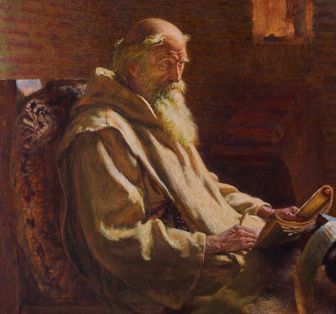
Bede's Ecclesiastical History of the English People, finished in 731 at the monastery of Jarrow, tells how the peoples of Britain received the Christian faith. A dedication to King Ceolwulf of Northumbria explains that history offers good examples to imitate and bad ones to shun, and names his informants, chief among them Abbot Albinus of Canterbury and the priest Nothelm, who searched the papal archives in Rome. Book I describes the island and its peoples, the Roman conquest, the martyrdom of St. Alban, the Pelagian controversy and the mission of Germanus, the departure of the Romans and the coming of the Angles, Saxons and Jutes, and then the mission sent by Pope Gregory the Great under Augustine, who lands in Kent in 597 and baptizes King Ethelbert; Gregory's letters and answers to Augustine's questions are given in full, including his advice to turn pagan temples into churches. Book II opens with Gregory's life and the famous story of the fair-haired boys in the Roman market whose people were called Angles, whom he wished to be co-heirs with the angels. It follows the conversion of Northumbria under King Edwin through the preaching of Paulinus, including the council at which a counsellor compares human life to a sparrow flying through a lighted hall in winter, and the pagan priest Coifi rides out to profane his own temple. Book III tells of King Oswald, the Irish monk Aidan sent from Iona to Lindisfarne, the conversion of the West Saxons, Middle Angles and East Saxons, and the Synod of Whitby in 664, where King Oswy chooses the Roman reckoning of Easter over the Irish. Book IV covers the work of Archbishop Theodore of Tarsus, the plague of 664, Abbess Hilda of Whitby, the cowherd Caedmon, who receives the gift of religious song in a dream, the Queen Ethelthryth, and the life and miracles of St. Cuthbert. Book V gives the healings of John of Beverley, the vision of Drythelm, the English missions to the Frisians and Germans, the death of Wilfrid, the acceptance of the Roman Easter by the Picts and Iona, and a survey of the English Church in 731, ending with a short account of Bede's own life and a list of his writings. The library text is A. M. Sellar's revised translation (London: George Bell and Sons, 1907), based on J. A. Giles's version of 1842, with Sellar's introduction, a life of Bede that prints Cuthbert's letter on his death, notes, the Continuation of Bede and an index.
Virtues in this work
- Charity: King Oswald sends his Easter feast to the poor at his gate and has the silver dish broken up and shared among them.
- Humility: Aidan travels on foot rather than horseback so that he can stop and speak with rich and poor alike.
- Prudence: Edwin weighs the new faith for years and consults his council before receiving baptism.
- Industry: Bede describes a life spent in study, teaching and writing amid the daily round of monastic worship.
- Piety: Caedmon turns every passage of Scripture he is taught into songs of praise and makes a peaceful end among his brethren.
Plot or Argument
- Preface
Bede dedicates the work to King Ceolwulf, states the purpose of history, names the informants for each kingdom, and asks readers to pray for him.
- Book I: Britain, Rome and the coming of Augustine
The island and its peoples; Caesar and Claudius; St. Alban's martyrdom; the Arian and Pelagian controversies and Germanus's mission; the departure of Rome and the coming of the Angles, Saxons and Jutes; Augustine's mission to Kent in 597 and Gregory's letters and answers to his questions.
- Book II: Gregory and the conversion of Northumbria
A sketch of Gregory the Great with the story of the English boys in the market; Augustine's meeting with the British bishops; the pagan reaction after Ethelbert's death; Edwin's marriage, the council where the sparrow parable is spoken, Coifi's destruction of his temple, the baptism of Edwin at York in 627, and his death at Hatfield in 633.
- Book III: Oswald, Aidan and Whitby
Oswald's victory at Heavenfield and his call to Iona; Aidan's mission at Lindisfarne and his life of poverty; Oswald's death and the miracles at his relics; the conversion of the West Saxons, Middle Angles and East Saxons; Fursa's visions; and the Synod of Whitby, where the Roman Easter is adopted.
- Book IV: Theodore, Hilda, Caedmon and Cuthbert
Theodore of Tarsus organizes the English Church and holds the councils of Hertford and Hatfield; plague strikes; Wilfrid evangelizes the South Saxons; Ethelthryth's life and death; Hilda of Whitby and the cowherd poet Caedmon; and the life, death and miracles of Cuthbert of Lindisfarne.
- Book V: Missions, visions and the Church in 731
Ethelwald of Farne; John of Beverley's healings; Caedwalla's baptism in Rome; the missions of Willibrord and others to the Frisians; the vision of Drythelm; Adamnan and the Holy Places; Wilfrid's life; the Picts and Iona accept the Roman Easter; and a survey of the bishoprics in 731.
- Book V, Chapter 24: Recapitulation and Bede's life
A chronological summary of the whole history is followed by Bede's account of himself, the list of his works and a closing prayer.
- Editorial matter and Continuation
Sellar's edition adds an introduction summarizing each book, a life of Bede with the letter of Cuthbert to Cuthwin on Bede's death, the brief annals known as the Continuation of Bede, notes and an index.
Characters
- Bede, author and historian
Monk of Wearmouth and Jarrow who gathered written records and testimony for the history and describes himself in its last chapter.
- Gregory the Great, pope and founder of the mission
Pope who, moved by English boys in a Roman market, sent Augustine to Britain and guided him by letter.
- Augustine of Canterbury, missionary archbishop
Roman monk sent by Gregory who landed in Kent in 597 and became the first Archbishop of Canterbury.
- Ethelbert, king of Kent
First English king to receive baptism, husband of the Christian Frankish princess Bertha.
- Edwin, king of Northumbria
King converted through Paulinus after long deliberation and a council of his chief men; killed at Hatfield in 633.
- Paulinus, missionary bishop
Roman missionary who preached to Edwin and baptized him at York.
- Coifi, pagan high priest
Edwin's chief priest who renounces the old gods and rides out with a spear to profane his own temple.
- Oswald, king of Northumbria
Christian king who invited Aidan from Iona, interpreted his preaching, and gave his Easter feast to the poor.
- Aidan, bishop of Lindisfarne
Irish monk from Iona who travelled on foot and taught nothing he did not practise.
- Oswy, king of Northumbria
King who presided at the Synod of Whitby and decided for the Roman Easter.
- Wilfrid and Colman, disputants at Whitby
Wilfrid argued for the Roman reckoning of Easter, Colman of Lindisfarne for the Irish custom of Columba.
- Hilda, abbess of Whitby
Noblewoman and abbess whose double monastery trained bishops and received the poet Caedmon.
- Caedmon, cowherd and poet
Lay brother who could not sing until a figure in a dream bade him sing of the creation.
- Theodore of Tarsus, archbishop of Canterbury
Greek-born archbishop who organized the English Church from 669 to 690.
- Cuthbert, bishop and hermit
Monk, hermit of Farne and bishop of Lindisfarne, whose life and miracles Bede also wrote separately.
Lessons
History as a school of example
In his preface Bede tells King Ceolwulf that history relating good deeds stirs the hearer to imitate them, and history of evil deeds warns him away. He therefore gathers lives of kings, bishops, monks and humble brothers as examples. He also names his sources and asks readers not to blame him for errors that came from common report, joining a moral purpose to a careful method.
- What two purposes for history does Bede give in his preface?
- Why does Bede list his informants kingdom by kingdom?
- Can a historian be both careful about facts and openly interested in moral lessons?
Conversion by persuasion and patience
Gregory advises that pagan temples be cleansed and used as churches and that festivals be turned to Christian feasts, because hard hearts cannot be stripped of everything at once. Edwin deliberates for years and consults his council before he is baptized. Bede shows a faith carried from Rome and Iona that wins kings and peoples through preaching, example and patience.
- What reason does Gregory give for keeping the temples in his letter to Mellitus?
- Why does Edwin call a council before accepting baptism?
- What does the sparrow parable suggest about why people seek religious truth?
Holiness that teaches by example
Aidan walks rather than rides so that he can speak with anyone he meets, gives away the gifts of kings, and teaches nothing he does not practise. Oswald gives his Easter dinner and the silver dish to the poor. Bede holds up such lives, along with Hilda's and Cuthbert's, as the means by which faith took root.
- Why does Aidan refuse to ride on horseback?
- What does Oswald do with the silver dish, and how does Aidan respond?
- Why might example persuade people more than argument?
Unity and the date of Easter
At Whitby in 664 the Irish-trained churches of the north and the Roman-trained churches of the south meet to settle when Easter should be kept. King Oswy decides for the Roman reckoning after hearing that the keys of the kingdom were given to Peter. Bede, who wrote on the calculation of time, praises the holiness of the Irish monks while arguing that unity in the date of the feast mattered.
- What arguments do Wilfrid and Colman each make at Whitby?
- Why does Oswy's decision turn on who holds the keys of heaven?
- How does Bede speak about the Irish monks after they lose the debate?
Every gift for the praise of God
Caedmon, a cowherd who left feasts when the harp came to him, receives in a dream the gift of making songs about the creation, and Hilda receives him into the monastery to put Scripture into English verse. Bede's own life, which he says he spent delighting in learning, teaching and writing, is offered as another kind of humble service.
- Why does Caedmon leave the feast, and what happens in the stable?
- How do Hilda and the learned men test his gift?
- What does Bede's description of his own life suggest about the value of ordinary work?
Context
After Roman rule ended in Britain early in the fifth century, Angles, Saxons and Jutes from the continent settled much of the island and formed kingdoms such as Kent, Northumbria, Mercia, East Anglia, Essex and Wessex, while British Christians held the west and Irish monks evangelized from Iona. Gregory the Great's mission of 597 began the conversion of the English from Kent, and Irish missionaries such as Aidan worked in Northumbria from 635. The two traditions differed over the calculation of Easter and the form of the monastic tonsure until the Synod of Whitby in 664. By Bede's lifetime Northumbria had become a centre of learning, with libraries such as Benedict Biscop's at Wearmouth and Jarrow, and books such as the Lindisfarne Gospels and the Codex Amiatinus.
Composition
Bede completed the History in 731, in his fifty-ninth year, and sent it to King Ceolwulf, who had seen an earlier draft. He drew on written sources such as Gildas, Orosius, Constantius's Life of Germanus and papal letters copied in Rome by Nothelm, and on testimony from monks and bishops across England, especially Abbot Albinus of Canterbury. He wrote in Latin and dated events from the birth of Christ. Sellar's 1907 translation revises J. A. Giles's of 1842, itself a revision of John Stevens's of 1723, and her notes draw on Charles Plummer's 1896 edition of the Latin text.
Reception
The History was copied widely across Europe; the Moore and Leningrad manuscripts survive from the eighth century. It was translated into Old English in the time of King Alfred and became the foundation of later English historical writing. Bede was named a Doctor of the Church by Pope Leo XIII in 1899. Modern historians regard the work as the principal source for early English history while noting that its miracle stories and its account of the British Church reflect Bede's purposes and sources, and they continue to debate how far it shaped the idea of a single English people.
Comparisons
- the-history-of-the-church
Bede took the title and method of ecclesiastical history from Eusebius, whose work he knew in Rufinus's Latin, quoting documents and tracing succession of bishops; Eusebius tells of the Church in the Roman Empire, Bede of its coming to a single people.
- caedmons-hymn
Bede's chapter on Caedmon (IV.24) is the source of the hymn, which he gives only in a Latin paraphrase; the library's record of the Old English poem preserved in manuscript margins shows what the cowherd's song sounded like.
- st-patricks-writings
Patrick's Confession records the conversion of Ireland from which the monks of Iona and Lindisfarne came; Bede, curiously, does not mention Patrick, though he praises the Irish missionaries.
- early-christian-lives
The lives of Antony, Martin, Columba and Benedict collected there set the patterns of holiness, ascetic retreat, travel on foot and miracles, that Bede follows in his portraits of Aidan, Cuthbert and Hilda.
- two-lives-of-charlemagne
Einhard wrote of Charlemagne about a century after Bede, and Alcuin of York, heir to Bede's school, taught at Charlemagne's court; together they show the Northumbrian learning Bede represents passing to the Frankish world.
- beowulf
Beowulf's mead-hall with its fire, feast and harp is the same world as Edwin's hall in the sparrow parable and the feast Caedmon leaves; the poem and the History are both products of a newly Christian English culture.
Quotes
Frequently cited
“For if history relates good things of good men, the attentive hearer is excited to imitate that which is good”
Frequently cited
““Right,” said he, “for they have an angelic face, and it is meet that such should be co-heirs with the Angels in heaven.”
Frequently cited
“The sparrow, flying in at one door and immediately out at another, whilst he is within, is safe from the wintry tempest; but after a short space of fair weather, he immediately vanishes out of your sight, passing from winter into winter again.”
Frequently cited
“And I also say unto you, that he is the door-keeper, and I will not gainsay him”
Frequently cited
““Cædmon, sing me something.” But he answered, “I cannot sing, and for this cause I left the banquet and retired hither, because I could not sing.””
Frequently cited
“I wholly applied myself to the study of Scripture; and amidst the observance of monastic rule, and the daily charge of singing in the church, I always took delight in learning, or teaching, or writing.”
“it was the highest commendation of his doctrine with all men, that he taught nothing that he did not practise in his life among his brethren”
“And I beseech Thee, good Jesus, that to whom Thou hast graciously granted sweetly to drink in the words of Thy knowledge, Thou wilt also vouchsafe in Thy loving-kindness that he may one day come to Thee, the Fountain of all wisdom, and appear for ever before Thy face.”
For Students
A reading companion for classical Christian high school students. See the student guide.
Reading Guide
Watch for
- How Bede tells you where he learned each story, in the Preface and throughout.
- The story of Gregory and the English boys in Book II, Chapter I, and its puns on Angles, Deira and Aelli.
- The council of King Edwin in Book II, Chapter XIII, with the sparrow parable and Coifi's ride.
- The contrast between Aidan's poverty and the kings' wealth in Book III.
- Caedmon in Book IV, Chapter XXIV, and Bede's own life in Book V, Chapter XXIV.
Key terms and names
- Ecclesiastical history
- A history of the Church and its spread, a form begun by Eusebius, which Bede applied to the English.
- Angles, Saxons and Jutes
- The Germanic peoples who settled in Britain after Roman rule ended, ancestors of the English.
- Synod of Whitby
- The meeting of 664 at Hilda's monastery where King Oswy chose the Roman method of dating Easter.
- Paschal question
- The dispute over how to calculate the date of Easter, which divided the Irish and Roman traditions in Britain.
- Tonsure
- The shaving of part of the head as a mark of a monk or cleric; the Irish and Roman forms differed.
- Anno Domini
- Dating years from the birth of Christ, a system Bede used throughout and helped make standard.
- Lindisfarne
- The tidal island off Northumbria where Aidan founded his monastery and Cuthbert later served as bishop.
Seminar Questions
- Comprehension Who sent Augustine to Britain, and where did he first preach?
- Comprehension What do Edwin's counsellors say at the council in Book II, Chapter XIII, and what does Coifi do afterward?
- Comprehension What was decided at Whitby in 664, and on what grounds?
- Interpretation Why does Bede include Gregory's playful puns on Angles, Deira and Aelli?
- Interpretation How does Bede present the Irish missionaries, and how does his tone change when he discusses their Easter custom?
- Interpretation What does the story of Caedmon suggest about the relation between learning, humility and grace?
- Big Question Should a historian record miracles that his trusted sources report, and how should a reader weigh them?
- Big Question What makes a scattered group of kingdoms into one people: language, faith, rulers or a shared story?
Faith Connections
- Matthew 28:19-20 (Scripture)
The Great Commission to make disciples of all nations stands behind every mission Bede describes, from Gregory's sending of Augustine to the English missions to the Frisians in Book V.
- Matthew 16:18-19 (Scripture)
Wilfrid quotes Christ's words to Peter about the rock and the keys at Whitby, and Oswy's decision turns on them.
- James 4:14 (Scripture)
James calls human life a vapour that appears for a little time and vanishes, the same insight Edwin's counsellor expresses in the sparrow parable.
- Gregory the Great, Pastoral Care (Church Fathers)
Gregory's handbook on the work of bishops, which Bede knew, teaches that a pastor must practise what he preaches, the quality Bede praises most in Aidan.
Logic and Rhetoric
Central argument: God's providence brought the faith to the English through the mission of Gregory, the labours of Irish and Roman teachers, and the conversion of kings. The lives of the holy men and women who carried it are examples to imitate, and the unity of the Church, even in the date of Easter, is a good to be sought. Therefore Bede argues that the English should remember this story and live up to it.
Rhetorical device: parable. Edwin's counsellor in Book II, Chapter XIII, compares human life to a sparrow's flight through a lighted hall from winter into winter, making an argument for faith from the shortness and uncertainty of life.
Debate: Resolved: that King Oswy was right to prefer the unity of the Roman Easter to the Irish custom of his own teachers.
Memory Work
The sparrow, flying in at one door and immediately out at another, whilst he is within, is safe from the wintry tempest; but after a short space of fair weather, he immediately vanishes out of your sight, passing from winter into winter again.
I wholly applied myself to the study of Scripture; and amidst the observance of monastic rule, and the daily charge of singing in the church, I always took delight in learning, or teaching, or writing.
Writing Prompts
Essay: Bede presents Aidan, Oswald, Hilda, Caedmon and Cuthbert as examples. Choose two and explain what each shows about holiness and why Bede thought the English needed to remember them.
Comparison with The History of the Church: Compare how Eusebius and Bede use documents, letters and the succession of bishops to tell the story of the Church, and what each is trying to prove.
Medical Lens
The History is an important source for the great pestilence of 664 and the plagues that followed, often identified by historians with the Justinianic plague pandemic: Bede records that it emptied the south and then Northumbria, carried off Bishop Cedd and his followers at Lastingham and Archbishop Deusdedit, struck Ireland, and drove the East Saxons back to idolatry; Sellar's life of Bede notes the plague of 686 at Jarrow. Book IV contains a rare early English account of surgery: the physician Cynifrid describes lancing the tumour under Queen Ethelthryth's jaw shortly before her death, and the healed incision found when her body was moved. Book V's chapters on John of Beverley include the healing of a mute youth, whom the bishop teaches to speak letter by letter and then gives to a physician to treat his scabbed head, alongside cures by blessing and relics. Visions such as Fursa's and Drythelm's, and Caedmon's dream, are presented as spiritual events; any medical reading of them is interpretive. Bede reports miracles from his informants as a historian of the Church, and the record treats them as part of his narrative rather than as clinical history.
- Book III, Chapters XXIII, XXVII and XXX
Cedd and his companions die at Lastingham; the pestilence of 664 spreads through southern England, Northumbria and Ireland; the East Saxons lapse into idolatry during the plague.
- Book IV, Chapter XIV
A pestilence in a South Saxon monastery ends after a boy's vision of Saints Peter and Paul and the intercession of King Oswald.
- Book IV, Chapter XIX
The physician Cynifrid recounts opening Ethelthryth's tumour beneath the jaw, her death, and the healed wound seen at her translation.
- Book V, Chapter II
Bishop John teaches a mute youth to speak and has a physician treat his scalp.
- Book V, Chapter XII
Drythelm, who seemed to have died, revives and describes a vision of the places of the dead, then lives as a penitent monk.
Creative Prompts
- Classroom
Draw a map of the English kingdoms in Bede's time and mark where each missionary began: Augustine in Kent, Paulinus at York, Aidan at Lindisfarne, Birinus at Dorchester, Cedd in Essex.
- Dialogue
Write the debate at Whitby from the point of view of a young monk of Lindisfarne who loves Aidan's memory but listens to Wilfrid's arguments.
- Poetry
Write a short poem of praise in the alliterative style of Caedmon's hymn on one of the days of creation.
- Essay
Retell the sparrow parable in your own words and explain whether it is a good reason for seeking religious truth.
Further Reading
- The Age of Bede, D. H. Farmer (ed.), trans. J. F. Webb
Bede's Lives of the Abbots of Wearmouth and Jarrow, his prose Life of Cuthbert, and other early lives.
- The World of Bede, Peter Hunter Blair
- The Venerable Bede, Benedicta Ward
- The Coming of Christianity to Anglo-Saxon England, Henry Mayr-Harting
Verification notes
Contents, names, dates and chapter locators were checked against the attached Gutenberg text of A. M. Sellar's 1907 translation, whose editor's preface states that it revises J. A. Giles's translation, itself a revision of John Stevens's, and that the notes rely on Charles Plummer's edition. Chapter numbers for the plague, surgery and vision passages were matched to the edition's table of contents and chapter headings. Facts about Bede's life follow Book V, Chapter 24 and Sellar's Life of Bede, including Cuthbert's letter on his death. The identification of the plague of 664 with the Justinianic pandemic and the debate about Bede's idea of an English people are summarized from standard scholarship. Quotes were checked against the attached text, which uses curly quotation marks and apostrophes.
- That Bede was declared a Doctor of the Church by Leo XIII in 1899.