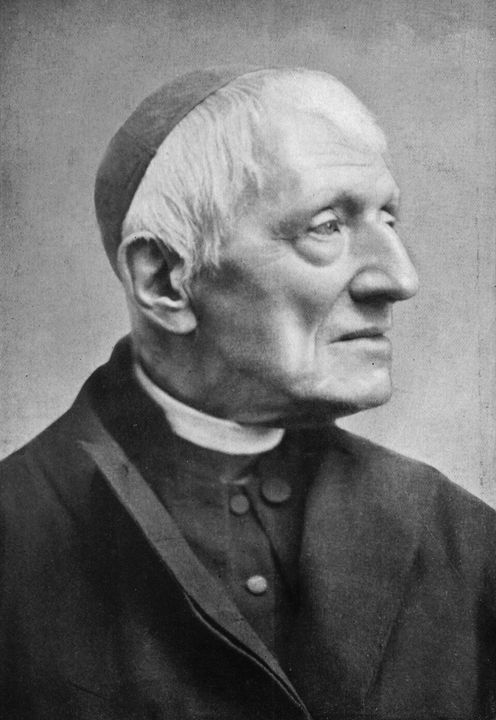
John Henry Newman (1801-1890) was a fellow of Oriel College, Oxford, vicar of the University Church of St. Mary the Virgin, and a leader of the Oxford Movement within the Church of England. Received into the Catholic Church in 1845, he founded the Birmingham Oratory, served as first rector of the Catholic University of Ireland, and was made a cardinal by Pope Leo XIII in 1879. His writings include the Parochial and Plain Sermons, The Idea of a University, An Essay on the Development of Christian Doctrine, The Dream of Gerontius and the Grammar of Assent; he was canonized in 2019.
Frequently Cited
“two and two only supreme and luminously self-evident beings, myself and my Creator”
Apologia Pro Vita Sua is John Henry Newman's defence of his honesty, written in 1864 in reply to the novelist and clergyman Charles Kingsley, who had written in Macmillan's Magazine that truth for its own sake had never been a virtue with the Roman clergy and that Father Newman taught it need not be. After an exchange of letters and a pamphlet by Kingsley, Newman decided that the only adequate answer was a history of his own mind.