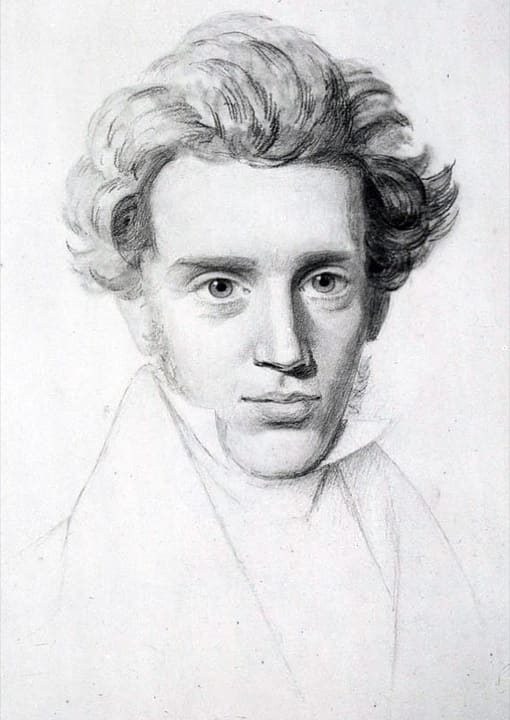
Søren Aabye Kierkegaard (1813–1855) was born in Copenhagen, the youngest child of a wealthy, devout and melancholy hosier, Michael Pedersen Kierkegaard. After a theology degree and a dissertation on irony (1841), he broke off his engagement to Regine Olsen and began publishing a stream of pseudonymous books, including Either/Or, Repetition, The Concept of Anxiety and The Sickness unto Death. His last years were spent attacking the Danish state church; he collapsed in the street and died in Frederiks Hospital at forty-two.
Fear and Trembling: Dialectical Lyric appeared in Copenhagen on 16 October 1843 under the pseudonym Johannes de silentio, 'John of silence', the same day as Repetition. Its subject is Genesis 22, in which God commands Abraham to take his son Isaac to Mount Moriah and offer him as a burnt offering.
The Sickness Unto Death: A Christian Psychological Exposition for Upbuilding and Awakening was published in Copenhagen on 30 July 1849 under the pseudonym Anti-Climacus, with Kierkegaard named as editor. Its title comes from Jesus' words about Lazarus in John 11:4, 'This sickness is not unto death.' The introduction argues that for the Christian even death is not the sickness unto death, since there is hope beyond it; the true sickness unto death is despair, a condition in which one cannot die and cannot live, a perpetual dying without end.