1888-1965 · American-born English poet, playwright and critic of the modernist era
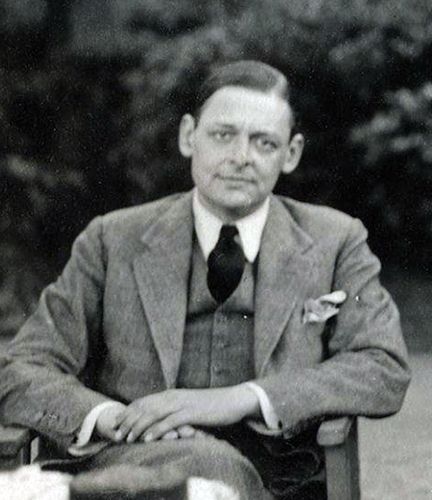
T. S. Eliot, photographed by Lady Ottoline Morrell (1934). Source · Public domain
About T. S. Eliot
Thomas Stearns Eliot (1888-1965) was born in St. Louis, Missouri, studied philosophy at Harvard, and settled in England in 1914, where he worked for Lloyds Bank and then as an editor at the publisher Faber. Prufrock and Other Observations (1917) and The Waste Land made him the leading poet and critic of English modernism. In 1927 he was received into the Church of England and became a British subject; his later poetry, from Journey of the Magi to Four Quartets, is Christian in theme. He received the Nobel Prize in Literature in 1948.
“‘A cold coming we had of it, Just the worst time of the year For a journey, and such a long journey: The ways deep and the weather sharp, The very dead of winter.’”
“were we led all that way for Birth or Death? There was a Birth, certainly, We had evidence and no doubt. I had seen birth and death, But had thought they were different; this Birth was Hard and bitter agony for us, like Death, our death.”
“We returned to our places, these Kingdoms, But no longer at ease here, in the old dispensation, With an alien people clutching their gods. I should be glad of another death.”
The Waste Land is a poem of 433 lines in five parts, dedicated to Ezra Pound and prefaced by a Latin and Greek epigraph from Petronius in which the Sibyl of Cumae, shrivelled in a jar, says she wants to die. Part I, The Burial of the Dead, opens with April as the cruellest month, stirring memory and desire in a dead land.
Journey of the Magi is a dramatic monologue in which one of the wise men of Matthew 2, now old, remembers the journey to Bethlehem and asks what it meant. T. S. Eliot wrote it in 1927, the year he was baptized and confirmed in the Church of England, and Faber and Gwyer published it that August as the eighth of its Ariel Poems, small illustrated pamphlets sold as Christmas cards, with a drawing by E. McKnight Kauffer.