Work record
Journey of the Magi
1927 · Early 20th Century · Poetry · English
Abstract
Background. Eliot composed this piece for a Faber Christmas pamphlet series in the summer he entered the Church of England. Its first words come, by his own acknowledgment, from Bishop Lancelot Andrewes preaching at Whitehall on Christmas Day 1622.
Content. An elderly wise man recalls the bitter midwinter trek: obstinate beasts, mutinous servants, inhospitable towns, and an inner chorus mocking the whole venture. After a night march the party descends into a fertile valley filled with emblems of a Passion still decades away, and finds the Child at dusk with scarcely a word about the scene. Looking back, the narrator wrestles with whether that event was a beginning or an ending, for it killed the life he had known. He has gone home to his realm only to feel a foreigner there.
Form. Long, sagging lines strung together by conjunctions give way in the final section to broken syntax and a halting restart, mirroring the speaker's effort to say what changed.
Themes. Conversion as both loss and gain, revelation only half understood at the time, and the exile of one who has seen something his own people have not.
Significance. It marks Eliot's turn toward explicitly Christian verse and remains among the most anthologized Nativity poems in English.
Main characters
- The Magus: Aged eastern sage who followed the star and now reflects
- The other Magi: Companions on the road, present only in the speaker's we
- The camel men: Grumbling hired drivers who desert along the way

Summary
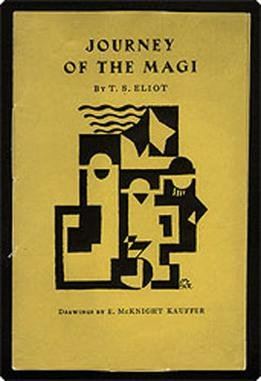
Journey of the Magi is a dramatic monologue in which one of the wise men of Matthew 2, now old, remembers the journey to Bethlehem and asks what it meant. T. S. Eliot wrote it in 1927, the year he was baptized and confirmed in the Church of England, and Faber and Gwyer published it that August as the eighth of its Ariel Poems, small illustrated pamphlets sold as Christmas cards, with a drawing by E. McKnight Kauffer. The poem has forty-three lines of free verse in three verse paragraphs. The first opens with five lines in quotation marks adapted from a Christmas Day sermon that Lancelot Andrewes preached before King James I in 1622: a cold coming, the worst time of the year, the very dead of winter. The speaker then lists the hardships in a long chain of clauses joined by and: galled and refractory camels, regret for summer palaces and silken girls bringing sherbet, deserting camel men, hostile cities and dirty villages, and voices singing that it was all folly. The second paragraph descends at dawn into a temperate valley full of images that look forward to the life and death of Christ, though the Magi cannot recognize them: three trees on the low sky, an old white horse galloping away, hands dicing for pieces of silver at a tavern door, feet kicking empty wine-skins. They arrive at evening and find the place, which the speaker calls, with dry understatement, satisfactory. The Nativity itself is never described. The third paragraph turns to reflection. The old man would make the journey again, but he insists on one question: were they led all that way for Birth or Death? He had thought birth and death were different, but this Birth was hard and bitter agony for them, like Death. Back in their kingdoms they are no longer at ease in the old dispensation, among a people clutching their gods, and he ends: I should be glad of another death. Readers have heard in the poem Eliot's own conversion, in which faith is gained at the cost of the old self. It is one of the most frequently anthologized religious poems of the twentieth century.
Virtues in this work
- Fortitude: The Magi press on through the very dead of winter despite deserting camel men and voices calling it folly.
- Faith: Though the signs give no information, the travelers keep going and the speaker affirms there was a Birth, certainly.
- Humility: The old Magus admits he cannot fully interpret what he saw and sets down his question honestly instead of claiming understanding.
Plot or Argument
- Lines 1-20: The hardships of the road
Quoting Andrewes, the old Magus recalls a winter journey of sore camels, deserting servants, unfriendly towns, regret for the summer palaces, and voices calling it all folly.
- Lines 21-31: The valley and the arrival
At dawn the travelers enter a green valley of foreshadowing images (three trees, a white horse, dicers for silver) and reach the birthplace at evening, which the speaker calls satisfactory.
- Lines 32-39: Birth or Death?
Years later the speaker would go again, but he presses the question of whether they were led to a birth or a death, since this Birth felt like their own death.
- Lines 40-43: Strangers at home
Returned to their kingdoms, the Magi live uneasily under the old dispensation among people clutching their gods, and the speaker longs for another death.
Characters
- The Magus, speaker
An aged wise man from the east recalling, long afterward, the journey to the Nativity.
- The other Magi, companions
The fellow travelers included in the speaker's repeated we.
- The camel men, servants
Hired attendants who curse, grumble, demand liquor and women, and run away.
Lessons
The cost of the journey
Eliot's Magi are not serene kings in a Christmas card but weary travelers who regret their comforts and hear voices calling the trip folly. The poem treats seeking Christ as costly, and the long chain of complaints makes the reader feel the miles.
- List the hardships in the first verse paragraph. Which seem physical and which spiritual?
- Why include the regret for silken girls and sherbet?
- What do the voices saying that this was all folly represent?
Signs the travelers cannot read
The valley in the second paragraph is crowded with images that point ahead to the Gospel story: three trees for Calvary, pieces of silver for Judas, dicing for the soldiers at the cross, wine-skins for new wine. The Magi pass them without understanding, while the reader sees what the speaker cannot.
- Which images in the valley point toward the Crucifixion?
- Why does the speaker say there was no information?
- What is the effect of calling the Nativity merely satisfactory?
A birth that is a death
The speaker's great discovery is that meeting Christ was like dying, because it ended the old life he had known. He returns home a stranger, and his wish for another death can be read as a longing for the completion of that change.
- Why does the speaker repeat set down as he begins the final question?
- In what sense was the Birth hard and bitter agony for the Magi?
- What other death might the speaker be glad of in the last line?
Context
By 1927 Eliot had moved from the fragmented despair associated with The Waste Land toward Anglo-Catholic Christianity. He was baptized privately on 29 June 1927 and confirmed the next day, and that autumn became a British subject. His prose of the period, including the essay on Lancelot Andrewes, praised the seventeenth-century preachers of the English Church, whose Nativity sermons supplied his opening lines.
Composition
Eliot wrote the poem for Faber and Gwyer's Ariel Poems, a series of illustrated pamphlets for Christmas, and it appeared in August 1927 as no. 8 with a drawing by E. McKnight Kauffer. Eliot later said he wrote it quickly, on a Sunday after church. The opening adapts Andrewes's 1622 Christmas sermon, and Eliot followed it with further Ariel poems, A Song for Simeon (1928), Animula, and Marina.
Reception
The poem was collected in Eliot's Collected Poems 1909-1935 and has been anthologized steadily since, often as the most approachable of his religious poems. Critics read it alongside Ash-Wednesday (1930) as a record of conversion. The 1927 pamphlet entered the United States public domain in 2023, though Eliot's work remains under copyright in Britain.
Comparisons
- the-bible
Matthew 2:1-12 is the source: the wise men follow the star, offer gifts, and depart into their own country another way, which Eliot extends into a lifetime of unease.
- the-second-coming
Yeats's 1919 poem also ends on a birth at Bethlehem that overturns an age, though his slouching rough beast is the menacing opposite of Eliot's hidden Christ.
- the-dream-of-the-rood
The Old English poem lets the Cross itself recount the Passion; Eliot's Magus glimpses that same tree, unknowing, in the three trees on the low sky.
- tennyson-ulysses
Both are monologues of aged travelers restless at home, but Tennyson's hero longs to sail out again while Eliot's longs for a death that completes his conversion.
Quotes
Frequently cited
“‘A cold coming we had of it, Just the worst time of the year For a journey, and such a long journey: The ways deep and the weather sharp, The very dead of winter.’”
Frequently cited
“were we led all that way for Birth or Death? There was a Birth, certainly, We had evidence and no doubt. I had seen birth and death, But had thought they were different; this Birth was Hard and bitter agony for us, like Death, our death.”
Frequently cited
“We returned to our places, these Kingdoms, But no longer at ease here, in the old dispensation, With an alien people clutching their gods. I should be glad of another death.”
“At the end we preferred to travel all night, Sleeping in snatches, With the voices singing in our ears, saying That this was all folly.”
“And three trees on the low sky, And an old white horse galloped away in the meadow. Then we came to a tavern with vine-leaves over the lintel, Six hands at an open door dicing for pieces of silver, And feet kicking the empty wine-skins,”
For Students
A reading companion for classical Christian high school students. See the student guide.
Reading Guide
Watch for
- The quotation marks around the first five lines, which borrow from Lancelot Andrewes's 1622 Christmas sermon.
- The long run of clauses beginning And in the first paragraph, piling hardship on hardship.
- The three trees, the white horse, the pieces of silver, and the wine-skins in the dawn valley.
- The understatement of satisfactory at the moment the Magi find the Child.
- The stammering repetition of set down before the question of Birth or Death.
Key terms and names
- Magi
- The wise men from the east in Matthew 2 who follow a star to worship the newborn King of the Jews; the poem's speaker is one of them.
- Dramatic monologue
- A poem spoken by a single character, here an aged Magus whose words reveal more than he fully understands.
- Lancelot Andrewes
- Bishop and preacher to King James I and a translator of the King James Bible, whose 1622 Nativity sermon supplies the poem's opening.
- Old dispensation
- The former religious order under which the Magi lived before the coming of Christ, now felt as foreign.
- Ariel Poems
- Faber and Gwyer's series of illustrated Christmas pamphlets; this poem was the eighth, in 1927.
- Foreshadowing
- Hints of later events; the valley images point ahead to the Crucifixion the Magi will never see.
Seminar Questions
- Comprehension What hardships of the journey does the Magus list in the first verse paragraph?
- Comprehension What do the travelers see in the valley before they arrive, and how does the speaker describe finding the place?
- Interpretation Why does Eliot never describe the Christ Child or the scene at the manger?
- Interpretation Which images in the valley foreshadow the Passion, and why can the Magi not recognize them?
- Interpretation Why did this Birth feel like Death to the Magi, and whose death is meant by our death?
- Interpretation What does the speaker mean by being no longer at ease in the old dispensation?
- Big Question Must following Christ always involve the death of an old self, and can that death be welcomed?
Faith Connections
- Matthew 2:1-12 (Scripture)
The Gospel account of the wise men, their gifts, and their return into their own country another way, which Eliot imagines continuing into old age.
- Romans 6:3-4 (Scripture)
Paul teaches that those baptized into Christ are baptized into his death so they may walk in newness of life, the pattern behind the Magus's Birth that is hard and bitter agony like Death.
- Hebrews 11:13-16 (Scripture)
The faithful confess that they are strangers and pilgrims on the earth who desire a better country; the returned Magi are likewise no longer at ease in their own kingdoms.
- Lancelot Andrewes, Sermon XV of the Nativity (Christmas Day 1622) (Church Fathers)
Andrewes dwells on how the wise men came at the worst time of year, by deep ways and in sharp weather, and did not delay; Eliot takes over his words and turns the sermon's praise of their promptness into an old man's memory.
Logic and Rhetoric
Central argument: The Magi endured a hard journey and found the promised Birth. Yet the encounter ended their former life, so that birth and death proved to be the same event. They returned home as strangers to their old world. Therefore true encounter with Christ is both a gain and a death, and the believer may long for the final death that completes it.
Rhetorical device: polysyndeton. In lines 6-15 hardship after hardship is joined by And (the camels, the camel men, the night-fires, the cities, the villages), so the grammar itself drags like the journey.
Debate: Resolved: that the Magus's final wish for another death is an expression of faith rather than despair.
Memory Work
‘A cold coming we had of it, Just the worst time of the year For a journey, and such a long journey: The ways deep and the weather sharp, The very dead of winter.’
We returned to our places, these Kingdoms, But no longer at ease here, in the old dispensation, With an alien people clutching their gods. I should be glad of another death.
Writing Prompts
Essay: Analyze how Eliot's Magus comes to see the Nativity as both Birth and Death, tracing the change from the complaints of the first paragraph to the final line.
Comparison with The Second Coming: Both Yeats and Eliot end with a birth connected to Bethlehem that overturns an old order. Compare the two births and what each poet thinks such an overturning means.
Creative Prompts
- Classroom
Read Matthew 2:1-12 aloud, then the poem, and chart which details Eliot takes from the Gospel, which from Andrewes's sermon, and which he invents.
- Poetry
Write a free-verse monologue by another minor figure of the Gospels (a shepherd, the innkeeper, Simeon) remembering the event decades later and still puzzling over one question.
- Essay
Argue whether the final line, I should be glad of another death, expresses despair or hope, using the Birth or Death passage as evidence.
Further Reading
- The Poems of T. S. Eliot, Volume I: Collected and Uncollected Poems, T. S. Eliot, ed. Christopher Ricks and Jim McCue
Annotated edition with the Andrewes source and composition history.
- For Lancelot Andrewes: Essays on Style and Order, T. S. Eliot
Eliot's 1928 essays, including his tribute to the preacher whose sermon opens the poem.
- T. S. Eliot: An Imperfect Life, Lyndall Gordon
- Eliot After The Waste Land, Robert Crawford
Verification notes
Journey of the Magi was first published in 1927 and entered the US public domain on 1 January 2023; it remains in copyright in the United Kingdom and other life-plus-70 countries until 2036. The stored text follows the poets.org public-domain text of the 1927 pamphlet, and every quote is found verbatim in it. Facts about Eliot's 1927 baptism, the Ariel series, and the Andrewes source are standard. The Crucifixion symbolism of the valley images is the common reading, not a statement by Eliot.
No verification flags recorded.