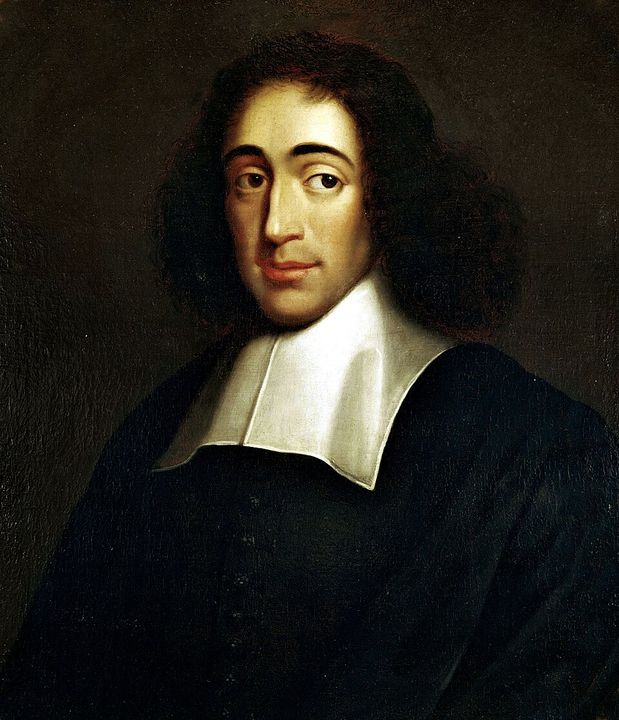
Baruch (Benedictus) de Spinoza (1632–1677) was a Dutch philosopher born in Amsterdam to a family of Portuguese Jewish merchants. In 1656 the Amsterdam Portuguese Jewish congregation pronounced a ban of excommunication (cherem) against him for his opinions. He supported himself partly by grinding optical lenses and lived quietly at Rijnsburg, Voorburg and The Hague, corresponding with scientists and scholars across Europe. He published only two works under his own name or with his involvement in his lifetime, an exposition of Descartes (1663) and the anonymous Theologico-Political Treatise (1670); his Ethics appeared after his death from a lung illness in 1677.
A Theologico-Political Treatise (Tractatus Theologico-Politicus) was published anonymously in Latin in Amsterdam in 1670, under a false Hamburg imprint, by the Dutch philosopher Baruch Spinoza. Its title page announces its purpose: to show that freedom to philosophize can be granted without harm to piety or the peace of the commonwealth, and cannot be withheld without destroying both.
Ethics Demonstrated in Geometrical Order is set out like Euclid: definitions, axioms, numbered propositions, proofs, corollaries and the discursive notes (scholia) where Spinoza speaks most freely. Its five parts lead from God to human blessedness.