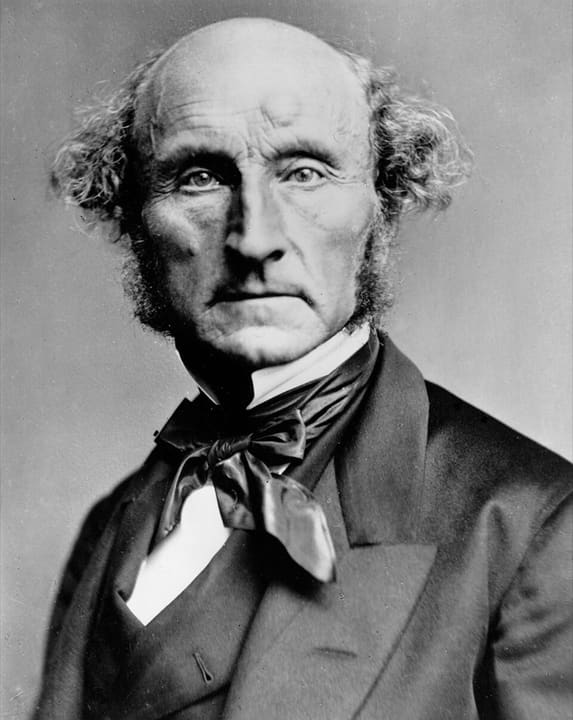
John Stuart Mill (1806–1873) was born in London and educated at home by his father, the historian and philosopher James Mill, who began teaching him Greek at three. He worked for the East India Company from 1823 until its government of India passed to the Crown in 1858. A System of Logic (1843) established his reputation and was followed by Principles of Political Economy (1848), On Liberty (1859), Considerations on Representative Government (1861), Utilitarianism (1861/1863), An Examination of Sir William Hamilton's Philosophy (1865) and The Subjection of Women (1869). He married Harriet Taylor in 1851, sat in Parliament for Westminster from 1865 to 1868, and died at Avignon in 1873. His Autobiography appeared posthumously the same year.
Considerations on Representative Government (1861)
The Subjection of Women (1869)
Autobiography (1873)
Frequently Cited
“That principle is, that the sole end for which mankind are warranted, individually or collectively, in interfering with the liberty of action of any of their number, is self-protection”
“If all mankind minus one, were of one opinion, and only one person were of the contrary opinion, mankind would be no more justified in silencing that one person, than he, if he had the power, would be justified in silencing mankind”
On Liberty, Ch. II, Of the Liberty of Thought and Discussion · Reader
“The creed which accepts as the foundation of morals, Utility, or the Greatest Happiness Principle, holds that actions are right in proportion as they tend to promote happiness, wrong as they tend to produce the reverse of happiness”
A System of Logic, Ratiocinative and Inductive, was published in London in 1843 in two volumes and went through eight editions in John Stuart Mill's lifetime, the last revised in 1872. Of its six books, the third, Of Induction, is the longest and the most influential; the library text gives that book alone, from an 1882 American printing of the eighth edition.
On Liberty asks what limits there are on the power society may legitimately exercise over the individual. Mill opens by observing that the old struggle between subjects and rulers has been transformed by democracy.
Considerations on Representative Government, published in London in 1861, is John Stuart Mill's full treatment of how a free people should be governed. Written in the years of debate over a second Reform Act, it gathers ideas Mill had developed in Thoughts on Parliamentary Reform (1859) and in his reading of Thomas Hare's scheme of proportional representation.
Utilitarianism is a short defence of the ethical theory Mill inherited from Jeremy Bentham and his own father. It was first published in three instalments of Fraser's Magazine in 1861 and as a book in 1863.
The Subjection of Women is John Stuart Mill's extended argument that the legal subordination of women to men in mid-Victorian Britain was wrong in principle and an obstacle to human improvement, and that it should give way to perfect equality before the law. Mill drafted it in 1860–1861, after the death of his wife Harriet Taylor Mill, and published it with Longmans in 1869.