Work record
A System of Logic, Book III: Of Induction
1843 · 19th Century · Philosophy · English
Abstract
Background. Victorian science was flourishing, and Herschel and Whewell had offered competing pictures of how it reaches general truths. Mill, a London civil servant trained in the empiricism of Locke, Hume and his father, set out to supply rules of evidence for experience as exact as those of the syllogism. This volume of the library holds only the third part, on inductive inference.
Argument. Reasoning from experience passes from cases examined to cases not examined, and its warrant is nature's regularity, a principle Mill thinks we ourselves learn late. Causes are the complete sets of conditions that a given result invariably follows. They are found by comparing instances and striking out circumstances, and where causes are tangled, as in the body or society, by reasoning from established laws and then checking the predictions.
Key Concepts. Five canons: Agreement, Difference, the Joint Method, Residues, Concomitant Variations. Plurality and intermixture of causes. Empirical laws versus explained laws. Legitimate hypotheses. Chance and probability. Grounds for disbelief, including testimony to miracles.
Significance. Studied for decades at Oxford and Cambridge, the book framed the classic dispute with Whewell over what the mind brings to discovery. Its canons still introduce students to causal inference in laboratory science, epidemiology and law, though Popper and others questioned whether science advances chiefly by induction.
Key figures
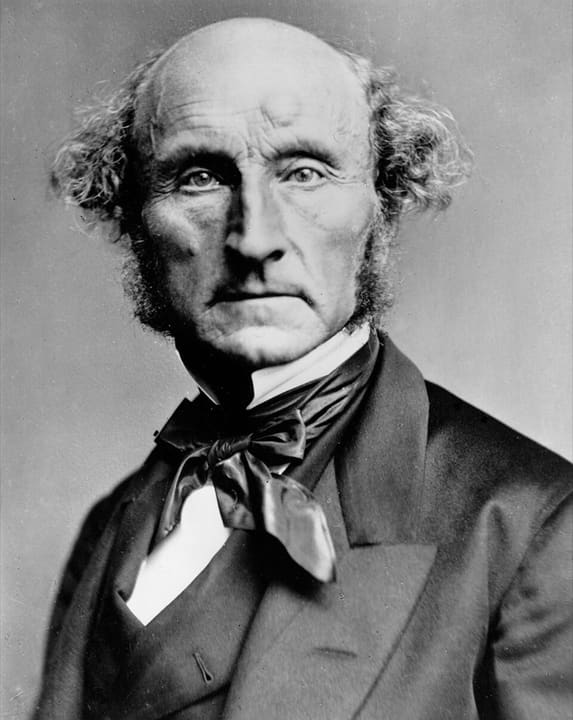
- John Stuart Mill: Empiricist philosopher building a logic for the natural and social sciences
- William Whewell: Master of Trinity College, Cambridge, and Mill's principal opponent on induction
- John Herschel: Astronomer whose 1830 discourse on scientific method Mill mines for examples
- Justus von Liebig: German chemist cited for his explanation of metallic poisons
- David Hume: Sceptic whose case against miracles closes the book

Summary
A System of Logic, Ratiocinative and Inductive, was published in London in 1843 in two volumes and went through eight editions in John Stuart Mill's lifetime, the last revised in 1872. Of its six books, the third, Of Induction, is the longest and the most influential; the library text gives that book alone, from an 1882 American printing of the eighth edition. Mill's aim is to explain how we can reason legitimately from observed facts to general truths, and so to give the empirical sciences a logic as rigorous as the syllogism had been for deduction. The book has twenty-five chapters. After preliminary remarks, Chapter II separates true induction from operations that only resemble it, and here Mill disputes William Whewell's account of Kepler: the ellipse, he insists, was in the facts before Kepler recognized it. Chapter III states the ground of induction. We infer not from past to future as such, but from the known to the unknown, and the warrant for every such inference is the uniformity of the course of nature, which Mill holds is itself the last and widest of our inductions. The chapter closes by asking why a single instance sometimes suffices for a universal conclusion while countless agreeing instances, such as the white swans Europeans had seen before Australia was explored, sometimes do not. Chapters IV and V treat laws of nature and the law of universal causation. Mill defines the cause of an event, philosophically speaking, as the sum total of its conditions, positive and negative, and argues that causation is invariable and unconditional sequence. After chapters on the composition of causes and on observation and experiment, Chapter VIII sets out the five canons for which the book is best known: the Methods of Agreement, Difference, the Joint Method, Residues and Concomitant Variations. Chapter IX illustrates them with Liebig's work on metallic poisons, Wells's theory of dew and other examples. The remaining chapters show the limits of these methods. Where many causes combine, as in medicine, physiology and society, direct experiment is weak, and Mill's example is the difficulty of learning whether mercury cures a disease; science must then rely on the deductive method, reasoning from known laws and verifying the conclusions. He goes on to explanation, hypotheses, empirical laws, chance and the calculation of probabilities, analogy, and approximate generalizations. The final chapter, on the grounds of disbelief, takes up Hume's argument on miracles and concludes that a miracle is not a breach of causation but a new effect ascribed to a new cause, so that the question turns on prior belief in such a cause. The Logic became a standard text at British universities, and Mill's methods remain the usual starting point for discussions of causal inference.
Virtues in this work
- Prudence: In Chapter X Mill warns that recoveries observed after a remedy prove little, and counsels careful comparison and verification before trusting a cure.
- Justice: Mill states Whewell's views at length and in later editions answers his reply, granting where he thinks Whewell is right about Kepler's process of guessing.
- Humility: He closes Chapter III by admitting that whoever can explain why one instance sometimes suffices has solved a problem the wisest of the ancients did not.
- Industry: Mill revised the work through eight editions over three decades, adding examples and replies to critics.
Plot or Argument
- Chapters I–II: what induction is, and what it is not
Induction is the operation of discovering and proving general propositions from particular facts. Mill excludes operations that only look inductive, such as summing up observed cases or describing facts under a new conception. Against Whewell he argues that Kepler's ellipse was a description of the observed path of Mars, found in the facts rather than added to them, and he answers Whewell's reply in later editions.
- Chapter III: the ground of induction
Every induction assumes that the course of nature is uniform. Mill denies that this is an intuition about the future; we reason from known to unknown cases in past, present and future alike. He calls uniformity the fundamental axiom of induction but holds that it is itself one of the last inductions we make, and he poses the problem of why one instance sometimes suffices and myriads sometimes do not.
- Chapters IV–V: laws of nature and the law of causation
Laws of nature are the fewest and simplest assumptions from which the whole order of nature could be inferred. The law of causation states that every event has an invariable antecedent. The cause is the whole set of conditions, positive and negative, on which the effect follows; ordinary speech singles out one condition, as when a man who has taken mercury goes out and catches cold. Causation is invariable and unconditional sequence, and Mill discusses the distinction of agent and patient, the continuance of effects and the relation of will to bodily motion.
- Chapters VI–VII: composition of causes; observation and experiment
In mechanics the joint effect of causes is the sum of their separate effects; in chemistry new properties often arise. Experiment varies circumstances at will and lets us take a cause and see what it produces; observation must wait for nature, and where experiment is impossible or limited, as in astronomy, mental philosophy, social science and physiology, deduction must take a larger part.
- Chapter VIII: the four methods of experimental inquiry
Mill states the five canons: the Method of Agreement, the Method of Difference, the Joint Method of Agreement and Difference, the Method of Residues and the Method of Concomitant Variations. He judges the Method of Difference the most powerful and stresses that each method works by eliminating circumstances that cannot be the cause.
- Chapter IX: examples of the methods
Mill illustrates the canons with Liebig's account of how salts of lead, mercury and arsenic kill by combining with animal tissue, Wells's theory of dew as described by John Herschel, and examples from heat, electricity and astronomy, including the use of residual phenomena to detect unknown causes.
- Chapters X–XI: plurality of causes and the deductive method
The same effect may have several causes, and the effects of different causes may mingle. Mill's test case is whether mercury is a remedy for a disease: simple observation yields nothing, experiment little, because so many conditions intervene, though a few specifics such as quinine and lime-juice are proved by direct trial. The remedy is the deductive method: induction of the separate laws, reasoning from them, and verification by observation.
- Chapters XII–XV: explanation, hypotheses and progressive effects
To explain a law is to show it as a case of a more general law. Hypotheses are legitimate when they suppose causes that can afterward be verified independently, and Mill discusses the limits of explanation and effects that accumulate over time.
- Chapters XVI–XXIV: empirical laws, chance and probable evidence
Empirical laws are uniformities not yet explained and are trustworthy only near the cases observed. Mill treats chance and its elimination, the calculation of chances, the extension of derived laws to adjacent cases, analogy, the evidence for the law of causation itself, uniformities of coexistence, approximate generalizations and the remaining laws of number, space and time.
- Chapter XXV: the grounds of disbelief
Mill asks when evidence should lead to disbelief rather than suspended judgement. He grants Hume that testimony cannot prove a miracle to one who does not already believe in a power able to work it, but argues that a miracle does not contradict causation, being a new effect ascribed to a new cause, and he criticizes Laplace's treatment of improbable coincidences.
Characters
- John Stuart Mill, author
Philosopher and East India Company official setting out an empiricist logic of the sciences.
- William Whewell, chief interlocutor
Cambridge philosopher and historian of science whose account of induction as the superinduction of ideas Mill disputes throughout.
- John Herschel, source
Astronomer whose Preliminary Discourse on the Study of Natural Philosophy supplies examples, including Wells's theory of dew.
- Johannes Kepler, test case
Whose discovery of the elliptical orbit of Mars Mill and Whewell interpret differently.
- Justus von Liebig, example
Chemist whose explanation of metallic poisoning illustrates the Methods of Agreement and Difference.
- David Hume, interlocutor
Whose argument on miracles Mill examines in the final chapter.
Lessons
From the known to the unknown
Mill argues that induction is not a matter of trusting that the future will resemble the past; we reason in the same way about the unobserved present and the unobserved past. Every such inference rests on the uniformity of nature, yet that uniformity is itself learned by experience. He leaves students with a hard question: why one careful experiment sometimes proves a law while a thousand agreeing observations, like the white swans, may not.
- Why does Mill say that time has nothing to do with the ground of induction?
- In what sense is the uniformity of nature both the axiom of induction and itself an induction?
- How would you answer Mill's question about the single instance and the myriad instances?
The cause is the whole set of conditions
In ordinary speech we name one condition as the cause of an event, but Mill insists that, philosophically speaking, the cause is the sum of all the conditions, positive and negative, on which the effect follows. A man who catches cold after taking mercury and going out of doors needed both conditions.
- Why does everyday language pick out one condition as the cause?
- What does Mill mean by a negative condition?
- How might Mill's view of causes change the way a doctor or a judge assigns responsibility?
Eliminate what cannot be the cause
The five canons of Chapter VIII all work by comparison and elimination. The Method of Difference, which compares a case where the effect occurs with one where it does not and which differ in only one circumstance, is the logic of the controlled experiment.
- State the Method of Agreement and the Method of Difference in your own words.
- Why does Mill consider the Method of Difference more powerful than the Method of Agreement?
- Why does Mill add that concomitant variation may show a connection 'through some fact of causation' rather than direct cause and effect?
Why medicine is hard to prove
Chapter X uses the question whether mercury cures a disease to show how many causes mingle in the body. Simple observation gives only vague impressions, and experiment is weakened by the many conditions of age, constitution and stage of illness. A few specifics, such as quinine, are strong enough to be proved directly; otherwise, Mill argues, medicine must combine known laws with careful verification.
- Why does Mill say simple observation of recoveries proves little about a remedy?
- Which remedies does he think are proved by direct experiment, and why?
- How do later practices such as comparison groups answer the difficulties Mill describes?
Context
Mill wrote when British natural science was expanding rapidly and philosophers were asking what made its methods reliable. John Herschel's Preliminary Discourse on the Study of Natural Philosophy (1830) and William Whewell's History of the Inductive Sciences (1837) and Philosophy of the Inductive Sciences (1840) offered rival accounts; Whewell held that discovery requires ideas supplied by the mind, while Mill defended an empiricist logic in the tradition of Locke and Hume. Mill also wished to show that the moral and social sciences could follow the same methods, which he took up in Book VI.
Composition
Mill worked on the Logic for more than a decade, from about 1830, while employed at the East India Company. His Autobiography records that reading Whewell's History and rereading Herschel helped him complete the theory of induction. John W. Parker published the book in London in two volumes in 1843. Whewell replied in 1849, and Mill answered him in later editions, which he revised repeatedly through the eighth edition of 1872. The library text is Harper's 1882 New York printing of the eighth edition, Book III only.
Reception
The Logic was a rare success for a philosophical treatise and became a textbook at Oxford and Cambridge for much of the century. The debate between Mill and Whewell over the role of ideas and hypotheses in discovery became a classic of the philosophy of science. Later critics, including W. S. Jevons and F. H. Bradley, attacked parts of the theory, and twentieth-century writers such as Karl Popper rejected the idea that science proceeds chiefly by induction, while others defended and refined Mill's methods as the basis of causal reasoning in experimental science, epidemiology and the law.
Comparisons
- whewell-novum-organon-renovatum
Whewell is Mill's chief opponent: he holds that induction superinduces a conception supplied by the mind upon the facts, while Mill holds that the conception is found in the facts. Reading both shows the strongest form of each side in the nineteenth-century debate.
- novum-organum
Bacon's tables of presence, absence and degrees anticipate Mill's Methods of Agreement, Difference and Concomitant Variations, and Mill praises Bacon for rejecting induction by simple enumeration.
- an-enquiry-concerning-human-understanding
Hume questioned how experience can justify expectation and argued against belief in miracles on testimony; Mill grounds induction on the uniformity of nature as itself learned from experience and partly accepts, partly limits, Hume's argument on miracles.
- popper-the-logic-of-scientific-discovery
Popper denied that science rests on induction and proposed falsification instead; Mill's discussion of white swans and of how a single instance may refute a universal is a useful point of comparison.
- bernard-introduction-to-experimental-medicine
Bernard, a generation later, makes controlled comparison the basis of physiology and medicine, giving practical form to the difficulties Mill describes in testing whether a remedy works.
- on-liberty
On Liberty applies to opinion the same conviction that knowledge grows through testing and correction; the Logic gives its epistemological background.
Quotes
“It is not from the past to the future, as past and future, that we infer, but from the known to the unknown; from facts observed to facts unobserved”
“the proposition that the course of nature is uniform, is the fundamental principle, or general axiom of Induction.”
“Why is a single instance, in some cases, sufficient for a complete induction, while in others, myriads of concurring instances, without a single exception known or presumed, go such a very little way toward establishing a universal proposition?”
“The ellipse was in the facts before Kepler recognized it; just as the island was an island before it had been sailed round.”
“The cause, then, philosophically speaking, is the sum total of the conditions, positive and negative taken together”
“If an instance in which the phenomenon under investigation occurs, and an instance in which it does not occur, have every circumstance in common save one, that one occurring only in the former; the circumstance in which alone the two instances differ, is the effect, or the cause, or an indispensable part of the cause, of the phenomenon.”
“there are some truths in medicine which are sufficiently proved by direct experiment.”
“is no contradiction to the law of cause and effect; it is a new effect, supposed to be produced by the introduction of a new cause.”
For Students
A reading companion for classical Christian high school students. See the student guide.
Reading Guide
Watch for
- Mill's distinction between real induction and operations that merely resemble it, and his quarrel with Whewell over Kepler.
- The claim that the uniformity of nature is both the axiom of induction and itself an induction.
- The definition of cause as the whole set of conditions, positive and negative.
- The five canons in Chapter VIII, and how each eliminates possible causes.
- The mercury example in Chapter X, which shows why combined causes defeat simple experiment, and the final chapter's treatment of Hume and miracles.
Key terms and names
- Induction
- In Mill's usage, the operation of discovering and proving general propositions from particular observed facts.
- Uniformity of nature
- The principle that what happens once will, under a sufficient degree of similarity of circumstances, happen again.
- Method of Difference
- Comparing a case where an effect occurs with one where it does not, alike in every circumstance but one, to identify that circumstance as cause or effect.
- Method of Concomitant Variations
- Inferring a causal connection when one phenomenon varies whenever another varies in a particular way.
- Plurality of causes
- The fact that the same effect can be produced by different causes, which weakens the Method of Agreement.
- Colligation
- Whewell's term, adopted by Mill in a restricted sense, for binding observed facts together under a single conception.
Seminar Questions
- Comprehension What does Mill mean when he says that we infer from the known to the unknown, not from the past to the future?
- Comprehension State the Method of Agreement and the Method of Difference, and give an example of each.
- Comprehension Why does Mill think it is so hard to prove that mercury cures a disease?
- Interpretation Mill says the uniformity of nature is the axiom of induction and also an induction itself. Is this circular? How does he try to avoid circularity?
- Interpretation Who has the better account of Kepler's discovery, Mill or Whewell? What does each think the mind contributes?
- Interpretation Why does Mill turn to the deductive method in sciences where causes are many and mixed?
- Big Question Can experience alone justify our confidence that nature is orderly, or must that confidence come from somewhere beyond experience?
- Big Question Mill concludes that the credibility of a miracle depends on prior belief in a being able to work it. Is that a fair statement of the question?
Faith Connections
- Genesis 8:22 (Scripture)
God's promise that seedtime and harvest, cold and heat, summer and winter shall not cease gives a theological ground for the regularity of nature that Mill treats as learned from experience.
- 1 Thessalonians 5:21 (Scripture)
'Prove all things; hold fast that which is good' expresses the habit of testing claims that Mill's methods systematize.
- Augustine, City of God XXI.8 (Church Fathers)
Augustine argues that a miracle is not contrary to nature but contrary to what is known of nature; Mill's description of a miracle as a new effect from a new cause, not a breach of causation, can be read alongside him.
- Hume, An Enquiry Concerning Human Understanding, Sections IV–V and X (Great Conversation)
Hume's sceptical questions about induction and his essay on miracles are the background against which Mill builds and limits his own position.
Logic and Rhetoric
Central argument: All inference from experience goes from the known to the unknown and rests on the uniformity of nature, which is itself the widest generalization from experience. The most important uniformity is the law of causation: every event has a set of conditions on which it invariably and unconditionally follows. Causes can be identified by comparing instances and eliminating circumstances that cannot be the cause, according to the methods of agreement, difference, residues and concomitant variations. Where many causes combine and experiment is weak, science must deduce from known laws and verify the results. Therefore induction, properly conducted, is a rigorous logic of proof and not merely a habit of expectation.
Rhetorical device: analogy. Against Whewell, Mill compares Kepler's recognition of the ellipse to discovering that a piece of land is an island by sailing round it: the island was an island before the voyage, as the ellipse was in the facts before Kepler saw it (see quote 4).
Debate: Resolved: That the scientific mind discovers order in the facts rather than supplying it to them.
Memory Work
It is not from the past to the future, as past and future, that we infer, but from the known to the unknown; from facts observed to facts unobserved
The ellipse was in the facts before Kepler recognized it; just as the island was an island before it had been sailed round.
Writing Prompts
Essay: Choose a question of cause and effect from science, medicine or everyday life. Explain how Mill's Method of Difference could be used to answer it, and what obstacles from Chapter X would stand in the way.
Comparison with Novum Organon Renovatum: Compare Mill's and Whewell's accounts of induction, using Kepler as the test case. Which account better explains how discoveries are actually made, and which better explains how they are proved?
Medical Lens
Book III is a key text in the history of therapeutic reasoning. Chapter X uses the question whether mercury cures a disease to show why simple observation of recoveries proves little and why the many conditions of age, constitution and stage of illness defeat crude experiment; Mill concludes that only strong specifics such as quinine, colchicum, lime-juice and cod-liver oil are proved by direct trial. His Method of Difference states the logic later embodied in controlled comparison, and his account of the plurality and intermixture of causes anticipates the problem of confounding in clinical and epidemiological inference. Chapter IX discusses Liebig's explanation of metallic poisoning, and Chapter VII the poison urali (curare) as an example of reasoning from effect to cause. Mill also treats the relation of volition to nerves and muscles and the limits of experiment in mental philosophy. Readers should take these as illustrations within a logic, not as clinical guidance of his day or ours.
- Book III, Ch. X, §§ 6–8
The extended example of testing mercury as a remedy, comparing the deductive, experimental and observational methods, and the remark on specifics such as quinine.
- Book III, Ch. IX, § 1
Liebig's account of how arsenious acid and salts of lead, copper and mercury destroy life by combining with animal tissue, used to illustrate the first two methods.
- Book III, Ch. VII, § 4
The poison urali, known from the arrows of Guiana, as an example of discovering an effect by experiment or a cause by observation.
- Book III, Ch. V, § 3
The man who takes mercury, goes out of doors and catches cold, used to show that the cause is the whole set of conditions.
- Book III, Ch. V
Discussion of volition, nerves and muscles in the production of bodily motion, and of the continuance of effects such as brain-fever after sunstroke.
Creative Prompts
- Classroom
Design a simple experiment on plant growth or dissolving rates using the Method of Difference. Then list every circumstance you had to hold constant and discuss which ones you could not control.
- Dialogue
Write a conversation between Mill and Whewell on Kepler's discovery of the ellipse, each stating the other's position fairly before answering it.
- Essay
Mill asks why one instance sometimes proves a law while many instances sometimes do not. Using the white swans and an example of your own, explain the problem and propose an answer.
Further Reading
- Autobiography, John Stuart Mill
Mill's account of his education and of writing the Logic.
- Preliminary Discourse on the Study of Natural Philosophy, John Herschel
The 1830 work Mill drew on for examples and rules of inquiry.
- The Philosophy of the Inductive Sciences, William Whewell
Whewell's rival account of induction, which Mill answers throughout Book III.
- John Stuart Mill: Victorian Firebrand, Richard Reeves
- Mill, John Skorupski
A philosophical study that treats the Logic at length.
Verification notes
Structure, chapter titles, arguments and all quotations are taken from the stored text of Book III (8th edition, Harper, 1882). Chapter and section numbers for quotes and passages were checked against the section marks in the stored text. Publication facts (Parker, 1843; eight editions to 1872; Whewell's 1849 reply) and the account of the book's reception follow standard histories and Mill's Autobiography. The quotation from Chapter XXV begins after the parenthetical credit to Thomas Brown in the source sentence, whose subject is 'A miracle'.
- The span of years Mill spent writing the Logic, given here as from about 1830.
- Page references in a standard edition (e.g. the Collected Works, vols. VII–VIII) for the quotations.