Work record
The Roman History
c. 390 CE · Ancient · History · Latin
Abstract
Background. A Greek-speaking staff officer who had served on two frontiers retired to Rome and set out, in Latin, to carry Roman history on from Nerva. He finished around 390, a decade after the Gothic war that ends his account.
Scope. Eighteen extant books treat a quarter-century in close detail: the execution of Gallus, Julian's Rhine victories, the Persian invasions, Julian's single reign, the brothers Valentinian and Valens, and the Gothic catastrophe of 378.
Content. The heart of the work is Julian: proclaimed by his soldiers at Paris, he reopens temples, recalls rival bishops and dies of a spear wound during the retreat from Ctesiphon. Later books turn to sorcery trials, Britain and Africa, and the Danube refugees whose ill-treatment precedes Valens's death.
Method. Ammianus joins memoir to research, inserting himself at Amida and on campaign, and breaks the narrative with learned digressions on plague, earthquakes, Persia and the Huns. Formal character sketches at each reign's end weigh each emperor's virtues and vices.
Significance. Often called the last great Latin historian of antiquity, he is the indispensable witness for Julian and Adrianople. Gibbon praised his accuracy, and modern scholars test his account of Goths, Persians and Huns against coins, inscriptions and excavation while still following his narrative.
Key figures
- Julian: Caesar in Gaul, then emperor; restorer of the old cults, killed in Persia
- Constantius II: Constantine's son, ruling until his death from fever in 361
- Ursicinus: Ammianus's commander in Gaul and the East
- Shapur II: Persian king whose army takes Amida
- Valentinian I and Valens: Brother emperors of West and East from 364
- Fritigern: Gothic chief victorious near Adrianople
- Ammianus Marcellinus: Officer-narrator present at Cologne, Amida and on the Persian march

Summary
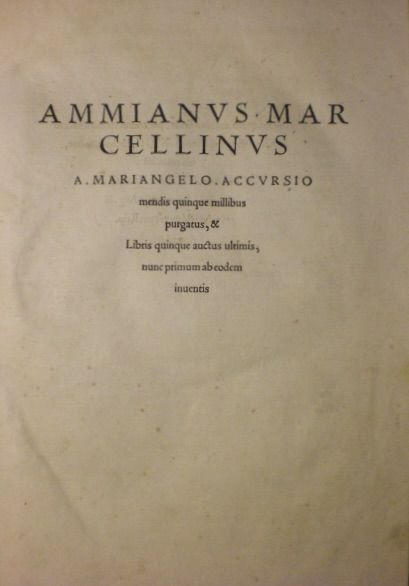
Ammianus Marcellinus wrote his history in thirty-one books, beginning with the accession of Nerva in AD 96, where Tacitus had stopped, and ending with the Gothic victory at Adrianople in 378. The first thirteen books are lost. The surviving Books XIV-XXXI cover only about twenty-five years, 353 to 378, which Ammianus had largely lived through, and they are the fullest narrative of the fourth-century empire. Book XIV opens with the harsh rule of the Caesar Gallus at Antioch and his execution in 354. Ammianus then follows his own commander, Ursicinus, to Gaul, where they put down the usurper Silvanus at Cologne in 355. Constantius II appoints his cousin Julian as Caesar in Gaul; Books XVI-XVIII narrate Julian's campaigns against the Alamanni, including the victory at Strasbourg in 357, alongside Constantius's state visit to Rome. In the East the Persian king Shapur II invades, and in 359 Ammianus is inside Amida during its siege and fall, escaping by night. Book XX tells how the Gallic troops proclaim Julian Augustus at Paris in 360; civil war is averted only by Constantius's death from fever in Cilicia in 361. Books XXII-XXV are the centre of the work. Julian, sole emperor, reforms the court, restores the temples and sacrifices, recalls exiled bishops of every party, tries to rebuild the Temple at Jerusalem, and quarrels with the people of Antioch. In 363 he invades Persia, reaches Ctesiphon, burns his fleet, and is mortally wounded by a spear in a skirmish during the retreat; Ammianus records his dying conversation on the soul and a long assessment of his virtues and faults. His successor Jovian makes a humiliating peace, surrendering Nisibis, and dies within months. Books XXVI-XXX treat the brothers Valentinian in the West and Valens in the East: the usurpation of Procopius, wars on the Rhine and Danube, the great barbarian raids on Britain and their repulse by the elder Theodosius, the revolt of Firmus in Africa, treason and magic trials at Rome and Antioch, and Valentinian's death from a burst blood vessel in a fit of rage in 375. Book XXXI describes the Huns and Alans, the Goths' flight across the Danube in 376, their mistreatment by Roman officials, the war in Thrace, and the battle near Adrianople on 9 August 378, where Valens and much of his army are killed. The history closes with Ammianus's farewell, signed as a Greek and a former soldier. Digressions on Rome's vices, Egypt, Persia, earthquakes, eclipses, obelisks and plague give the work an encyclopedic range. C. D. Yonge's translation was first published in Bohn's Classical Library in 1862; the library text is a later Bell reprint.
Virtues in this work
- Fortitude: The garrison of Amida, Ammianus among them, holds out for seventy-three days against Shapur's army before the walls are breached.
- Temperance: Ammianus praises Julian's chastity, plain food and short sleep, and holds up sober provincial bishops as a model against Roman luxury.
- Justice: Ammianus condemns Julian's law against Christian teachers even while admiring him, an act of fairness toward those outside his own religion.
- Prudence: Valens's refusal to wait for Gratian's army before attacking at Adrianople shows by contrast what prudent command would have required.
Plot or Argument
- Books XIV-XV: Gallus, Silvanus and the making of a Caesar
The surviving text opens in 353 with the cruelty of Gallus at Antioch and his recall and execution. Ammianus, serving under Ursicinus, recounts the suppression of Silvanus at Cologne and Constantius's choice of Julian as Caesar for Gaul.
- Books XVI-XIX: Julian in Gaul and the siege of Amida
Julian wins over his troops and defeats the Alamanni at Strasbourg, while Constantius makes his ceremonial entry into Rome. Shapur II attacks Mesopotamia, and Ammianus gives an eyewitness account of the siege and fall of Amida in 359, with a digression on the causes and kinds of pestilence.
- Books XX-XXI: Julian proclaimed Augustus
Ordered to send troops east, Julian is acclaimed Augustus at Paris. Both emperors prepare for war, and Julian marches down the Danube until Constantius dies of fever at Mopsucrenae in November 361.
- Books XXII-XXIII: Julian's reign and the march east
Julian purges the court, restores pagan cult, recalls exiled bishops, attempts to rebuild the Jerusalem Temple, and winters at Antioch. Book XXIII begins the Persian expedition with a long description of the Persian kingdom.
- Books XXIV-XXV: The Persian campaign and Julian's death
The army descends the Euphrates and reaches Ctesiphon, then retreats after the fleet is burned. Julian is speared in a skirmish and dies discussing the nobility of the soul; Ammianus weighs his character. Jovian is chosen emperor, cedes Nisibis and five provinces beyond the Tigris, and dies at Dadastana.
- Books XXVI-XXVII: Valentinian, Valens and Procopius
Valentinian is chosen emperor and takes Valens as colleague. Procopius, Julian's kinsman, seizes Constantinople and is defeated. Wars with the Alamanni follow, and the contest between Damasus and Ursinus for the see of Rome ends in bloodshed.
- Books XXVIII-XXX: Trials, frontiers and Valentinian's death
Ammianus narrates treason and sorcery prosecutions at Rome and Antioch, the recovery of Britain by the elder Theodosius, the revolt of Firmus in Africa and the frontier wars. Valentinian dies of a seizure while raging at Quadic envoys at Brigetio.
- Book XXXI: The Goths and Adrianople
The Huns drive the Goths to the Danube; admitted into Thrace, they are starved and cheated by Roman officers and rise in revolt. Valens marches against them without waiting for Gratian and is killed in the disaster near Adrianople. Ammianus closes with an epilogue on his aims and his successors.
Characters
- Ammianus Marcellinus, narrator and participant
Officer on Ursicinus's staff who appears in the narrative at Cologne, Amida and in Persia.
- Ursicinus, Roman general
Ammianus's commander, a loyal soldier repeatedly undermined at court.
- Constantius II, emperor, 337-361
Son of Constantine, suspicious of rivals, portrayed as dignified but swayed by courtiers.
- Gallus, Caesar in the East
Julian's half-brother, whose cruelty at Antioch leads to his execution.
- Julian, Caesar, then emperor, 361-363
Philosopher-soldier and restorer of pagan cult; the hero of the history, though not without faults.
- Shapur II, king of Persia
Long-reigning Sasanian ruler who besieges Amida and later gains Nisibis.
- Jovian, emperor, 363-364
Officer chosen after Julian's death who makes peace with Persia.
- Valentinian I, emperor in the West, 364-375
Able, energetic and violently tempered ruler.
- Valens, emperor in the East, 364-378
Valentinian's brother, killed at Adrianople.
- Procopius, usurper
Kinsman of Julian who seizes Constantinople in 365.
- Theodosius the Elder, Roman general
Restores order in Britain and fights Firmus in Africa; father of the later emperor Theodosius I.
- Fritigern, Gothic leader
Chief of the Goths admitted into Thrace who leads them to victory at Adrianople.
Lessons
A soldier writes what he saw
Ammianus was at Cologne in 355, inside Amida in 359 and on the Persian march of 363, and he moves between his own experience and the larger narrative. His eyewitness chapters are among the most vivid in ancient historiography. Students can see how participation gives a historian both authority and a point of view.
- How does the narrative change when Ammianus himself appears, as in the escape from Amida?
- What does his loyalty to Ursicinus lead him to stress or excuse?
- Why does he sign the work as a Greek and a former soldier?
Julian measured in full
Ammianus admired Julian and shared his religion, yet he criticizes Julian's superstition, his love of popularity and his law barring Christian teachers. His assessment in Book XXV lists virtues and faults side by side. The portrait shows how a historian can honour a hero without hiding his errors.
- Which of Julian's actions does Ammianus praise most, and which does he condemn?
- How does Ammianus's account of Julian's death recall the deaths of philosophers and generals of the past?
- Can admiration and honest criticism coexist in a single portrait?
Disaster from mismanagement
Book XXXI shows that the Goths' crossing in 376 became a war because Roman officials exploited the hungry refugees, and that Valens fought at Adrianople without waiting for his nephew Gratian. Ammianus treats the defeat as the result of human choices as well as fortune.
- What decisions by Lupicinus and Maximus turn the Goths from settlers into enemies?
- Why does Valens attack before Gratian's army arrives?
- Why does Ammianus compare Adrianople with Cannae?
Religion in a divided age
Ammianus writes as a believer in the traditional gods during the decades when Christianity became the faith of the court. He records Julian's sharp judgment on quarrelling sects and the bloodshed at the election of Damasus, but also praises sober provincial bishops and calls Julian's ban on Christian teachers cruel.
- How fair is Ammianus to Christians, judging from Books XXII and XXVII?
- What kind of bishop does Ammianus admire, and why?
- Why might Julian have expected Christian disunity to help his restoration of the old cults?
Context
The fourth-century empire was ruled by Constantine's family until 363 and then by the house of Valentinian. Emperors spent their reigns on the frontiers, facing the Alamanni on the Rhine, Sasanian Persia in Mesopotamia and, after 376, the Goths within the Danube provinces. Christianity, favoured since Constantine, became the dominant religion of the court, while Julian's brief reign (361-363) attempted a revival of the traditional cults. Ammianus lived through all of this as a soldier and wrote it up as a civilian in Rome.
Composition
Ammianus seems to have reached Rome around 380 and composed the history there in the later 380s, completing it by about 390 or 391; internal references, such as his mention of the Serapeum as still standing in Alexandria, help with the dating. He wrote in Latin though Greek was his native language, and he may have given public readings of parts of it. The first thirteen books, covering 96 to 353, were lost before the medieval manuscripts were copied; the surviving books depend chiefly on a ninth-century manuscript now in the Vatican (Vat. lat. 1873) and are damaged in places. C. D. Yonge's English translation appeared in Bohn's Classical Library in 1862.
Reception
Ammianus was little cited in late antiquity, though Priscian quotes him. Since the Renaissance he has been valued as the last great Latin historian of Rome and as the main narrative source for 353-378. Edward Gibbon relied on him heavily and praised his accuracy, and modern historians of Julian, the Persian wars and the Gothic war build on his narrative while debating his bias toward Ursicinus and Julian and the extent of his knowledge of Christianity.
Comparisons
- tacitus-the-histories
Ammianus began his history at Nerva, where Tacitus's ended, and both write as senatorial or military insiders who close portraits with judgments on emperors; his self-description as truthful echoes Tacitus's claim to write without hatred or favour.
- gibbon-decline-and-fall-selections
Gibbon's chapters on Julian and on the Gothic war are built from Ammianus, whom he praised as an accurate and faithful guide; reading the two together shows how an Enlightenment historian reshaped a Roman source.
- heather-the-fall-of-the-roman-empire
Peter Heather's modern account of the Goths, the Huns and Adrianople uses Book XXXI as its central narrative source and tests it against archaeology.
- procopius-history-of-the-wars-persian-war
Procopius, two centuries later, writes another soldier-official's account of Rome's wars with Persia, with a similar mix of campaign narrative and personal observation.
- city-of-god
Augustine wrote City of God within a generation of Ammianus, answering pagan Romans who blamed Christianity for Rome's disasters; Ammianus shows the outlook of an educated traditionalist in the same world.
- the-history-of-the-peloponnesian-war
Ammianus cites Thucydides on the Athenian plague in his own digression on pestilence at Amida, placing himself in the line of Greek historians who wrote what they had suffered.
Quotes
Frequently cited
“Thus have I, a Greek by birth, and formerly a soldier, related all the events from the accession of Nerva to the death of Valens, to the best of my abilities; professing above all things to tell the truth, which, as I believe, I have never knowingly perverted, either by silence or by falsehood.”
Frequently cited
“no wild beasts are so hostile to men as Christian sects in general are to one another.”
Frequently cited
“Nor, except the battle of Cannæ, is so destructive a slaughter recorded in our annals;”
“Both philosophers and skilful physicians agree that excess of cold, or of heat, or of moisture, or of drought, all cause pestilences;”
“But his forbidding masters of rhetoric and grammar to instruct Christians was a cruel action, and one deserving to be buried in everlasting silence.”
“a cavalry spear, grazing the skin of his arm, pierced his side, and fixed itself in the bottom of his liver.”
“live in imitation of some of the priests in the provinces, whom the most rigid abstinence in eating and drinking, and plainness of apparel, and eyes always cast on the ground, recommend to the everlasting Deity and his true worshippers as pure and sober-minded men.”
“They never shelter themselves under roofed houses, but avoid them as people ordinarily avoid sepulchres as things not fitted for common use.”
For Students
A reading companion for classical Christian high school students. See the student guide.
Reading Guide
Watch for
- The chapters where Ammianus himself appears: the Silvanus affair at Cologne (XV.5), the siege and escape from Amida (XVIII.6-XIX.8), and the Persian march (XXIII-XXV).
- Julian's double portrait: his justice and courage beside his superstition and the school law, gathered in the assessment of XXV.4.
- The digressions on Rome's vices (XIV.6, XXVIII.4), on pestilence (XIX.4), on Persia (XXIII.6) and on the Huns (XXXI.2), and how each serves the story around it.
- Ammianus's remarks about Christians and bishops, including the Damasus and Ursinus riot (XXVII.3).
- The chain of decisions in Book XXXI that leads from the Danube crossing to Adrianople.
Key terms and names
- Protector domesticus
- A member of an elite corps of young officers attached to the emperor or a senior general; Ammianus served in this rank under Ursicinus.
- Caesar and Augustus
- In the fourth century, Augustus was the senior emperor and Caesar a junior partner; Julian's promotion from Caesar to Augustus at Paris in 360 nearly caused civil war.
- Amida
- Fortified Roman city on the upper Tigris (modern Diyarbakir), besieged and taken by Shapur II in 359 while Ammianus was inside.
- Nisibis
- Frontier city in Mesopotamia that Jovian surrendered to Persia in 363, a loss Ammianus treats as a disgrace.
- Digression (excursus)
- A planned departure from the narrative to describe a people, place or natural phenomenon; Ammianus uses them often to show his learning.
- Adrianople
- City in Thrace (modern Edirne) near which the Goths destroyed Valens's army on 9 August 378.
- Genius of the State
- The guardian spirit of the Roman people, which Julian reports seeing in visions at Paris and before his death.
Seminar Questions
- Comprehension How does Julian go from Caesar in Gaul to sole emperor between 355 and 361?
- Comprehension What happens to the Goths between their crossing of the Danube in 376 and the battle near Adrianople?
- Comprehension How does Ammianus escape from Amida, and what does he see on the way?
- Interpretation Ammianus admires Julian yet calls his school law cruel. What does this tell you about the kind of judge Ammianus wants to be?
- Interpretation Why does Ammianus describe Julian's death with a dialogue on the soul and a comparison to Epaminondas? What earlier deaths is he inviting readers to remember?
- Interpretation Ammianus blames both Roman officials and Valens's haste for Adrianople. Which cause does he present as more important, and how can you tell?
- Big Question Ammianus reports that fire drove workmen from Julian's attempt to rebuild the Temple at Jerusalem, and Christian writers read the same event as divine judgment. How should a historian handle events that different communities interpret in religious terms?
- Big Question Ammianus claims never to have perverted the truth by silence. Can a historian who leaves things out still tell the truth?
Faith Connections
- Matthew 24:1-2 (Scripture)
Jesus foretells that not one stone of the Temple will be left on another; Ammianus records Julian's failed attempt to rebuild it in 363 (XXIII.1), which Christian writers of the period saw as confirming the prophecy.
- 1 Timothy 3:2-3 (Scripture)
Paul asks that a bishop be sober, temperate and not given to greed; Ammianus, writing as a pagan, praises the same qualities in provincial clergy after the violent contest for the see of Rome.
- Gregory of Nazianzus, Orations 4 and 5 (Against Julian) (Church Fathers)
Gregory, who studied at Athens alongside Julian, wrote two invectives after the emperor's death, attacking above all the school law that Ammianus also judges harshly; reading both shows a pagan and a Christian agreeing on that point from opposite loyalties.
- Augustine, City of God, Book XVIII, ch. 52 (Church Fathers)
Augustine counts Julian's ban on Christian teachers of the liberal arts among the persecutions of the Church, the same measure Ammianus records in XXII.10.
Logic and Rhetoric
Central argument: A ruler's fate and the empire's depend on character: emperors who govern with justice, restraint and attention to counsel (Julian at his best) preserve the state, while those swayed by flatterers, anger or haste (Constantius's courtiers, Valentinian's rage, Valens at Adrianople) bring disaster; therefore the historian's task is to judge each ruler truthfully, praising and blaming without favour.
Rhetorical device: Exemplum (comparison with a famous historical case). In XXV.3.8 the wounded Julian calls for arms and a horse, and Ammianus compares him with Epaminondas asking for his shield at Mantinea; at XXXI.13.19 he measures Adrianople against Cannae.
Debate: Resolved: The Roman defeat at Adrianople was caused more by the mistreatment of the Goths in 376-377 than by Valens's decisions on the day of battle.
Memory Work
Thus have I, a Greek by birth, and formerly a soldier, related all the events from the accession of Nerva to the death of Valens, to the best of my abilities; professing above all things to tell the truth, which, as I believe, I have never knowingly perverted, either by silence or by falsehood.
But his forbidding masters of rhetoric and grammar to instruct Christians was a cruel action, and one deserving to be buried in everlasting silence.
Writing Prompts
Essay: Using Books XXII and XXV, write an essay on whether Ammianus's picture of Julian is a eulogy, a critique or a balanced judgment.
Comparison with The Histories: Ammianus set out to continue Tacitus. Compare how each historian narrates the death of an emperor (Galba or Otho in Tacitus; Julian or Valens in Ammianus) and what each death teaches about the empire.
Medical Lens
Ammianus is a rich source for late-Roman ideas of disease and for the deaths of emperors. His digression on pestilence at Amida (XIX.4) summarizes the inherited theory that extremes of heat, cold, moisture and drought, or air corrupted by corpses, cause epidemics, and sorts plagues into pandemic, epidemic and a fast-killing third kind; he cites Homer and Thucydides and says the garrison's sickness lifted after rain. Julian's spear wound to the liver, the physician's attempt to help him and his death by blood loss (XXV.3) form a detailed battlefield case. Constantius dies of fever (XXI.15); Jovian dies suddenly at Dadastana, and Ammianus reports competing explanations, including fumes from a newly plastered room and indigestion (XXV.10). Valentinian's fatal attack while shouting at envoys (XXX.6), with loss of speech, convulsions and death, is described closely; it is often read as a stroke, a hedged modern interpretation. The sorcery and poisoning trials at Rome and Antioch (XXVIII-XXIX) show how fear of magic and poison shaped prosecutions. Famine among the Goths in Thrace (XXXI.4) and Julian's visions before his death (XX.5, XXV.2) round out the material.
- Book XIX, ch. 4
Unburied dead at Amida breed pestilence; Ammianus explains the causes and three kinds of plague and the garrison's recovery after rain.
- Book XXI, ch. 15
Constantius II falls ill with fever on the march and dies at Mopsucrenae in Cilicia.
- Book XXV, ch. 3
Julian is speared through the side, cuts his fingers trying to pull out the weapon, is treated by a physician, and dies after losing blood while discussing the soul.
- Book XXV, ch. 10
Jovian dies suddenly at Dadastana; Ammianus gives the explanations current at the time, among them noxious fumes and overeating.
- Books XXVIII, ch. 1 and XXIX, ch. 1-2
Prosecutions at Rome and Antioch for sorcery and poisoning spread through the senatorial class.
- Book XXX, ch. 6
Valentinian, enraged at the Quadic envoys, loses his voice, is seized by convulsions and dies at Brigetio.
- Book XXXI, ch. 4
Starving Gothic refugees on the Danube are forced by Roman officers to trade for food on ruinous terms.
- Book XX, ch. 5 and Book XXV, ch. 2
Julian sees the Genius of the State in a vision at Paris and again, departing in grief, before his death.
Creative Prompts
- Fiction
Retell the night escape from Amida in 359 in Ammianus's voice as he might have described it to a friend in Rome thirty years later.
- Dialogue
Write a conversation between Julian and a Christian teacher of rhetoric at Antioch after the school law of 362, giving each his strongest case.
- Essay
Compare Ammianus's assessment of Julian (XXV.4) with his portraits of Valentinian (XXX.7-9) and Valens (XXXI.14). What standard of a good emperor do they share?
- Classroom
Map the Gothic crossing of 376 and the campaign of 378, marking each decision that Ammianus treats as a turning point.
Further Reading
- The Roman World of Ammianus, John Matthews
Standard modern study of the historian and his world.
- The Fall of the Roman Empire: A New History, Peter Heather
- The Decline and Fall of the Roman Empire, Edward Gibbon
Chapters 19-26 follow Ammianus closely.
- Julian the Apostate, G. W. Bowersock
- City of God, Augustine of Hippo
A Christian contemporary's account of Rome's history and providence.
Verification notes
Quotations were checked by search against the stored Yonge text (Project Gutenberg #28587, a Bell reprint of the 1862 Bohn translation); book, chapter and section numbers follow that text. The narrative outline, the dates of Strasbourg (357), Amida (359), Julian's death (363) and Adrianople (378) are standard. Ammianus's Antiochene birth rests on a letter of Libanius whose addressee some scholars dispute, so it is given as traditional.
- Ammianus's birth at Antioch and his dates (c. 330-c. 395) are traditional and debated.
- The exact date of completion (c. 390-391) is inferred from internal references.
- The shelfmark of the main manuscript (Vatican, Vat. lat. 1873) should be checked against a critical edition before citation.