Work record
The Library (Bibliotheca)
1st–2nd century AD · Ancient · Collection · Greek
Abstract
Background. Once credited to the Athenian scholar Apollodorus, the compilation cites a first-century BC chronicler and so belongs to the Roman imperial age; its real compiler is unknown. The Byzantine patriarch Photius read and summarized it in the ninth century.
Content. Successive books trace three great lineages: the children of Deucalion, ending with the Argo; the Argive descendants of Inachus, culminating in Heracles; and the house of Agenor at Thebes, with Arcadian, Spartan, Athenian and Cretan families. Where the manuscripts fail mid-way through Theseus, a later summary carries the narrative through Pelops, the Trojan War, the homecomings and Odysseus's last years.
Method. Prose is spare and factual, offering neither allegorical nor rationalizing explanations of the gods' deeds. Variants are set side by side and credited to Hesiod, Pherecydes, Acusilaus, Stesichorus or Euripides, preserving traces of many vanished poems.
Medicine and Madness. Notable episodes include Melampus curing the raving daughters of Proetus and Asclepius reviving corpses with Gorgon blood before Zeus's thunderbolt, together with the god-sent frenzies of Heracles, Agave and the Argive women.
Significance. As antiquity's sole surviving complete mythological compendium, it underlies nearly every modern handbook of Greek legend. Frazer's 1921 Loeb version, reproduced here without its notes, joined the main text with the Vatican and Sabbaitic epitomes.
Main characters
- Zeus: Youngest son of Cronus who wins rule of the cosmos
- Prometheus: Titan who shapes humankind and brings them fire
- Heracles: Son of Alcmena whose labours fill most of Book II
- Perseus: Slayer of Medusa and ancestor of Heracles
- Melampus: Prophet who heals the frenzied Argive women
- Oedipus: Answerer of the Sphinx and doomed Theban king
- Asclepius: Apollo's son, a healer slain for restoring the dead
- Theseus: Athenian who enters the labyrinth
- Ulysses: Planner of the Wooden Horse, wanderer homeward to Ithaca
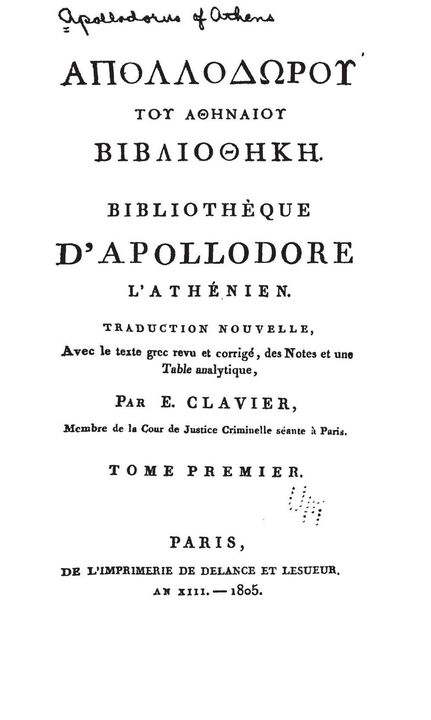

Summary
The Library is the only complete handbook of Greek mythology to survive from antiquity. In plain, compressed prose it tells the traditional stories of the gods and heroes in order, from the beginning of the world to the death of Odysseus, organized chiefly by family lines. Book I begins with Sky and Earth and their children, the Hundred-handed, the Cyclopes and the Titans; Cronus castrates his father and swallows his own children until Zeus, hidden in a Cretan cave, overthrows him. It then narrates the wars against the Giants and the monster Typhon, Prometheus's making of men and theft of fire, the flood survived by Deucalion and Pyrrha, and the descendants of Hellen, including the Calydonian boar hunt and Meleager, and ends with the full voyage of the Argonauts: Jason, the Golden Fleece, Medea, and their flight to Corinth. Book II follows the descendants of Inachus of Argos: Io, Danaus and his fifty daughters, Proetus and the maddened daughters whom the seer Melampus heals, Bellerophon, and Perseus with the Gorgon's head; then the longest single narrative in the work, the life of Heracles, his madness and killing of his children, the twelve labours for Eurystheus, his later adventures, his death on Mount Oeta and his deification, followed by the return of his descendants to the Peloponnese. Book III begins with the line of Agenor: Europa and the bull, Cadmus founding Thebes, the birth of Dionysus and the punishment of those who resisted him, Oedipus and the Sphinx's riddle, the Seven against Thebes and the Epigoni. It continues with the Arcadian families, the birth of Hermes, Asclepius the healer who raised the dead and was struck down by Zeus, the Spartan line of Tyndareus, Helen and the Dioscuri, the early kings of Athens, and Minos of Crete, breaking off in the story of Theseus. The rest survives only in an Epitome, a summary recovered from two Byzantine manuscripts in the 1880s and 1890s: Theseus and the Minotaur, the house of Pelops and Atreus, the causes and course of the Trojan War, the Wooden Horse and the sack of Troy, the returns of the Greek leaders, and the wanderings and death of Odysseus. The author constantly records variant versions and names his sources, among them Hesiod, Pherecydes, Acusilaus, Stesichorus and the tragic poets, which makes the Library a guide to lost early Greek literature. The library text is Sir James George Frazer's Loeb translation of 1921, without his extensive notes and appendices.
Virtues in this work
- Fortitude: Heracles endures twelve labours for Eurystheus, from the Nemean lion to Cerberus, to atone for his madness.
- Prudence: Oedipus saves Thebes by reasoning out the Sphinx's riddle after many have died failing to answer it.
- Piety: The Library's many stories of those punished for slighting Dionysus or Hera show the honor owed to the gods in Greek belief.
Plot or Argument
- Book I: Origins of the gods
Sky and Earth, the Titans, Cronus's swallowing of his children, Zeus's victory, the war with the Giants and the defeat of Typhon.
- Book I: Prometheus to the Argonauts
Prometheus fashions men and steals fire; Deucalion's flood; the families of Hellen, the Calydonian boar hunt, and the voyage of the Argo with Jason and Medea.
- Book II: The Argive line and Perseus
Io, Danaus and the Danaids, the madness of Proetus's daughters cured by Melampus, Bellerophon and the Chimera, and Perseus's quest for Medusa's head.
- Book II: Heracles
Heracles's birth and youth, his madness, the twelve labours for Eurystheus, his servitude to Omphale, his death on Oeta and the return of the Heraclids.
- Book III: Thebes
Europa and Cadmus, the birth of Dionysus, Pentheus and other resisters, Oedipus and the Sphinx, the Seven against Thebes, the Epigoni and Alcmaeon.
- Book III: Arcadia, Sparta, Athens and Crete
The Arcadian families and Atalanta, Hermes, Asclepius, Tyndareus and Helen, the kings of Athens, Minos and Daedalus; the book breaks off with Theseus.
- Epitome: Theseus and the house of Atreus
Theseus's journey and the Minotaur, Ariadne, Daedalus and Icarus; Tantalus, Pelops, Atreus and Thyestes.
- Epitome: The Trojan War
The judgment of Paris, the gathering at Aulis, the war's ten years, the Wooden Horse and the sack of Troy.
- Epitome: The returns and Odysseus
The storms and fates of the returning Greeks, Agamemnon's murder and Orestes, and the wanderings, homecoming and varied accounts of the death of Odysseus.
Characters
- Zeus, king of the gods
Hidden from Cronus as an infant, he overthrows the Titans and rules among the Olympians.
- Prometheus, Titan
Moulds men from water and earth, steals fire for them, and is chained on the Caucasus.
- Heracles (Hercules), hero
Son of Zeus and Alcmena whose madness, labours and deification form the center of Book II.
- Perseus, hero
Beheads the Gorgon Medusa and rescues Andromeda.
- Jason and Medea, Argonaut and sorceress
Win the Golden Fleece together and flee from Colchis to Iolcus and Corinth.
- Melampus, seer and healer
Understands the speech of animals and cures the maddened daughters of Proetus.
- Oedipus, king of Thebes
Solves the Sphinx's riddle and unknowingly marries his mother.
- Asclepius (Aesculapius), healer
Son of Apollo, taught by Chiron, who raises the dead and is struck by Zeus's thunderbolt.
- Theseus, Athenian hero
Kills the Minotaur with Ariadne's help; his story is completed in the Epitome.
- Ulysses (Odysseus), Greek hero
Devises the Wooden Horse and, after long wanderings, returns to Ithaca.
Lessons
A map of the myths
The Library arranges hundreds of myths by family trees, so the reader sees how Perseus, Heracles, Oedipus and Agamemnon belong to connected houses. It is the backbone behind the epics and tragedies, and reading it shows how the Greeks thought of their past as a vast genealogy.
- Why might a writer organize myths by family lines rather than by theme?
- How does knowing Heracles's ancestry through Perseus change how you read his story?
- Which family in the Library seems most burdened by its own history?
Many versions, honestly reported
The author repeatedly says 'some say' and names Hesiod, Acusilaus, Pherecydes or Euripides for different versions, as with the cause of the madness of Proetus's daughters. The Library models careful scholarship that records disagreement instead of hiding it.
- Why does the author give more than one cause for the madness of Proetus's daughters?
- What is gained and lost by reporting variants rather than choosing one?
Pride and its limits
Again and again mortals who compete with gods, from Niobe to the resisters of Dionysus, are destroyed, and even the healer Asclepius is struck down when he raises the dead. The Library records a world in which the boundary between human and divine must not be crossed.
- Why does Zeus kill Asclepius, according to the Library?
- Is Prometheus punished for pride or for kindness to mankind?
- How does the Library present the limits placed on human power?
Labour and endurance
Heracles performs his labours as penance after killing his children in madness, and is promised immortality when they are done. The Library presents heroic endurance as a path through guilt toward a reward.
- Why must Heracles serve Eurystheus?
- How do the labours change the meaning of his earlier crime?
Context
The Library belongs to the Roman imperial period, when Greek scholars compiled handbooks, commentaries and summaries of the classical heritage for readers who no longer had all the older poems at hand. It draws on early epic and genealogical poetry, on prose mythographers such as Pherecydes and Acusilaus, and on Athenian tragedy, many of which are now lost. Its author refers to these sources by name and makes no attempt to explain the myths allegorically or rationally.
Composition
The work is dated to the 1st or 2nd century AD because it cites Castor of Rhodes; the traditional attribution to Apollodorus of Athens (2nd century BC) is now generally rejected. The patriarch Photius summarized it in the 9th century. The surviving manuscripts break off in Book III with Theseus; the remainder is known from an epitome found in a Vatican manuscript and published by Richard Wagner in 1885, and from fragments in a manuscript of the monastery of St Sabbas published by Papadopoulos-Kerameus in 1891. Frazer's Loeb edition (1921) combined these sources.
Reception
The Library has served for centuries as the standard reference for Greek myth, used by Byzantine scholars, Renaissance mythographers and modern handbook writers. Frazer's edition, with notes drawing on comparative anthropology, was itself an influential work of scholarship.
Comparisons
- metamorphoses
Ovid tells many of the same myths, Io, Perseus, Cadmus, Daedalus, with poetic transformation as the thread; Apollodorus gives the bare stories in genealogical order with sources named.
- the-iliad
The Epitome summarizes the whole Trojan War in a few pages, placing the episode of Achilles's wrath that Homer expands into an epic within the full cycle from Paris's judgment to the sack.
- argonautica
Apollonius's epic of the Argo and the Library's prose account in Book I cover the same voyage; comparing them shows how a poet elaborates and a mythographer compresses.
- the-theban-plays
Book III gives the whole Theban saga, from Cadmus to the Epigoni, in which Sophocles's Oedipus and Antigone are single episodes.
- hippocratic-writings
The Library's legends of Melampus, first to cure by drugs and purifications, and of Asclepius the healer show the mythical prehistory that the Hippocratic physicians claimed and also set aside.
- bulfinch-age-of-fable
Bulfinch retells many of the same myths for nineteenth-century readers, drawing largely on Ovid, whereas the Library is an ancient Greek compendium that reports its sources.
Quotes
Frequently cited
“Sky was the first who ruled over the whole world.”
Frequently cited
“Prometheus moulded men out of water and earth and gave them also fire, which, unknown to Zeus, he had hidden in a stalk of fennel.”
Frequently cited
“What is that which has one voice and yet becomes four-footed and two-footed and three-footed?”
“being a seer and the first to devise the cure by means of drugs and purifications”
“The Pythian priestess then first called him Hercules, for hitherto he was called Alcides.”
“having become a surgeon, and carried the art to a great pitch, he not only prevented some from dying, but even raised up the dead”
“Zeus, fearing that men might acquire the healing art from him and so come to the rescue of each other, smote him with a thunderbolt.”
“he invented the construction of the Wooden Horse and suggested it to Epeus, who was an architect.”
For Students
A reading companion for classical Christian high school students. See the student guide.
Reading Guide
Watch for
- How the author moves from family to family, and how often a new story begins with a genealogy.
- The phrases some say and according to, followed by the name of an older poet or historian.
- Heracles's madness and penance in Book II.4.12 before the labours begin.
- Asclepius in Book III.10 and the reason Zeus gives for killing him.
- The change in Book III where the manuscripts break off and the Epitome takes over.
Key terms and names
- Mythographer
- A writer who collects and records myths in prose rather than retelling them as poetry; the author of the Library is the best-preserved ancient example.
- Epitome
- A summary; the end of the Library survives only in two Byzantine summaries, covering Theseus, the Trojan War and the returns.
- Genealogy
- A record of descent; the Library is organized by the families of Deucalion, Inachus and Agenor.
- Purification
- A ritual cleansing from blood-guilt or pollution, sought by Heracles, Bellerophon, Alcmaeon and others after killing.
- Labours of Heracles
- The tasks imposed by Eurystheus, from the Nemean lion to Cerberus; the Pythian priestess orders ten, and two more are added.
- Pseudo-Apollodorus
- The name scholars use for the unknown author, since the work cannot be by the earlier Apollodorus of Athens.
Seminar Questions
- Comprehension How does Zeus come to power in Book I?
- Comprehension Why does Heracles have to perform labours for Eurystheus?
- Comprehension What is the Sphinx's riddle, and how does Oedipus solve it?
- Interpretation The author often gives two or three versions of a story without choosing between them. What does this suggest about how the Greeks held their myths?
- Interpretation Why might Zeus fear that men would come to the rescue of each other through Asclepius's art?
- Interpretation Many stories in Book III punish those who refuse to honor Dionysus. What picture of the gods do these stories give?
- Big Question Are there limits to what human skill, especially medicine, should try to do?
Faith Connections
- Genesis 6-9 (Scripture)
The Library's flood, survived by Deucalion and Pyrrha in a chest, invites comparison with Noah's ark; students can weigh the different reasons each account gives for the flood and the different covenant that follows.
- John 11:1-44 (Scripture)
Asclepius is killed for raising the dead; in the Gospel Christ raises Lazarus as a sign of the life he gives, and calls himself the resurrection and the life.
- Augustine, City of God VI-VII (Church Fathers)
Augustine discusses Varro's division of theology into the mythical, the civil and the natural, and examines the stories of the poets; his argument helps students see how early Christians read the Greek and Roman myths.
Logic and Rhetoric
Central argument: The Library treats myth as history: the gods and heroes descend from one another in traceable lines from the first rulers of the world to the generation after Troy. Because every story belongs to a family, every hero's fate is connected to the deeds of ancestors. The work therefore presents the Greek past as one continuous, ordered genealogy, while honestly recording where the sources disagree.
Rhetorical device: catalogue. Lists of names, such as the Titans in Book I.1.3, the Argonauts in Book I.9.16 and the suitors of Penelope at the end of the Epitome, give the work its encyclopedic character.
Debate: Resolved: that a reference book like the Library is a better introduction to Greek myth than the poems of Homer or Ovid.
Memory Work
What is that which has one voice and yet becomes four-footed and two-footed and three-footed?
Writing Prompts
Essay: Using Book II, explain how Heracles's madness, penance and labours fit together into one story of guilt and reward.
Comparison with The Theban Plays: Compare the Library's brief account of Oedipus in Book III.5 with Sophocles's Oedipus the King, and explain what the playwright adds to the bare story.
Medical Lens
The Library preserves several founding legends of Greek medicine and madness. Melampus is called the first to cure by drugs and purifications, and his cure of the daughters of Proetus, who wander the countryside in a frenzy, is achieved by a chase with shouts and frenzied dancing followed by purification; the Library reports two religious causes for their madness (rejecting the rites of Dionysus, according to Hesiod, or slighting Hera's image, according to Acusilaus), and the story is an early document of the idea that madness can be treated. Asclepius, trained by Chiron in healing and called a surgeon, raises the dead with the Gorgon's blood, using the blood of one side as a poison and of the other as a cure, until Zeus kills him lest men rescue one another from death; the episode stands at the head of the long debate about the proper limits of medicine. Chiron's incurable arrow wound, the regrowing liver of Prometheus, the divine madness that drives Heracles, Lycurgus, Agave and the Argive women to kill, and the Furies that pursue Alcmaeon after matricide show the Greek habit of describing mental disturbance as sent by gods. These are mythical narratives; modern labels for them are interpretations.
- Book II.2.2
The daughters of Proetus go mad and roam the land; Melampus demands a share of the kingdom, then cures them by a pursuit and purification, though the eldest dies.
- Book III.10.3-4
Asclepius learns healing from Chiron, raises the dead with the Gorgon's blood, and is struck down by Zeus.
- Book II.4.12
Heracles, driven mad by Hera, throws his own children into the fire and goes into exile for purification.
- Book II.5.4
Heracles accidentally wounds Chiron with a poisoned arrow; the medicine fails, and the immortal centaur longs to die.
- Book I.7.1
An eagle daily devours the lobes of Prometheus's liver, which grow again by night.
Creative Prompts
- Classroom
Draw the family tree from Inachus to Heracles using Book II, and mark where Io, Danaus, Proetus, Perseus and Alcmena appear.
- Essay
Compare the Library's account of one myth, such as Perseus or Daedalus, with Ovid's in the Metamorphoses, and explain what each version emphasizes.
- Fiction
Retell the Sphinx episode from the point of view of a Theban citizen waiting for someone to solve the riddle.
- Dialogue
Write a conversation between Asclepius and Chiron about whether a healer should ever try to raise the dead.
Further Reading
- Theogony and Works and Days, Hesiod
One of the Library's main sources for the origins of the gods.
- Early Greek Myth: A Guide to Literary and Artistic Sources, Timothy Gantz
- The Routledge Handbook of Greek Mythology, Robin Hard
Based on H. J. Rose's handbook; follows many of the Library's genealogies.
- The Golden Bough, James George Frazer
The translator's major work of comparative religion.
Verification notes
Quotes are verified against the attached text. The attached transcription marks only book and section (for example [2..12]); the chapter numbers in locators follow the standard Loeb numbering (book.chapter.section; Epitome chapter.section) and were matched to the section markers by content. The dating by the citation of Castor and the history of the Epitome manuscripts (Wagner 1885; Papadopoulos-Kerameus 1891) are standard in Frazer's introduction and later scholarship.
- Standard Loeb chapter numbers in locators (e.g. II.5.4 for Chiron's wound, I.9.16 for the Argonaut catalogue) should be confirmed against a printed Loeb edition.