Work record
A Treatise Concerning the Principles of Human Knowledge
1710 · 18th Century · Philosophy · English
Abstract
Background. Locke had taught that the mind perceives ideas, some of which resemble qualities in an external matter. Berkeley, a fellow of Trinity College Dublin, saw in that picture a path to scepticism and atheism and set out to close it.
Thesis. For anything sensible, existing means being perceived. Only spirits, which perceive and will, are substances; bodies are ordered collections of ideas, and their order comes from God. Fire still burns and bread still nourishes; what disappears is an unseen stuff that, Berkeley holds, no one has ever perceived or coherently described.
Structure. An introduction on language disposes of abstraction first, because Berkeley thinks belief in matter depends on it. Part I then states the principle, refutes material substance, replies to more than a dozen objections, and applies the result to physics, geometry, and the knowledge of minds.
Key Concepts. Abstract general ideas; signs; the inseparability of primary and secondary qualities; passive ideas and active spirits; notions of spirit; laws of nature as divine regularity; God's existence as more evident than any man's.
Significance. Often called the classic statement of idealism in English, the book provoked Johnson's stone, Hume's sceptical extension, Reid's appeal to common sense and Kant's careful distinction from it. It still frames classroom debate over whether perception reaches an independent world.
Key figures
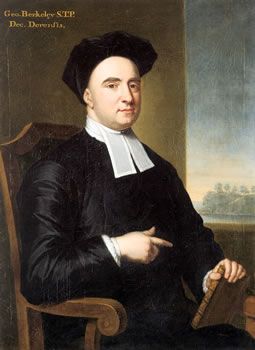
- George Berkeley: Young Trinity College fellow and Anglican deacon arguing for immaterialism
- John Locke: Author of the Essay whose abstract ideas and qualities Berkeley attacks
- Isaac Newton: Natural philosopher whose absolute space and motion Berkeley questions
- Thomas Herbert, Earl of Pembroke: Statesman to whom the book is dedicated

Summary
George Berkeley's Treatise Concerning the Principles of Human Knowledge, published in Dublin in 1710 when its author was a twenty-five-year-old fellow of Trinity College, argues that the material world, understood as an unthinking substance existing outside every mind, is a philosophers' invention. What exists are minds and the ideas they perceive; for sensible things, to be is to be perceived. The book's subtitle announces its target: the causes of error in the sciences and the grounds of scepticism, atheism and irreligion. A short Preface asks the reader to suspend judgment until the whole has been read. The Introduction, in twenty-five numbered sections, attacks the doctrine of abstract ideas, especially John Locke's account of a general idea of a triangle that is neither oblique nor rectangle, neither equilateral nor scalene, but all and none of these at once. Berkeley says he cannot frame such an idea. A word becomes general, he argues, by standing as a sign for any of many particular ideas, and language serves ends besides conveying ideas, such as stirring the passions. Philosophers have raised a dust of words and then complained that they cannot see. Part I, in 156 sections, builds the positive case. The objects of knowledge are ideas of sense, of reflection, and of memory and imagination, and there is something distinct from them that perceives them: mind, spirit or soul. A table exists when it is seen or felt. Berkeley turns Locke's distinction against itself: if colour, heat and taste exist only in the mind, so do extension, figure and motion, for no one can conceive the one set without the other. Material substance as a support of qualities proves either contradictory or empty. Ideas are passive; only spirits act. Since the ideas of sense do not depend on my will, they must be caused by another Spirit, and the steady order in which that Spirit excites them is what we call the laws of nature. Berkeley then answers objections: that real things become chimeras, that fire would no longer burn, that we must stop saying the sun rises, that Scripture speaks of bodies. His replies insist that nothing real is lost; only a needless abstraction is removed. The closing sections draw consequences for natural philosophy, including Newton's absolute space, for mathematics and the infinite divisibility of extension, and for knowledge of other minds. God, he concludes, is known more evidently than any human being, and the aim of the whole is to promote reverence and the truths of the Gospel. Berkeley called this book Part I; a planned second part was never published. A second edition appeared in London in 1734. The library's text is the Project Gutenberg edition, which prints editorial section headings in capitals and gives some first-edition readings in notes.
Virtues in this work
- Piety: Berkeley ends the treatise in section 156 by declaring that its whole design is to bring readers to a sense of God's presence and their duty.
- Humility: The Preface asks readers to suspend judgment until they have read the whole, and the Introduction blames philosophers' own habits, not the limits of nature, for their confusion.
- Prudence: In section 51 Berkeley counsels speaking in the ordinary way about fire and sunrise while thinking precisely, refusing to let a philosophical thesis disrupt common speech.
Plot or Argument
- Preface and Introduction, sections 1-5: the dust philosophers raise
Berkeley proposes that most philosophical perplexities are self-made and that their chief source is a false view of language and of abstract ideas. He promises to trace these principles to their root.
- Introduction, sections 6-17: against abstract general ideas
Locke's account of abstract ideas, such as a general triangle with no particular shape, is examined and rejected. A particular idea becomes general by being used as a sign for others of its sort, as a geometer's drawn line stands for any line.
- Introduction, sections 18-25: the uses and abuses of words
Language does not exist only to convey ideas; it also moves passions and directs action. The reader is urged to set words aside and attend to the ideas themselves, drawing the curtain of words to reach the tree of knowledge.
- Part I, sections 1-7: ideas, spirit, and esse est percipi
The objects of knowledge are ideas, and the perceiving mind is something distinct from them. For unthinking things, existence consists in being perceived, so the whole frame of the world has no subsistence outside some mind, created or eternal.
- Part I, sections 8-24: matter dismantled
An idea can resemble only an idea. Primary qualities such as extension and motion cannot be separated from secondary qualities such as colour, and both exist only in a mind. Material substance is unintelligible, unknowable even if it existed, and useless in explaining how we come to have ideas. Section 23's trees in a park are offered as a test the reader cannot pass.
- Part I, sections 25-33: spirits as causes and the laws of nature
Ideas are inert, so their cause must be an active spirit. Because the ideas of sense come unbidden and in a regular order, they are produced by a wiser and more powerful Will, whose set rules are the laws of nature. Real things differ from imaginings by being stronger, more orderly and not dependent on our will.
- Part I, sections 34-84: objections answered
Berkeley takes up objections one by one: that he turns things into chimeras, abolishes natural causes, contradicts common speech, the Copernican system, or Scripture's miracles. He answers that we should think with the learned and speak with the vulgar, and that nothing in daily experience changes.
- Part I, sections 85-134: consequences for science and mathematics
Removing matter frees philosophy from scepticism and from disputes about substance. Natural science is recast as learning the signs of nature's language rather than hidden causes; Newton's absolute space and motion are questioned; and the infinite divisibility of finite extension is rejected as a product of abstraction.
- Part I, sections 135-156: spirits, God, and duty
We have a notion, not an idea, of spirits, because they act rather than being perceived. Other human minds are known only through their effects, but God is known through the whole order of nature and so more evidently than any man. The book ends by naming its purpose: to inspire a sense of God's presence and of duty.
Lessons
Test a word by the idea behind it
Berkeley's Introduction holds that many disputes survive only because a word appears to name something no one can actually picture, such as a triangle of no particular kind. His method is to ask, of every key term, what particular idea it calls up. Even readers who reject immaterialism can use this habit in any argument.
- Can you form a general idea of a triangle, or only a particular one used as a sign?
- Which words in a current debate might be raising a dust rather than naming something clear?
- Is Berkeley right that language exists for purposes beyond conveying ideas?
Common sense can be on a strange-sounding side
Berkeley claims that his denial of matter defends the ordinary person, who trusts what is seen and touched, against philosophers who say real things lie hidden behind appearances. He keeps the table, the apple and the fire; he removes only the unperceived substratum. The lesson is that a surprising thesis may be offered as a return to plain experience.
- Does Berkeley's view agree more with common sense than Locke's, or less?
- What does Berkeley mean by thinking with the learned and speaking with the vulgar?
Order in nature as a language
For Berkeley the regular sequence of sensations, the laws of nature, shows the wisdom of the Spirit who produces them, and science learns to read those regularities as signs. Nature becomes something like speech addressed to finite minds. This turns natural philosophy into a form of attention to God's steady habits of acting.
- How does Berkeley distinguish real things from dreams and imaginings?
- What changes, and what stays the same, for a scientist who adopts Berkeley's account of causes?
- Is the regularity of nature evidence for a mind behind it?
Philosophy in the service of piety
The subtitle and the final section state that the book was written to undermine scepticism and atheism and to promote reverence for God. Berkeley's metaphysics is not a game with appearances but an argument that God is the most evident of all minds. Readers can weigh the argument while understanding the purpose that drives it.
- Why does Berkeley think belief in matter leads toward atheism?
- Is God known more evidently than other human beings, as section 147 claims?
Context
Berkeley wrote in the generation after Locke's Essay Concerning Human Understanding (1690) and Newton's Principia (1687), when the new philosophy described the world as matter in motion, perceived through ideas that might or might not resemble it. Many readers feared that such a picture led toward Hobbes's materialism or toward scepticism about the external world. Berkeley, a young Anglican scholar in Dublin, answered both by denying the unperceived matter itself.
Composition
Berkeley's notebooks of 1707-1708, later published as the Philosophical Commentaries, record the growth of his immaterialism. An Essay towards a New Theory of Vision (1709) prepared the ground by treating visual ideas as signs of tangible ones. The Principles appeared in Dublin in 1710, printed by Aaron Rhames for Jeremy Pepyat, as Part I of a larger plan. Finding it misunderstood, Berkeley restated the case in the more popular Three Dialogues between Hylas and Philonous (London, 1713). He revised the Principles for a London edition of 1734, removing the words Part I from the title page.
Reception
Early readers often treated the book as a paradox, and Boswell's Life of Johnson records Samuel Johnson striking a stone with his foot as a reply. Hume, in the Treatise, praised Berkeley's account of general terms as one of the most valuable recent discoveries, while turning Berkeley's arguments in a sceptical direction. Thomas Reid answered him with a philosophy of common sense, and Kant distinguished his own idealism from Berkeley's in the Critique of Pure Reason. Later idealists and phenomenalists returned to the Principles, and it remains a standard text in teaching the problem of perception.
Comparisons
- an-essay-concerning-human-understanding
Locke is Berkeley's main interlocutor: the Introduction attacks Locke's abstract general ideas, and Part I turns Locke's primary and secondary qualities against the existence of matter.
- a-treatise-of-human-nature
Hume adopts Berkeley's account of general ideas and his critique of material substance, but applies the same reasoning to the self and to causation, reaching a sceptical result Berkeley meant to prevent.
- meditations-on-first-philosophy
Descartes doubts the senses and then restores the material world by appeal to God's veracity; Berkeley keeps the senses and God but drops matter as an unneeded middle term.
- critique-of-pure-reason
Kant's Refutation of Idealism names Berkeley's position and sets his own transcendental idealism against it, holding that inner experience depends on outer objects in space.
- boswell-life-of-johnson
Boswell's account of Johnson kicking a stone after a conversation about Berkeley is the most famous common-sense reply to immaterialism, and is useful for asking whether it touches Berkeley's actual claim.
Quotes
Frequently cited
“we have first raised a dust and then complain we cannot see.”
Frequently cited
“Their ESSE is PERCIPI, nor is it possible they should have any existence out of the minds or thinking things which perceive them.”
Frequently cited
“in such things we ought to THINK WITH THE LEARNED, AND SPEAK WITH THE VULGAR.”
“we need only draw the curtain of words, to hold the fairest tree of knowledge, whose fruit is excellent, and within the reach of our hand.”
“This perceiving, active being is what I call MIND, SPIRIT, SOUL, or MYSELF.”
“all the choir of heaven and furniture of the earth, in a word all those bodies which compose the mighty frame of the world, have not any subsistence without a mind”
“Now THE SET RULES OR ESTABLISHED METHODS WHEREIN THE MIND WE DEPEND ON EXCITES IN US THE IDEAS OF SENSE, ARE CALLED THE LAWS OF NATURE”
“what deserves the first place in our studies is the consideration of GOD and our DUTY”
For Students
A reading companion for classical Christian high school students. See the student guide.
Reading Guide
Watch for
- The general triangle in the Introduction, sections 13-16, where Berkeley tries and fails to picture Locke's abstract idea and explains how a geometer's particular figure stands for all triangles.
- Part I, section 3, where Berkeley asks what we mean in saying the table in his study exists when he has left the room.
- Sections 9-15, where he argues that extension and motion are as mind-dependent as colour and heat.
- The trees in a park and books in a closet of section 23, a test of whether anyone can conceive an unperceived thing.
- The objections in sections 34-84, especially the reply that fire still burns and that we may still say the sun rises.
Key terms and names
- Idea
- For Berkeley, any object of perception or thought: a colour seen, a sound heard, a remembered taste. Ideas are passive and exist only in a mind.
- Esse est percipi
- Latin for to be is to be perceived, Berkeley's formula in Part I, section 3 for the existence of sensible things such as tables, odours and colours.
- Abstract general idea
- Locke's supposed idea of, for example, a triangle that is no particular kind of triangle. Berkeley's Introduction denies that anyone can form one.
- Primary and secondary qualities
- Locke's division between extension, figure and motion, held to be in bodies, and colour, taste and heat, held to be in the perceiver. Berkeley argues the division cannot stand.
- Spirit
- The active, perceiving being that Berkeley also calls mind, soul or myself. It is known by a notion rather than an idea, because it acts rather than being perceived.
- Laws of nature
- In section 30, the set rules by which God excites ideas of sense in finite minds, learned by experience of which ideas follow which.
- Immaterialism
- The name later given to Berkeley's position that there is no unthinking material substance, only minds and their ideas.
Seminar Questions
- Comprehension What does Berkeley find impossible about Locke's general idea of a triangle, and how does he think a particular triangle can serve in a general proof?
- Comprehension According to Part I, section 3, what do we mean when we say that a table exists while we are out of the room?
- Comprehension How does Berkeley tell the difference between real things and things we merely imagine, in sections 29-33?
- Interpretation Why does Berkeley think that conceding colour and heat to be in the mind forces us to concede extension and motion as well?
- Interpretation In section 23 Berkeley says that in imagining unperceived trees you are still perceiving them. Is this a fair test or a trick of words?
- Interpretation Why does Berkeley believe that his view, not the materialist's, is the friend of common sense and of religion?
- Big Question If God sustains every sensation we have, as Berkeley holds, does anything about our ordinary life or science change, and should it?
Faith Connections
- Hebrews 1:3 (Scripture)
Berkeley quotes the phrase about the Son upholding all things by the word of his power in Part I, section 147, applying it to God's maintenance of the order of perception between minds.
- Acts 17:24-28 (Scripture)
Paul tells the Athenians that in God we live and move and have our being, a text Berkeley's readers long associated with his picture of finite spirits wholly dependent on an infinite Spirit for every idea of sense.
- Psalm 19:1-4 (Scripture)
The heavens declare God's glory with speech that has no words. Berkeley's claim that visible ideas are a language by which God informs us, in section 44, gives the psalm's image a philosophical form.
- Augustine, Confessions X (Great Conversation)
Augustine asks the earth and sky whether they are God and hears them answer that God made them, then turns inward to memory and the mind. Like Berkeley, he treats the soul's knowledge of itself and of God as more certain than knowledge of bodies.
Logic and Rhetoric
Central argument: Sensible things such as tables and apples are collections of ideas. Ideas cannot exist except in a mind that perceives them. Therefore sensible things cannot exist unperceived. Since the ideas of sense are not produced by my own will and come in a regular order, they must be caused by another, more powerful and wise Spirit. Therefore the existence and order of the world show the continual activity of God, and the notion of unthinking material substance is both unintelligible and unnecessary.
Rhetorical device: hypophora (raising an objection and answering it). Part I, sections 34-84 are built as a series of numbered objections, such as the one in section 51 that a Spirit rather than fire now heats, each followed by Berkeley's answer, culminating in the reply that we ought to think with the learned and speak with the vulgar.
Debate: Resolved: Berkeley's denial of matter is more consistent with Locke's own principles than Locke's belief in matter.
Memory Work
we have first raised a dust and then complain we cannot see.
in such things we ought to THINK WITH THE LEARNED, AND SPEAK WITH THE VULGAR.
Writing Prompts
Essay: Reconstruct the argument of Part I, sections 1-7 in numbered premises, then evaluate the step from the claim that we perceive only ideas to the claim that nothing exists unperceived.
Comparison with An Essay Concerning Human Understanding: Locke and Berkeley share the starting point that the mind's immediate objects are ideas. Compare their accounts of primary and secondary qualities and argue which follows more consistently from that shared starting point.
Medical Lens
The Principles is not a medical book, but it bears on the mind-body problem that later psychiatry inherited: Berkeley denies that bodies act on minds at all and treats the perceiving spirit as the only active substance. His earlier New Theory of Vision, on how sight learns distance through association with touch, was discussed in connection with Cheselden's 1728 report of a boy given sight by cataract surgery. Late in life Berkeley championed tar-water as a near-universal remedy in Siris (1744), a separate work that belongs to the history of popular medicine rather than to this treatise.
- Part I, sections 18-20
Berkeley argues that no one can explain how body could act on spirit to produce an idea, so material causes explain nothing about perception.
- Part I, sections 43-44
Summary of the New Theory of Vision: distance is not seen directly but suggested by ideas of sight that have been joined with ideas of touch.
Creative Prompts
- Dialogue
Write a short exchange in which a student kicks a stone, as Johnson did, and Berkeley replies using the argument of Part I, section 23 about trees in a park.
- Essay
Explain Berkeley's case against Locke's general triangle in the Introduction and decide whether a geometry proof needs an abstract idea.
- Classroom
Have students list the qualities of an apple, as in Part I, section 1, sort them into Locke's primary and secondary qualities, and then test Berkeley's claim that the two lists cannot be separated.
- Poetry
Write a poem built on the phrase about the choir of heaven and furniture of the earth, imagining the world as held in being by being perceived.
Further Reading
- Three Dialogues between Hylas and Philonous, George Berkeley
Berkeley's 1713 restatement of the Principles in dialogue form.
- An Essay towards a New Theory of Vision, George Berkeley
- Berkeley, G. J. Warnock
- The Life of George Berkeley, Bishop of Cloyne, A. A. Luce
Verification notes
Publication facts (Dublin 1710; London second edition 1734; Three Dialogues 1713) and the structure of an Introduction of 25 sections and Part I of 156 sections are well established and match the stored text. All eight quotations were found by search in the stored Project Gutenberg text; words in capitals are reproduced as printed there, where the edition uses capitals for emphasis, and the section headings in capitals are editorial rather than Berkeley's. Johnson's stone-kicking is recorded by Boswell under August 1763 and is paraphrased, not quoted.
- Which printed edition the Gutenberg transcription follows (it appears to be the 1734 text with 1710 variants in notes, plus editorial headings).
- The account that the manuscript of a second part was lost during Berkeley's travels in Italy rests on his own later letter and is not stated in this record.