Work record
Cuchulain of Muirthemne
1902 · Early 20th Century · Collection · English
Abstract
Background. Gregory, a Galway landowner who taught herself Irish during the literary revival, set out to give her tenants and neighbours a readable whole from scattered medieval manuscripts and the scholarly versions printed from them. Where the old tellings disagreed, she picked the episode or detail that fitted best and supplied only short linking sentences.
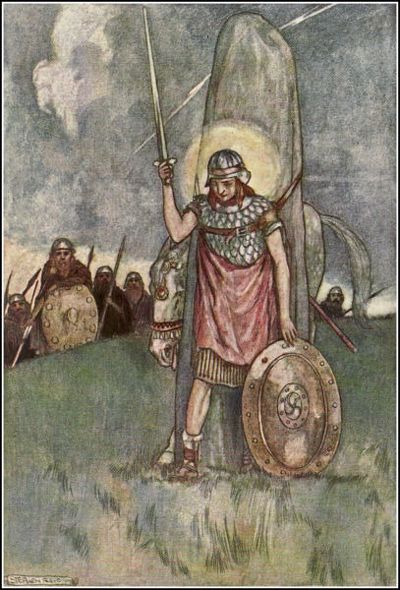
Narrative. The chapters run from the hero's birth and the boyhood feat that names him, through his courtship, rivalries at Bricriu's feast and the tragedy of Deirdre, to the great cattle raid in which he guards Ulster's fords single-handed and slays his foster-brother. Later tales bring Fand, the death of his own son and, last, his fall at Muirthemne, bound upright to a stone.
Style. She chose the idiom of Kiltartan cottages over learned diction, so warriors speak in rhythms of Irish country talk; Yeats, in his preface, hailed that choice.
Themes. Glory bought with an early death, bonds of fosterage and kingship, the danger of broken geasa, and the grief of those left behind, voiced in keens by Deirdre, Cuchulain and Emer.
Significance. The book fed the Irish dramatic movement, shaping Yeats's Cuchulain plays and Synge's dialogue, and for decades it was how most English readers met the Tain and the Red Branch heroes.
Main characters
- Cuchulain: Boy-hero turned champion of Ulster, fated to die young
- Emer: His wife, wooed with riddles
- Conchubar: King of Ulster at Emain Macha
- Maeve: Queen of Connaught who launches the cattle raid
- Ferdiad: Foster-brother whom Cuchulain must fight at the ford
- Deirdre: Exile in Alban with the sons of Usnach
- Fergus: Exiled Ulsterman in Maeve's army
- Laeg: Cuchulain's charioteer

Summary
Cuchulain of Muirthemne is Lady Gregory's arrangement of the Ulster Cycle, the oldest group of Irish heroic tales, told in the English of the Kiltartan countryside in County Galway, with its Irish turns of phrase such as 'it is what he said'. Working from medieval Irish texts and the editions and translations of nineteenth-century scholars, she joined the separate tales into a single life of the hero Cuchulain, leaving out what she thought her readers would not care for and adding little of her own. The book opens with a dedication to the people of Kiltartan and a preface by W. B. Yeats. Cuchulain is born to Dechtire, sister of King Conchubar of Ulster, and is first called Setanta. As a small boy he defeats the whole boy-troop at Emain Macha; he kills the fierce hound of the smith Culain in self-defence and offers to guard Culain's house himself until a new hound is trained, earning the name Cuchulain, the Hound of Culain. Hearing the druid Cathbad say that whoever takes arms that day will win great fame but a short life, he takes arms at once. He courts Emer, daughter of Forgall Manach, in riddling speech, trains in arms overseas with the warrior-woman Scathach, and wins her hand. Bricriu's Feast and the Championship of Ulster show the heroes Conall, Laegaire and Cuchulain quarrelling over the champion's portion until Cuchulain alone faces a stranger's beheading test without flinching. Other tales follow: the High King Conaire, the Fate of the Sons of Usnach, in which Deirdre flees to Alban with Naoise and returns to tragedy through Conchubar's treachery, and the Dream of Angus Og. The long centre of the book is the War for the Bull of Cuailgne, the Tain. Queen Maeve of Connaught, comparing her wealth with her husband Ailell's, sends the armies of Ireland to seize the Brown Bull of Cuailgne while the men of Ulster lie under the curse of Macha, a weakness like childbirth pains. The seventeen-year-old Cuchulain holds the fords alone, killing champion after champion, until Maeve sends his foster-brother Ferdiad, and after three days' combat Cuchulain kills him and mourns him. Ulster awakens, the armies meet, and the Brown Bull kills Maeve's White-Horned Bull. Later chapters tell of Fand and the jealousy of Emer, the Battle of Rosnaree, and the sorrowful killing of Connla, Cuchulain's son by Aoife. In the Great Gathering at Muirthemne Maeve and the children of Calatin bring about the hero's death: mortally wounded, he ties himself to a pillar-stone to die standing, and Emer is buried with him. The library text is the 1907 third edition published by John Murray, scanned and cleaned from OCR.
Virtues in this work
- Justice: After killing Culain's hound in self-defence, the boy offers to guard the smith's house himself until a new hound is trained.
- Fortitude: Cuchulain holds the fords alone against the armies of Ireland while the other men of Ulster lie under Macha's curse.
- Friendship: Cuchulain and Ferdiad send each other healing herbs and food each night of their combat, and Cuchulain keens for his foster-brother when he has fallen.
- Honor: Cuchulain alone keeps his word in the beheading test of the Championship of Ulster, kneeling for the stranger's blow.
Plot or Argument
- Dedication and Yeats's Preface
Lady Gregory dedicates the book to the people of Kiltartan, explaining that she joined the confused old versions into one plain account in the way her nurse Mary Sheridan told stories; Yeats praises the book and the Irish idiom of its English.
- Birth and Boy Deeds of Cuchulain
Dechtire's son by Lugh of the Long Hand; Setanta defeats the boy-troop at Emain Macha; the killing of Culain's hound and the new name Cuchulain; Cathbad's prophecy of fame and a short life; the boy takes arms and returns from his first foray in battle-heat.
- The Courting of Emer
Cuchulain woos Emer in riddling speech; her father Forgall Manach sends him to train with Scathach; he returns, storms Forgall's fort and carries Emer home.
- Bricriu's Feast and the Championship of Ulster
Bricriu sets the heroes and their wives quarrelling over the champion's portion; judgments at Cruachan and before Curoi; Cuchulain alone keeps his bargain in the beheading test.
- The High King of Ireland
Eochaid Feidlech and Etain, and the reign and fall of Conaire the Great at Da Derga's hostel.
- Fate of the Sons of Usnach
Deirdre, raised for Conchubar, flees to Alban with Naoise and his brothers; lured home under Fergus's safeguard, they are betrayed, and Deirdre laments Alban and Naoise before her death.
- The Dream of Angus Og, Cruachan and the Wedding of Maine Morgor
Angus pines for a dream-woman until a physician guesses his sickness; tales of Maeve's court at Cruachan and further adventures that lead toward the great war.
- The War for the Bull of Cuailgne
Maeve and Ailell's pillow-talk over their wealth; the hosting of Ireland against Ulster under Macha's curse; Cuchulain alone at the fords; his sleep watched by Lugh; the three-day combat with Ferdiad and Cuchulain's lament.
- The Awakening of Ulster and The Two Bulls
The druid physician Fingan reads Cethern's wounds; the men of Ulster rise from their weakness; Fergus turns aside from Cuchulain; the battle and retreat of Connaught; the Brown Bull destroys the White-Horned and dies.
- The Only Jealousy of Emer to The Only Son of Aoife
Fand of the Sidhe and Emer's jealousy, ended by Manannan's cloak; advice to a prince at Teamhair; the sons of Doel Dermait; the Battle of Rosnaree; Cuchulain's combat with the youth Conlaoch, who proves to be his son.
- The Great Gathering at Muirthemne and the Death of Cuchulain
Maeve and the children of Calatin raise enchantments against him; ill omens; Lugaid's spear wounds him; he ties himself to a pillar-stone and dies; the Grey of Macha defends him; Conall's vengeance and Emer's lament and death; the three times fifty queens see him in his Druid chariot.
Characters
- Cuchulain, hero
Champion of Ulster, first called Setanta, who chooses a short life with lasting fame.
- Emer, Cuchulain's wife
Daughter of Forgall Manach, wooed in riddles, who dies of grief at his grave.
- Conchubar, king of Ulster
Cuchulain's uncle, ruling at Emain Macha, whose desire for Deirdre leads to the sons of Usnach's deaths.
- Cathbad, druid
Teacher at Emain who names Cuchulain and foretells his fame and short life.
- Laeg, charioteer
Son of Riangabra, Cuchulain's faithful driver and companion at the fords.
- Maeve, queen of Connaught
Proud and warlike queen who sends the armies of Ireland for the Brown Bull.
- Ailell, king of Connaught
Maeve's husband, whose possession of the White-Horned Bull begins the war.
- Fergus, exiled Ulster hero
Former king of Ulster serving with Maeve, Cuchulain's foster-father, and guarantor of the sons of Usnach.
- Ferdiad, foster-brother and opponent
Son of Daman, trained with Cuchulain under Scathach, sent against him at the ford.
- Deirdre, tragic heroine
Beautiful woman foretold to bring sorrow, who flees with Naoise to Alban.
- Naoise, son of Usnach
Deirdre's husband, killed with his brothers Ainnle and Ardan on their return to Ulster.
- Conall Cearnach, Ulster champion
Cuchulain's rival for the champion's portion and the avenger of his death.
Lessons
Fame chosen over a long life
When Cathbad says that the boy who takes arms that day will be famous but short-lived, Cuchulain takes arms at once and says he would gladly live a single day if his deeds were remembered. The whole book follows the cost of that choice to its end at the pillar-stone.
- Why does Cuchulain care more about his name than about a long life?
- Does the ending of the book make his choice look wise or sad, or both?
- Who else in the book chooses honour over safety?
Making amends
The boy Setanta kills Culain's hound to save his own life, yet he sees the smith's loss and offers to be his watch-dog until a new hound is trained. He takes his very name from that act of repair, so the hero's identity begins in responsibility.
- Was the boy to blame for killing the hound? Why does he offer to make up for it anyway?
- What does Cathbad's judgment of the offer show about how the Ulstermen thought of justice?
Friendship tested by war
Ferdiad and Cuchulain trained together under Scathach and swore never to fight each other, but Maeve's promises and threats bring Ferdiad to the ford. Cuchulain fights him only because he must defend Ulster, and his lament afterwards is one of the most moving passages in the book.
- How does Maeve persuade Ferdiad to fight his foster-brother?
- What does Cuchulain remember about Ferdiad in his lament?
- Can a person be loyal to a friend and to his people when the two are at war?
A people's stories in a people's speech
Lady Gregory wrote for her neighbours in Kiltartan, telling heroic stories in the English they spoke every day rather than in a learned style. The book shows how old tales can be handed back to the people they first belonged to.
- What phrases in the book sound different from ordinary English, and what effect do they have?
- Why does Gregory say in her dedication that she wrote the book for the people of Kiltartan?
Context
The Ulster Cycle is a body of medieval Irish prose tales, with verse passages, about King Conchubar's court at Emain Macha and its champions; the stories are set in a legendary pre-Christian Ireland and survive in manuscripts written down by Christian scribes from the twelfth century onward, though the tales themselves are older. By 1900 scholars in Ireland, Britain, Germany and France had edited and translated many of them, and the Irish literary revival, together with the Gaelic League founded in 1893, sought to bring this heritage back to Irish readers.
Composition
Lady Gregory learned Irish in the 1890s and combined the scholarly versions of such writers as Eugene O'Curry, Whitley Stokes, Kuno Meyer, Ernst Windisch and Henri d'Arbois de Jubainville, whom she names in her notes, choosing and fitting together parts of different tellings. She wrote in the Hiberno-English of the Kiltartan district near her home at Coole, a style later called Kiltartanese. John Murray published the book in London in 1902 with a preface by W. B. Yeats; in her dedication she notes that Douglas Hyde (the Craoibhin Aoibhin) had put some of the stories into modern Irish. The library text is the 1907 third edition.
Reception
Yeats opened his preface by calling it the best book to come out of Ireland in his time, and drew on it for his Cuchulain plays, beginning with On Baile's Strand (1904). John Millington Synge was influenced by Gregory's use of country idiom, and her version long served English-speaking readers as the standard way into the Ulster Cycle. Later translators, such as Thomas Kinsella in The Tain (1969), returned more closely to the medieval texts.
Comparisons
- fairy-and-folk-tales-of-the-irish-peasantry
Yeats's 1888 anthology gathers the folk tales of the Irish countryside; Gregory's book does for the old heroic sagas what that collection did for fairy lore, in a closely related literary revival.
- the-iliad
Achilles and Cuchulain both accept a short life in exchange for undying fame, and both mourn a beloved companion; Ferdiad's death at the ford invites comparison with Patroclus and Hector.
- the-mabinogion
The Welsh tales are the nearest Celtic counterpart to the Ulster Cycle, sharing the Otherworld visitors, shape-shifting and heroic feasting of Gregory's book.
- beowulf
Both heroes fight monsters and champions alone, and both end with a hero's death and burial; Beowulf comes down in its own Old English verse while Gregory reworks Irish sources into modern prose.
- ramayana
Rama and Cuchulain are both royal heroes whose fame is foretold at a boyhood test of arms, and both books end in sorrowful leave-takings between hero and wife.
- le-morte-darthur
Malory, like Gregory, joined many separate medieval stories into one connected life of a court and its champions, ending in the fall of its greatest hero.
Quotes
Frequently cited
“the stories which it tells are a chief part of Ireland's gift to the imagination of the world — and it tells them perfectly for the first time.”
Frequently cited
“if there is a whelp of the same breed to be had in Ireland, I will rear him and train him until he is as good a hound as the one killed; and until that time, Culain," he said, "I myself will be your watch-dog, to guard your goods and your cattle and your house.”
Frequently cited
“It is little I would care," said Cuchulain, "if my life were to last one day and one night only, so long as my name and the story of what I had done would live after me.”
Frequently cited
“he tied himself to it with his breast-belt, the way he would not meet his death lying down, but would meet it standing up.”
“When I began to gather these stories together, it is of you I was thinking, that you would like to have them and to be reading them.”
“My love to you, O land to the east, and it goes ill with me to leave you; for it is pleasant are your bays and your harbours and your wide flowery plains and your green-sided hills; and little need was there for us to leave you.”
“Dear to me was your beautiful ruddiness; dear to me your comely form; dear to me your clear grey eye; dear to me your wisdom and your talk.”
“it was said of him that he could tell what a person's sickness was by looking at the smoke of the house he was in; and he knew by looking at a wound what sort the person was that gave it.”
For Students
A reading companion for classical Christian high school students. See the student guide.
Reading Guide
Watch for
- The two boyhood scenes, the hound of Culain and the taking of arms, that give Cuchulain his name and his fate.
- The riddling conversation between Cuchulain and Emer at their first meeting, which Yeats explains in a note at the end of the book.
- Deirdre's laments in the Fate of the Sons of Usnach, built from the names of places she loved in Alban.
- How Cuchulain fights at the fords of the Tain while the other men of Ulster lie under Macha's curse.
- The combat with Ferdiad: the healing herbs Cuchulain sends across the ford each night and the food Ferdiad sends back, and Cuchulain's lament afterwards.
Key terms and names
- Emain Macha
- King Conchubar's royal seat in Ulster, home of the boy-troop and the Red Branch heroes.
- Red Branch
- The company of Ulster champions at Conchubar's court, among them Cuchulain, Conall and Laegaire.
- Muirthemne
- Cuchulain's own plain in the south of Ulster, near the sea, which gives the book its title.
- The Brown Bull of Cuailgne
- The great bull of Ulster that Maeve sends her armies to seize, beginning the war at the centre of the book.
- Geasa
- Sacred bonds or prohibitions laid on a hero; breaking them brings misfortune, as Fergus learns when bound to stay at Borach's feast.
- The Sidhe
- The people of the Otherworld hills, such as Lugh, Angus Og and Fand, who help or trouble the heroes.
- Gae Bulg
- Cuchulain's terrible spear, learned from Scathach, with which he kills Ferdiad.
- Kiltartan English
- The Irish-flavoured English of the Galway countryside in which Gregory tells the stories, with turns such as 'it is what he said'.
Seminar Questions
- Comprehension How does the boy Setanta get the name Cuchulain, and what does he promise Culain?
- Comprehension Why does Queen Maeve want the Brown Bull of Cuailgne, and why can the men of Ulster not fight when her army comes?
- Comprehension Who is Ferdiad, and why does he agree to fight Cuchulain at the ford?
- Interpretation Cathbad warns that fame will come with a short life. Why do you think the book tells us this so early?
- Interpretation Deirdre's laments are made of place-names. Why might naming places be a powerful way to show grief and love?
- Interpretation Why does Cuchulain tie himself to the pillar-stone at the end? What does this last act say about the kind of hero he is?
- Big Question Is it better to be remembered for great deeds or to live a long, quiet life?
Faith Connections
- 2 Samuel 1:17-27 (Scripture)
David's lament for Saul and Jonathan, with its cry of how the mighty are fallen and its praise of Jonathan's love, makes a natural companion to Cuchulain's keening over Ferdiad at the ford.
- Proverbs 22:1 (Scripture)
Scripture says a good name is rather to be chosen than great riches; set beside Cuchulain's wish that his name and story outlive him, it raises the question of what kind of name is worth having.
- John 15:13 (Scripture)
Cuchulain lays down his own safety to hold the fords for Ulster; Christ's words on laying down one's life for one's friends give students a measure for thinking about the hero's sacrifice.
- Augustine, City of God V.12-19 (Church Fathers)
Augustine examines the Roman love of glory, which spurred great deeds and restrained other vices, yet he argues it falls short of seeking the glory of God; his discussion fits a hero who lives for his name.
Logic and Rhetoric
Central argument: A hero's worth is proved by keeping faith (with his word, his king and his people) even unto death; Cuchulain makes amends to Culain, holds the fords alone and dies standing, and so the book presents a short life well spent as greater than a long life without honour.
Rhetorical device: anaphora. In the lament for Ferdiad in the War for the Bull of Cuailgne, Cuchulain repeats 'dear to me' at the start of each clause as he remembers his foster-brother.
Debate: Resolved: that Ferdiad was more to blame than Maeve for the fight at the ford.
Memory Work
It is little I would care," said Cuchulain, "if my life were to last one day and one night only, so long as my name and the story of what I had done would live after me.
Dear to me was your beautiful ruddiness; dear to me your comely form; dear to me your clear grey eye; dear to me your wisdom and your talk.
Writing Prompts
Essay: Using the hound of Culain, the fight with Ferdiad and the death at the pillar-stone, explain what Cuchulain believes a hero owes to others.
Comparison with The Iliad: Achilles and Cuchulain each choose glory and a short life. Compare how the two heroes face that choice and how each story honours them at the end.
Medical Lens
The book preserves a striking picture of medicine in early Irish saga. Physicians are named professionals attached to kings: Fingan, Conchubar's druid physician, is said to diagnose an illness from the smoke of a house and to read from a wound what kind of warrior inflicted it, and he examines Cethern's wounds one by one after fifteen other physicians have pronounced him beyond cure. In the Dream of Angus Og all the physicians of Ireland fail to name Angus's wasting until Fergne, physician of Conn, sees that the sickness is on his mind and not his body and guesses it is love for a woman, an episode that belongs to the long literary tradition of lovesickness diagnosed by a perceptive physician. Healing in battle is often supernatural: Lugh puts Druid herbs on Cuchulain's wounds while he sleeps for three days and nights after weeks without rest, and the Sidhe cast healing herbs into the streams. The curse of Macha, by which the men of Ulster fall into a weakness like the pains of childbirth when danger comes, is a mythic explanation, not a description of any illness. Emer dies of grief at Cuchulain's grave. Early Irish law texts also set out duties of care toward the injured, which some scholars connect with the saga's physicians; any modern reading of these episodes is interpretive.
- The Dream of Angus Og
Angus pines and refuses food for a year after a dream-woman stops visiting him; Fergne, physician of Conn, judges the sickness to be of the mind and identifies love as its cause.
- The War for the Bull of Cuailgne (Macha's curse)
Macha, forced to race while pregnant, gives birth at the goal and lays on the men of Ulster a weakness like that of childbirth in their hour of need.
- The War for the Bull of Cuailgne (Lugh's watch at the Lerga)
Exhausted after fighting since Samhain with only brief rests on his spear, Cuchulain sleeps three days and nights while Lugh heals his wounds with Druid herbs.
- The Awakening of Ulster (Fingan and Cethern)
Fingan examines each of Cethern's wounds in turn and names the warriors who dealt them from the wounds alone.
- Death of Cuchulain (Emer's lament)
Emer asks Conall to make the grave wide, lies down beside Cuchulain and dies of grief; the two are buried under one stone.
Creative Prompts
- Fiction
Write Laeg's account of the days at the ford, as he might tell it to Emer after the war.
- Poetry
Write a lament in the pattern of Deirdre's farewell to Alban, naming the places you would miss most and one memory of each.
- Classroom
Retell the hound of Culain episode aloud in Gregory's Kiltartan style, then in plain modern English, and discuss what changes.
- Essay
Compare Cuchulain's lament for Ferdiad with another lament for a friend you have read. What makes each moving?
Further Reading
- Gods and Fighting Men, Lady Gregory
Gregory's 1904 companion volume on the Tuatha De Danaan and the Fenian tales of Finn and Oisin.
- The Tain, Thomas Kinsella (trans.)
Translation of the Tain Bo Cuailnge from the medieval Irish (1969), with brush drawings by Louis le Brocquy.
- The Hound of Ulster, Rosemary Sutcliff
A retelling of Cuchulain's life for young readers (1963).
- On Baile's Strand, W. B. Yeats
Yeats's verse play (1904) on Cuchulain's combat with his unknown son.
- Early Irish Myths and Sagas, Jeffrey Gantz (trans.)
Modern prose translations of Ulster Cycle and other tales, including the Exile of the Sons of Uisliu and Bricriu's Feast.
Verification notes
Contents, chapter order and character names follow the stored 1907 text, which has twenty chapter headings from Birth of Cuchulain to Death of Cuchulain, Yeats's preface, Gregory's dedication and notes. The text is an OCR scan; all eight quotations were chosen from clean passages and found verbatim by searching it (straight apostrophes and quotation marks as in the file). Locators are by chapter because page numbers were removed from the cleaned text. The scholars named in the composition section all appear in Gregory's notes. The influence on Synge and the description of the style as Kiltartanese are commonly stated in literary histories.
- Exact page references in the 1902 first edition for the quoted passages.
- Publication details for Rosemary Sutcliff's The Hound of Ulster (1963) and Jeffrey Gantz's Early Irish Myths and Sagas (1981).