Work record
The Fall of Constantinople, 1453: Eyewitness Accounts
1453 · Medieval · History · Various
Abstract
Background. In spring 1453 an Ottoman army under a young sultan laid siege to the thousand-year-old Christian capital, defended by a small garrison of Greeks, Venetians and Genoese. Several people inside and outside the walls left written records.
Sources. A Venetian diary kept from the galleys, a papal archbishop's letter, an imperial courtier's memoir, a Greek history compiled on Lesbos, and two chronicles written for the victor together form the core testimony. The library holds no full text because the standard English versions are still under copyright.
Content. The witnesses describe the bombardment by giant cannon, a relief squadron fighting into the harbor, the sultan's fleet rolled across a ridge into the Golden Horn, tunnel warfare, ominous signs, the wounding of the chief Genoese captain, the death of the emperor and the pillage that followed.
Perspectives. Each writer judges through his own loyalty: Venetian pride, grief at court, a plea for Christian unity, and celebration of the conqueror's resolve. Writers who were absent, like the Lesbos historian, relied on survivors and add vivid episodes that cannot always be checked.
Significance. Read together, these narratives let students test one event against several viewpoints and see how later historians such as Gibbon and Runciman assembled their accounts.
Key figures
- Constantine XI Palaiologos: Last emperor, killed on the walls
- Mehmed II: Sultan whose army took the city
- Giovanni Giustiniani Longo: Genoese captain of the land defenses
- Nicolò Barbaro: Venetian galley doctor and daily diarist
- George Sphrantzes: Imperial confidant who survived captivity
- Doukas: Lesbos-based Greek historian of the Ottoman rise
- Kritovoulos and Tursun Beg: Writers in the conqueror's service

Summary
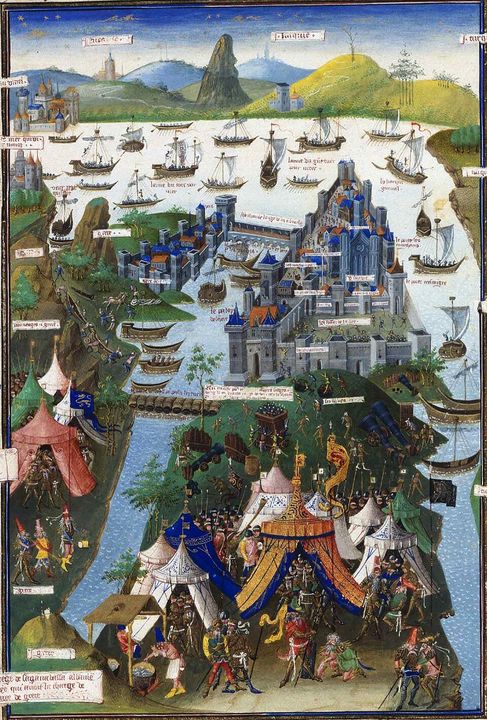
This record surveys the eyewitness and near-contemporary narratives of the Ottoman siege and capture of Constantinople, from 6 April to 29 May 1453, and the perspectives each brings. The library does not include a full text: the accounts were written in Italian, Greek, Latin and Ottoman Turkish, and the standard English translations (Barbaro by J. R. Melville Jones, 1969; Sphrantzes by Marios Philippides, 1980; Doukas by Harry J. Magoulias, 1975) are under copyright, so no quotations are given. The story the sources share runs as follows. Sultan Mehmed II, about twenty-one years old, built the fortress of Rumeli Hisar on the Bosphorus in 1452 to cut the city's sea traffic. Emperor Constantine XI Palaiologos, holding little more than the city, sought help from the West; in December 1452 the union of the Greek and Latin churches agreed at Florence was proclaimed in Hagia Sophia by Cardinal Isidore, to the dismay of many citizens. Help came chiefly from Venetians in the harbor and from the Genoese captain Giovanni Giustiniani Longo with some seven hundred men. Sphrantzes, ordered by the emperor to count the defenders, found fewer than five thousand Greeks able to fight, with perhaps two thousand foreigners, facing an army many times larger. Mehmed's guns, among them the great bombard cast by the founder Orban, pounded the land walls. On 20 April a few Genoese ships and an imperial transport fought their way through the Ottoman fleet into the Golden Horn, which a boom closed to enemy ships; two days later the sultan had dozens of ships hauled overland behind Galata and launched into the harbor. Mines and countermines, night assaults and repairs filled May, and several writers record omens: an eclipse of the moon, a fallen icon, storm and fog. Before dawn on 29 May the final assault came in three waves. Giustiniani was wounded and carried from the walls, his men followed, Janissaries entered, and some writers say a small postern, the Kerkoporta, had been left open. Constantine died fighting and his body was never certainly identified. The city was sacked; many fled by ship, thousands were enslaved, and Mehmed entered Hagia Sophia, which became a mosque. Barbaro wrote as a Venetian, Sphrantzes as the emperor's grieving friend, Doukas as a Greek who blamed both the sultan and the quarrels of Christians, and Kritovoulos and Tursun Beg as servants of the conqueror who praised his courage and vision.
Virtues in this work
- Fortitude: Constantine XI refused to abandon his city and died with its defenders in the final assault.
- Magnanimity: Mehmed II undertook the great design of moving his fleet overland and carried a siege that earlier sultans had abandoned.
- Piety: On the last night Greeks and Latins together filled Hagia Sophia for the liturgy and prayer, as the witnesses report.
- Honor: Sphrantzes served the emperor faithfully to the end and wrote his memory into his chronicle after captivity.
Plot or Argument
- Prelude: Rumeli Hisar and the church union (1451-1452)
Mehmed II comes to the throne, builds his fortress on the Bosphorus and sinks a Venetian ship that will not stop; Constantine XI appeals westward, and the union of the churches is proclaimed in Hagia Sophia amid popular opposition, which Doukas reports in detail.
- Preparations and the forces (January-April 1453)
Giustiniani arrives with Genoese troops; the Venetians in the harbor agree to fight; Sphrantzes's secret census of defenders; the boom across the Golden Horn; Orban's great gun and the Ottoman army camped before the land walls.
- Bombardment and the sea fight (April 1453)
Barbaro's diary records the daily cannonade and repairs; on 20 April the relief ships break through the Ottoman fleet, and on 22 April Ottoman ships are dragged overland into the Golden Horn.
- Mines, towers, omens and councils (May 1453)
Mining is countered by tunneling defenders; a siege tower is burned; embassies and offers are exchanged; witnesses record an eclipse, fog and other signs that disheartened the city, and quarrels between Venetians, Genoese and Greeks.
- The last assault (29 May 1453)
Waves of irregulars, Anatolian troops and Janissaries attack; Giustiniani is wounded and withdraws; the walls are entered near the St. Romanus gate and, by Doukas's account, through the Kerkoporta; Constantine XI falls.
- The sack and its aftermath
Plunder and captivity; Mehmed enters the city and Hagia Sophia; the fate of the megadux Loukas Notaras; Sphrantzes's captivity and ransom; refugees reach Chios, Crete and Venice, and the news spreads across Europe.
- The witnesses and their viewpoints
Venetian (Barbaro), Genoese and papal (Leonard of Chios), Byzantine courtly (Sphrantzes), Byzantine historical (Doukas, Chalkokondyles), Greek-Ottoman (Kritovoulos) and Ottoman (Tursun Beg) accounts compared.
Characters
- Constantine XI Palaiologos, last Roman (Byzantine) emperor
Defender of the city who refused to surrender and died in the final assault.
- Mehmed II, Ottoman sultan
Young ruler who planned the siege, moved his fleet overland, and made the city his capital.
- Giovanni Giustiniani Longo, Genoese commander
Leader of the defense of the land walls, whose wounding on 29 May proved decisive.
- Nicolò Barbaro, Venetian ship's physician and diarist
Kept the most detailed daily record of the siege from the harbor and walls.
- George Sphrantzes, imperial official and chronicler
Friend of the emperor who counted the defenders and lost his family in the sack.
- Doukas, Greek historian
Writer in Lesbos who gathered testimony and reported the Kerkoporta story.
- Loukas Notaras, megadux (chief minister)
Leading Byzantine official, opponent of the church union, executed after the fall.
- Orban, cannon founder
Engineer who cast the giant bombard for the sultan.
- Cardinal Isidore, papal legate
Proclaimer of the church union in December 1452 who escaped the sack in disguise.
Lessons
One siege, many witnesses
No single account of 1453 tells the whole story. The Venetian diarist praises Venetians and blames the Genoese; Leonard of Chios blames the Greeks who resisted church union; Sphrantzes mourns his master; Doukas weighs Greek, Latin and Turkish causes; Kritovoulos and Tursun Beg celebrate the conqueror's genius. Historians build their picture by comparing these voices, noting where they agree, as on the overland ships and Giustiniani's wound, and where they differ.
- What loyalties did Barbaro, Sphrantzes, Doukas and Tursun Beg each bring to their accounts?
- Which events do nearly all the witnesses agree on?
- How should a historian decide between two eyewitnesses who disagree?
Holding a post to the end
Constantine XI was offered terms and the chance to leave, but the sources agree he stayed with his city and died in the final assault. His conduct, told by Greek and Latin witnesses alike, made him a lasting figure of loyalty. Ottoman writers in turn praised the courage and planning of Mehmed, a ruler of twenty-one who carried out what earlier sultans had attempted.
- What choices did Constantine XI have in May 1453?
- How do the Ottoman writers portray Mehmed's leadership during the siege?
- Why do people across centuries honor a leader who dies defending what cannot be saved?
Division within the walls
The defenders were few, and they were divided over the union of the churches and by rivalry between Venetians and Genoese. Doukas records bitter words in the city over the union; Barbaro accuses the Genoese of Galata of double dealing. The sources let us see how a besieged people argued about faith, loyalty and trust even as the walls were falling.
- Why did the union of the churches proclaimed in 1452 divide the city?
- What accusations did the Venetian and Genoese defenders make against each other?
- How do internal divisions affect a community facing an outside threat?
Ingenuity and technology in war
The siege is famous for new and bold methods: great bronze cannon that broke walls built a thousand years before, ships rolled over a hill into a closed harbor, mines and countermines underground. The defenders answered with night repairs, Greek fire and countermining. The witnesses show how engineering and resolve worked together on both sides.
- How did Mehmed get his ships into the Golden Horn?
- What role did Orban's cannon play, according to the accounts?
- Does the story of 1453 show that walls and fleets matter less than the will of those who hold them?
Context
By 1453 the Roman Empire of the East, ruled from Constantinople since the fourth century, had shrunk to the city, a few islands and the Morea in Greece, after the Fourth Crusade of 1204 and the long advance of the Ottoman Turks, who had moved their capital to Adrianople (Edirne) and ruled most of the Balkans and Anatolia. Earlier Ottoman sieges in 1394-1402 and 1422 had failed. The Council of Florence in 1439 agreed a union of the Greek and Latin churches in hope of Western help, but it was widely rejected in the East, and the crusade of Varna in 1444 ended in defeat. Mehmed II, sultan from 1451, resolved to take the city as the crown of his empire; after its capture he made it his capital, repopulated it, appointed Gennadios Scholarios as Orthodox patriarch, and styled himself heir to the Roman emperors. For Greek Christians the fall ended an empire that had lasted over a thousand years; for the Ottomans it fulfilled a long-held aspiration and opened their age as a world power. Historians differ on the numbers involved and on how much weight to give the church quarrel, the Western failure to send aid, and Ottoman artillery.
Composition
Barbaro's Giornale, in Venetian Italian, is a diary written during or shortly after the siege and first printed in 1856. Leonard of Chios's Latin letter to Pope Nicholas V is dated 16 August 1453. Sphrantzes wrote his brief Greek chronicle (the Chronicon Minus) in old age on Corfu, in the 1470s; a longer version, the Chronicon Maius, is a sixteenth-century expansion by Makarios Melissourgos and is used with caution. Doukas finished his Greek history about 1462. Kritovoulos dedicated his Greek history of Mehmed to the sultan around 1467, and Tursun Beg wrote his Ottoman Turkish History of the Conqueror in the 1480s. Other witnesses include Cardinal Isidore, the Florentine Jacopo Tedaldi, the poet Ubertino Pusculo, and the Russian tale attributed to Nestor-Iskander.
Reception
The accounts were mined by Gibbon for the closing chapters of his Decline and Fall and form the basis of Steven Runciman's The Fall of Constantinople, 1453 (1965) and of later studies. Translations and editions in the twentieth century made the Greek, Italian and Ottoman sources accessible together, and comparison of them is now a standard exercise in reading sources from more than one side.
Comparisons
- runciman-the-fall-of-constantinople-1453
Runciman's narrative history weaves these eyewitness accounts into a single story; reading the sources' viewpoints first shows how a modern historian chose among them.
- gibbon-decline-and-fall-selections
Gibbon's final chapters on the siege draw on Doukas, Phrantzes (Sphrantzes) and Leonard of Chios and end his history of Rome with the death of the last Constantine.
- villehardouin-conquest-of-constantinople
The Latin capture of the city in 1204, told by a crusading leader, is the earlier conquest that weakened Byzantium and that Greek writers of 1453 still remembered.
- psellos-chronographia
Psellos's portraits of eleventh-century emperors show the Byzantine court at the height of its learning, four centuries before Sphrantzes recorded its end.
- kaldellis-the-new-roman-empire
Kaldellis's history of Byzantium as a Roman state explains why witnesses on both sides called the defenders Romans and the sultan claimed a Roman inheritance.
- herrin-byzantium
Herrin's thematic history of the empire places the fall within a thousand years of Byzantine civilization and its legacy.
Quotes
For Students
A reading companion for classical Christian high school students. See the student guide.
Reading Guide
Watch for
- Which side each witness was on and where he was during the siege.
- Events that all the sources report, such as the overland ships and Giustiniani's wound.
- Stories found in only one source, such as Doukas's Kerkoporta gate.
- How the writers explain the fall: God's judgment, human error, divided Christians, or the conqueror's skill.
- That the library offers no full text; students should read these accounts in an authorized translation or through a modern history.
Key terms and names
- Land walls (Theodosian Walls)
- The triple line of walls and moat built in the fifth century across the city's landward side.
- Golden Horn
- The city's harbor inlet, closed in 1453 by a floating boom or chain.
- Janissaries
- The sultan's elite infantry, who led the decisive wave of the final assault.
- Church union
- The reunion of the Greek and Latin churches agreed at Florence in 1439 and proclaimed in Constantinople in 1452.
- Kerkoporta
- A small gate in the walls that Doukas says was left open on the last morning.
- Bombard
- A large early cannon firing stone balls, such as the gun cast for Mehmed by Orban.
- Megadux
- The Byzantine grand admiral and chief minister, the office of Loukas Notaras.
Seminar Questions
- Comprehension How did the Ottoman fleet enter the Golden Horn despite the boom?
- Comprehension Who were Barbaro, Sphrantzes and Doukas, and where was each during the siege?
- Comprehension What happened to Giustiniani and to Constantine XI on 29 May 1453?
- Interpretation Why might a Venetian and a Genoese witness describe the same defense very differently?
- Interpretation How do the Ottoman writers present the conquest, and what values do they praise in Mehmed?
- Interpretation Why did several Christian writers explain the fall as a judgment of God, and what sins did they name?
- Big Question Can we know what really happened in a past event when every witness had a side?
- Big Question Was the emperor right to refuse terms and stay, knowing the city would likely fall?
Faith Connections
- Psalm 46:1-3 (Scripture)
God is our refuge and strength, though the earth give way. The besieged city held processions with its icons and filled Hagia Sophia on the last night with prayer.
- John 15:13 (Scripture)
Greater love has no one than to lay down his life for his friends. Constantine XI's choice to stay with his people has long been read in this light.
- Mark 3:24-25 (Scripture)
A house divided cannot stand. Doukas and other writers saw the quarrels over church union and between Italian allies as part of the city's weakness.
- Augustine, City of God I.1-7 (Church Fathers)
Written after the sack of Rome in 410, Augustine's opening books ask how Christians should understand the fall of a Christian city, a question the witnesses of 1453 also faced.
Logic and Rhetoric
Central argument: Several of the Christian witnesses reason that God protects a faithful city; Constantinople fell; therefore the fall must be a judgment on the city's sins, whether its rejection of church union, its divisions, or its people's faults. Ottoman writers reason from the same event that God granted victory to a just and resolute ruler.
Rhetorical device: providential interpretation. Barbaro's diary closes its account of the fall by attributing the outcome to the will of God, while Tursun Beg presents the same victory as divine favor to the sultan.
Debate: Resolved: that internal division, more than Ottoman strength, caused the fall of Constantinople in 1453.
Writing Prompts
Essay: Choose two witnesses of the siege, one from inside the walls and one from the Ottoman side. Using a modern history such as Runciman's, explain how their loyalties shaped what they reported about the final day.
Comparison with Chronicle of the Fourth Crusade and the Conquest of Constantinople: Constantinople was taken in 1204 by Latin crusaders and in 1453 by the Ottomans. Compare how Villehardouin and the witnesses of 1453 explain the city's fall and the conduct of the victors.
Medical Lens
Medical interest is modest. Nicolò Barbaro, the fullest diarist of the siege, served as a physician with the Venetian galleys, though his diary records events rather than his practice. The turning point of the final assault, as most witnesses tell it, was the wounding of Giovanni Giustiniani Longo, whose withdrawal from the walls disheartened his men; sources differ on the nature of the wound (arrow, crossbow bolt or gunshot), and he died of it weeks later at Chios. Accounts describe wounds from early gunpowder weapons, the burning of a siege tower, and the dead of the final day.
- Barbaro, diary entry for 29 May 1453
Giustiniani's wound and withdrawal during the final assault.
- Sphrantzes, Chronicon Minus, on the fall
The death of Constantine XI and the capture and later deaths of Sphrantzes's children.
Creative Prompts
- Dialogue
Imagine Barbaro and Tursun Beg meeting years later to compare their memories of 22 April 1453, the day the ships crossed the hill.
- Essay
Compare how a Venetian, a Byzantine and an Ottoman witness explain why the city fell. What does each emphasize, and what does each leave out?
- Fiction
Write the night of 28 May 1453 from the point of view of a sailor on one of the Venetian galleys in the Golden Horn.
- Classroom
Build a chart listing each witness, his language, his location during the siege, his loyalty, and one event he describes that others do not.
Further Reading
- The Fall of Constantinople, 1453, Steven Runciman
- Diary of the Siege of Constantinople, 1453, Nicolò Barbaro (trans. J. R. Melville Jones)
- The Fall of the Byzantine Empire: A Chronicle by George Sphrantzes, 1401-1477, George Sphrantzes (trans. Marios Philippides)
- Decline and Fall of Byzantium to the Ottoman Turks, Doukas (trans. Harry J. Magoulias)
- History of Mehmed the Conqueror, Kritovoulos (trans. Charles T. Riggs)
- 1453: The Holy War for Constantinople and the Clash of Islam and the West, Roger Crowley
Verification notes
This is a survey record with no attached text and no quotations, as the standard English translations named in the quote note are under copyright. The siege dates (6 April-29 May 1453), the sea fight of 20 April, the overland transfer of ships on 22 April, the union proclaimed on 12 December 1452, Sphrantzes's count of 4,973 Greek defenders plus about 2,000 foreigners, Giustiniani's death at Chios, and the dates and languages of the sources are standard facts from Runciman and the translators' introductions. Army sizes are disputed and are given only in general terms. The Kerkoporta story comes from Doukas and is not confirmed by other witnesses.
- Exact publication years of the English translations (Jones 1969, Philippides 1980, Magoulias 1975, Riggs 1954) and of the first printing of Barbaro's diary (1856).
- Dates of composition of Kritovoulos (c. 1467) and Tursun Beg (1480s).
- Whether Barbaro is best described as ship's physician or surgeon (sources use both).