Work record
Gonzales v. Raich
2005 · Postwar Contemporary · Court Decision · English
Abstract
Question Presented. Can Congress, using its commerce and necessary-and-proper powers, forbid Californians to grow and consume marijuana within their own homes for medical purposes that state law permits?
Arguments. The patients maintained that plants never bought, sold or carried across a border are neither commerce nor interstate, and that state-sanctioned medical users form a distinct class. Federal lawyers replied that Congress built a single system to govern a nationwide drug market and that home supplies, multiplied across many users, would weaken it.
Holding. Six justices sided with the government. Relying on the wheat-quota precedent of 1942, Stevens found a rational basis for treating home-grown supplies as part of a national market. Scalia reached the same result through the necessary-and-proper power. O'Connor and Thomas protested that local, noncommercial conduct lay beyond federal reach and that the Court had erased the limits it drew only a decade earlier.
Significance. The ruling confirmed the breadth of the commerce power after the federalism decisions of the 1990s, showed that those decisions did not reach comprehensive economic schemes, and left medical marijuana a matter of continuing conflict between state legalization and federal scheduling, with patients exposed to federal prosecution even where state law protected them.
Text. Stevens appears in full; the other three opinions are abridged, and the reporter's notes are not reproduced.
Key figures
- Angel Raich and Diane Monson: California patients using marijuana on medical advice
- Alberto R. Gonzales: Attorney General and named petitioner
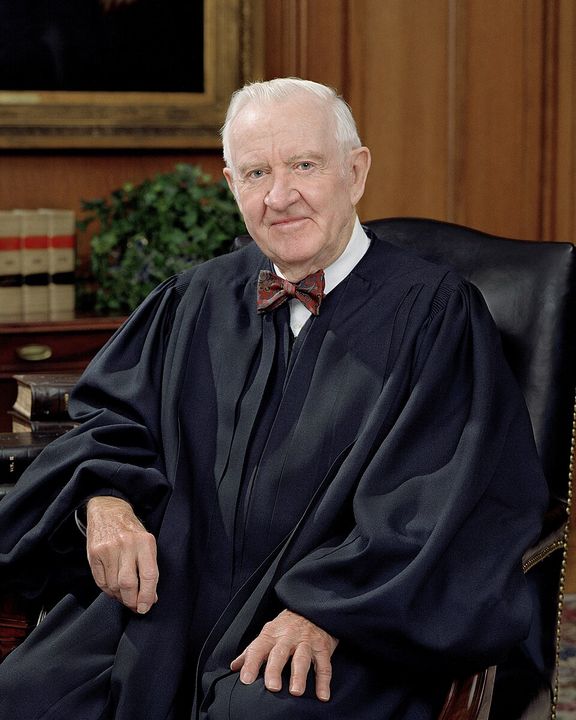
- John Paul Stevens: Wrote the opinion of the Court
- Antonin Scalia: Concurred in the judgment on necessary-and-proper grounds
- Sandra Day O'Connor: Lead dissenter defending state experimentation
- Clarence Thomas: Separate dissenter on the meaning of commerce

Summary
In 1996 California voters approved Proposition 215, the Compassionate Use Act, which exempted from state prosecution seriously ill patients and their caregivers who possessed or grew marijuana for medical use on a physician's recommendation. Angel Raich and Diane Monson, two California residents with serious medical conditions, used marijuana on the advice of their doctors. Monson grew her own plants; two unnamed caregivers grew marijuana for Raich and gave it to her without charge. In August 2002 county deputies and federal Drug Enforcement Administration agents came to Monson's home. Although the county officers found her conduct lawful under state law, the federal agents destroyed her six plants after a three-hour standoff. Raich and Monson then sued the Attorney General and the head of the DEA, seeking to bar enforcement of the federal Controlled Substances Act of 1970 against their purely local cultivation and use. The Ninth Circuit ordered a preliminary injunction, relying on United States v. Lopez (1995) and United States v. Morrison (2000). The question was whether Congress's power to regulate commerce among the states, together with the Necessary and Proper Clause, extends to marijuana grown at home and used locally for medicine in compliance with state law. Raich's counsel, Randy Barnett, argued that the activity was neither commercial nor interstate, that it never entered any market, and that a separate class of state-sanctioned medical use lay beyond federal reach. The government answered that Congress had created a comprehensive scheme to control the national market in dangerous drugs, that marijuana is a fungible commodity with an established interstate market, and that exempting home-grown supplies would undercut enforcement. On 6 June 2005 the Court reversed, six to three. Justice Stevens traced federal drug regulation from the 1906 food and drug law through the Marihuana Tax Act of 1937 to the Controlled Substances Act, which placed marijuana in Schedule I. Drawing on Wickard v. Filburn (1942), he held that Congress may regulate purely local activities that are part of an economic class of activities substantially affecting interstate commerce, and that Congress had a rational basis for concluding that leaving home-grown marijuana outside its scheme would affect the national market. He noted that the law provided a procedure for reclassifying drugs. Justice Scalia, concurring in the judgment, grounded the result in the Necessary and Proper Clause as a means of making an interstate regulation effective. Justice O'Connor, joined by the Chief Justice and in most parts by Justice Thomas, dissented, arguing that the decision made the limits announced in Lopez and Morrison meaningless and denied California its role as a laboratory for policy. Justice Thomas, dissenting separately, argued that activity neither interstate nor commercial falls outside the Commerce Clause. The library text gives Stevens's full opinion and excerpts of the other three, with notes left out. On remand the Ninth Circuit rejected Raich's remaining claims in 2007. Many states have since authorized medical or adult use while federal law still lists marijuana as a controlled substance.
Virtues in this work
- Justice: Stevens holds that a single national rule must apply evenly, while the dissenters insist that the Constitution's division of powers be honored.
- Humility: The majority acknowledges the patients' strong arguments yet declines to decide medical questions it leaves to Congress, agencies and voters.
- Charity: Raich's caregivers supplied her medicine without charge, and the Court treats the patients' suffering with evident sympathy.
Plot or Argument
- The Compassionate Use Act and the raid
Stevens describes Proposition 215, the two patients and their doctors' conclusions, the August 2002 seizure at Monson's home, and the lower courts' rulings.
- A century of federal drug law
Part II surveys the 1906 labeling law, the Harrison Narcotics Act, the Marihuana Tax Act of 1937 and the Controlled Substances Act of 1970, which placed marijuana in Schedule I as a drug with high potential for abuse and no accepted medical use.
- Wickard and the aggregation principle
Part III explains that Congress may regulate local activities that, taken in the aggregate, substantially affect interstate commerce, and finds the parallels with Wickard's home-grown wheat striking.
- Lopez and Morrison distinguished
Part IV holds that, unlike the statutes struck down in those cases, the CSA is an economic regulatory scheme, and that Congress rationally declined to carve out a class of state-approved medical users.
- Other avenues
Part V notes that the patients' due process and medical-necessity claims were not decided, and that the democratic process and the statute's rescheduling procedure remain open.
- Scalia's concurrence (excerpt)
Scalia argues that Congress's power over local activity comes not from the Commerce Clause alone but from the Necessary and Proper Clause, which permits regulation of noneconomic local conduct when needed to make an interstate regulation effective.
- The dissents (excerpts)
O'Connor defends the states as laboratories and argues that Congress offered no evidence that home-grown medical marijuana affected the national market. Thomas maintains that local, noncommercial cultivation is not commerce among the several states and that the ban is not a proper means under McCulloch.
Characters
- Angel McClary Raich, respondent
Oakland resident who relied on caregivers to supply marijuana recommended by her physician.
- Diane Monson, respondent
Butte County resident whose home-grown plants were seized by federal agents in 2002.
- Alberto R. Gonzales, petitioner
Attorney General of the United States, substituted for John Ashcroft as the case proceeded.
- Justice John Paul Stevens, author of the opinion of the Court
Held that Congress may regulate home-grown marijuana as part of a national market.
- Justice Sandra Day O'Connor, dissenting
Defended California's experiment and the limits announced in Lopez.
- Justice Clarence Thomas, dissenting
Argued that local, noncommercial activity is not interstate commerce.
- Randy E. Barnett, counsel for the respondents
Law professor who argued that the patients' conduct lay outside federal commerce power.
Lessons
The aggregation principle
Under Wickard, a single farmer's wheat or a single patient's plants may be trivial, but Congress may consider the effect of all such activity taken together. Stevens applied that reasoning to marijuana, holding that Congress could rationally fear that home-grown supplies would leak into the national market.
- What similarities does Stevens see between Filburn's wheat and the respondents' marijuana?
- Why does it matter that the Court asks only whether Congress had a rational basis?
- Is there any local activity that could not be aggregated into an effect on national commerce?
Limits on federal power
The dissenters argued that if Congress can regulate a plant grown and used in one home without sale, the limits recognized in Lopez and Morrison mean little. The majority replied that those cases involved noneconomic statutes, while the drug law regulates a commodity traded in a national market.
- How does Stevens distinguish Lopez and Morrison?
- What does Thomas mean when he says Congress could regulate virtually anything?
- What role should courts play in policing the boundary between federal and state power?
States as laboratories
O'Connor invoked Justice Brandeis's image of the states as laboratories that may try novel policies without risk to the rest of the country. California had chosen a different policy on medical marijuana; the question was whether federal law left room for that experiment.
- Why does O'Connor say this case exemplifies the role of states as laboratories?
- What are the benefits and risks of letting states adopt differing drug policies?
Medicine, law and the democratic process
Stevens acknowledged the patients' strong arguments about therapeutic value but held that the constitutional question did not turn on them. He pointed instead to the statute's procedure for reclassifying drugs and to the voices of voters and legislators as the proper routes for change.
- Why does Stevens say the case is made difficult by the respondents' arguments?
- Who should decide whether a drug has an accepted medical use: Congress, a federal agency, states or physicians?
Context
Federal regulation of drugs began with the Pure Food and Drug Act of 1906 and the Harrison Narcotics Act of 1914, and marijuana was federally taxed from 1937. The Controlled Substances Act of 1970 sorted drugs into five schedules and placed marijuana in the most restrictive. Beginning with California in 1996, a number of states authorized medical use, creating a direct conflict with federal law.
Composition
Raich and Monson sued in October 2002 in the Northern District of California; the Ninth Circuit ruled for them in December 2003. The case was argued in Washington on 29 November 2004 and decided on 6 June 2005. It was the first major test of the Lopez and Morrison decisions as applied to a comprehensive federal regulatory scheme.
Reception
The decision was read as confirming the broad reach of the Commerce Clause recognized since Wickard, and as setting practical limits on the federalism revival of the 1990s. In later years federal enforcement priorities toward state-authorized marijuana programs changed several times, and Congress restricted the Justice Department from using appropriated funds to interfere with state medical programs. Scholars continue to debate whether Scalia's Necessary and Proper reasoning offers a firmer ground than the majority's.
Comparisons
- wickard-v-filburn
Stevens calls the parallels with Filburn's home-consumed wheat striking and rests the decision on Wickard's aggregation principle.
- mcculloch-v-maryland
Scalia's reliance on the Necessary and Proper Clause and Thomas's argument that the ban is not a proper means both return to Marshall's 1819 test.
- gibbons-v-ogden
Thomas's understanding of commerce among the several states draws on the founding-era meaning that Marshall first defined for the Court in 1824.
- nfib-v-sebelius
Seven years later the Chief Justice's opinion drew a line between regulating existing activity, as in Raich, and compelling people to enter commerce.
- linder-v-united-states
Linder (1925) limited federal power over a physician's medical judgment under the Harrison Act; Raich addresses federal power over medical use authorized by a state.
- the-federalist-papers
Madison's assurance in Federalist No. 45 that federal powers are few and defined is the vision O'Connor and Thomas invoke against the majority.
Quotes
Frequently cited
“Our case law firmly establishes Congress’ power to regulate purely local activities that are part of an economic “class of activities” that have a substantial effect on interstate commerce.”
Frequently cited
“If Congress can regulate this under the Commerce Clause, then it can regulate virtually anything–and the Federal Government is no longer one of limited and enumerated powers.”
“The case is made difficult by respondents’ strong arguments that they will suffer irreparable harm because, despite a congressional finding to the contrary, marijuana does have valid therapeutic purposes.”
“Congress may regulate even noneconomic local activity if that regulation is a necessary part of a more general regulation of interstate commerce.”
“This case exemplifies the role of States as laboratories.”
For Students
A reading companion for classical Christian high school students. See the student guide.
Reading Guide
Watch for
- The history of federal drug law in Part II and what each statute added.
- Stevens's comparison between this case and Wickard.
- How the Court distinguishes Lopez and Morrison.
- Scalia's distinction between the Commerce Clause and the Necessary and Proper Clause.
- O'Connor's and Thomas's warnings about the limits of federal power.
Key terms and names
- Commerce Clause
- Article I, section 8, clause 3, giving Congress power to regulate commerce among the several states.
- Necessary and Proper Clause
- The clause empowering Congress to make all laws necessary and proper for carrying out its enumerated powers.
- Aggregation principle
- The rule that Congress may consider the combined effect of many small local activities on interstate commerce.
- Schedule I
- The most restrictive category of the Controlled Substances Act, for drugs found to have high abuse potential and no accepted medical use.
- Federalism
- The division of governmental power between the national government and the states.
- Preliminary injunction
- A court order preventing an action while a lawsuit is pending.
Seminar Questions
- Comprehension What did California's Compassionate Use Act allow, and why did federal agents nonetheless seize Monson's plants?
- Comprehension On what earlier case does Stevens chiefly rely, and why?
- Interpretation Why does Scalia agree with the result but not fully with Stevens's reasoning?
- Interpretation How do O'Connor and Thomas differ in their arguments against the majority?
- Interpretation Why does Stevens mention the rescheduling procedure and the democratic process at the end of his opinion?
- Big Question When national and state laws conflict over a matter of health and conscience, which should prevail, and why?
Faith Connections
- Romans 13:1-7 (Scripture)
Paul's teaching on submission to governing authorities raises the question, central to the case, of which authority governs when two levels of government disagree.
- Luke 10:33-35 (Scripture)
The Good Samaritan's care for a suffering stranger with oil and wine is a classic image of compassionate treatment of the sick.
Logic and Rhetoric
Central argument: Stevens reasons that Congress may regulate local activity forming part of an economic class that substantially affects interstate commerce, that the national market in marijuana is such a class, and that Congress rationally refused to exempt home-grown medical use; the dissenters reply that local, noncommercial conduct sanctioned by a state lies outside the commerce power and that the decision leaves federal power without limit.
Rhetorical device: reductio ad absurdum. Thomas argues that if Congress can reach a plant grown and consumed in one home, it can reach virtually anything (quote 4), treating the majority's principle as proving too much.
Debate: Resolved: that Congress's power over interstate commerce should extend to goods grown and used within a single home.
Memory Work
Our case law firmly establishes Congress’ power to regulate purely local activities that are part of an economic “class of activities” that have a substantial effect on interstate commerce.
If Congress can regulate this under the Commerce Clause, then it can regulate virtually anything–and the Federal Government is no longer one of limited and enumerated powers.
Writing Prompts
Essay: Evaluate the majority's reasoning in Raich by weighing Stevens's reliance on Wickard against O'Connor's defense of state experimentation.
Comparison with Wickard v. Filburn: Compare the reasoning in Wickard (1942) and Raich (2005), and explain whether the differences between wheat for a farm and marijuana for medicine should have changed the result.
Medical Lens
Raich records how American law has classified drugs by potential for abuse and accepted medical use, from the 1906 labeling law through the Harrison Act to the five schedules of 1970, and it sets physicians' recommendations under state law against a federal finding that marijuana has no accepted medical use, a conflict between medical judgment, state policy and national drug control that remains unresolved.
- Opinion of the Court, Part II, paragraph beginning Shortly after taking office in 1969
Surveys the history of federal drug regulation and explains how the five schedules of the Controlled Substances Act sort drugs by potential for abuse, dependence and accepted medical use.
- Opinion of the Court, Part I, paragraph beginning Respondents Angel Raich and Diane Monson are California residents
Describes the patients' physicians' conclusion, after trying conventional medicines, that marijuana was the only effective treatment available to them.
- Opinion of the Court, Part V, at the sentence beginning As the Solicitor General confirmed during oral argument
Points to the statutory procedure for reclassifying a Schedule I drug as an avenue for those who believe it has medical value.
Creative Prompts
- Classroom
Hold a moot court for November 2004 in which the acting Solicitor General and Raich's counsel argue over whether home cultivation is commerce, with student justices writing as Stevens, Scalia, O'Connor and Thomas.
- Essay
Compare Roscoe Filburn's wheat with Diane Monson's plants and decide whether the analogy Stevens draws holds up in every respect.
- Dialogue
Write a conversation between a county deputy and a DEA agent at Monson's home in August 2002 about which law each is bound to enforce.
Further Reading
- Restoring the Lost Constitution: The Presumption of Liberty, Randy E. Barnett
Constitutional theory by the lawyer who argued for the respondents, including his account of the original meaning of the Commerce Clause.
- The American Disease: Origins of Narcotic Control, David F. Musto
Standard history of American drug regulation from the nineteenth century onward.
Verification notes
Each of the five quotations (two from Stevens, one each from Scalia, O'Connor and Thomas) was found by Grep as an exact substring of the stored text, which uses curly quotation marks and apostrophes; the Scalia quotation begins after a run-together word in the source line. Facts about the patients, the 2002 seizure and the lower courts come from the opinion. Counsel's names, the Chief Justice's absence at argument and the 2007 remand decision come from standard accounts. The record avoids clinical detail about the respondents' conditions.
- Confirm the respondents' home communities (Raich in Oakland, Monson in Butte County), which are not stated in the opinion.
- Confirm the date and holding of the Ninth Circuit's 2007 decision on remand (Raich v. Gonzales, 500 F.3d 850).