Work record
The Homeric Hymns
7th–6th century BC · Ancient · Poetry · Greek
Abstract
Background. Antiquity credited these praise-songs to Homer; scholars now assign them to many anonymous singers. Several may have opened epic recitals at festivals.
Content. Four long narratives dominate. Demeter mourns her daughter, serves as a nurse at Eleusis, starves the world and wins a compromise that founds her Mysteries. Apollo is born on Delos and claims Delphi by slaying a serpent. Infant Hermes makes a lyre, rustles his brother's herd and charms his way to Olympus. Aphrodite, caught in her own snare, lies with Anchises and recalls the grim fate of Tithonus.
Structure. Twenty-nine shorter pieces follow, some only a few lines, greeting individual gods with epithets, a brief myth and a farewell. Among them are Dionysus turning pirates into dolphins, a prayer to Ares for courage, and salutes to Earth, Helios and Selene.
Themes. Divine honours and their limits, the gulf between immortals and mortals, a parent's sorrow, cunning and reconciliation, and the origins of shrines and rites.
Translation. Evelyn-White's plain prose keeps the epithets and repeated formulas of the Greek, and his bracketed line numbers let readers locate each passage in the original.
Significance. Thucydides cited the Delian poem as Homer's work. The Demeter story, recovered from a single Moscow manuscript in 1777, is central to the study of Greek religion and of the Eleusinian cult.
Main characters
- Demeter: Grain goddess searching for her lost daughter
- Persephone: Her daughter, seized by the lord of the dead
- Apollo: Lyre god born on Delos who founds the Delphic oracle
- Hermes: Newborn trickster, inventor of the lyre
- Aphrodite: Love goddess humbled by her own passion
- Anchises: Trojan cowherd, father of Aeneas
- Dionysus: Wine god captured by sea-raiders

Summary
The Homeric Hymns are a collection of thirty-three anonymous Greek poems addressed to the gods, composed in the same dactylic hexameter and formulaic language as the Iliad and Odyssey. Ancient audiences treated many of them as Homer's own; most scholars now see them as the work of different singers over a long period, with the four great narrative hymns usually dated to the archaic age and some short pieces much later. Many were probably sung as preludes before a rhapsode's recitation of epic, which is why several end with a promise to remember the god and pass on to another song. The Hymn to Demeter tells how Hades carries off Persephone while she gathers flowers in the plain of Nysa. Demeter wanders, disguised as an old woman, to Eleusis, where she nurses the baby Demophoon in the house of Celeus and tries to make him immortal by hiding him in the fire at night until his mother Metaneira screams. Revealing herself, she demands a temple and withholds the grain until Zeus sends Hermes to bring Persephone back; because the girl has eaten a pomegranate seed she must spend a third of each year below. The goddess then teaches her mysteries to the Eleusinian lords. The Hymn to Apollo has a Delian part, closing with the singer's portrait of himself as the blind man of Chios, and a Pythian part telling how Apollo founded Delphi, killed the she-dragon there and recruited Cretan sailors as his priests. The Hymn to Hermes is a comedy: born at dawn, the infant god invents the lyre from a tortoise by noon and steals Apollo's cattle by evening, then lies his way through a trial before Zeus and wins his brother's friendship with the gift of the lyre. The Hymn to Aphrodite shows Zeus turning the goddess's power on herself, so that she loves the Trojan herdsman Anchises and conceives Aeneas; her story of Tithonus, granted immortality without youth, is its sombre centre. The seventh hymn tells how Dionysus turned the pirates who seized him into dolphins. The short hymns greet Ares, Artemis, Athena, Hera, Heracles, Asclepius, the Dioscuri, Pan, Hephaestus, Poseidon, Hestia, Earth, Helios, Selene and others in a few lines of praise and prayer. Hugh G. Evelyn-White's prose version comes from the 1914 Loeb volume Hesiod, the Homeric Hymns and Homerica; the library file keeps his line-number markers and also carries the short Epigrams of Homer that follow the hymns in that volume.
Virtues in this work
- Piety: Demeter commands the people of Eleusis to build her temple, and the hymn praises those who keep her rites with awe.
- Charity: Demeter, though grieving, takes the infant Demophoon to her breast and nurses him in the house of Celeus.
- Friendship: Hermes and Apollo end their quarrel over the stolen cattle by exchanging the lyre and the herdsman's staff.
- Prudence: Aphrodite refuses to seek for Anchises the deathless life that ruined Tithonus.
Plot or Argument
- Hymn I: fragments to Dionysus
Only the opening and close survive of a hymn on the birthplace of Dionysus, born on the far-off mountain Nysa.
- Hymn II: to Demeter
The seizure of Persephone, Demeter's search and her disguise at Eleusis, the nursing of Demophoon in the fire, the famine, Persephone's return and the pomegranate seed, and the founding of the Eleusinian Mysteries.
- Hymn III: to Apollo, Delian and Pythian
Leto's labour and the birth of Apollo on Delos, the Delian festival and the blind singer of Chios; then Apollo's search for an oracle site, the killing of the dragon at Pytho and the Cretan sailors brought as priests.
- Hymn IV: to Hermes
The newborn god invents the lyre, steals and hides Apollo's cattle, pleads innocence before Zeus, and is reconciled with Apollo by trading the lyre for the herdsman's staff and honours.
- Hymns V and VI: to Aphrodite
Aphrodite's seduction of Anchises on Mount Ida, her revelation of herself, the tales of Ganymede and Tithonus, and the prophecy of Aeneas; a short hymn on her arrival at Cyprus.
- Hymn VII and the shorter hymns
Dionysus and the Tyrrhenian pirates, followed by brief hymns of greeting to Ares, Artemis, Athena, Hera, Demeter, the Mother of the Gods, Heracles, Asclepius, the Dioscuri, Hermes, Pan, Hephaestus, Apollo, Poseidon, Zeus, Hestia, the Muses, Earth, Helios and Selene, ending with Hymn XXXIII to the Dioscuri as saviours of ships.
Characters
- Demeter, goddess of grain
Grieving mother who withholds the harvest until her daughter is restored.
- Persephone, daughter of Demeter
Maiden carried off by Hades, who must return below for part of each year.
- Hades (Aidoneus), lord of the dead
The Host of Many, who seizes Persephone with Zeus's leave.
- Metaneira, queen of Eleusis
Mother of Demophoon, whose fright interrupts Demeter's attempt to make him immortal.
- Apollo, god of the lyre and the oracle
Born on Delos, founder of Delphi, and Hermes' wronged elder brother.
- Leto, mother of Apollo
Wanders in search of a land willing to receive her child's birth.
- Hermes, trickster god
Infant inventor of the lyre and thief of Apollo's cattle.
- Aphrodite, goddess of love
Made by Zeus to love a mortal, she bears Aeneas to Anchises.
- Anchises, Trojan herdsman
Mortal lover of Aphrodite on Mount Ida.
- Dionysus, god of wine
Seized by pirates, he reveals his power and turns them into dolphins.
Lessons
A mother's grief and the seasons
The Hymn to Demeter ties the yearly cycle of growth and barrenness to a mother's loss and partial recovery of her child. Even the gods must accept a compromise: Persephone returns, but the pomegranate seed binds her to the underworld for a third of the year.
- Why does Demeter's grief take the form of a famine that threatens both men and gods' sacrifices?
- What does the pomegranate seed mean in the settlement Zeus arranges?
- How does the hymn present the hope offered to those initiated at Eleusis?
Immortality is not enough
Aphrodite's story of Tithonus, who was granted endless life but not endless youth, teaches that a gift without wisdom can be a curse. Demeter's failed attempt to make Demophoon deathless makes a similar point about the boundary between gods and mortals.
- What mistake does Eos make when she asks Zeus for Tithonus' immortality?
- Why does Aphrodite refuse to ask the same gift for Anchises?
Wit and reconciliation
The Hymn to Hermes shows a newborn god who wins his place on Olympus by invention, cunning and finally generosity. The quarrel between brothers ends not with punishment but with an exchange of gifts that gives each god his proper honours.
- How does Hermes defend himself before Zeus, and why does Zeus laugh?
- What does Apollo gain from the lyre, and what does Hermes gain in return?
- Is Hermes admirable, or only amusing?
The singer and his song
Several hymns reflect on poetry itself: the blind man of Chios asks the Delian maidens to remember him, Hermes' first song is about the gods' origins, and Hymn XXV says that singers come from the Muses and Apollo. Greek religion here is inseparable from performance and memory.
- Why might ancient readers have taken the blind man of Chios to be Homer?
- What do the closing formulas, such as a promise to remember the god in another song, suggest about how these hymns were performed?
Context
The hymns belong to the oral and rhapsodic culture of archaic Greece, when professional reciters performed epic at festivals and opened with praise of a god. The Hymn to Demeter is closely linked with the Eleusinian Mysteries near Athens, and the Hymn to Apollo with the festivals of Delos and the oracle at Delphi.
Composition
Dates are disputed and vary hymn by hymn. The Demeter, Aphrodite and Apollo hymns are commonly placed in the 7th or 6th century BC, the Hermes hymn somewhat later, and some short pieces, such as the Hymn to Ares, much later still. Whether the Delian and Pythian parts of the Apollo hymn were originally one poem is debated. The Hymn to Demeter survives in a single manuscript found in Moscow in 1777. Evelyn-White's translation was published in the Loeb Classical Library in 1914.
Reception
Thucydides (3.104) quotes the Delian hymn as Homer's, and the hymns were studied in antiquity alongside Homer. In English, Chapman translated them in the early 17th century, Shelley translated the Hymn to Hermes, and the Demeter story has become a standard text for the study of Greek religion and of mourning.
Comparisons
- the-odyssey
The hymns share Homer's formulas and meter; Demeter disguised as an old woman at Eleusis resembles Odysseus disguised in his own palace, a god or hero recognised by stages.
- the-iliad
The Hymn to Aphrodite tells of the conception of Aeneas, whom the Iliad shows fighting for Troy and rescued by his divine mother in Book 5.
- metamorphoses
Ovid retells the rape of Proserpina and Ceres' search in Metamorphoses V, and the pirates turned to dolphins in Book III, both stories first known from these hymns.
- apollodorus-library
The Library summarises Persephone's abduction and Hermes' theft of Apollo's cattle in prose, showing how the hymn versions became standard mythography.
- the-bacchae-and-other-plays
Euripides' Bacchae, like Hymn VII, shows Dionysus disguised and underestimated before he reveals his power over those who refuse him.
Quotes
Frequently cited
“Happy is he among men upon earth who has seen these mysteries; but he who is uninitiate and who has no part in them, never has lot of like good things once he is dead, down in the darkness and gloom.”
Frequently cited
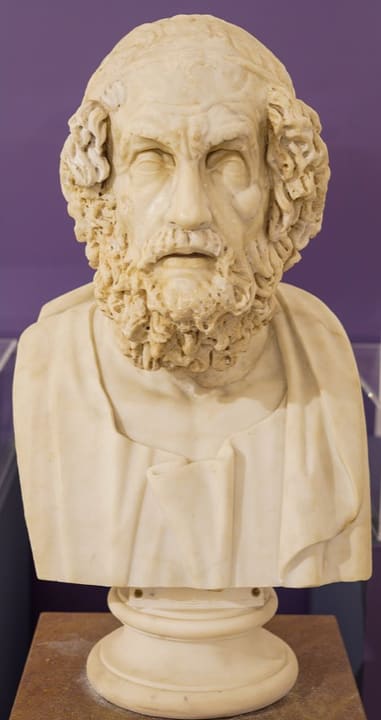
“He is a blind man, and dwells in rocky Chios: his lays are evermore supreme.”
“For it was Hermes who first made the tortoise a singer.”
“There he babbles endlessly, and no more has strength at all, such as once he had in his supple limbs.”
“I begin to sing of Asclepius, son of Apollo and healer of sicknesses.”
“Happy is he whom the Muses love: sweet flows speech from his lips.”
“I will sing of well-founded Earth, mother of all, eldest of all beings. She feeds all creatures that are in the world, all that go upon the goodly land, and all that are in the paths of the seas, and all that fly: all these are fed of her store.”
For Students
A reading companion for classical Christian high school students. See the student guide.
Reading Guide
Watch for
- The narcissus that Earth makes grow as a snare for Persephone at the opening of the Hymn to Demeter.
- Demeter's disguise at the well of Eleusis and the moment Metaneira sees her son in the fire.
- The blind man of Chios at the end of the Delian part of the Hymn to Apollo.
- How quickly the infant Hermes works: the lyre by noon, the cattle by evening.
- Formulas at the end of hymns, where the singer hails the god and turns to another song.
Key terms and names
- Hymn
- Here a hexameter poem of praise to a god, often sung as a prelude to epic recitation.
- Eleusinian Mysteries
- Secret rites of Demeter at Eleusis whose founding the Hymn to Demeter tells; initiates were promised a better lot after death.
- Host of Many
- A title of Hades in the Hymn to Demeter, naming him as lord of the many dead.
- Pytho
- The old name of Delphi, which the Pythian part of the Hymn to Apollo derives from the rotting of the dragon Apollo killed there.
- Rhapsode
- A professional reciter of epic poetry; the closing lines of many hymns suggest a rhapsode moving on to his main performance.
- Tithonus
- Trojan prince loved by Eos, given immortality without youth, whose fate Aphrodite tells Anchises.
Seminar Questions
- Comprehension Why does Demeter leave Olympus, and what does she do at the house of Celeus?
- Comprehension How does Hermes hide the tracks of Apollo's cattle, and how is he found out?
- Comprehension What does Aphrodite promise Anchises about their son, and what does she forbid him to tell?
- Interpretation Why does Demeter's plan to make Demophoon immortal fail, and what does its failure say about the difference between gods and men?
- Interpretation Is the Hymn to Hermes a comedy about a god, or a serious account of how the gods divide their honours?
- Interpretation Why might the singer of the Delian hymn want to be remembered by the maidens of Delos rather than by name?
- Big Question What do these hymns reveal about what the Greeks hoped for, and feared, from their gods?
- Big Question Is a long life without health and youth a gift or a curse?
Faith Connections
- Acts 17:22-28 (Scripture)
Paul at Athens quotes Greek poets to say that in God we live and move and have our being; the hymns show the kind of worship his hearers knew, and why he could begin from their search for the divine.
- John 12:24 (Scripture)
Jesus speaks of a grain of wheat that must fall into the earth and die to bear fruit; the Demeter hymn also binds grain to death and return, though the hymn's hope is initiation rather than resurrection.
- Psalm 104 (Scripture)
The psalm praises the Creator who gives food to every creature; Hymn XXX gives that role to Earth herself, a contrast worth drawing out.
- Clement of Alexandria, Exhortation to the Greeks II (Church Fathers)
Clement, who knew Greek literature well, discusses the Eleusinian story of Demeter and Persephone at length in urging Greeks toward Christ; he is a fair witness to how early Christians engaged these myths.
Logic and Rhetoric
Central argument: The gods hold honours that each must be given and that mortals must respect; when an honour is denied, as Demeter's is, the order of the world itself is disturbed until a new settlement restores it.
Rhetorical device: ring composition. Many short hymns open with an invocation, narrate or praise, then close by greeting the god again and promising another song, as in Hymn XXV to the Muses and Apollo.
Debate: Resolved: that the Hymn to Demeter is more a poem about a mother's love than about religious ritual.
Memory Work
He is a blind man, and dwells in rocky Chios: his lays are evermore supreme.
Happy is he whom the Muses love: sweet flows speech from his lips.
Writing Prompts
Essay: Explain how the Hymn to Demeter connects grief, famine and the founding of a religious rite, using the scenes at Eleusis and the final settlement with Zeus.
Comparison with Metamorphoses: Compare the abduction of Persephone in the Hymn to Demeter with Ovid's version in Metamorphoses V. How does each poet portray the gods' power and the mother's sorrow?
Medical Lens
Three passages matter for the history of medicine. The Tithonus story in the Hymn to Aphrodite is the classical image of extreme old age: endless life without youth, grey hair, immobility and endless babbling behind closed doors. Modern readers sometimes connect it with dementia and with the ethics of prolonging life, which is an interpretation rather than the poem's own frame. In the Hymn to Demeter the goddess, taking service as a nurse at Eleusis, promises to protect the infant Demophoon from the Undercutter and the Woodcutter, which commentators usually explain as folk names for teething or for a childhood ailment and its remedy, along with charms against witchcraft; this is an early glimpse of household medicine and the role of the nurse. Demeter's grief, her refusal of ambrosia and nectar, and the famine she sends on the earth join bereavement with starvation. The brief Hymn XVI greets Asclepius as healer of sicknesses and soother of cruel pangs, early evidence of the cult that later framed Greek temple healing.
- Hymn V, To Aphrodite, ll. 218-246
Aphrodite tells how Eos asked immortality but not youth for Tithonus, and how he withered and was shut in a room.
- Hymn II, To Demeter, ll. 224-230
Demeter, disguised as an old nurse, promises Metaneira to guard the baby from the Undercutter and from witchcraft.
- Hymn II, To Demeter, ll. 40-53 and 301-320
Demeter's mourning and fasting, then the year of barren fields that nearly destroys mankind.
- Hymn XVI, To Asclepius
Five-line hymn to Asclepius, born of Coronis, as healer and soother of pain.
Creative Prompts
- Essay
Compare Demeter's grief in Hymn II with a lament from the Iliad. How does a goddess mourn differently from a mortal?
- Poetry
Write a short hymn in the manner of Hymns VIII-XXXIII, with an invocation, a few lines of praise and a closing farewell, for a place you know well.
- Dialogue
Stage the trial before Zeus in the Hymn to Hermes, with Apollo as accuser and the infant Hermes conducting his own defence.
Further Reading
- Theogony and Works and Days, Hesiod
Published in the same 1914 Loeb volume as these hymns; the archaic account of the gods' origins.
- The Homeric Hymn to Demeter, Helene P. Foley (ed.)
Translation, commentary and interpretive essays (Princeton University Press, 1994).
- The Homeric Hymns, trans. Apostolos N. Athanassakis
Modern verse translation with notes.
- Hymn to Mercury, Percy Bysshe Shelley
Shelley's verse translation of the Hymn to Hermes.
Verification notes
Contents and structure are secure. All seven quotations were found verbatim in the stored Gutenberg text of Evelyn-White's translation; line ranges come from the translator's own markers in the file. The stored file contains Hymns I-XXXIII and, after them, the short Epigrams of Homer from the same Loeb volume; Hesiod and the epic-cycle fragments are not included. Dating of individual hymns is approximate and disputed. The interpretation of the Undercutter and Woodcutter as teething and its remedy is a common commentators' reading, not certain.
- Publication details for the Athanassakis translation (Johns Hopkins University Press; first edition 1976).
- Hymn IV quotation sits within the translator's block ll. 1-29 (Greek l. 25); confirm the single-line reference before citing it as l. 25.