Work record
Of the Laws of Ecclesiastical Polity (Preface and Book I)
1594 · Renaissance Early Modern · Political Theory · English
Abstract
Background. Elizabeth's religious settlement kept bishops and a fixed liturgy, and from the 1570s a vigorous Puritan movement argued that Scripture required instead a consistory of pastors and elders like Geneva's. Hooker, after years of preaching opposite such a lecturer in London, answered with a systematic treatise.
Content. Addressing his opponents as brethren, the Preface recounts how the Genevan model arose from that city's own needs and pleads for patient self-examination. Book I then builds an ordered hierarchy of laws: the rule God keeps in his own works, the regularity of nature, angelic obedience, the moral law reason finds, laws societies frame by agreement, the customs binding nations together, and revelation.
Key Concepts. Law as any rule directing action toward its end; reason as the eye of goodness; universal human agreement as evidence of nature's teaching; consent as the ground of civil authority; Scripture sufficient for salvation yet silent on many matters of order.
Significance. The work became a cornerstone of Anglican theology and a classic of English prose, admired for its long, balanced periods. Locke borrowed from its account of political society, and scholars still weigh its relation to Reformed and scholastic thought. The library supplies only the opening portion, the Preface and first book, from an older popular edition.
Key figures
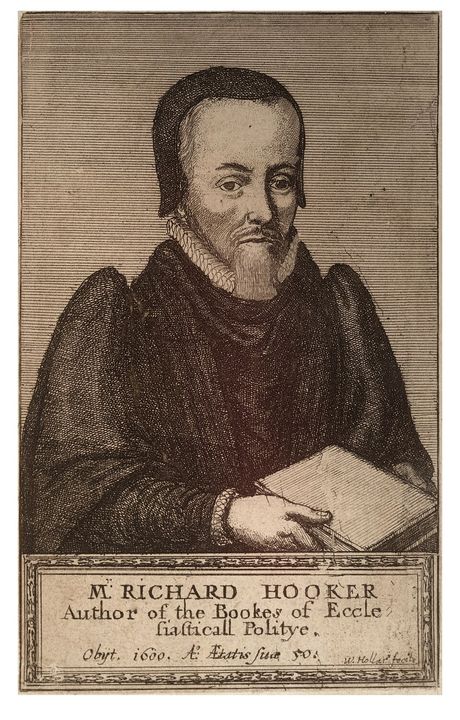
- Richard Hooker: Master of the Temple and defender of the established church
- The disciplinarian Puritans: Reformers seeking government by elders on the Genevan model
- John Calvin: Genevan reformer, honoured in the Preface's history of the discipline

Summary
Of the Laws of Ecclesiastical Polity is Richard Hooker's defence of the order of the Church of England as settled under Elizabeth I, written against the Puritan party that wished to replace government by bishops with the presbyterian discipline practised at Geneva. The library text contains the Preface and Book I, the opening portion of a work in eight books; the Everyman printing it comes from also includes editorial footnotes, a few of which remain in this OCR text, while that printing's modern introduction is omitted. The Preface is addressed to those who seek, as they term it, the reformation of the laws and orders ecclesiastical. Hooker begins by explaining that he writes so that posterity may know the established church was not abandoned in silence. He then traces the origin of the disciplinarian programme to John Calvin's work at Geneva, praising Calvin as incomparably the wisest man the French church ever had, while arguing that the Genevan arrangement grew out of local circumstances, a popular city government and a need for order, rather than from a pattern commanded in Scripture. He examines how the cause has won followers in England, asks its leaders whether they will submit to any judgment higher than their own, warns of the disorders that he thinks would follow if the discipline were imposed, and closes by urging his opponents to examine their opinions point by point and to deem it not impossible that they might err. Book I, Concerning Laws and Their Several Kinds in General, steps back from the controversy to ask what law is. Hooker defines law broadly as any rule or canon by which actions are framed toward their end. He distinguishes the law eternal that God has set for himself, the law of nature obeyed by natural agents, the celestial law of the angels, the law of reason that binds human beings as rational creatures, the human laws by which political societies are ordered, the law of nations, and the divine law revealed in Scripture. Human beings discover the law of reason by the light of understanding, and the general and perpetual consent of mankind is a sign of what nature teaches. Political societies arise because people cannot live well alone, and their laws have binding force through the consent of the governed, given directly or through representatives. Scripture supplies supernatural laws that reason could not find and repeats many natural ones, but it does not settle every detail of church government, some of whose positive laws may change with circumstances. The concluding chapter states the purpose of the whole: to show that good laws come from the Father of lights and to give readers a method for judging any disputed ordinance by its first causes. Books I to IV first appeared together in 1593 (title page often dated 1594), Book V in 1597, and the remaining books after Hooker's death.
Virtues in this work
- Humility: Hooker urges his opponents, and by implication himself, to 'deem it not impossible' to err and to weigh what is spoken rather than who speaks.
- Charity: He praises Calvin as the wisest man the French church ever had and addresses those he argues against as beloved brethren.
- Prudence: Book I distinguishes laws that never change from positive laws that may rightly vary with circumstances, so that church order can be judged by reason.
- Justice: Hooker teaches that human laws must be measured by the law eternal and the law of reason to discern whether they are reasonable, just and righteous.
Plot or Argument
- Preface, chapters I–II: purpose and the Genevan origin of the discipline
Hooker addresses the advocates of presbyterian discipline, explains why he writes, and recounts how Calvin, trained in civil law, established a consistory at Geneva after the city had rejected its bishop, presenting the arrangement as a prudent response to Genevan conditions.
- Preface, chapters III–V: how the cause spread and the appeal to disputation
He describes the means by which the disciplinarian cause won popular support in England, addresses its learned leaders directly, and responds to their challenge for a public disputation by noting that the universities are already open to such debate.
- Preface, chapters VI–IX: the need for a definitive judgment and an appeal for reconsideration
Hooker asks whether his opponents will accept any judgment higher than their own, sets out the aim of his eight books, warns of separatist consequences already visible, and ends by asking his brethren to re-examine their cause with meekness.
- Book I, chapters I–IV: law in God, nature and the angels
After explaining why a general discourse on law must come first, Hooker defines law as the rule that directs any operation to its end, distinguishes the first and second law eternal, and describes the law of natural agents and the obedience of the angels.
- Book I, chapters V–IX: the law of reason
All things desire their perfection, and human beings, beginning without knowledge, grow in it by degrees. The will moves toward what reason judges good; the law of reason is found by the light of understanding and confirmed by the general consent of mankind, and keeping it brings good to the whole order of things.
- Book I, chapter X: political societies and human law
Reason leads people to form societies for a life fit for human dignity; government arises by agreement, and laws receive authority from public approbation, given personally or through those acting in the people's name. The law of nations governs relations between societies.
- Book I, chapters XI–XV: Scripture and supernatural law
Because natural goods cannot satisfy the human desire for God, God reveals supernatural laws in Scripture, which also restates many natural laws, was written down to preserve them, and is sufficient for its end of salvation; yet some positive laws in Scripture were given for particular times and may change.
- Book I, chapter XVI: conclusion
Hooker reviews the kinds of law, explains that he chose a harder but more profitable path than simple praise of law, and closes with his tribute to Law, whose seat is the bosom of God and whose voice is the harmony of the world.
Characters
- Richard Hooker, author
Master of the Temple and later a country parson, who defends the Elizabethan church settlement by grounding it in a general theory of law.
- The advocates of the 'Lord's Discipline', addressees
English Puritans, among them followers of Thomas Cartwright, who sought presbyterian church government; Hooker addresses them throughout the Preface as brethren.
- John Calvin, historical figure
Reformer of Geneva whose consistorial discipline Hooker describes with respect while denying that it is binding on every church.
- St. Paul, authority cited
Frequently quoted on judging all things and holding fast what is good.
- Aristotle and the scholastic tradition, authorities cited
Sources for Hooker's account of ends, natural law and political society, used alongside Scripture and the church fathers.
Lessons
Law as a ladder from God to the city
Hooker does not begin with the disputed question of bishops but with the nature of law itself, tracing a single idea of ordered action from God's own being through the stars, the angels, human reason and political societies. By setting the controversy inside this larger order, he invites his readers to judge it calmly by first principles rather than by party feeling.
- Why does Hooker think a general discourse on law must come before the specific questions of church government?
- How many kinds of law does Hooker distinguish, and how are they related?
- What is gained, and what might be lost, by treating every kind of rule as a kind of law?
Reason and Scripture as partners
Hooker holds that God teaches both by the light of reason and by revelation. Scripture contains truths reason could never reach and is sufficient for salvation, but it also presupposes and restates natural law, and it does not prescribe every detail of church order. The Christian must therefore use reason, consent and tradition in matters Scripture leaves open.
- According to Book I, why did God reveal laws that reason could not find?
- Why does Hooker think the Scripture repeats laws that reason can discover for itself?
- How does Hooker's view differ from the claim, made by his opponents, that Scripture prescribes a complete form of church government?
Consent and the authority of human laws
In Book I, chapter X, Hooker argues that political societies arise by agreement and that human laws bind because public approbation has made them, whether the people consent directly or through those authorized to act for them. Later writers, John Locke among them, quoted this chapter with approval.
- What does Hooker mean when he says laws are not laws which public approbation has not made so?
- How can people consent to laws made before they were born, according to Hooker?
- Why might Locke have found this chapter useful a century later?
Charity in controversy
The Preface is a model of earnest disagreement: Hooker praises Calvin, calls his opponents brethren, admits that their zeal first made him think they must have strong reasons, and asks them to weigh what is spoken rather than who speaks. Students can study how he joins firm conviction to courtesy.
- Find two places in the Preface where Hooker speaks generously of those he opposes.
- What does Hooker ask his readers to do when he urges them to deem it not impossible that they might err?
- Does courtesy toward an opponent strengthen or weaken an argument?
Context
The Elizabethan Settlement of 1559 restored the Book of Common Prayer and the royal supremacy while keeping government by bishops. From the 1570s a Puritan movement, led in argument by Thomas Cartwright and expressed in the Admonition to the Parliament of 1572, pressed for a presbyterian discipline of pastors, elders and deacons modelled on Geneva, which they held to be commanded in Scripture. The anonymous Marprelate tracts of 1588–89 sharpened the quarrel, and Archbishop John Whitgift moved against the movement. Hooker wrote to give the established order a reasoned defence grounded in the nature of law.
Composition
Hooker's appointment as Master of the Temple in 1585 brought him into public disagreement with Walter Travers, the Temple's afternoon lecturer and an advocate of presbyterian discipline, until Travers was silenced in 1586. Hooker then devoted himself to the Laws. The Preface and Books I–IV were printed in London in 1593, with support arranged by his former pupil Edwin Sandys; the title page is often dated 1594. Book V followed in 1597. Books VI and VIII appeared in 1648 and Book VII in 1662, and scholars have discussed how far these posthumous books reflect Hooker's final drafts. The library text is the Preface and Book I from an Everyman's Library printing; its editorial footnotes partly survive in the OCR.
Reception
A pamphlet called A Christian Letter (1599) accused Hooker of departing from the doctrine of the English reformers, and the footnotes of this printing cite it. In the seventeenth century the Laws became a foundational text for the Church of England, and Izaak Walton's Life (1665) presented Hooker as a model of learned humility. John Locke repeatedly quoted 'the judicious Hooker' in his Second Treatise. Later readers have valued the work as a landmark of English prose and of natural-law thought; scholars continue to debate how close Hooker stood to the continental Reformed tradition and to the scholastics.
Comparisons
- summa-theologica
Hooker's scheme of eternal, natural, divine and human law follows the questions on law in Aquinas's Summa (I-II, qq. 90–97), adapted to a Protestant church and an English setting.
- calvin-institutes
Calvin's Institutes shaped the theology of both Hooker and his opponents; Book IV's teaching on church order is the background to the discipline Hooker declines to treat as binding on all churches.
- second-treatise-of-government
Locke cites 'the judicious Hooker' for the natural equality of men and for the origin of political society in consent, drawing directly on Book I, chapter X.
- lex-rex
Samuel Rutherford's Lex, Rex (1644), from the Scottish presbyterian side that Hooker opposed, also grounds political authority in law and the consent of the people, reaching different conclusions about church and crown.
- cicero-republic-and-laws
Cicero's description of true law as right reason in agreement with nature, eternal and the same in Rome and Athens, is a classical ancestor of Hooker's law of reason.
- leviathan
Hobbes, writing sixty years later, also derives government from agreement, but from fear in a state of war rather than from a natural sociability ordered by reason and God's law.
Quotes
“Think ye are men, deem it not impossible for you to err; sift unpartially your own hearts, whether it be force of reason or vehemency of affection, which hath bred and still doth feed these opinions in you.”
“whom, for mine own part, I think incomparably the wisest man that ever the French church did enjoy, since the hour it enjoyed him.”
“HE that goeth about to persuade a multitude, that they are not so well governed as they ought to be, shall never want attentive and favourable hearers”
“All things that are, have some operation not violent or casual.”
“And the light of that eye, is reason. So that two principal fountains there are of human action, Knowledge and Will;”
“The general and perpetual voice of men is as the sentence of God himself.”
“Laws they are not therefore which public approbation hath not made so.”
“of Law there can be no less acknowledged, than that her seat is the bosom of God, her voice the harmony of the world”
For Students
A reading companion for classical Christian high school students. See the student guide.
Reading Guide
Watch for
- The courteous tone of the Preface: how Hooker addresses his opponents as brethren and praises Calvin.
- Hooker's broad definition of law in Book I, chapter II, as any rule by which actions are framed toward an end.
- The account in chapter X of how political societies and their laws arise by consent.
- The discussion in chapters XIV–XV of what Scripture is sufficient for, and which of its positive laws may change.
- The closing tribute to Law at the end of chapter XVI.
Key terms and names
- Ecclesiastical polity
- The government and ordering of the church: its offices, laws, worship and discipline.
- Discipline
- In the Preface, the presbyterian system of church government by pastors, elders and deacons that Hooker's opponents called the Lord's Discipline.
- Law eternal
- The order God has set for himself in all his works, from which all other kinds of law derive.
- Law of reason
- The natural law that binds human beings as rational creatures, discovered by the light of understanding.
- Positive law
- Law established by a lawgiver for particular circumstances, which may be changed when circumstances change, as distinct from natural law.
- Public approbation
- The consent of a society, given directly or through representatives, that gives human laws their authority in Hooker's account.
- Elizabethan Settlement
- The religious arrangement of 1559 that established the Church of England under the queen with bishops and the Book of Common Prayer.
Seminar Questions
- Comprehension Whom does Hooker address in the Preface, and what change do they want to make in the Church of England?
- Comprehension How does Hooker describe the way Calvin's discipline was established at Geneva?
- Comprehension List the kinds of law Hooker distinguishes in Book I.
- Interpretation Why does Hooker say that critics of established government always find willing hearers, and how does this shape his own method?
- Interpretation What does Hooker mean when he calls the general and perpetual voice of men the sentence of God himself?
- Interpretation How does Hooker's account of Scripture's sufficiency allow some church laws to change while others remain fixed?
- Big Question In matters where Scripture does not speak plainly, how should Christians decide how to order their common life?
- Big Question Can a law be just if the people it governs have never consented to it?
Faith Connections
- 1 Thessalonians 5:21 (Scripture)
Hooker quotes Paul's counsel to 'try all things' and hold fast what is good to explain how he examined his opponents' claims before reaching his own resolution.
- Romans 2:14-15 (Scripture)
Paul's teaching that Gentiles without the written law do by nature the things contained in the law underlies Hooker's account of a law of reason known to all people.
- James 1:17 (Scripture)
Book I's conclusion says that the gift of good and perfect laws, like every good and perfect gift, comes from the Father of lights.
- Augustine, City of God XIX.13 (Church Fathers)
Augustine's definition of peace as the tranquillity of order stands behind Hooker's picture of a universe in which every creature keeps its proper law, and of Law as 'the mother of their peace and joy'.
Logic and Rhetoric
Central argument: All things act according to law, and all laws derive from the eternal law of God. Human beings discover the law of reason by understanding and receive supernatural law through Scripture; political societies make further human laws by consent. Scripture is sufficient for salvation but does not prescribe every detail of church government, which belongs to positive law that may vary with time and place. Therefore the laws of the Church of England, made by lawful authority and agreeable to reason, may rightly be obeyed, and no one is bound by God's law to overturn them for the Genevan discipline.
Rhetorical device: personification. In the closing sentence of Book I Law is pictured as a figure whose seat is the bosom of God and whose voice is the harmony of the world, receiving homage from angels, men and every creature.
Debate: Resolved: Where Scripture is silent, a church may order its worship and government by reason and lawful authority.
Memory Work
of Law there can be no less acknowledged, than that her seat is the bosom of God, her voice the harmony of the world
Think ye are men, deem it not impossible for you to err; sift unpartially your own hearts, whether it be force of reason or vehemency of affection, which hath bred and still doth feed these opinions in you.
Writing Prompts
Essay: Explain how Hooker's division of the kinds of law in Book I supports his argument in the Preface that the Genevan discipline is not binding on the Church of England.
Comparison with Second Treatise of Government: Locke quotes Hooker on the origin of political society. Compare Book I, chapter X, with Locke's account of consent in the Second Treatise, and explain what Locke takes from Hooker and what he adds.
Medical Lens
A work of theology and legal philosophy without medical subject matter. Book I's account of how the soul begins without knowledge and grows by degrees through the senses and reason belongs to the history of psychology in a broad sense, but the text contains no discussion of disease or healing.
Creative Prompts
- Classroom
Draw Hooker's 'ladder of laws' from Book I as a diagram, from the law eternal down to the laws of a single nation, and label each rung with one example from the text.
- Dialogue
Write a conversation at the Temple Church in 1585 between Hooker and Walter Travers about whether Scripture prescribes one form of church government.
- Essay
Explain how Hooker uses his general theory of law in Book I to prepare for the argument of the Preface about church order.
Further Reading
- The Life of Mr. Richard Hooker, Izaak Walton
The seventeenth-century life that shaped Hooker's reputation; admiring and not always reliable.
- Summa Theologiae, Treatise on Law (I-II, qq. 90–97), Thomas Aquinas
- Second Treatise of Government, John Locke
Quotes Hooker on natural equality and consent.
- Richard Hooker and the Construction of Christian Community, Arthur Stephen McGrade (ed.)
Verification notes
Quotations are exact substrings of the stored OCR text, including its spelling ('unpartially', 'favourable') and its capitalized opening 'HE'. Chapter locations are taken from the chapter numerals in the text; only the final quotation carries a section number, from the '[8.]' marker. The summary of Preface chapters III–VIII is condensed. Dates of publication (Preface and Books I–IV, 1593, title page often 1594; Book V, 1597; Books VI and VIII, 1648; Book VII, 1662) and the Temple controversy with Travers follow standard accounts. The library text is the Everyman's Library printing of the Preface and Book I; the identity of the editor of that printing's footnotes was not checked.
- Publication date of the first instalment (1593 vs. 1594) as printed on the title page.
- The role of Edwin Sandys in arranging publication.
- Attribution of the edited footnotes in the Everyman printing.