Work record
The Life of St. Teresa of Jesus
1565 · Renaissance Early Modern · Memoir · Spanish
Abstract
Background. Her confessors, cautious about a nun's reports of locutions and visions in a Spain watchful of illuminist sects, ordered her to set down how God had led her, so that learned men could judge it.
Occasion. Begun at the time of her first foundation and reworked over three years at St. Joseph's, the book is written to a confessor, often turning aside to address God directly.
Content. The narrative covers girlhood, the choice of the Carmelite habit, near-fatal sickness, two decades of half-hearted devotion, and conversion before a picture of the suffering Christ. A long teaching on degrees of prayer follows, then trials with doubting advisers, visionary favors, and the struggle to open a tiny, poor convent against civic resistance.
Teaching. Prayer is friendship sustained by perseverance; God's part grows as the soul's diminishes; Christ's humanity remains the sure path; and every grace must be tested by its fruits of humility and obedience.
Form. Narrative and instruction alternate: chapters of story frame a central treatise, the tone moves from confession to praise, and Teresa's humor and digressions keep the voice of conversation throughout.
Significance. Prized as Castilian prose and as a manual of contemplation, the work helped secure its author's canonization and her later recognition as a Doctor of the Church, and its garden image still shapes instruction in prayer.
Key figures
- Teresa of Jesus: Carmelite nun of Avila, writing under obedience
- Alonso Sánchez de Cepeda: Her devout father
- Rodrigo de Cepeda: Brother and partner in the childhood quest for martyrdom
- Peter of Alcantara: Franciscan ascetic who approved her prayer and her plans
- Francis Borgia: Jesuit who reassured her about her graces
- Baltasar Álvarez: Jesuit confessor during years of doubt
- Pedro Ibáñez: Dominican theologian who supported the new convent
- St. Joseph: Patron to whom she credits her healing and her first foundation

Summary
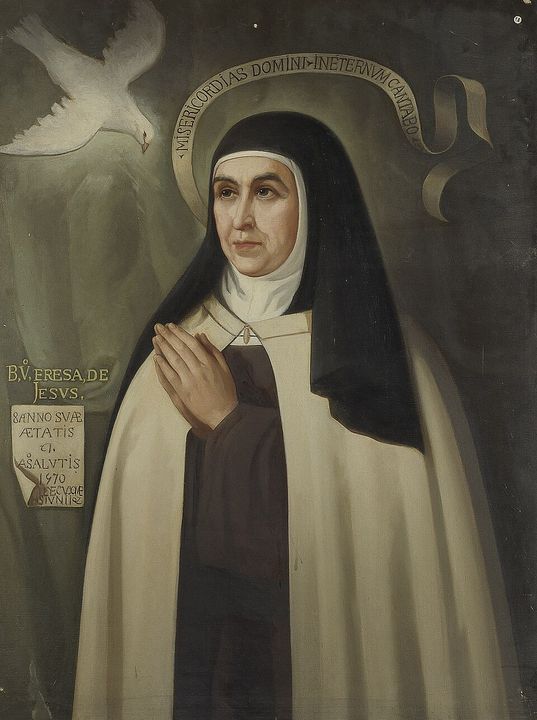
The Life of St. Teresa of Jesus is the spiritual autobiography that the Carmelite nun Teresa of Avila wrote at the command of her confessors, so that they could judge whether the extraordinary graces she reported came from God. It follows her from childhood in Avila to the founding of the convent of St. Joseph in 1562, and in its middle chapters becomes a treatise on prayer. Teresa begins with devout parents and a father fond of good books; at about seven she and her brother Rodrigo set out to beg their way to the land of the Moors to be martyred, and are brought back by an uncle. After her mother's death she grows vain, reads romances of chivalry, and is sent to the Augustinian convent school in Avila, where a holy nun rekindles her piety. Against her father's wishes she enters the Carmelite Monastery of the Incarnation. Her health soon breaks down: fainting fits, heart trouble, harsh remedies at a healer's town, a trance of about four days in which she is thought dead and anointed, and a paralysis lasting years, from which she credits her recovery to St. Joseph. For many years after she gives up and resumes mental prayer, divided between God and the pleasures of conversation in the convent parlor. Her turning comes before an image of Christ grievously wounded and in reading Augustine's Confessions. Chapters XI to XXII break off the story to describe prayer through the image of a garden watered in four ways: by drawing water from a well (meditation by one's own labor), by a water wheel (the prayer of quiet), by a stream (the sleep of the faculties) and by rain from heaven (union). Teresa insists that the humanity of Christ must never be left behind. Returning to her life, she describes locutions and intellectual visions, the doubts of confessors who fear the devil is deceiving her, the help of Jesuit confessors, Francis Borgia and Peter of Alcantara, the vision of an angel who pierces her heart with a golden spear, and a vision of the place prepared for her in hell. Chapters XXXII to XXXVI tell how she founded St. Joseph's, a poor house of thirteen nuns living the primitive Carmelite rule, amid the anger of the city and her own monastery. The last chapters record further favors and counsels. The Lewis translation also prints Benedict Zimmerman's introduction, chronology and notes, and Teresa's Relations, shorter accounts of her soul written for confessors. Teresa finished a first version in June 1562 and the present text, as most scholars agree, between 1563 and 1565; it passed through the Inquisition's hands and was first printed by Luis de León at Salamanca in 1588. David Lewis's English translation first appeared in 1870; the library text is the enlarged third edition of 1904.
Virtues in this work
- Humility: Teresa submits each vision to her confessors and writes that she may be deceived, recounting her faults more fully than her graces.
- Fortitude: She endures years of paralysis and the hostility of Avila over St. Joseph's without abandoning her purpose.
- Faith: Before the image of the wounded Christ in Chapter IX she gives herself to God after years of wavering.
- Friendship: She defines prayer itself as friendship with God and relies on friends such as Peter of Alcantara in the work of reform.
Plot or Argument
- Chapters I-III: Childhood and vocation
Pious parents, the plan for martyrdom among the Moors, play at hermits, the death of her mother, vanity and romances, the Augustinian convent school, and the struggle that leads her to the religious life.
- Chapters IV-VII: The Incarnation, illness and lukewarmness
She enters the Carmelites, falls gravely ill, undergoes cruel remedies, lies insensible for about four days, is paralyzed, takes St. Joseph as patron, and for years wavers between prayer and worldly conversation.
- Chapters VIII-X: Prayer as friendship and her conversion
She defends mental prayer as friendship with God, describes her conversion before an image of the wounded Christ and through Augustine's Confessions, and begins to describe the graces that followed.
- Chapters XI-XIII: The first water
The garden image is introduced; beginners draw water from the well by meditation and effort, persevering through dryness and learning humility.
- Chapters XIV-XVII: The second and third waters
The prayer of quiet, compared to the water wheel, and the sleep of the faculties, compared to a stream, in which God does more and the soul less.
- Chapters XVIII-XXII: The fourth water and the humanity of Christ
Union and rapture, compared to rain from heaven; the effects of these graces; and the warning that the sacred humanity of Christ is the safe road even in the highest prayer.
- Chapters XXIII-XXXI: Confessors, locutions and visions
Her fears and her confessors' doubts, the Jesuits and Peter of Alcantara, how to tell divine locutions from false ones, visions of Christ, the piercing of her heart by an angel, and her trials from devils.
- Chapters XXXII-XXXVI: The vision of hell and the founding of St. Joseph's
A vision of hell moves her to found a house of strict poverty and enclosure; she describes the opposition of Avila, the brief from Rome, the opening in August 1562 and the eventual peace.
- Chapters XXXVII-XL and the Relations
Further favors, visions of heaven and counsels on the spiritual life, followed by the Relations, shorter accounts of her soul written for her confessors over many years.
Characters
- Teresa of Jesus, author and narrator
Carmelite nun of Avila who writes candidly of her faults, her illnesses and the graces of prayer.
- Alonso Sánchez de Cepeda, father
Devout reader of good books who loves his daughter tenderly and at first opposes her entering religion.
- Rodrigo de Cepeda, brother
Brother close to her in age with whom she sets out as a child to seek martyrdom.
- Pedro Ibáñez, Dominican confessor
Theologian of Avila who supports the foundation of St. Joseph's and bids her write her life.
- Peter of Alcantara, Franciscan reformer
Austere friar who approves her spirit and encourages the foundation.
- Francis Borgia, Jesuit
Former duke and Jesuit superior who visits Avila and reassures her about her prayer.
- Baltasar Álvarez, Jesuit confessor
Young Jesuit who guides her through years of doubt about her visions.
- García de Toledo, Dominican confessor
Probable addressee of the final version, who asked her to recount the founding of St. Joseph's.
Lessons
Prayer as friendship
In Chapter VIII Teresa defines mental prayer as being on terms of friendship with God and conversing often with Him who loves us. She urges even those who pray badly not to give it up, since she herself abandoned prayer and returned to it. Prayer, for her, is less a technique than a relationship kept up through faithfulness.
- Why does Teresa think a person who prays poorly should keep praying anyway?
- What does the comparison with human friendship explain about prayer, and what does it leave out?
- How did giving up prayer for a time affect Teresa, by her own account?
The four waters: effort and grace
Teresa's garden can be watered from a well with much labor, by a wheel, by a stream, or by rain. As the soul advances, God does more and the gardener less, until the rain falls without labor. The image keeps together human effort and divine gift, and warns beginners not to expect the later waters by their own striving.
- What does each of the four ways of watering stand for in Chapters XI-XXI?
- Why does Teresa say beginners must expect dryness and keep drawing water?
- Does the image suggest that effort matters less as one grows, or that it changes its form?
Humility and discernment
Teresa submits every grace to her confessors, writes because she is commanded, and admits she may be deceived. She gives tests for telling true locutions from false: the true leave peace, humility and a desire to obey. Her caution is part of her holiness, not opposed to it.
- Why does Teresa write that she is more afraid of people who fear the devil than of the devil himself?
- What signs does she give in Chapter XXV for telling whether a locution comes from God?
- Why might obedience to a confessor be a protection for someone who receives unusual experiences?
Reform begins small
Moved by a vision of hell and by news of divisions in the Church, Teresa founds a house of only thirteen nuns living in poverty and enclosure. The city rises against her and her own monastery censures her, yet the small house becomes the root of a reform across Spain. The lesson is that renewal can begin with a few people living faithfully.
- Why did the people of Avila oppose the new convent in Chapters XXXV-XXXVI?
- Why does Teresa insist on poverty and a small number of nuns?
- What can her method of reform teach about changing an institution from within?
Context
Teresa wrote in the Spain of Philip II, at the height of the Catholic Reformation and of Spanish mysticism. The Council of Trent met between 1545 and 1563, the Society of Jesus had recently arrived in Avila, and Franciscan and Carmelite reformers were calling religious houses back to their first rules. The Spanish Inquisition was watchful of the alumbrados, groups accused of claiming direct illumination, which made a woman's account of visions a delicate matter; Teresa's confessors asked for written accounts so that learned men could test her experience. Her family on her father's side were of converso descent, a fact established by later research and not mentioned in the book.
Composition
Teresa wrote several accounts of her inner life for confessors. A first version of the Life was finished in June 1562, around the time of the foundation of St. Joseph's; the text we have, divided into forty chapters and including the story of the foundation, was written, as Benedict Zimmerman argues in the introduction to this edition, between 1563 and 1565 at St. Joseph's. The manuscript was examined by the Inquisition after 1574, approved, and kept by the Holy Office; Luis de León edited it for the first printed edition of her works, Salamanca, 1588. David Lewis's translation first appeared in 1870; the third edition of 1904 adds Zimmerman's introduction, chronology and notes, and includes the Relations.
Reception
The Life became one of the classics of Christian spirituality and of Spanish prose, admired for its directness and its humor as well as its teaching on prayer. Teresa was beatified in 1614 and canonized in 1622, and in 1970 Paul VI declared her, with Catherine of Siena, one of the first women Doctors of the Church. The scene of the angel with the golden spear inspired Bernini's sculpture in Santa Maria della Vittoria in Rome, and the four waters remain a standard image in teaching on contemplative prayer.
Comparisons
- confessions
Teresa says Augustine's Confessions came into her hands at her conversion and that she saw herself in his scene in the garden; both books are autobiographies addressed to God, confessing sin and praising grace.
- story-of-a-soul
Therese of Lisieux, a Carmelite of the same reformed order, also wrote her life under obedience; Teresa describes extraordinary graces and a great reform, Therese an ordinary hidden way of little acts.
- practice-of-the-presence-of-god
Brother Lawrence's simple conversation with God amid kitchen work echoes Teresa's definition of prayer as friendship, without her stages and visions.
- early-franciscan-sources
Peter of Alcantara, who encourages Teresa, was a Franciscan reformer; the poverty Teresa insists on at St. Joseph's draws on the same ideal as Francis of Assisi's.
- apologia-pro-vita-sua
Newman, like Teresa, writes a life to answer doubts about his good faith, tracing his inner history for readers who suspect him of deception.
Quotes
Frequently cited
“mental prayer is nothing else, in my opinion, but being on terms of friendship with God, frequently conversing in secret with Him Who, we know, loves us.”
Frequently cited
“It seems to me that the garden may be watered in four ways: by water taken out of a well, which is very laborious;”
Frequently cited
“I am really much more afraid of those people who have so great a fear of the devil, than I am of the devil himself.”
“I used to discuss with my brother how we could become martyrs.”
“I remained there nearly a year, for three months of it suffering most cruel tortures--effects of the violent remedies which they applied.”
“It was a representation of Christ most grievously wounded; and so devotional, that the very sight of it, when I saw it, moved me--so well did it show forth that which He suffered for us.”
“All things fail; but Thou, Lord of all, never failest!”
“The soul is satisfied now with nothing less than God.”
For Students
A reading companion for classical Christian high school students. See the student guide.
Reading Guide
Watch for
- How Teresa judges her own childhood and youth in Chapters I-II, often more severely than the events seem to warrant.
- The long illness of Chapters IV-VI and the patience she says she learned from it.
- The turning point before the image of the wounded Christ and Augustine's Confessions in Chapter IX.
- The four waters of Chapters XI-XXI and how each stage shifts the work from the gardener to God.
- The opposition to the founding of St. Joseph's in Chapters XXXII-XXXVI and how Teresa meets it.
Key terms and names
- Mental prayer
- Prayer of the mind and heart, as opposed to reciting set words; Teresa defines it as friendly conversation with God.
- Prayer of quiet
- The second water, in which the will is held still in God while the memory and understanding may wander.
- Union
- The fourth water, in which all the faculties are absorbed in God and the soul does nothing but receive.
- Locution
- Words Teresa believes she heard from God, not with the ears but in the soul; Chapter XXV gives tests for judging them.
- Monastery of the Incarnation
- The large Carmelite convent in Avila where Teresa lived for about twenty-seven years before the reform.
- St. Joseph's
- The small convent of strict poverty and enclosure Teresa founded in Avila in 1562, the first house of the reform.
- Confessor
- The priest who hears a person's confession and gives spiritual direction; Teresa writes the Life at her confessors' command.
Seminar Questions
- Comprehension What did Teresa and her brother plan to do as children, and how did it end?
- Comprehension What are the four ways of watering the garden, and which stage of prayer does each represent?
- Comprehension Why did the people of Avila oppose the founding of St. Joseph's?
- Interpretation Why does Teresa call herself so wicked when her faults, as she describes them, seem small?
- Interpretation Why does she insist in Chapter XXII that even advanced souls must not set aside the humanity of Christ?
- Interpretation What role do her confessors play in the book, and does she treat their doubts as an obstacle or a help?
- Big Question How can a person tell whether an inner experience comes from God, from the imagination, or from somewhere worse?
- Big Question Is prayer chiefly something we do or something done in us?
Faith Connections
- John 15:15 (Scripture)
Jesus tells his disciples he calls them friends, not servants. Teresa's definition of prayer as friendship with God in Chapter VIII rests on this promise.
- Isaiah 58:11 (Scripture)
The Lord promises that his people will be like a watered garden. Teresa's four waters describe how that garden is watered, first by labor and at last by God alone.
- 1 John 4:1 (Scripture)
John tells believers to test the spirits. Teresa's tests for locutions in Chapter XXV and her submission to confessors put this command into practice.
- Augustine, Confessions VIII (Church Fathers)
Teresa says that when she read how Augustine heard the voice in the garden, it seemed that the Lord had spoken it to her. Her own turning in Chapter IX follows his pattern of long delay and sudden surrender.
Logic and Rhetoric
Central argument: God gives Himself to anyone who perseveres in prayer, however weak or sinful. Teresa, by her own account a great sinner who abandoned prayer for years, received extraordinary mercies once she returned. Therefore no one should give up mental prayer, since what God did for her He can do for others.
Rhetorical device: extended metaphor (allegory). Chapters XI-XXI carry the image of a garden watered from a well, by a wheel, by a stream and by rain through eleven chapters to map the stages of prayer.
Debate: Resolved: that obedience to a spiritual director is a safeguard rather than a limit for someone who reports unusual religious experiences.
Memory Work
mental prayer is nothing else, in my opinion, but being on terms of friendship with God, frequently conversing in secret with Him Who, we know, loves us.
All things fail; but Thou, Lord of all, never failest!
Writing Prompts
Essay: Teresa tells her story as a long struggle between divided loyalties and God's patience. Using Chapters VII-IX, explain what finally changes her and why she thinks it took so long.
Comparison with Confessions: Compare the conversion scenes in Augustine's Confessions VIII and Teresa's Life IX. What role do books, images and the example of others play in each?
Medical Lens
Chapters IV to VI are one of the fullest first-person illness narratives of sixteenth-century Spain. Teresa describes fainting fits, a heart complaint, months of violent remedies from a healer at a place famous for cures (Becedas, according to the chronology in this edition), a collapse in her father's house in which she lay insensible for about four days, was anointed and was thought dead, and a paralysis that lasted years and left her, by her own account, praising God when she could at last crawl on hands and knees; she attributes her recovery to St. Joseph's intercession after physicians had failed. Later writers have proposed retrospective diagnoses ranging from infection to epilepsy to a conversion disorder; these are speculative readings of a sixteenth-century account and the evidence does not settle them. Her careful phenomenology of prayer, including the suspension of the faculties, rapture with bodily effects, and the piercing of the heart that she says is spiritual pain in which the body shares, has interested psychologists of religion such as William James, who discussed her in The Varieties of Religious Experience. Teresa herself submits her experiences to confessors for testing and judges them by their effects on her conduct, not by their intensity.
- Chapter IV, §§ 6-8
Fainting fits and heart trouble after entering the convent; her father takes her to a place of cures, where she suffers harsh remedies.
- Chapter V
The crisis in her father's house: about four days insensible, the last anointing, and her family's belief that she was dead.
- Chapter VI
Years of paralysis and pain endured with patience, and her recovery, which she credits to St. Joseph.
- Chapters XVIII-XX
Union and rapture described with attention to their bodily effects: loss of sensation, coldness, and the body lifted or held motionless.
- Chapter XXIX, §§ 16-17
The vision of the angel with a fiery spear and her description of a pain that is spiritual but shared by the body.
Creative Prompts
- Classroom
Draw a garden diagram of the four waters from Chapters XI-XXI, labeling each method of watering with the stage of prayer Teresa assigns to it.
- Essay
Teresa writes under obedience and repeatedly says she may be deceived. Explain how this humility shapes the way she presents her visions in Chapters XXIII-XXIX.
- Dialogue
Write a conversation between Teresa and one of the confessors who feared her visions came from the devil, using the tests she gives in Chapter XXV.
- Fiction
Tell the story of the two children, Teresa and Rodrigo, setting out from Avila for the land of the Moors, from the uncle's point of view.
Further Reading
- The Interior Castle, Teresa of Avila
Her mature account of prayer as seven dwelling places of the soul.
- The Way of Perfection, Teresa of Avila
Written for the nuns of St. Joseph's; a commentary on prayer and the Our Father.
- The Varieties of Religious Experience, William James
James's lectures on mysticism draw repeatedly on Teresa.
- Teresa of Avila: The Progress of a Soul, Cathleen Medwick
Verification notes
Chapter headings, section numbers and episodes were checked against the attached Gutenberg text of David Lewis's translation (third edition, London: Thomas Baker, 1904), which includes Benedict Zimmerman's introduction, a chronology, notes and the Relations. The composition dates (first version June 1562; present text 1563-1565) follow Zimmerman's introduction, which argues the point against older biographers. The chronology printed in this edition gives older dates for her entry to the Incarnation (1533) and illness (1537); modern scholars usually give 1535 for her entry and 1538-1539 for the illness and trance, and the summary avoids exact years for these events. Her converso ancestry is established by modern archival research. Quotes were checked against the attached text.
- Exact year of her entry into the Monastery of the Incarnation (1533 in the edition's chronology; 1535 in most modern accounts).
- Whether the final version was addressed to García de Toledo, as the Reforma suggests; Zimmerman leaves it uncertain.
- Date of the first edition of Lewis's translation (usually given as 1870).