Work record
Principles of Geology
1830-1833 · 19th Century · Essays · English
Abstract
Background. Cuvier's sudden revolutions and English attempts to identify a recent universal deluge dominated discussion when a young barrister turned geologist returned from Sicily and Naples in 1828 determined to defend Hutton's slower world. The three volumes that followed went through twelve editions; the library holds the ninth, after the ancient rock record had been moved into a separate Manual.
Thesis. Ordinary agents, acting no more violently than today, could have produced every feature of the crust given sufficient ages; appeals to unobserved convulsions arose from an imagined brevity of earth history and discourage investigation.
Method. Lyell measures what he can witness: sediment carried by great rivers, retreating English cliffs, the 1783 Calabrian shocks, Swedish shores slowly emerging, and Roman columns at Pozzuoli pitted by shellfish between bands of smooth marble.
Scope. A historical first book is followed by one on inorganic agents and a third on living things: variability, the reality of species, their dispersal into distinct provinces, their disappearance, their entombment in deposits, and finally the reef-building corals of the Pacific and Indian oceans, explained by Darwin's theory of slow subsidence.
Significance. Darwin studied the opening volume aboard the Beagle, and Whewell's review named the rival schools uniformitarian and catastrophist. Historians now separate several senses of uniformity in the work, some foundational to modern geology, others since modified.
Key figures
- Charles Lyell: Scottish-born geologist arguing for causes now in action
- James Hutton: Edinburgh founder of a cyclical theory of the earth
- Abraham Gottlob Werner: Freiberg teacher of a universal ancient ocean
- Jean-Baptiste Lamarck: Naturalist whose transmutation theory is weighed and declined
- Charles Darwin: Younger friend whose South American and coral-reef findings Lyell cites
- William Hamilton: British envoy at Naples whose reports of the 1783 shocks Lyell uses

Summary
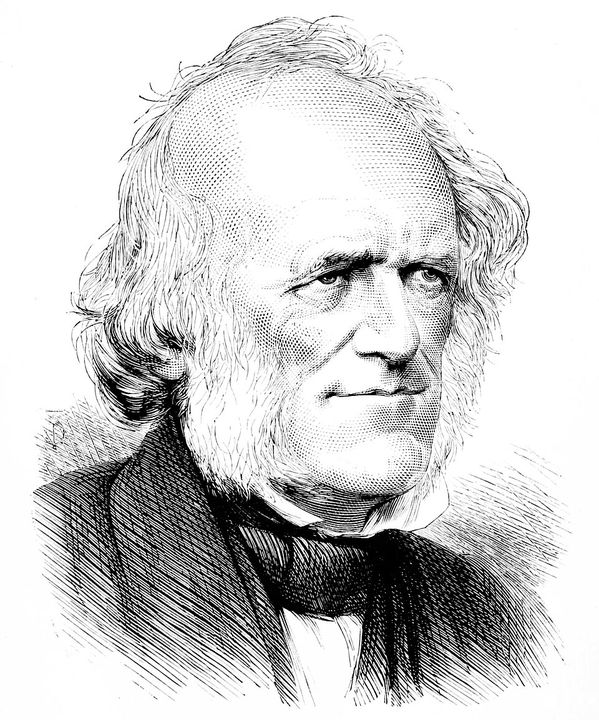
Principles of Geology is Charles Lyell's argument that the earth's past can be explained by the same causes that are acting on it now, working at their present intensity over immense periods of time. The first edition appeared in three volumes in 1830, 1832 and 1833, under a subtitle describing it as an attempt to explain the former changes of the earth's surface by reference to causes now in operation. Lyell revised it repeatedly. The library text is the 1854 New York printing of the ninth edition (1853), in which, as the Preface explains, the old fourth book on the rock record had been moved to a separate Manual of Elementary Geology, so that the Principles now treat the modern changes of the earth and its inhabitants. Book I (Chapters I to XIII) opens with a history of geology from ancient cosmogonies through Arabic writers such as Avicenna, Italian students of fossils, Abraham Werner and James Hutton. Lyell argues that the science was long held back by a belief that the earth was only a few thousand years old, which forced writers to imagine sudden, violent catastrophes. He imagines Egyptologists who believed the Nile valley had been inhabited only since 1800 and shows what absurd theories they would invent to explain the pyramids. He then considers climate change, the history of life and the antiquity of man, and concludes that the assumption of a discordance between ancient and present causes discourages patient inquiry. Book II (Chapters XIV to XXXII) surveys the inorganic agents now at work. Rivers cut valleys and build deltas such as those of the Mississippi and Ganges; ice carries boulders; waves wear away the coast of England. Lyell describes the volcanoes of Naples, Vesuvius and Etna, and the Calabrian earthquake of 1783. In Chapter XXIX the frontispiece subject, the so-called Temple of Serapis at Pozzuoli, shows columns bored by marine molluscs to a height of about twenty-three feet: the ground had sunk beneath the sea and risen again within historic times, without destroying the building. Further chapters treat the slow rising of land in Sweden and the causes of earthquakes and volcanoes. Book III (Chapters XXXIII to L) turns to the living world: whether species are real and fixed, a detailed critique of Lamarck's theory of transmutation, hybrids, the geographical distribution of plants and animals, the extinction of species through competition and changing conditions, the burial of organic remains in peat, caves and sediments, and finally coral reefs, where Lyell adopts the theory of his friend Charles Darwin. Darwin carried the first volume aboard the Beagle in 1831 and later said that it altered the whole tone of his mind.
Virtues in this work
- Industry: Lyell built his case from years of fieldwork, including his 1828 visit to measure the borings on the columns at Pozzuoli.
- Prudence: In Book I he warns against theories that outrun evidence and asks geologists to test every explanation against causes they can observe.
- Humility: He closes Book I by calling human beings mere sojourners on the planet, enduring for a moment of time, even as he praises the mind's reach.
Plot or Argument
- Preface: the Principles and the Manual
Lyell explains that the earlier editions included an account of the ancient rock record, now published separately, and that the Principles treat the effects of causes now in action as a key to the earth's autobiography.
- Book I, Chapters I–IV: history of geology
From Egyptian and Greek cosmogonies to Avicenna, Steno, Werner and Hutton, Lyell traces how the science developed and praises those who explained the earth by natural causes.
- Book I, Chapters V–XIII: the case for uniform causes
Lyell argues that misconceptions about the age of the earth produced theories of sudden catastrophe. He examines changes of climate, the progression of life, supposed past violence of water and fire, and concludes that geological phenomena should be referred to ordinary causes multiplied by time.
- Book II, Chapters XIV–XXI: water at work
Rivers, springs, glaciers, icebergs, waves, tides and currents are shown excavating, transporting and depositing material, building deltas and destroying coasts, with examples from the Mississippi, the Ganges, the Rhine and the cliffs of England.
- Book II, Chapters XXII–XXVIII: volcanoes and earthquakes
Lyell surveys active volcanic regions, recounts the eruptive history around Naples, the burial of Herculaneum and Pompeii, the structure of Etna, and the Calabrian earthquake of 1783, measuring their permanent effects on the landscape.
- Book II, Chapters XXIX–XXXII: the rise and fall of land
The bored columns of the Temple of Serapis prove that land near Naples sank and rose again in historic times; the coast of Sweden is rising slowly without earthquakes. Lyell discusses theories of a fluid interior and chemical causes of volcanic heat.
- Book III, Chapters XXXIII–XLIII: species, distribution and extinction
Lyell sets out and rejects Lamarck's transmutation of species, examines hybrids and variability, maps the distinct provinces of plants and animals, and argues that species are continually becoming extinct through competition, spreading of rivals and changes of climate.
- Book III, Chapters XLIV–L: how living things shape and enter the record
Organisms alter physical geography and are buried in peat, blown sand, volcanic ash, caves, rivers and seas; human remains and works are buried too. The book closes with the formation of coral reefs.
Characters
- Charles Lyell, author
Scottish geologist and former barrister who argues his case like an advocate.
- James Hutton, predecessor
Scottish geologist whose theory of slow, cyclical change Lyell revives and extends.
- John Playfair, predecessor
Hutton's expositor, quoted in the epigraphs on the uniformity of nature's laws.
- Abraham Gottlob Werner, opponent
German mineralogist whose theory of a universal primeval ocean Lyell criticizes.
- Jean-Baptiste Lamarck, opponent
French naturalist whose theory of the transmutation of species is examined and rejected in Book III.
- Charles Darwin, contemporary authority
Lyell's friend, cited often for observations from the voyage of the Beagle and for his theory of coral reefs.
Lessons
The present as a guide to the past
Lyell's method is to study rivers, volcanoes and earthquakes as they act today and then ask how much they could accomplish over long ages. Small causes, he argues, become great when multiplied by time. The method still guides geologists, though they now also recognize rare large events.
- What everyday processes does Lyell use to explain valleys, deltas and coastlines?
- Why does he distrust explanations that invoke sudden catastrophes?
- Can you think of a geological event that Lyell's method would have difficulty explaining?
Assumptions shape what we see
In Chapter V Lyell imagines scholars who believe Egypt was first inhabited in 1800 and then try to explain the pyramids. His point is that a wrong assumption about time forces every new fact into an ever more strained theory.
- What absurd explanations does Lyell imagine his Egyptologists inventing?
- How does he apply the parable to early geologists?
- Is there a danger of the opposite error, of assuming too much time?
Reading the landscape as a document
Lyell treats rocks, shells and ruins as records written in a symbolic language. The Temple of Serapis, with its bored columns, becomes a document of the land's rising and sinking. Careful observation turns a ruin into evidence.
- How do the borings of molluscs in the columns allow Lyell to measure the sinking and rising of the land?
- What else in your own surroundings might be read as a record of past change?
A science that shaped another
Darwin read the Principles on the Beagle and learned from Lyell to explain large effects by small, continuing causes. Yet Lyell himself, in this edition, argued against the transmutation of species. The book shows how a method can lead a reader beyond the author's own conclusions.
- What arguments does Lyell give against Lamarck in Book III?
- How might Lyell's account of extinction and distribution have prepared Darwin's thinking?
Context
In the early nineteenth century geologists debated whether the earth's features were formed by causes like those now acting or by past revolutions of far greater violence. Georges Cuvier described repeated sudden catastrophes in the history of life; in England, William Buckland and others linked the most recent upheaval with the biblical Flood. James Hutton had argued in 1788 and 1795 for slow cycles of erosion and uplift, and John Playfair had popularized his views in 1802. Lyell, trained in law, set out to make the case for present causes as fully and persuasively as possible.
Composition
Lyell's travels of 1828, especially to the Auvergne, Etna and the Bay of Naples, supplied much of his evidence. John Murray published the first volume in January 1830, the second in January 1832 and the third in May 1833. Lyell revised the work through eleven editions in his lifetime, the twelfth appearing just after his death. In 1838 he moved the account of the rock record into his Elements of Geology, so from the later editions the Principles concentrate on modern changes. The ninth edition (1853), reprinted in New York by D. Appleton in 1854, is the library text; the tenth edition of 1867-1868 accepted Darwin's theory of natural selection.
Reception
The book became the standard English work on geology. In a review of 1832 William Whewell coined the terms uniformitarian and catastrophist to describe the opposing camps. Darwin, who took the first volume on the Beagle and received the second in South America, dedicated the second edition of his Journal of Researches to Lyell. Later scholars, including Martin Rudwick and Stephen Jay Gould, have distinguished several meanings of Lyell's uniformity: of natural laws, of processes, of rates and of a steady state, and have noted that geologists today accept the first two while also recognizing rare large events. Assessments of his treatment of his predecessors and opponents vary.
Comparisons
- on-the-origin-of-species
Darwin's argument that small variations accumulated over vast time produce new species applies Lyell's method to the living world; his chapter on the imperfection of the geological record draws directly on Lyell.
- the-voyage-of-the-beagle
Darwin read the Principles on the voyage and interpreted the raised beaches of Chile and the coral islands of the Pacific through Lyell's eyes; Lyell in turn cites Darwin's observations throughout.
- whewell-novum-organon-renovatum
Whewell, who coined the terms uniformitarian and catastrophist in reviewing Lyell, treats geology as a palaetiological science that reasons from present effects to past causes.
- the-bible
Lyell's Chapter V argues that a short chronology drawn from Genesis held back geology; reading the two side by side raises the question of what kind of history the opening chapters of Genesis intend to give.
Quotes
“They may be regarded, in short, as a symbolical language, in which the earth's autobiography is written.”
“Geology is the science which investigates the successive changes that have taken place in the organic and inorganic kingdoms of nature; it inquires into the causes of these changes, and the influence which they have exerted in modifying the surface and external structure of our planet.”
“Never was there a dogma more calculated to foster indolence, and to blunt the keen edge of curiosity, than this assumption of the discordance between the ancient and existing causes of change.”
“It also endeavors to estimate the aggregate result of ordinary operations multiplied by time”
“Thus, although we are mere sojourners on the surface of the planet, chained to a mere point in space, enduring but for a moment of time, the human mind is not only enabled to number worlds beyond the unassisted ken of mortal eye, but to trace the events of indefinite ages before the creation of our race”
“it is clear that the columns must have continued for a long time in an erect position, immersed in salt water, and then the submerged portion must have been upraised to the height of about twenty-three feet above the level of the sea.”
For Students
A reading companion for classical Christian high school students. See the student guide.
Reading Guide
Watch for
- The epigraphs from Bacon, Linnaeus and Playfair and the Preface's image of the earth's autobiography.
- The parable in Chapter V of scholars who think Egypt was first inhabited in 1800 and must explain the pyramids and mummies.
- The end of Chapter XIII, where Lyell summarizes his method and closes Book I with a meditation on the reach of the human mind.
- The Temple of Serapis in Chapter XXIX, pictured in the frontispiece, with its band of mollusc borings.
- Lyell's careful statement and rejection of Lamarck's theory in Book III, and his use of Darwin's observations.
Key terms and names
- Uniformity of causes
- Lyell's principle that the forces now acting on the earth, such as rivers, waves, volcanoes and earthquakes, are the same in kind and degree as those that shaped it in the past.
- Catastrophism
- The opposing view, named by William Whewell, that the earth's history was punctuated by sudden, violent revolutions far greater than anything now observed.
- Temple of Serapis
- A Roman market building at Pozzuoli near Naples, then thought to be a temple, whose columns bored by marine molluscs show that the land sank below the sea and later rose.
- Lithodomus
- A boring marine bivalve whose pear-shaped holes in the columns at Pozzuoli record their long immersion in seawater.
- Transmutation of species
- The theory, defended by Lamarck, that species gradually change into others; Lyell examines and rejects it in Book III of this edition.
- Delta
- The deposit of sediment built where a river enters a lake or sea, such as those of the Mississippi and Ganges described in Book II.
- Calabrian earthquake
- The series of earthquakes in southern Italy in 1783 that Lyell studies in Chapter XXVIII for its permanent effects on the landscape.
Seminar Questions
- Comprehension According to Lyell, why did early geologists invent theories of sudden catastrophe?
- Comprehension How do the columns of the Temple of Serapis show that the land rose and fell? What measurements does Lyell give?
- Comprehension What does Lyell think happens to species over time, and why does he reject Lamarck's transmutation?
- Interpretation Lyell was trained as a lawyer. Where in Book I does he argue like an advocate, and how does that affect how you weigh his case?
- Interpretation What is the point of the parable of the Egyptologists in Chapter V, and is it a fair comparison?
- Interpretation Darwin learned his method from Lyell but reached a conclusion about species that this edition rejects. What in Lyell's method might have led Darwin there?
- Big Question Lyell closes Book I by marvelling that creatures enduring for a moment can trace ages before their own existence. What does this capacity suggest about human nature?
- Big Question How should readers of Scripture respond when natural science discovers that the earth is much older than earlier interpreters assumed?
Faith Connections
- Job 14:18-19 (Scripture)
Job observes that mountains fall and crumble and that the waters wear the stones. Lyell's Book II is in effect a long study of this slow wearing, carried out by rivers, waves and frost.
- Ecclesiastes 1:4-7 (Scripture)
The Preacher describes the earth abiding while rivers run to the sea and return again, a picture of steady, recurring natural processes close to Lyell's vision of a world shaped by causes that continue in the same way.
- Psalm 90:2-4 (Scripture)
Before the mountains were brought forth, God is from everlasting, and a thousand years are as yesterday in his sight. The psalm sets the human span against vast time much as Lyell's close to Book I does, but grounds it in God's eternity.
- Hugh Miller, The Testimony of the Rocks (1857) (Great Conversation)
Miller, a Scottish evangelical and self-taught geologist, accepted the great age of the earth that Lyell defended and argued that the geological record and the Genesis account of creation could be read in harmony.
Logic and Rhetoric
Central argument: The causes now acting on the earth, such as erosion, deposition, volcanoes, earthquakes and the gradual rising and sinking of land, can be observed and measured. Given enough time, their accumulated effects are sufficient to produce the features geologists find in the rocks. Theories of past catastrophes arose from an assumption that the earth was young, not from evidence. Therefore the geologist should explain the past by present causes acting at present intensities over long ages, and reject appeals to unobserved violent revolutions.
Rhetorical device: analogy (parable). In Chapter V Lyell imagines Egyptologists convinced that the Nile valley was first inhabited in the nineteenth century, who invent extravagant theories to explain the pyramids and mummies; the parable makes the reader feel how a mistaken assumption about time distorts the interpretation of evidence.
Debate: Resolved: That the geologist should never invoke a cause greater in kind or degree than those now observed.
Memory Work
It also endeavors to estimate the aggregate result of ordinary operations multiplied by time
They may be regarded, in short, as a symbolical language, in which the earth's autobiography is written.
Writing Prompts
Essay: Lyell argues that the earth's past should be explained by causes now in operation, multiplied by time. Using the parable of the Egyptologists, the Temple of Serapis and his account of rivers and deltas, explain his method and evaluate its strengths and its limits.
Comparison with On the Origin of Species: Darwin learned from Lyell to explain great effects by small causes acting over vast time, yet the edition of the Principles in the library rejects the transmutation of species. Compare Lyell's account of species in Book III with Darwin's argument in the Origin and explain how Darwin used Lyell's method to reach a different conclusion.
Medical Lens
Medicine appears incidentally. Lyell's account of the Calabrian earthquake of 1783 records the deaths that followed from epidemics caused by hunger, exposure and malaria from newly formed stagnant pools, reflecting the period's understanding of malaria as arising from marsh air. His discussion of the Temple of Serapis notes that the Serapis cult had taken over the healing attributes of Aesculapius and that devotees slept in the temple hoping for revelations about their diseases, a practice of incubation known from ancient medicine. In Book III he treats epidemic disease, famine and swarms of locusts as forces that can thin or extinguish animal populations. Several of the early geologists in his historical chapters, including Avicenna, were physicians.
- Book II, Ch. XXVIII
Deaths after the Calabrian earthquake of 1783 from epidemics attributed to insufficient food, exposure and malaria from new stagnant lakes.
- Book II, Ch. XXIX
The Serapis cult's healing role and the practice of sleeping in the temple to receive cures in dreams.
- Book III, Ch. XL–XLI
Epidemic disease and famine from locust swarms discussed as causes of population loss and extinction.
Creative Prompts
- Classroom
Set a tray of sand and soil on a slope and run water over it for a class period, measuring the channel each day. Then estimate, as Lyell would, how long a real river might take to carve a valley.
- Essay
Retell Lyell's parable of the Egyptologists in Chapter V for a modern discovery, and explain what it teaches about the influence of assumptions on interpretation.
- Dialogue
Write a conversation at the Geological Society in 1832 between Lyell and a catastrophist such as Buckland or Sedgwick about the Temple of Serapis.
- Adaptation
Design an illustrated museum panel on the Temple of Serapis that explains to visitors how mollusc borings record the rising and sinking of land.
Further Reading
- The Voyage of the Beagle, Charles Darwin
Dedicated in its second edition to Lyell.
- Illustrations of the Huttonian Theory of the Earth, John Playfair
- Time's Arrow, Time's Cycle, Stephen Jay Gould
On Hutton, Lyell and the meanings of uniformity.
- Worlds Before Adam, Martin J. S. Rudwick
Geology in the age of reform, with extended treatment of Lyell.
- Charles Lyell: The Years to 1841, Leonard G. Wilson
Verification notes
All six quotations were found by search in the stored Project Gutenberg text of the ninth edition (New York: D. Appleton, 1854), and chapter locators were checked against the chapter headings in that file. Publication dates of the first edition are taken from the table in the ninth-edition Preface. The first-edition subtitle is paraphrased, not quoted. Darwin's remark about the tone of his mind is paraphrased from his letters and autobiography and not quoted. The library text is the ninth edition, so statements in the summary about contents refer to it rather than to the 1830-1833 first edition, which included a fourth book on the rock record.
- Confirm the exact wording and source of Darwin's comment that the Principles altered the tone of his mind before quoting it.
- Confirm the attribution of the 1783 Calabrian casualty figures, which Lyell takes from Sir William Hamilton.