Work record
Experiments in Plant Hybridisation (in Bateson's Mendel's Principles of Heredity)
1866 · 19th Century · Essays · German
Abstract
Background. Breeders before 1860 had crossed countless plants without discovering rules. A Moravian friar spent eight seasons cultivating carefully chosen pea varieties, reported his findings to a provincial society, and was almost entirely ignored until three botanists reached the same conclusions at the century's turn.
Findings. Seven contrasting traits each behaved as discrete units. One member of every pair masked the other in crosses; the hidden form returned in roughly one quarter of the next generation. Different traits sorted without influencing one another, and reciprocal crosses with the parent stocks supported the claim that each pollen grain or ovule carries a single version of every trait. Bean crosses gave partly similar results, while hawkweed hybrids bred true, a puzzle Mendel could not resolve.
Edition. The library volume is the 1902 Cambridge book that introduced these papers to English-speaking biologists. It joins a revised horticultural society translation, the short hawkweed study, an explanatory lecture coining terms such as homozygote, and an energetic rebuttal of Weldon's statistical objections.
Significance. These pages founded genetics. They offered evolutionary theory a particulate mechanism of inheritance, opened the way to understanding hereditary disease, and launched a quarrel between Mendelians and biometricians that Fisher later reconciled. Classroom biology still teaches its ratios and terms.
Key figures
- Gregor Mendel: Augustinian friar and teacher who bred peas in Brünn
- William Bateson: Cambridge biologist and translator-advocate
- W. F. R. Weldon: Biometrician whose critique prompted the Defence
- Francis Galton: Statistician of ancestral inheritance
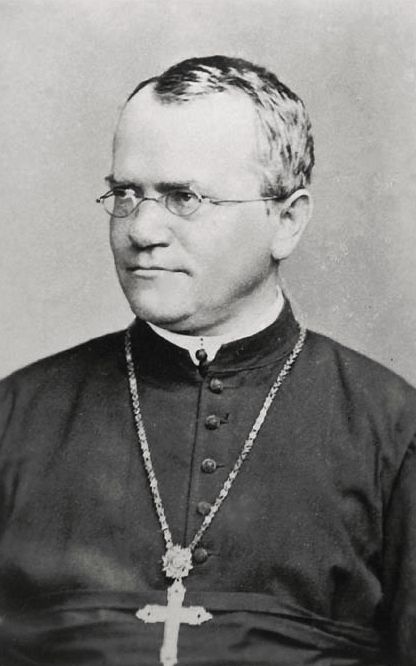

Summary
Gregor Mendel's 'Experiments in Plant Hybridisation' was read to the Natural History Society of Brünn (now Brno, in the Czech Republic) at its meetings of 8 February and 8 March 1865 and printed in the Society's proceedings, which appeared in 1866. Mendel, an Augustinian friar and schoolteacher, reported eight years of crossing varieties of the garden pea in his monastery garden. The paper was little noticed until 1900, when Hugo de Vries, Carl Correns and Erich von Tschermak independently reached similar results and drew attention to it. The library text is the volume in which William Bateson brought Mendel to English readers: Mendel's Principles of Heredity: A Defence (Cambridge, 1902). It contains Bateson's preface and introductory lecture, a revised Royal Horticultural Society translation of the pea paper, a translation of Mendel's later paper on Hieracium (hawkweed), and Bateson's long reply to the biometrician W. F. R. Weldon. Mendel chose the pea because its varieties differ in sharp, constant characters, its flowers protect against stray pollen, and its hybrids are fertile. He followed seven pairs of characters, among them round or angular seeds, yellow or green seed contents, tall or dwarf stems and the position of the flowers. In every first cross the hybrid resembled one parent: Mendel called that character dominant and the one that disappeared recessive. When the hybrids were self-fertilised, the recessive character reappeared in about a quarter of the offspring; in one trial 5,474 round seeds stood to 1,850 angular, and over all the experiments the average ratio was 2.98 to 1, or 3 to 1. Further generations showed that the dominant-looking plants were of two kinds, one-third breeding true and two-thirds behaving again like hybrids, giving the series A + 2Aa + a. When two or three pairs of characters were combined, each pair followed its own ratio independently, producing all possible combinations in predictable numbers. Mendel explained these results by supposing that hybrids form egg and pollen cells carrying each parental character in equal numbers, and he confirmed the theory by crossing the hybrids back to their parents. Briefer experiments with beans (Phaseolus) and a concluding comparison with the work of Kölreuter and Gärtner close the paper. The 1869 Hieracium paper reports that hawkweed hybrids, unlike peas, bred true. Bateson's introduction explains Mendel's principle of the purity of germ cells and contrasts it with Francis Galton's law of ancestral heredity, introducing the terms allelomorph, heterozygote and homozygote. His Defence answers Weldon's objections point by point, examining the colours and shapes of peas, the records of earlier breeders such as Knight and Laxton, and apparent exceptions, and ends predicting that Mendel's work will transform every science of living things.
Virtues in this work
- Industry: Mendel grew and counted thousands of pea plants over eight years before reporting a result, as his introductory remarks note.
- Humility: Mendel leaves to 'the friendly decision of the reader' whether his plan of experiment was the best suited to its end.
- Fortitude: Mendel writes that it requires courage to undertake a labour of such extent, and he carried it through without recognition.
- Justice: Bateson's Defence insists that Mendel be judged by his own records rather than by a critic's misreading of them.
Plot or Argument
- Bateson's preface and introduction
Bateson hails Mendel as a solitary discoverer who cut a way through the jungle of heredity while Darwin was at work, and explains why he has rushed this volume out in answer to Weldon. His lecture, revised from an address to the Royal Horticultural Society in 1900, compares Galton's statistical law of ancestral heredity with Mendel's principle of segregation and introduces the vocabulary of allelomorphs, heterozygotes and homozygotes.
- Mendel: introductory remarks and choice of plants
Earlier hybridists such as Kölreuter, Gärtner and Wichura had made many crosses but never counted the forms of the offspring by generation or determined their statistical relations. Mendel sets out the requirements for an experimental plant and explains why Pisum meets them.
- Mendel: arrangement of the experiments and the hybrids
Seven pairs of differentiating characters are chosen, from seed shape and colour to stem length. In each cross the hybrid shows one character unchanged, the dominant, while the other, the recessive, withdraws.
- Mendel: the generations bred from the hybrids
In the first generation from the hybrids, dominants and recessives appear in the ratio of about 3 to 1. Recessives breed true; of the dominants one-third breed true and two-thirds repeat the hybrid ratio, so that the series is 1 : 2 : 1. In later generations the proportion of hybrids steadily declines.
- Mendel: several characters combined
Crossing plants that differ in two characters yields 315 round yellow, 101 angular yellow, 108 round green and 32 angular green seeds, the combinations predicted if each pair of characters behaves independently. With three pairs, all twenty-seven classes of the predicted series appear.
- Mendel: the reproductive cells of the hybrids
Mendel infers that a hybrid forms egg and pollen cells of every constant type in equal numbers, and tests this by crossing hybrids with each parent; the observed classes match the prediction. Chance union of these cells accounts for the ratios.
- Mendel: other species and concluding remarks
Experiments with Phaseolus partly agree and show compound flower colours. Mendel compares his findings with Gärtner's transformation experiments and the question of the stability of species. The 1869 Hieracium paper reports hybrids whose offspring did not vary, which Mendel treats as a puzzle for further work.
- Bateson's Defence of Mendel's principles
In seven sections and a conclusion Bateson answers Weldon's article in Biometrika (1902): he contrasts Mendel's principle with the ancestral law, corrects what he calls the critic's version of Mendel, reviews the facts of dominance in peas, examines each case Weldon cited from older breeders, argues that exceptions do not overturn a principle, and discusses whether germ cells are absolutely pure.
Characters
- Gregor Mendel, author of the experiments
Augustinian friar and teacher at Brünn who crossed garden peas for eight years and found the numerical laws of their inheritance.
- William Bateson, editor and defender
Cambridge biologist who republished and championed Mendel's work in English and answered its critics.
- W. F. R. Weldon, critic answered
Oxford zoologist and biometrician whose 1902 Biometrika article questioned Mendel's laws and occasioned Bateson's Defence.
- Francis Galton, earlier theorist
Founder of the statistical study of heredity whose law of ancestral heredity Bateson contrasts with Mendel's principle.
- Karl Friedrich von Gärtner, predecessor
German hybridist whose extensive crosses Mendel cites and compares with his own results.
- Hugo de Vries, Carl Correns and Erich von Tschermak, rediscoverers
Botanists whose independent work in 1900 confirmed Mendel's results and brought his paper to notice.
Lessons
Choose the right material
Mendel begins by explaining that an experiment is only as good as the material chosen for it. By selecting a plant with sharp, constant characters, controlled pollination and fertile hybrids, he made it possible to count and classify every offspring.
- What three or more requirements does Mendel list for an experimental plant?
- Why did earlier hybridists, in Mendel's view, fail to discover general laws?
- Why does Bateson's note say Mendel's success came from his clear conception of three primary necessities?
Counting reveals hidden order
Single crosses had shown earlier observers only that hybrid offspring vary. By counting thousands of seeds and plants across generations, Mendel found the ratios 3 : 1 and 1 : 2 : 1 and the independent combination of characters. Patient numerical record turned a confusion into a law.
- What ratio did Mendel find in the first generation bred from the hybrids, and how close were individual experiments to it?
- How did he show that the dominant-looking plants were of two kinds?
- Why do larger numbers of plants give more reliable ratios?
Hypothesis and test
Mendel did not stop at describing his ratios. He proposed that hybrids form equal numbers of reproductive cells of each type, deduced what crosses back to the parents should yield, and found the predictions confirmed.
- What does Mendel suppose about the egg and pollen cells of the hybrids?
- How do the back-crosses test that supposition?
- Why is a confirmed prediction stronger evidence than a pattern noticed after the fact?
Neglect, rediscovery and controversy
Mendel's paper lay largely unread for thirty-five years. When it was rediscovered, Bateson defended it fiercely against Weldon, who thought it too simple for the facts of heredity. The dispute between Mendelians and biometricians was later resolved when R. A. Fisher and others showed that Mendelian factors could account for continuous variation.
- Why does Bateson think Weldon's critique was dangerous to young researchers?
- What kinds of evidence does Bateson use to answer Weldon?
- What might explain why an important discovery goes unnoticed for decades?
Context
In the mid-nineteenth century plant breeders and naturalists such as Kölreuter and Gärtner had made thousands of crosses without finding general laws, and Darwin's Origin of Species (1859) left the mechanism of heredity unexplained, relying on blending and, later, on his hypothesis of pangenesis. Mendel worked in Brünn, a manufacturing town in Moravia with an active natural history society and an Augustinian monastery that supported scientific teaching. After 1900 heredity became a field of intense research, and in Britain a dispute arose between Bateson's Mendelians and the biometricians Karl Pearson and W. F. R. Weldon, who studied heredity statistically following Galton.
Composition
Mendel presented the pea paper in two lectures in 1865; it appeared in the Verhandlungen des naturforschenden Vereines in Brünn, vol. IV, dated 1865 and issued in 1866. He sent copies to several scientists, and corresponded with the botanist Carl Nägeli, at whose suggestion he turned to Hieracium; that paper was read in 1869 and printed in 1870. An English translation was published by the Royal Horticultural Society in its Journal in 1901. Bateson revised it and added the Hieracium paper, his lecture and his Defence in Mendel's Principles of Heredity: A Defence (Cambridge University Press, 1902), the volume reproduced in the library text.
Reception
Mendel's paper was cited only a handful of times before 1900. After its rediscovery it became the foundation of genetics, a word Bateson proposed in 1905, and Mendelian inheritance was soon traced in animals and in human traits. The quarrel with the biometricians ended in the synthesis set out in R. A. Fisher's 1918 paper on correlation between relatives. In 1936 Fisher also argued that Mendel's reported numbers agree with expectation more closely than chance would usually allow; later scholars have offered differing explanations, from unconscious bias by assistants to the way Mendel selected and reported his trials, and many conclude that the question does not affect the soundness of his experiments or conclusions.
Comparisons
- on-the-origin-of-species
Darwin's theory needed a source of heritable variation that would not be blended away; Bateson's introduction remarks that the history of evolutionary thought would have been very different had Mendel's paper reached Darwin.
- the-descent-of-man
Darwin's later book discusses the inheritance of traits in human beings without a theory of particulate heredity; Mendelian principles, applied to human traits after 1900, supplied one.
- bernard-introduction-to-experimental-medicine
Published in 1865, the same year Mendel read his paper, Bernard's book argues for the experimental method in the life sciences; Mendel's design, counting and testing of predictions exemplify such method in botany.
- whewell-novum-organon-renovatum
Whewell held that discovery joins precise facts to a new conception and that true theories predict unobserved results; Mendel's hypothesis of equal germ cells, confirmed by back-crosses, fits that account.
- lavoisier-elements-of-chemistry
Bateson declared Mendel's experiments worthy to rank with those that founded the atomic laws of chemistry; Lavoisier's careful weighing, like Mendel's careful counting, turned qualitative observation into quantitative law.
Quotes
“an unknown man, Gregor Johann Mendel, had, alone, and unheeded, broken off from the rest--in the moment that Darwin was at work--and cut a way through.”
“It requires indeed some courage to undertake a labour of such far-reaching extent”
“The value and utility of any experiment are determined by the fitness of the material to the purpose for which it is used”
“The expression “recessive” has been chosen because the characters thereby designated withdraw or entirely disappear in the hybrids, but nevertheless reappear unchanged in their progeny”
“there is found, as between the number of forms with the dominant and recessive characters, an average ratio of 2·98 to 1, or 3 to 1.”
“Had Mendel’s work come into the hands of Darwin, it is not too much to say that the history of the development of evolutionary philosophy would have been very different from that which we have witnessed.”
“Each conception of life in which heredity bears a part--and which of them is exempt?--must change before the coming rush of facts.”
For Students
A reading companion for classical Christian high school students. See the student guide.
Reading Guide
Watch for
- Mendel's reasons for choosing the pea, in Selection of the Experimental Plants.
- The first use of the words dominant and recessive.
- The tables of seed and plant counts, and how close each comes to 3 : 1.
- The formula A + 2Aa + a and what each term stands for.
- Bateson's tone in the Preface and Conclusion, and how it differs from Mendel's.
Key terms and names
- Dominant
- Mendel's term for the character that appears unchanged in the hybrid.
- Recessive
- The character that disappears in the hybrid but reappears unchanged in some of its offspring.
- Hybrid
- The offspring of a cross between two forms differing in one or more characters.
- Allelomorph
- Bateson's term for each of a pair of alternative characters (later shortened to 'allele').
- Heterozygote and homozygote
- Bateson's terms for an organism formed from germ cells bearing different allelomorphs, and one formed from germ cells bearing the same.
- Purity of germ cells (segregation)
- The principle that each reproductive cell of a hybrid carries only one of the two alternative characters.
- Biometrician
- A follower of Galton and Pearson who studied heredity by the statistics of continuous variation in populations.
Seminar Questions
- Comprehension What seven pairs of characters did Mendel follow, and how did he choose them?
- Comprehension What happened to the recessive character in the hybrids and in their offspring?
- Comprehension What did Mendel find when plants differing in two characters were crossed?
- Interpretation Why was counting the offspring of every generation the key to Mendel's success?
- Interpretation How does Mendel's hypothesis about egg and pollen cells explain the 1 : 2 : 1 series?
- Interpretation Why did Bateson think Weldon's criticism needed so long and forceful an answer?
- Big Question What does Mendel's story teach about the relation between patient, obscure work and recognized achievement?
- Big Question How much of who a living thing is comes from inheritance, and what remains open to growth and choice?
Faith Connections
- Genesis 1:11-12 (Scripture)
Plants yield seed 'after his kind'; Mendel's experiments examine with precision how the characters of a kind pass from parent to offspring.
- Ecclesiastes 11:6 (Scripture)
'In the morning sow thy seed, and in the evening withhold not thine hand': a fitting text for eight years of planting and counting in a monastery garden.
- Colossians 3:23 (Scripture)
'Whatsoever ye do, do it heartily, as to the Lord, and not unto men': Mendel carried out his work faithfully though it brought him no recognition in his lifetime.
- The Rule of St Augustine (Great Conversation)
Mendel lived under the Augustinian rule, whose communities long combined prayer, teaching and learning; the monastery at Brünn supported his scientific study and supplied his garden.
Logic and Rhetoric
Central argument: If hybrids form egg and pollen cells carrying each of the parental characters in equal numbers, and these unite at random, then the offspring of hybrids will show the dominant and recessive characters in the ratio 3 : 1, will consist of true-breeding dominants, hybrids and recessives in the ratio 1 : 2 : 1, and will combine several pairs of characters independently. The counts of thousands of peas agree with these consequences, and crosses back to the parents confirm the predicted composition of the germ cells; therefore the hypothesis is justified.
Rhetorical device: invective and irony (Bateson). In his Conclusion Bateson borrows Horace Walpole's phrase to say that Weldon is about as likely to light a fire with a wet dish-clout as to kindle interest in Mendel by his tempered appreciation, a sharp contrast with Mendel's own plain, numerical prose.
Debate: Resolved: That Mendel's simple ratios were a better foundation for the study of heredity than Galton's statistics of continuous variation.
Memory Work
The value and utility of any experiment are determined by the fitness of the material to the purpose for which it is used
The expression “recessive” has been chosen because the characters thereby designated withdraw or entirely disappear in the hybrids, but nevertheless reappear unchanged in their progeny
Writing Prompts
Essay: Explain how Mendel moved from counting peas to a hypothesis about germ cells and then tested that hypothesis. Use his experiments on seed shape and the back-crosses, and assess what made his method successful.
Comparison with On the Origin of Species: Darwin and Mendel worked in the same years without knowing each other's ideas. Explain what problem in Darwin's theory Mendel's results address, and why Bateson thought the history of evolutionary thought would have been different had Darwin read Mendel.
Medical Lens
Mendel's paper concerns peas, but it founded the genetics on which modern medical understanding of inherited disease rests. Bateson's introduction contrasts Mendel's principle of segregation with Galton's statistical law of ancestral heredity, built partly on studies of human stature, and forecasts that an exact knowledge of heredity will change man's power over nature. In the same year as this book, 1902, Archibald Garrod, in correspondence with Bateson, interpreted alkaptonuria as a recessive Mendelian trait, the beginning of the study of inborn errors of metabolism. Mendelian ideas were also taken up, in the following decades, by eugenics movements in several countries; the history of medicine treats that use as a separate chapter in which hereditary theory was applied to social policy. For psychiatry, the book stands at the turn from nineteenth-century theories of hereditary degeneration, which assumed blending and cumulative taint, to the particulate model later used in psychiatric genetics.
- Bateson, Introduction, opening and section on the law of ancestral heredity
Bateson's forecast that the laws of heredity will change man's outlook and power, and his comparison of Galton's ancestral law, drawn partly from human stature, with Mendel's principle.
- Mendel, The Reproductive Cells of the Hybrids
The hypothesis that hybrids form equal numbers of germ cells of each parental type, the basis of later recessive and dominant patterns of inherited disease.
Creative Prompts
- Classroom
Simulate Mendel's monohybrid cross with two-coloured beads or coins: each 'hybrid parent' contributes one of two alleles at random. Record 100 offspring, compare the ratio with 3 : 1, and pool the class results to see the ratio approach Mendel's.
- Fiction
Write the evening of 8 February 1865 in Brünn, when a friar reads a paper on peas to a society of local naturalists who do not see what he has found.
- Dialogue
Stage the 1902 dispute between Bateson and Weldon over whether heredity is best studied by Mendel's simple ratios or by Galton's statistics of continuous variation.
- Essay
Why was Mendel's paper neglected for thirty-five years? Weigh explanations such as the journal it appeared in, the novelty of its mathematical method, and the questions biologists of the 1860s were asking.
Further Reading
- The Monk in the Garden, Robin Marantz Henig
A popular account of Mendel's life and the rediscovery of his work.
- Gregor Mendel: The First Geneticist, Vítězslav Orel
- Ending the Mendel-Fisher Controversy, Allan Franklin, A. W. F. Edwards, Daniel J. Fairbanks, Daniel L. Hartl and Teddy Seidenfeld
Reprints Fisher's 1936 paper with later assessments.
- Inborn Errors of Metabolism, Archibald E. Garrod
Garrod's 1909 lectures applying Mendelian inheritance to human metabolic disease.
Verification notes
Contents follow the stored Project Gutenberg text of Bateson's 1902 volume. All seven quotations were found by search in content/texts/mendel-experiments-in-plant-hybridisation.txt and copied exactly, including curly quotation marks, the middle dot in '2·98' and the double hyphens. The seed counts (5,474 round to 1,850 angular; 315, 101, 108 and 32 in the dihybrid cross) are from the text. Bateson's biographical note gives Mendel's birth date as 22 July 1822, which is his baptismal date; many sources give 20 July. The Garrod, Fisher and eugenics remarks follow standard histories of genetics.
- The name of the original Royal Horticultural Society translator (often given as C. T. Druery) and the volume of the RHS Journal (1901).
- Mendel's birth date (20 or 22 July 1822).
- The year Bateson first proposed the word 'genetics' (usually given as 1905, in a letter to Adam Sedgwick, and publicly in 1906).