Work record
The Monroe Doctrine
1823 · 19th Century · Political Theory · English
Abstract
Background. With Spanish America newly free and French troops having restored Spain's king, American leaders feared a European effort to reclaim the lost colonies. Britain, through George Canning, proposed a joint statement; Jefferson and Madison favoured accepting, but Adams persuaded the cabinet that the republic should speak alone rather than come in as a small boat behind a British warship.
Content. The bulk of the report covers treaties, debt, the army, West Point, pirates off Cuba, an epidemic at the Key West station, postal accounts, the Cumberland Road and a canal plan. Two short passages, one on Russian claims along the Pacific shore and one following remarks on Greece and Spain, carry the lasting policy.
Key Concepts. No fresh European settlements anywhere in North or South America; American abstention from Europe's internal conflicts; recognition of present European holdings; treating intervention against the new republics as an unfriendly act.
Structure. Opening remarks on informing a sovereign people lead into foreign relations, then domestic administration, then hemispheric policy, and finally a survey of national growth since independence, when population stood near three million against roughly ten million in 1823.
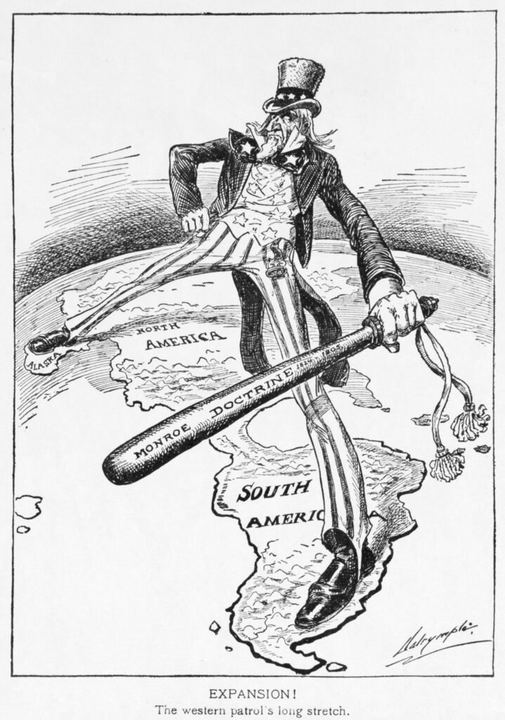
Significance. Little enforced at first, the principles were reasserted by Polk in 1845, acquired Monroe's name around mid-century, and were enlarged by Theodore Roosevelt's 1904 corollary, becoming a lasting reference point in American diplomacy.
Key figures
- James Monroe: Fifth President, author and signer of the message
- John Quincy Adams: Secretary of State who shaped the non-colonization language
- George Canning: British Foreign Secretary whose joint-declaration offer preceded the message
- Alexander I: Russian emperor whose coastal claims prompted negotiation
- David Porter: Commodore leading the anti-piracy squadron near Cuba

Summary
The Monroe Doctrine is the name later given to a few passages in President James Monroe's Seventh Annual Message to Congress, sent in writing on December 2, 1823, and read aloud to the new Eighteenth Congress. The library text gives the whole message, so readers can see the famous statements in their setting. Monroe begins by explaining that because the people are sovereign, they must be given full information about public affairs. He then reviews relations with foreign powers: boundary commissions under the Treaty of Ghent with Great Britain, trade with the British West Indies, claims against France, and an invitation from the Emperor of Russia to settle by negotiation the two countries' rights on the North West coast of North America. In that paragraph Monroe announces the first principle of the doctrine: the American continents, being free and independent, are no longer to be considered subjects for future colonization by any European power. Most of the message then turns to home affairs. Monroe reports on the national debt and finances, the army, coastal fortifications, the Military Academy at West Point, an attack by the Arikara on a trading party and Colonel Leavenworth's expedition against their village, the navy's campaign under Commodore David Porter against pirates in the West Indies, a deadly fever at the navy's station on Thompson's Island, the suppression of the slave trade, the Post Office, the Cumberland Road and a proposed canal joining the Chesapeake and the Ohio. Near the end he expresses hope that the Greeks will win their independence and then turns to Spain and Portugal, where the allied powers of Europe had intervened by force. Here he states the second principle: the United States takes no part in Europe's own wars, but it would consider any attempt by those powers to extend their system to this hemisphere as dangerous to its peace and safety, and any interference with the newly independent Spanish American republics as unfriendly to the United States. Existing European colonies would not be disturbed. The message closes by measuring the Union's growth since the Revolution, from three million people to about ten million. Secretary of State John Quincy Adams shaped much of the foreign-policy language, and the name Monroe Doctrine came into general use only in the 1850s.
Virtues in this work
- Prudence: Monroe promises to stay out of Europe's wars and to leave existing colonies alone, while keeping the right to act if neutrality toward Spain and the new republics must change.
- Fortitude: A young and lightly armed nation publicly warns the great monarchies of Europe not to extend their system into the Americas.
- Justice: The message upholds the independence of the Spanish American republics that the United States had recognized on what Monroe calls just principles.
Plot or Argument
- Why the people must be informed
Monroe opens by explaining that since the people are sovereign, they and their representatives need full and accurate information on public affairs.
- Foreign relations and the North West coast
He reviews negotiations with Britain, France and others. In the paragraph on Russia's proposal to negotiate rights on the North West coast, he announces that the American continents are closed to future colonization by European powers.
- Finances, army and frontier
Reports on the public debt, the army, fortifications, West Point, armories and the expedition against the Arikara after their attack on General Ashley's trading party.
- Navy, pirates and fever
The navy protects American commerce in the Mediterranean and Pacific; Commodore Porter's squadron hunts pirates near Cuba, a malignant fever strikes the station at Thompson's Island, and ships are ordered to seize American vessels in the slave trade.
- Post Office and internal improvements
Postal finances and post roads, manufactures, repairs to the Cumberland Road, a proposed Chesapeake and Ohio canal, and harbour works in Delaware and Pennsylvania.
- Greece, Spain and Portugal
Monroe hopes Greece will become independent, then notes that the allied powers have intervened by force in Spain.
- The two hemispheres
The United States does not take part in Europe's own wars, but would view any European attempt to extend its political system to the Americas, or to oppress the new republics, as dangerous and unfriendly; existing colonies will be left alone.
- The growth of the Union
Monroe closes by comparing the nation in 1823 with its condition at the end of the Revolution and credits its prosperity to its institutions.
Characters
- James Monroe, author
Fifth President, who signed and sent the message to Congress.
- John Quincy Adams, Secretary of State
Not named in the message, but the main author of its non-colonization principle and an advocate of an independent American statement.
- Emperor of Russia (Alexander I), foreign sovereign
Whose government proposed negotiations over the North West coast.
- Commodore David Porter, naval commander
Led the squadron against pirates in the West Indies.
- Commodore John Rodgers, naval officer
Sent with surgeons to investigate the fever at Thompson's Island.
- Colonel Henry Leavenworth, army officer
Commander at Fort Atkinson who led the expedition against the Arikara village.
Lessons
Two hemispheres, two systems
Monroe's message divides the world into Europe, whose quarrels the United States would stay out of, and the Americas, where it would not accept new European control. The idea joins a promise of restraint with a warning. Students can see that a famous policy began as a few sentences in a long report.
- What does Monroe promise Europe, and what does he warn Europe against?
- Why does he say the political system of the allied powers is different from that of America?
A policy in its setting
Most of the message is about debts, forts, roads, mail and pirates. Reading the whole text shows how foreign policy sat alongside ordinary government business, and how a president reported to Congress in 1823.
- Why might the later name Monroe Doctrine make readers forget the rest of the message?
- Which other topic in the message surprised you most, and why?
- What does the message show about what the federal government did in 1823?
Neutrality and its limits
Monroe says the United States declared neutrality between Spain and its former colonies and will keep it unless a change requires otherwise. He leaves the government room to act while promising restraint. Careful wording, the message shows, can keep options open.
- Find the condition Monroe attaches to American neutrality. Why include it?
- Is it wise for a nation to announce in advance what it will treat as unfriendly?
Context
By 1823 most of Spain's American colonies had declared independence, and the United States had recognized several of the new republics in 1822. In Europe, the allied monarchies of the Holy Alliance had restored royal power in Italy, and in April 1823 a French army entered Spain and restored King Ferdinand VII's absolute rule. Americans and Britons feared the allies might help Spain recover its former colonies. Separately, a Russian decree of 1821 had claimed the North West coast south to the 51st parallel and barred foreign ships from nearby waters.
Composition
In August 1823 the British Foreign Secretary, George Canning, proposed to the American minister in London, Richard Rush, a joint declaration against intervention in Spanish America. Former Presidents Jefferson and Madison advised Monroe to accept, but Secretary of State John Quincy Adams argued in cabinet in November that the United States should state its principles on its own. Monroe adopted that course and placed the statements in his annual message of December 2, 1823; Adams had already drafted the non-colonization principle in instructions concerning Russia.
Reception
European governments largely dismissed the statement, and the British navy, not American power, did most to keep the allies out of Latin America in the 1820s. Russia agreed in an 1824 treaty to the line of 54°40' as the southern limit of its claims. President James K. Polk restated the principles in 1845, and the label Monroe Doctrine became common in the 1850s. In 1904 Theodore Roosevelt added the Roosevelt Corollary, claiming a right for the United States to act as an international police power in the hemisphere. Historians have debated ever since how much the original statement owed to Adams, to Canning's offer, and to Monroe himself.
Comparisons
- washington-farewell-address-and-selected-letters
Washington's Farewell Address (1796) warned against permanent alliances and entanglement in Europe's quarrels; Monroe's promise to stay out of Europe's wars builds directly on it while adding a claim about the Western Hemisphere.
- the-founding-documents
Monroe credits the nation's prosperity to the Constitution and contrasts American government with the European monarchies; the founding documents supply the system he is defending.
- madison-selected-writings
Madison, Monroe's predecessor, was consulted on Canning's offer in 1823 and advised cooperation with Britain, a road Monroe did not finally take.
- jefferson-selected-writings
Jefferson, Monroe's mentor, also advised accepting Canning's proposal and wrote that America should never entangle itself in the broils of Europe nor suffer Europe to meddle with American affairs.
- citizenship-in-a-republic
Theodore Roosevelt, whose 1904 corollary greatly enlarged the meaning of Monroe's statement, speaks in this 1910 address about the duties of citizens in a great republic.
Quotes
“The people being with us exclusively the sovereign, it is indispensable that full information be laid before them on all important subjects”
“the American continents, by the free and independent condition which they have assumed and maintain, are henceforth not to be considered as subjects for future colonization by any European powers.”
“In the wars of the European powers in matters relating to themselves we have never taken any part, nor does it comport with our policy so to do.”
“We owe it, therefore, to candor and to the amicable relations existing between the United States and those powers to declare that we should consider any attempt on their part to extend their system to any portion of this hemisphere as dangerous to our peace and safety.”
“With the existing colonies or dependencies of any European power we have not interfered and shall not interfere”
For Students
A reading companion for classical Christian high school students. See the student guide.
Reading Guide
Watch for
- Monroe's reason, at the very start, for giving Congress so much detail: the people are sovereign and need full information.
- The paragraph on Russia and the North West coast, where the non-colonization principle appears almost in passing.
- The many reports on forts, roads, mail, pirates and fever that fill the middle of the message.
- The turn from Greece to Spain and Portugal near the end, where Monroe describes the allied powers' intervention in Spain.
- The difference Monroe draws between Europe's own wars and any European move into the Americas.
Key terms and names
- Annual message
- The President's yearly report to Congress on the state of the Union; in 1823 it was sent in writing and read aloud by a clerk.
- Non-colonization
- Monroe's principle that no European power should found new colonies anywhere in North or South America.
- Allied powers
- The European monarchies, often called the Holy Alliance, that had helped restore the King of Spain's full power in 1823.
- North West coast
- The Pacific coast of North America claimed in part by Russia, Britain and the United States, the subject of the negotiations Monroe reports.
- Hemisphere
- Half of the globe; Monroe uses it for the Americas, which he treats as separate from Europe's political system.
- Neutrality
- Taking neither side in a war; the United States declared it in the war between Spain and its former colonies.
Seminar Questions
- Comprehension Why does Monroe say he must give Congress and the people such full information?
- Comprehension In what part of the message does the warning against future colonization first appear, and what negotiation is Monroe reporting there?
- Comprehension What does Monroe say the United States will do, and not do, about European colonies that already exist in the Americas?
- Interpretation Monroe says the political system of the allied powers is essentially different from that of America. What difference does he have in mind?
- Interpretation Why might Monroe have placed his warning to Europe near the end of a long report on roads, forts and the mail, instead of in a separate speech?
- Interpretation Monroe expresses warm hopes for Greece but promises to stay out of Europe's wars. How do these two statements fit together?
- Big Question Should a nation declare in advance what it will treat as a threat, or keep its plans to itself?
Faith Connections
- Proverbs 26:17 (Scripture)
He that meddles with strife not belonging to him is like one that takes a dog by the ears. Monroe's promise to take no part in Europe's own quarrels reflects the same prudence.
- Romans 12:18 (Scripture)
If it be possible, as much as lieth in you, live peaceably with all men. Monroe speaks of candor and friendly relations with the European powers even while warning them, an attempt to keep peace while drawing a firm line.
- George Washington, Farewell Address (1796) (Great Conversation)
Washington urged Americans to avoid permanent alliances and to keep out of Europe's ambitions and rivalries. Monroe, who served under Washington in the Revolution, repeats that rule and adds a new claim about the Americas.
Logic and Rhetoric
Central argument: Europe's monarchies have a political system different from America's. The United States has stayed out of Europe's own wars and intends to continue doing so. But the new American republics are free and independent, and any European attempt to recolonize or control them would threaten the peace and safety of the United States. Therefore the American continents are closed to new colonization, and European interference with the new republics will be treated as unfriendly, while existing colonies are left alone.
Rhetorical device: antithesis. In the closing foreign-affairs passage Monroe sets Europe's wars, in which the United States has never taken part, against the movements in this hemisphere, with which it is of necessity more immediately connected.
Debate: Resolved: The United States was wise to issue its 1823 warning alone rather than jointly with Great Britain.
Memory Work
In the wars of the European powers in matters relating to themselves we have never taken any part, nor does it comport with our policy so to do.
Writing Prompts
Essay: Using the full text of the message, explain what Monroe actually said about Europe and the Americas and how much of the message is about other subjects. Then argue why a few sentences became the best-remembered part.
Comparison with Farewell Address and Selected Letters: Washington warned against entangling the nation in Europe's affairs; Monroe repeats the warning and adds a claim about the Western Hemisphere. Compare the two texts and argue whether Monroe was following Washington's advice or going beyond it.
Medical Lens
One paragraph reports that in August 1823 a very malignant fever broke out at the navy's anti-piracy station on Thompson's Island (Key West), killing many, striking the commanding officer and disabling most of the medical officers. Commodore Rodgers was sent with skilled surgeons to learn the origin of the fever and whether it would recur, and Porter withdrew most of the squadron. The outbreak is generally identified by historians as yellow fever, though the message does not name it; the passage shows the period's practice of investigating local causes of fever before the mosquito's role was known.
- Navy section, paragraph on Thompson's Island
The malignant fever at the West India station, the loss of medical officers, and Commodore Rodgers's mission with surgeons to determine the fever's origin.
Creative Prompts
- Classroom
Make a two-column chart of the message: in one column list every topic Monroe reports on; in the other mark which ones later became known as the Monroe Doctrine.
- Dialogue
Write the November 1823 cabinet conversation in which John Quincy Adams argues that the United States should speak on its own rather than join Britain's declaration.
- Fiction
Write a letter from a sailor in Commodore Porter's squadron at Thompson's Island in the summer of 1823.
- Essay
Compare Monroe's warning to Europe with Washington's advice in the Farewell Address. Is Monroe continuing Washington's policy or changing it?
Further Reading
- The Making of the Monroe Doctrine, Ernest R. May
- A History of the Monroe Doctrine, Dexter Perkins
- John Quincy Adams and the Foundations of American Foreign Policy, Samuel Flagg Bemis
- The Last Founding Father: James Monroe and a Nation's Call to Greatness, Harlow Giles Unger
Verification notes
All quotations were found verbatim by Grep in content/texts/monroe-doctrine.txt (the full Seventh Annual Message as printed in Richardson's Messages and Papers of the Presidents, from The American Presidency Project). The doctrine passages are often cited by paragraph number (the Russia paragraph as the seventh, the closing passages as the forty-eighth and forty-ninth in the Avalon excerpt); paragraph numbering differs between printings, so locators here describe position instead. Background facts (Canning's proposal to Rush in August 1823, Jefferson's and Madison's advice, Adams's cabinet argument, the 1821 Russian decree, the 1824 Russo-American treaty at 54°40', the Roosevelt Corollary of 1904) are standard. The identification of the Thompson's Island fever as yellow fever is the usual historical reading, not stated in the message.
- Paragraph numbers of the doctrine passages in Richardson's printing.
- The decade in which the name Monroe Doctrine came into common use (usually given as the 1850s).