Work record
Reflections on the Revolution in France
1790 · 18th Century · Political Theory · English
Abstract
Background. In November 1789 a London club celebrating 1688 cheered a sermon hailing events in Paris and sent greetings to the new French legislature. Burke, a veteran Whig parliamentarian, answered with a letter addressed to a young acquaintance across the Channel.
Argument. English freedom rests on precedent and descent, not on a theory of popular choice. The settlement of 1689 repaired the monarchy without unmaking it. The French, by contrast, are demolishing crown, church, aristocracy and courts on speculative principles, and the result will be instability, bankruptcy and finally a soldier's rule.
Structure. The first half answers the sermon, contrasts the two revolutions, narrates the attack on Versailles and defends the English church settlement. The second half audits the Assembly's work clause by clause: the departments, representation, the crown, the courts, the army and the treasury.
Key Concepts. Prescription, prudence, inherited opinion as stored wisdom, attachment to local loyalties, a compact that joins ancestors to descendants, and reverence for religion as the ground of public order. Against the metaphysician, Burke sets the statesman who weighs circumstances and works with the materials a nation already has.
Significance. Rival pamphlets by Wollstonecraft and Paine made the book the centre of a national debate, it split the Whigs, and later generations treated it as the charter of conservative thought.
Key figures
- Edmund Burke: Irish-born Whig member of Parliament writing in his own voice
- Richard Price: Dissenting preacher whose Old Jewry sermon prompted the reply
- Charles-Jean-François Depont: Young Parisian correspondent to whom the letter is addressed
- Marie Antoinette: Queen whose ordeal at Versailles inspires the book's lament
- Louis XVI: Monarch brought from Versailles to Paris in October 1789
- Jacques Necker: Finance minister whose figures Burke turns against the Assembly

Summary
Edmund Burke's Reflections on the Revolution in France, published in London in November 1790, is cast as a long letter to a young Frenchman, Charles-Jean-François Depont, who had asked Burke's opinion of events in Paris. Its immediate occasion was the sermon A Discourse on the Love of Our Country, preached by the Dissenting minister Richard Price on 4 November 1789 to the Revolution Society at the meeting-house in the Old Jewry, and the society's address of congratulation to the French National Assembly. The library text is the Reflections alone, from volume 3 of the Nimmo edition of Burke's Works. Burke first answers Price's claim that the Revolution of 1688 gave the English a right to choose their own governors, to cashier them for misconduct, and to frame a government for themselves. Reading the Declaration of Right and the Act of Settlement, he argues that 1688 was a narrow act of necessity meant to preserve the ancient constitution and the hereditary succession. From Magna Carta to the Petition of Right, the English have claimed their liberties as an entailed inheritance from their forefathers, so that the state, like a family estate, may be improved without being torn down. He then turns to France. The National Assembly, he says, is dominated by provincial lawyers and obscure clergy without experience of great affairs, and it governs by abstract rights of man instead of the real rights that civil society secures, such as justice, the fruits of one's industry, and instruction in life and consolation in death. Government is a contrivance of practical wisdom, a matter for experience rather than metaphysics. The most famous pages describe the October Days of 1789, when a crowd invaded Versailles and the royal family was taken to Paris, and recall Burke's sight of Marie Antoinette as dauphiness years before; he laments that the age of chivalry is gone and with it the manners that softened power. Burke defends prejudice, meaning settled affection with its reason inside it, and the English establishment of the Church, which he describes as consecrating the state. Society is a contract, but a partnership in all virtue between the living, the dead, and those yet to be born. He condemns the confiscation of Church lands and the paper money of assignats issued against them. The second half examines the new constitution in detail: the geometrical division of France into departments, the three bases of representation, the reduced executive, the new judicature, the army and the finances, and predicts disorder and military rule. He closes by describing himself as a man who wishes to preserve consistency by varying his means. The book was answered at once by Mary Wollstonecraft and in 1791 by Thomas Paine's Rights of Man, and it became a founding text of modern conservatism.
Virtues in this work
- Prudence: Burke insists that questions of government, like those of food and medicine, be settled by experience and the art of administering remedies rather than by theory.
- Piety: He defends reverence for ancestors and for the established Church as the ground of a commonwealth that remembers it acts in trust from God.
- Honor: The lament for Marie Antoinette praises the generous loyalty and sense of honour that once made obedience free and power gentle.
- Humility: Burke argues that each man's private stock of reason is small and should draw on the general bank and capital of nations and of ages.
Plot or Argument
- The occasion: Dr. Price and the Revolution Society
Burke explains that the letter began as a reply to a young gentleman in Paris and grew into a book. He describes the Revolution Society and Richard Price's sermon at the Old Jewry, and the address transmitted through Earl Stanhope to the National Assembly. He declines to congratulate France on liberty in the abstract until he knows how that liberty is combined with government, public force, discipline, revenue, morality and religion.
- 1688 read as preservation, not as a precedent for choosing kings
Against Price's three rights (to choose governors, to cashier them for misconduct, to frame a government), Burke reads the Declaration of Right and the Act of Settlement. The Revolution, he argues, was an act of necessity that departed from the strict order of succession only as little as possible and then bound the nation to the heirs of the Protestant line. A state without some means of change cannot preserve itself, but the English corrected their constitution in order to conserve it.
- Liberty as an entailed inheritance
From Magna Carta through the Petition of Right to the Declaration of Right, the English have claimed their liberties as an inheritance from their ancestors, to be transmitted to posterity. This method gives freedom a pedigree and a gravity, joins the constitution to the order of nature and the affections of family, and lets the state be improved without being rebuilt.
- The National Assembly and the rights of man
Burke examines the composition of the Third Estate and the clergy in the Assembly and argues that men without experience of the state are trying to reconstruct it from first principles. He sets the real rights of men in civil society, justice, the fruits of their industry, the acquisitions of their parents, instruction and consolation, against metaphysical rights which, by claiming everything, secure nothing. Government is a matter of practical wisdom, as food and medicine are questions for the farmer and the physician.
- The October Days and the age of chivalry
Burke recounts the night of 5–6 October 1789, the invasion of the queen's apartments at Versailles and the procession that carried the royal family to Paris. Remembering Marie Antoinette as he saw her at Versailles some sixteen or seventeen years before, he mourns the passing of chivalry, the generous loyalty and manners that made power gentle and obedience liberal, and warns that a philosophy which strips away these decent draperies of life leaves only force.
- Prejudice, establishment and the partnership of generations
The English, he says, are not converts of Rousseau or Voltaire; they cherish their prejudices because they contain latent wisdom and make duty a habit. Religion is the basis of civil society, and the Church establishment consecrates the commonwealth so that those who exercise power remember they act in trust. Society is indeed a contract, but not a trading partnership: it is a partnership between the living, the dead and the unborn, a clause in the great primeval contract of eternal society.
- Confiscation, assignats and the religious houses
Burke condemns the seizure of Church property, the treatment of clergy and religious orders, and the paper currency of assignats secured on the confiscated lands. He compares the Assembly's finance unfavourably with Necker's figures and with what a prudent reform of the old monarchy might have achieved, and he defends the French nobility and clergy against the charge that they were beyond amendment.
- The new constitution examined
In the second half Burke reviews the legislative body, built on three bases (territory, population and contribution) and on the geometrical division of France into departments, communes and cantons; the reduced and dependent executive; the judicature that replaces the parlements; the army, whose discipline he expects to fail; and the revenue. He predicts that such a constitution will end in the rule of a popular general.
- Conclusion: consistency by varying the means
Burke offers his views as those of a man who has opposed arbitrary power all his life and who now speaks against a new form of it. He describes himself as one who would preserve consistency by varying his means to secure the unity of his end, and who, when the vessel is in danger of being overset on one side, carries the small weight of his reasons to the other.
Characters
- Richard Price, chief opponent
Dissenting minister and moral philosopher whose sermon of 4 November 1789 at the Old Jewry occasioned the book.
- Charles-Jean-François Depont, addressee
The very young gentleman at Paris (unnamed in the text) whose request for Burke's opinion began the correspondence.
- Marie Antoinette, subject of the central lament
Queen of France, whom Burke remembers seeing at Versailles as dauphiness and whose humiliation in the October Days he describes.
- Louis XVI, subject
King of France, presented as a mild and well-meaning prince carried captive to Paris.
- Earl Stanhope, minor figure
Chairman through whom the Revolution Society's address was transmitted to the National Assembly.
- Hugh Peters, historical comparison
Puritan preacher executed in 1660, whose words at the time of Charles I Burke compares with Price's.
- Jacques Necker, authority on finance
Louis XVI's finance minister, whose budgets and estimates Burke uses against the Assembly's financial measures.
- Henry IV of France, exemplar
The admired Bourbon king whom Burke cites as proof that a firm monarch can also be beloved.
Lessons
Liberty received as a family inheritance
Burke argues that the English never claimed their freedom as an abstract right but as an inheritance passed down from Magna Carta to the Declaration of Right. Treating liberty like an estate held in trust makes each generation a steward rather than an owner, bound to receive and to hand on.
- What does Burke gain by comparing the constitution to an entailed estate?
- Why does he say people will not look forward to posterity who never look backward to their ancestors?
- Can rights that are inherited also be called natural? How does Burke answer?
The real rights of men in society
Burke does not deny that men have rights; he denies that abstract rights can be applied to government without prudence. The rights that matter are the advantages civil society actually secures: justice, the fruits of labour, protection, instruction and consolation. Government is judged by how it supplies human wants, not by the purity of its theory.
- Which rights does Burke list as the real rights of men?
- Why does he say that by having a right to everything men want everything?
- What does his comparison to food and medicine show about how he thinks political questions should be answered?
Affection begins in the little platoon
Public spirit, Burke says, grows outward from love of the small groups to which we belong, the family, the neighbourhood, the order or profession, toward love of country and of mankind. A politics that dissolves these attachments in the name of the nation weakens the very affections it needs.
- What is the little platoon, and why does Burke call it the first link in a series?
- Why does he think contempt for one's own rank or order is a sign of ambition rather than public spirit?
- What are the little platoons in your own life, and how do they prepare you for larger loyalties?
Manners as the drapery of life
In the lament for Marie Antoinette, Burke argues that chivalry, reverence and courtesy are not ornaments but supports of civilized life: they make power gentle and obedience free. Strip them away and only calculation and force remain.
- Why does Burke place the scene at Versailles at the emotional centre of the book?
- Paine accused Burke of pitying the plumage and forgetting the dying bird. How might Burke reply?
- Do manners and reverence still do the work Burke assigns to them?
Reform in order to conserve
Burke is not against all change. He insists that a state without the means of change cannot preserve itself, and he praises the English for correcting their constitution in 1688 while keeping its principles. Prudent reform repairs the building; revolution pulls it down to build from a plan.
- How does Burke distinguish the Revolution of 1688 from the Revolution in France?
- What principles of conservation and correction does he find in English history?
- When does reform become revolution, by Burke's standard?
Context
The Estates-General met at Versailles in May 1789 and the Third Estate declared itself the National Assembly in June. The Bastille fell on 14 July; in August the Assembly abolished feudal dues and exemptions and adopted the Declaration of the Rights of Man and of the Citizen; in October a Parisian crowd brought the royal family from Versailles to Paris; in November Church property was placed at the disposal of the nation. In England many Whigs and Dissenters welcomed these events as a French version of 1688, and Richard Price's sermon of 4 November 1789, on the anniversary of the landing of William of Orange, linked the two revolutions directly. Burke, a Rockingham Whig who had defended the American colonists and attacked the abuses of the East India Company, saw the French case as different in kind.
Composition
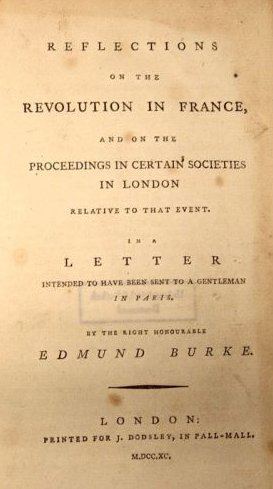
The preface says Burke answered Depont's first request in October 1789 but held the letter back; a second request led to a fuller discussion that outgrew the letter form. He worked on it through the first half of 1790, revising heavily, and J. Dodsley published it in London on 1 November 1790. The letter form is kept throughout, with frequent addresses to the reader as Sir. The library text is the Reflections alone, from volume 3 of the John C. Nimmo edition of The Works of the Right Honourable Edmund Burke, transcribed by Project Gutenberg.
Reception
The book sold widely in Britain and was soon translated into French. Mary Wollstonecraft's A Vindication of the Rights of Men appeared within weeks, and Thomas Paine's Rights of Man (1791) answered it point by point; dozens of other replies followed in what is called the Revolution controversy. The book divided the Whig party: Burke's quarrel with Fox in the Commons in May 1791 ended their friendship, and he defended his position in An Appeal from the New to the Old Whigs (1791). The execution of the king and the Terror of 1793–94 persuaded many readers that his predictions had been borne out. In the nineteenth and twentieth centuries the Reflections became a classic of conservative political thought, admired by readers as different as Coleridge, Matthew Arnold and Russell Kirk, while historians have debated how fully Burke understood the condition of France before 1789.
Comparisons
- common-sense-rights-of-man-and-other-writings
Paine's Rights of Man (1791) was written as a direct reply: it denies that one generation can bind the next, defends the Declaration of the Rights of Man, and mocks the Marie Antoinette passage. Reading the two side by side gives the whole Revolution controversy in its clearest form.
- the-social-contract
Rousseau grounds legitimate authority in the general will of citizens assembled now; Burke, who names Rousseau among those the English have not followed, describes the social contract as a partnership binding the dead and the unborn.
- second-treatise-of-government
Price read 1688 through Lockean consent and the right to remove rulers who break their trust; Burke reads the same events through the Declaration of Right as a careful preservation of hereditary succession.
- a-tale-of-two-cities
Dickens's novel imagines the storming of the Bastille and the Terror that followed the events Burke described in 1790, and like Burke it dwells on mobs, prisons and the fate of individuals caught in a revolution.
- the-scarlet-pimpernel
Orczy's adventure of 1792–93, with its English rescuers of French aristocrats, turns into romance the English reaction to the Revolution that Burke's book helped to form.
- the-spirit-of-the-laws
Montesquieu's praise of intermediate powers and of the English constitution supplies much of the background to Burke's defence of nobility, clergy and parlements as barriers between the monarch and the people.
Quotes
“A state without the means of some change is without the means of its conservation.”
“People will not look forward to posterity, who never look backward to their ancestors.”
“To be attached to the subdivision, to love the little platoon we belong to in society, is the first principle (the germ, as it were) of public affections.”
“What is the use of discussing a man's abstract right to food or medicine? The question is upon the method of procuring and administering them.”
“But the age of chivalry is gone. That of sophisters, economists, and calculators has succeeded; and the glory of Europe is extinguished forever.”
“Prejudice renders a man's virtue his habit, and not a series of unconnected acts. Through just prejudice, his duty becomes a part of his nature.”
“We know, and, what is better, we feel inwardly, that religion is the basis of civil society, and the source of all good, and of all comfort.”
“it becomes a partnership not only between those who are living, but between those who are living, those who are dead, and those who are to be born.”
For Students
A reading companion for classical Christian high school students. See the student guide.
Reading Guide
Watch for
- The three rights Burke quotes from Price's sermon (to choose governors, to cashier them for misconduct, to frame a government) and how he answers each from the Declaration of Right.
- The comparison of English liberty to an entailed inheritance, and how often Burke returns to the language of family, estate and ancestors.
- The scene of the October Days and the memory of Marie Antoinette, where the argument turns into lament.
- Burke's defence of prejudice and of the Church establishment, and his description of society as a partnership of the living, the dead and the unborn.
- The medical images of the state's distempers, the physician and the empiric, which Burke uses to contrast experience with theory.
Key terms and names
- Revolution Society
- A London club that met each 4 November to commemorate the Revolution of 1688. Its address of congratulation to the French National Assembly in 1789 was one occasion of the book.
- Old Jewry
- The London street whose Dissenting meeting-house was the site of Richard Price's sermon. Burke uses the name throughout as shorthand for Price's doctrines.
- Declaration of Right
- The act of 1689 that settled the crown on William and Mary and listed the rights of the English. Burke reads it as proof that the Revolution meant to preserve hereditary succession.
- Entailed inheritance
- In English law, an estate settled so that it must descend in a fixed line. Burke uses the image for liberties received from ancestors and owed to descendants.
- Prejudice
- For Burke, an inherited opinion or settled affection that carries its reason within it and moves a person to act without hesitation. He uses the word in praise.
- Little platoon
- Burke's image for the small group or order to which a person belongs, whose love is the first step toward love of country and mankind.
- Assignats
- Paper money issued by the National Assembly and secured on confiscated Church lands, which Burke predicts will lose its value.
- October Days
- The events of 5–6 October 1789, when a crowd from Paris invaded Versailles and the royal family was brought back to the city.
Seminar Questions
- Comprehension What three rights did Richard Price claim for the English people, and what documents does Burke use to deny that 1688 established them?
- Comprehension What happened at Versailles on 5–6 October 1789, according to Burke, and how does he connect it to his memory of the queen?
- Comprehension What are the real rights of men that Burke says civil society secures?
- Interpretation Why does Burke prefer to speak of liberties as an inheritance rather than as the rights of man? What does the family image let him say that abstract language cannot?
- Interpretation Burke praises prejudice. How is his meaning different from our ordinary use of the word, and is his defence persuasive?
- Interpretation Society, Burke says, is a contract, but not like a partnership in pepper and coffee. What makes the partnership of generations different from an ordinary contract?
- Big Question Do we owe anything to people who lived before us, or to people not yet born? How would that debt affect the way we change our laws?
- Big Question Can a revolution ever be justified on Burke's principles, and if so, what would distinguish it from the one he condemns?
Faith Connections
- Proverbs 22:28 (Scripture)
Remove not the ancient landmark, which thy fathers have set. Burke's warning against tearing up the landmarks of the country in favour of a geometrical plan applies the proverb's caution to the constitution of a state.
- Psalm 78:3-7 (Scripture)
The psalmist tells of things our fathers have told us, to be shown to the generation to come, that they might set their hope in God. Burke's partnership of the dead, the living and the unborn gives political form to this duty of handing on what has been received.
- Romans 13:1-7 (Scripture)
Paul's teaching that rulers are ministers of God for good stands behind Burke's claim that the Church establishment reminds those in power that they hold it in trust from God, though Burke also defends the limits placed on English kings in 1688.
- Richard Hooker, Of the Laws of Ecclesiastical Polity, Book VIII (Great Conversation)
Hooker described church and commonwealth in England as one society under two aspects. Burke's defence of the establishment as consecrating the state belongs to the same Anglican tradition.
Logic and Rhetoric
Central argument: Government exists to supply human wants, and the wisdom needed to do this is learned through long experience, not deduced from abstract rights. The English constitution embodies that experience as an inheritance, corrected when necessary but always conserved, as in 1688. The French Assembly instead has destroyed its inherited institutions, Church, nobility, parlements and monarchy, in the name of metaphysical rights. Therefore its new order lacks both the wisdom and the affections that hold a society together, and it will end in confusion and in rule by force.
Rhetorical device: apostrophe and pathetic description. In the passage on the October Days, Burke turns from argument to direct, emotional recollection of the queen at Versailles, ending with the cry that the age of chivalry is gone, so that the reader feels the loss before weighing the argument.
Debate: Resolved: That inherited institutions deserve the benefit of the doubt over plans based on abstract reasoning.
Memory Work
To be attached to the subdivision, to love the little platoon we belong to in society, is the first principle (the germ, as it were) of public affections.
it becomes a partnership not only between those who are living, but between those who are living, those who are dead, and those who are to be born.
Writing Prompts
Essay: Burke says a state without the means of some change is without the means of its conservation. Using his account of 1688 and his criticism of the National Assembly, explain how he distinguishes reform from revolution, and argue whether the distinction holds.
Comparison with Common Sense, Rights of Man, The Age of Reason, and The American Crisis: Paine insists that every generation must be free to act for itself; Burke describes society as a partnership of generations. Compare their views of inheritance, rights and the Revolution of 1688, and argue which better accounts for the duties citizens owe.
Medical Lens
The Reflections is not about medicine, but Burke argues by medical analogy throughout, and his images are useful to a historian of medicine. He treats the state as a body with distempers that need remedies, and opposes the experienced physician, who cures disorders by known methods, to the empiric or quack, who promises to regenerate the whole constitution by a new theory. The language of madness also recurs: the opening asks whether one should congratulate a madman who has escaped from the restraint of his cell, and later pages speak of delirium and frenzy. These are eighteenth-century commonplaces about confinement and insanity, written a few years before the York Retreat and Pinel's reforms in Paris, and they show how naturally a politician of 1790 thought of the mad as people to be restrained for their own good. Any connection to psychiatry is an analogy in Burke's rhetoric, not a medical argument.
- Opening pages, on congratulating France
Burke asks whether he should felicitate a madman escaped from the protecting restraint of his cell on his restoration to light and liberty.
- On the real rights of men
Abstract rights compared with a right to food or medicine; Burke would call in the farmer and the physician rather than the professor of metaphysics.
- On the Assembly's new constitution
The physician of the state who, not content to cure distempers, undertakes to regenerate constitutions; the Assembly's members likened to empirics.
Creative Prompts
- Dialogue
Stage a conversation in a London coffee-house in 1791 between Burke and Thomas Paine about whether one generation can bind the next.
- Fiction
Write the reply young Depont might have sent from Paris after reading the Reflections in the spring of 1791.
- Essay
Burke says prejudice makes a man's virtue his habit. Choose one inherited custom of your family or community and explain what latent wisdom it may hold.
- Classroom
Make a two-column chart of the Revolution of 1688 and the French Revolution of 1789 as Burke presents them, and mark each point where he says they differ.
Further Reading
- Rights of Man, Thomas Paine
The most famous reply.
- A Vindication of the Rights of Men, Mary Wollstonecraft
The first published answer, 1790.
- The Great Melody: A Thematic Biography of Edmund Burke, Conor Cruise O'Brien
- Edmund Burke: Philosopher, Politician, Prophet, Jesse Norman
- The Conservative Mind, Russell Kirk
Opens with Burke as the founder of a tradition.
Verification notes
Publication facts, the occasion (Price's sermon and the Revolution Society) and the structure of the argument are standard. All eight quotations were found by search in the stored Nimmo-edition text (content/texts/reflections-on-the-revolution-in-france.txt) and copied exactly. The Reflections has no chapters or numbered sections, so locators name the topic Burke is discussing rather than a page; readers using another edition can find them by those topics. The addressee is not named in the text; Depont's identity comes from Burke's correspondence. Paine's plumage remark is cited in a discussion question as a paraphrase, not as a quotation.
- The exact publication day (usually given as 1 November 1790) and the first publisher (J. Dodsley).
- The date of Burke's first, unsent letter to Depont (the preface says October 1789).