Work record
Utopia
1516 (Latin); English 1551 · Renaissance Early Modern · Political Theory · Latin
Abstract
Background. Composed during a trade embassy to Flanders and finished in London, the work grew from the humanist friendship of More, Erasmus and Peter Giles and from fresh reports of voyages to the Americas.
Argument. In the first book a returned voyager declines royal service, blames England's hanging of thieves on enclosure, idleness and war, and finally blames private ownership itself, while the author defends working patiently within flawed courts. The second book answers with a portrait of a crescent island where goods are held in common, labour is shared, rulers are elected, hospitals serve all, gold is despised and religious belief is free though not unlimited.
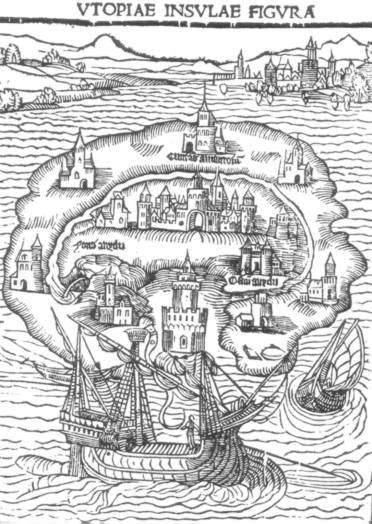
Structure. Real names and a verifiable diplomatic mission frame an invented report, and the printed volume added maps, an alphabet and commendatory letters to sustain the fiction. Jest and earnest alternate throughout, and the closing paragraph withdraws the narrator's assent from much that the traveller praised.
Key Concepts. Counsel and conscience; crime and its social causes; common ownership; true and false pleasure; health as a good; toleration with limits; and how far reason can reach without revelation.
Significance. It named a genre and a word, shaped later ideal and nightmare commonwealths from Bacon to the twentieth century, and remains debated as satire, programme or puzzle by a martyr-saint.
Key figures
- Raphael Hythloday: Fictional traveller who narrates Utopia's customs
- Thomas More: The author as a sceptical interlocutor
- Peter Giles: Antwerp town clerk who introduces Raphael
- Cardinal John Morton: Host of the remembered dinner debate on theft
- Cuthbert Tunstall: More's fellow envoy to Flanders in 1515
- Utopus: Legendary founder and lawgiver of the island

Summary
Utopia is a dialogue in two books, written in Latin and presented as a true report. In Book I More, writing in his own person, recalls his embassy to Flanders in 1515 with Cuthbert Tunstall. At Antwerp his friend Peter Giles introduces him to Raphael Hythloday, a Portuguese scholar-traveller who sailed with Amerigo Vespucci and stayed on in the New World. Giles and More urge Raphael to put his learning at the service of a king. He refuses, arguing that princes care for war and money, not good counsel, and illustrates with a dinner he once attended at the table of Cardinal John Morton. There, when a lawyer praised England's hanging of thieves, Raphael replied that hanging does not prevent theft when men have no other way to live, that discharged soldiers, idle retainers and tenants driven off the land by enclosure for sheep-pasture are forced to steal, and that England first makes thieves and then punishes them. He proposed penal labour instead. Raphael then imagines advising the French king against conquest and debased coinage, and concludes that no court would hear him. More answers that a wise man should not desert the commonwealth, any more than a ship in a storm, but should use a more pliable philosophy. Raphael replies that at court one must approve wicked counsels or be ignored, and declares that while property remains and money is the measure of all things, no nation can be governed justly or happily. Book II, given after dinner, describes the crescent-shaped island of Utopia, made an island by its founder Utopus. Its fifty-four cities share the same laws; the capital is Amaurot. Elected Syphogrants and Tranibors serve under a prince chosen for life. All citizens farm in turn, learn a trade and work six hours a day. There is no private property and no money in internal use; goods are taken freely from common storehouses, and meals are eaten in common halls. The sick are nursed in four large public hospitals outside each city. Gold and silver are made into chamber-pots and the fetters of slaves, so that the visiting Anemolian ambassadors, dressed in gold, are mistaken for servants. The Utopians hold that a rightly ordered pleasure, above all health and the pleasures of the mind, is the end of life, and believe in the immortality of the soul and divine providence. Marriage is monogamous; the incurably and painfully ill may be counselled toward voluntary death. They hate war, fight by hired mercenaries and bribery when they must, and allow freedom of religion under a law of Utopus, punishing only those who preach with violence. Raphael closes by calling other states a conspiracy of the rich, and More, unconvinced on several points, says he rather wishes than hopes to see many Utopian customs adopted. The book was printed at Louvain in 1516 under Erasmus's care; the first English translation, by Ralph Robinson, appeared in 1551, and the library text is Gilbert Burnet's 1684 translation in Henry Morley's edition.
Virtues in this work
- Justice: Raphael argues before Cardinal Morton that a law which hangs men driven to theft by enclosure is neither just nor useful.
- Prudence: More urges that a counsellor should steer the ship in a storm as best he can rather than abandon it.
- Temperance: The Utopians seek only true pleasures and keep gold for chamber-pots and fetters so that no one will covet it.
- Charity: Every city keeps four great hospitals where the sick receive the first and best of the market.
Plot or Argument
- Book I: The meeting at Antwerp
More, on embassy in Flanders, meets Peter Giles and through him Raphael Hythloday, a traveller in the New World, who refuses to become a king's counsellor.
- Book I: Cardinal Morton's table
Raphael recounts his argument that capital punishment for theft is unjust and useless, that enclosure for sheep drives the poor to steal, and that the Polylerits' penal labour is better; a friar and a hanger-on supply comic interruptions.
- Book I: The dialogue of counsel
Raphael imagines the French king's council, bent on conquest and money-raising, and More pleads for an indirect philosophy that works within the play; Raphael ends by indicting private property.
- Book II: The island, its towns and magistrates
The geography of Utopia, its fifty-four cities and Amaurot, the rotation of citizens between town and farm, and the elected Syphogrants, Tranibors and prince.
- Book II: Trades, manner of life and traffic
Six-hour working days, universal trades, common halls and storehouses, public hospitals, the contempt for gold, and the comedy of the Anemolian ambassadors.
- Book II: Philosophy, learning and pleasure
The Utopians' ethics of true and false pleasure, their eagerness for Greek learning, and the honour they give to medicine as part of natural philosophy.
- Book II: Slaves, marriage, punishment and war
Penal slavery, the care of the incurable and counselled voluntary death, monogamous marriage and divorce by the senate, few laws, and a cautious, mercenary way of waging war.
- Book II: Religions and conclusion
Religious toleration under Utopus's law, belief in providence and immortality, the reception of Christianity, Raphael's peroration against the conspiracy of the rich, and More's reserved reply.
Characters
- Raphael Hythloday, traveller and principal speaker
A learned Portuguese voyager, his surname meaning roughly a dealer in nonsense, who describes Utopia and argues against private property.
- Thomas More, narrator
The author as a character, an English envoy who argues for patient, indirect counsel and doubts parts of Raphael's account.
- Peter Giles, host
Town clerk of Antwerp and friend of More, who introduces Raphael.
- Cardinal John Morton, statesman
Archbishop of Canterbury and Lord Chancellor, in whose household More served as a boy; host of the debate on theft.
- Cuthbert Tunstall, envoy
More's colleague on the 1515 embassy, later Bishop of London and of Durham.
- Utopus, founder
The conqueror who cut the isthmus to make Utopia an island and laid down its law of religious freedom.
Key claims
The main steps of the argument, in order, and how they fit together.
- Hanging thieves fails because enclosure, idleness and war drive the poor to steal, so England first makes thieves and then punishes them.How it is supported: Raphael's argument at Cardinal Morton's table and the example of the Polylerits' penal labour.
- Princes care for war and money, so a philosopher's honest counsel will not be heard at court.How it is supported: Raphael's imagined session of the French king's council.
- A wise man should not desert the commonwealth but should work patiently within flawed courts through indirect counsel.How it is supported: More's comparison with not abandoning a ship in a storm.
- Wherever property is private and money measures all things, the few gather wealth while the many are driven into want and crime.How it is supported: Raphael's conclusion from the social causes of theft and the corruption of counsel.
- In Utopia, common ownership, shared labour, elected magistrates, public hospitals and contempt for gold produce a just and happy commonwealth.How it is supported: The detailed portrait of the island's cities, six-hour workday and common storehouses.
- Reason without revelation can lead people to an ethics of true pleasure, belief in providence and immortality, and limited toleration.How it is supported: The Utopians' philosophy, religion and their reception of Christianity.
- More, as narrator, withholds assent from much that Raphael praises and closes with wishes rather than hopes.How it is supported: The reserved closing paragraph after Raphael's speech against the conspiracy of the rich.
Argument map
Supported by
- 4Wherever property is private and money measures all things, the few gather wealth while the many are driven into want and crime.
which rests on
- 1Hanging thieves fails because enclosure, idleness and war drive the poor to steal, so England first makes thieves and then punishes them.
- 2Princes care for war and money, so a philosopher's honest counsel will not be heard at court.
- 5In Utopia, common ownership, shared labour, elected magistrates, public hospitals and contempt for gold produce a just and happy commonwealth.
which rests on
- 6Reason without revelation can lead people to an ethics of true pleasure, belief in providence and immortality, and limited toleration.
- 7More, as narrator, withholds assent from much that Raphael praises and closes with wishes rather than hopes.
which rests on
- 3A wise man should not desert the commonwealth but should work patiently within flawed courts through indirect counsel.
Therefore
Plain-language summaries of the author's argument, not quotations.
Lessons
Justice must look at causes
At Cardinal Morton's table Raphael argues that hanging thieves while the poor are driven from their land punishes the effect and ignores the cause. More presents justice as including the prevention of crime through work, education and fair use of land, not only severe penalties.
- What does Raphael mean by saying sheep devour men?
- Is it fair to punish a crime that circumstances made likely? What would More's lawyer reply?
- What does the Polylerits' system of penal labour try to achieve?
The duty and danger of counsel
Raphael refuses to serve kings because, he says, a good man at court must either approve wicked counsels or be ignored. More replies that one should not abandon the ship in a storm but steer it as well as one can. Their debate frames a question More himself faced when he entered Henry VIII's service and later refused the oath.
- Which speaker, Raphael or More, gives the stronger argument about serving a king?
- What does More mean by a philosophy that suits the play being acted?
- How does More's own later life bear on this debate?
Seeing through false value
Utopians make chamber-pots of gold and laugh at the ambassadors who arrive dressed in it. They class gambling, hunting and pride in rank as false pleasures. By making the reader's values look strange, More asks what wealth and honour are really worth.
- Why do the Utopian children mistake the Anemolian ambassadors for servants?
- Which pleasures do the Utopians call true, and which false?
- Is a society that despises gold freer, or simply differently bound?
Reading a serious joke
The island is called No-place, the traveller's name suggests nonsense, and More ends by doubting much of what he has heard. Readers must decide which Utopian customs More admires, which he mocks and which he offers as a challenge to Christian Europe, where Christians themselves fall short of what pagans achieve by reason alone.
- Why would More give his traveller and his island joking names?
- Which Utopian customs would More, a devout Catholic, have rejected?
- What is the effect of More's last sentence?
Context
Utopia belongs to the circle of Christian humanists around Erasmus, who sought reform of Church and society through classical learning and the Gospel. It responds to English problems of More's day, including the enclosure of arable land for sheep-farming, vagrancy, the hanging of thieves and the costly wars of princes, and to the reports of the New World that had followed Amerigo Vespucci's published voyages. More draws on Plato's Republic, Plutarch's account of Sparta and the community of goods among the first Christians in Acts. The book was written before the Reformation divided Western Christianity, and some passages, such as its toleration and its Utopian debate about choosing priests, read differently after 1517.
Composition
More wrote the description of the island (Book II) while on embassy in the Low Countries in 1515 and the dialogue of counsel (Book I) in London in 1516. The Latin text, with prefatory letters and verses by More's friends, was printed at Louvain late in 1516 under Erasmus's supervision, and revised at Basel by Johann Froben in 1518. It was not printed in England in More's lifetime. Ralph Robinson's English translation appeared in 1551 and Gilbert Burnet's in 1684. The library text is Burnet's translation as printed by Henry Morley, whose introduction states that Burnet's is the translation given; Morley's section headings (Of their Towns, Of their Magistrates, and so on) divide Book II.
Reception
More's coinage gave European languages the word utopia, from Greek roots meaning no place, and founded a genre that includes Bacon's New Atlantis, Campanella's City of the Sun and, by inversion, the dystopias of the twentieth century. Readers have taken the book as satire, as a blueprint for common ownership, as a humanist thought-experiment and as a Christian rebuke to Christian Europe. More was canonized by Pope Pius XI in 1935.
Comparisons
- the-republic
Raphael cites Plato's Commonwealth by name; both describe an ideal city without private property among the governing class and both ask whether a philosopher should enter politics.
- the-prince
Written within three years of Utopia, Machiavelli's treatise gives exactly the kind of counsel Raphael refuses to give, advising princes on war, money and reputation without reference to justice.
- gullivers-travels
Swift's traveller, like Hythloday, visits imaginary nations whose customs expose European folly; the Houyhnhnms' reasonable commonwealth descends from Utopia.
- city-of-god
Augustine distinguishes the earthly city from the heavenly; More's island is a pagan city ordered by reason, which the book holds up to Christian cities that have revelation yet live worse.
- the-giver
Lowry's planned community imagines the cost of an ordered society without money or rivalry, where common provision is bought at the cost of memory and freedom.
Quotes
Frequently cited
“your sheep, which are naturally mild, and easily kept in order, may be said now to devour men and unpeople, not only villages, but towns”
Frequently cited
“if you suffer your people to be ill-educated, and their manners to be corrupted from their infancy, and then punish them for those crimes to which their first education disposed them, what else is to be concluded from this but that you first make thieves and then punish them?”
Frequently cited
“They eat and drink out of vessels of earth or glass, which make an agreeable appearance, though formed of brittle materials; while they make their chamber-pots and close-stools of gold and silver”
Frequently cited
“there are many things in the commonwealth of Utopia that I rather wish, than hope, to see followed in our governments.”
“you must not, therefore, abandon the commonwealth, for the same reasons as you should not forsake the ship in a storm because you cannot command the winds.”
“as long as there is any property, and while money is the standard of all other things, I cannot think that a nation can be governed either justly or happily”
“But they take more care of their sick than of any others; these are lodged and provided for in public hospitals.”
“this is one of their most ancient laws, that no man ought to be punished for his religion.”
For Students
A reading companion for classical Christian high school students. See the student guide.
Reading Guide
Watch for
- How Book I slides from real events (the 1515 embassy, Peter Giles) into fiction with the arrival of Raphael.
- The debate at Cardinal Morton's table, including the comic friar and the hanger-on.
- More's image of the ship in a storm and Raphael's answer to it.
- The Anemolian ambassadors in their gold chains in Book II.
- More's final paragraph, and the customs he says seemed absurd.
Key terms and names
- Utopia
- More's coinage from Greek, meaning no place; prefatory verses also pun on eu-topia, good place.
- Hythloday
- Raphael's surname, built from Greek words that suggest a speaker of nonsense or trifles.
- Enclosure
- Fencing common or arable land for private sheep-pasture, which Raphael blames for evicting the poor and causing theft.
- Amaurot
- The capital city of Utopia, whose name suggests a dim or shadowy city.
- Syphogrant and Tranibor
- Elected Utopian magistrates over thirty households and over ten Syphogrants respectively.
- Polylerits
- A people Raphael describes in Book I who punish thieves with public labour and restitution rather than death.
- Counsel
- Advice given to a ruler; whether a wise man should offer it is the central question of Book I.
Seminar Questions
- Comprehension Why does Raphael say that hanging thieves fails to prevent theft in England?
- Comprehension How do the Utopians use gold and silver, and what happens when the Anemolian ambassadors arrive?
- Comprehension What law did Utopus make about religion, and why was one newly baptized Utopian banished?
- Interpretation More gives his traveller a name that suggests nonsense and his island a name meaning nowhere. How should those names shape the way we read the book?
- Interpretation Raphael says Christian preachers have bent Christ's teaching like a leaden rule to fit men's lives. How does that charge connect the Utopians' pagan virtues to a critique of Christian Europe?
- Interpretation Which Utopian customs would the devout More have rejected, and how does the closing paragraph signal his disagreement?
- Big Question Can a just society be built by institutions alone, or does Raphael's own remark about pride show that the problem lies in the human heart?
Faith Connections
- Acts 4:32-35 (Scripture)
The first Christians had all things common. Raphael says the Utopians were drawn to Christianity partly because Christ and his followers lived by that rule.
- Matthew 10:27 (Scripture)
Christ commands that what is heard in the ear be preached on the housetops. Raphael cites this command when he refuses to soften his counsel to suit princes.
- Augustine, City of God XIX (Church Fathers)
Augustine describes the limited peace an earthly city can achieve. Utopia shows how far reason without revelation might go, and More's ending leaves the reader aware of what such a city still lacks.
- Thomas More, A Dialogue of Comfort against Tribulation (Great Conversation)
Written in the Tower while More awaited execution, it shows the author of Utopia choosing conscience over royal service, a living answer to the Book I debate about counsel.
Logic and Rhetoric
Central argument: Raphael argues: wherever money measures all things and property is private, the few will gather wealth while the many are driven into want and crime; laws cannot cure this while property remains; Utopia, without property or money, is just and happy; therefore Europe should learn from it. More frames this argument without endorsing it, ending with wishes rather than hopes.
Rhetorical device: ironic speaking names. Utopia (no place), Amaurot (dim city) and Hythloday (nonsense-speaker) let More publish a sharp critique while reminding readers it comes from nowhere.
Debate: Resolved: that a wise man should serve an unjust king rather than refuse to give counsel.
Memory Work
you must not, therefore, abandon the commonwealth, for the same reasons as you should not forsake the ship in a storm because you cannot command the winds.
there are many things in the commonwealth of Utopia that I rather wish, than hope, to see followed in our governments.
Writing Prompts
Essay: Is Utopia a blueprint, a satire or a thought-experiment? Argue from at least three passages, including the closing paragraph.
Comparison with The Republic: Compare Plato's guardians and More's Utopians: how does each society handle property, family and the education of citizens, and why does each author think this produces justice?
Medical Lens
Utopia contains some of the most cited early modern passages on public health and the ethics of dying. Each city has four public hospitals outside its walls, large enough to isolate infectious patients, staffed by skilful physicians and so well kept that citizens prefer them to being sick at home; the hospital steward has first choice of the market for the sick. Slaughter and the washing of carcasses are done by slaves at places outside the town, lest the air be infected by ill smells, a precaution consistent with the miasmatic and humoral thinking of More's age. Health is ranked as the chief bodily pleasure, and the Utopians prize the Hippocratic writings and Galen brought by Raphael's companion, counting medicine one of the most pleasant and useful parts of philosophy. Most discussed is the counsel given to those with incurable and torturing disease: after every comfort has been given, priests and magistrates may urge voluntary death by fasting or by opium, never by force, while self-killing without public approval is denied burial honours. Old age is described as a disease in itself. Readers have long debated whether these passages state More's own views, since he was a devout Catholic who ends the book by distancing himself from many Utopian customs; they are best read as the reasoning of a pagan commonwealth without revelation, not as More's endorsement. More's friend Thomas Linacre, founder of the College of Physicians, is named in Morley's introduction.
- Book II, Of Their Traffic
The four public hospitals outside each city, isolation of infectious patients, attendance by physicians, and the steward's priority in the market.
- Book II, Of Their Traffic
Butchering and washing of beasts done outside the town so the air is not corrupted.
- Book II, Of the Travelling of the Utopians
Health as the foundation of bodily pleasure, and the Utopians' esteem for Hippocrates, Galen and the study of medicine.
- Book II, Of Their Slaves, and of Their Marriages
Care of the incurable, counselled voluntary death by fasting or opium, refusal of honours to unsanctioned suicide, and old age called a disease of itself.
Listen to the book
Public-domain audiobook from LibriVox, read by Jenilee, translated by Gilbert Burnet. Recording: Utopia (Burnet translation) on LibriVox (Internet Archive).
LibriVox recordings are volunteer readings released into the public domain. The reading may follow a different edition or translation from the text in this library.
Creative Prompts
- Dialogue
Write the conversation More promises at the end, in which he and Raphael examine the Utopians' common ownership over supper.
- Essay
Who wins the Book I debate about counsel, Raphael or More? Use More's later career to test your answer.
- Fiction
Write a letter from an Anemolian ambassador describing his embarrassing arrival in Amaurot dressed in gold.
- Classroom
Divide Utopian customs into three lists: those More probably admired, those he probably mocked, and those you cannot decide about. Defend one item in each list.
Further Reading
- The Praise of Folly, Desiderius Erasmus
- The Life of Sir Thomas More, William Roper
- Thomas More: A Biography, Richard Marius
- The Life of Thomas More, Peter Ackroyd
- A Man for All Seasons, Robert Bolt
Verification notes
The attached Project Gutenberg text (#2130) is Gilbert Burnet's 1684 translation in Henry Morley's edition (Morley's introduction: 'Burnet's is the translation given in this volume'); the text header and meta file name Burnet. This record therefore names Gilbert Burnet (1684) in translationUsed, abstract.author, fullText and every quote's translation field. Quote locators use Morley's section headings; Book I and Book II are not separately headed in this text, and Book II begins within the first section. Publication facts (Louvain 1516 with Erasmus and Peter Giles; Froben at Basel, November 1518; Robinson 1551; Burnet 1684) were checked against the Wikipedia article (en.wikipedia.org/wiki/Utopia_(book)) and Morley's introduction. Canonization in 1935 and the patronage of statesmen (2000) are well established. All quotes were found in the attached text.
- Date and series of the Henry Morley edition from which the Gutenberg text derives.