Work record
The Ramayana
c. 5th century BC-3rd century AD (traditional) · Ancient · Epic · Sanskrit
Abstract
Background. Revered in Hindu tradition as sacred history and as the first true poem, the Ramayana gathers a heroic legend of the kingdoms of Kosala and Videha into a vast poem ascribed to the hermit-sage Valmiki. Scholars see layers added over centuries, with the first and last books often judged later.
Narrative. Banished by his stepmother's scheme on the day he should become heir, Rama goes to the wilderness with Sita and Lakshman, while loyal Bharat governs in his stead. Ravan seizes Sita by trickery. Allied with the Vanars, Rama sends Hanuman across the sea, bridges the ocean, defeats Ravan in battle and returns in triumph to be crowned.
Themes. Dharma in every relationship, from son and king to wife and brother; the cost of a word once given; loyal service; the protection owed to those who seek refuge; and the grief of separation, voiced in the many laments of Dasaratha, Kausalya and Rama.
Translation. Griffith, a Sanskrit scholar at Benares, put six books into brisk English octosyllabic rhyme between 1870 and 1874 and left the seventh, which he thought a later supplement, in prose summary.
Significance. Retold in Tamil, Hindi, Thai, Javanese and many other languages, staged yearly in Ramlila and remembered at Diwali, the story remains among the most widely known narratives of Asia.
Main characters
- Rama: Exiled prince of Ayodhya, honoured as an incarnation of Vishnu
- Sita: His wife, carried off to Lanka and faithful in captivity
- Lakshman: Devoted younger brother and companion in exile
- Bharat: Brother who rules as regent under Rama's sandals
- Hanuman: Vanar hero who leaps the ocean in search of Sita
- Sugriva: Vanar king and Rama's sworn ally
- Ravan: Ten-headed Rakshas king of Lanka
- Vibhishan: Ravan's brother, who changes sides and is crowned in Lanka

Summary
The Ramayana, the story of Rama's journey, is one of the two great Sanskrit epics of India, attributed to the sage Valmiki and composed in the sloka couplet. It opens with a frame: Valmiki asks the sage Narada whether any man on earth is perfectly virtuous, hears the life of Rama, and, moved to pity when a fowler shoots one of a pair of curlews, utters the first sloka; the god Brahma then bids him tell the whole tale. Book I tells how King Dasaratha of Ayodhya, long childless, holds a great sacrifice and is granted four sons: Rama by Queen Kausalya, Bharat by Kaikeyi, and the twins Lakshman and Satrughna by Sumitra. The gods, oppressed by Ravan, the ten-headed king of the Rakshases of Lanka, ask Vishnu to be born as a man to destroy him. The sage Visvamitra takes the boys Rama and Lakshman to guard his sacrifice, and at Mithila Rama bends and breaks the great bow of Siva and wins King Janak's daughter Sita. In Book II, on the eve of Rama's consecration as heir, the hunchbacked maid Manthara stirs Kaikeyi to claim two boons the king once promised her: Bharat's succession and Rama's exile to the forest for fourteen years. Rama accepts at once to keep his father's word; Sita insists on sharing his exile and Lakshman follows. Dasaratha dies of grief. Bharat, returning, refuses the throne, seeks Rama in the forest, and when Rama will not return carries home his brother's sandals, ruling in their name from the village of Nandigram. Book III follows the exiles through the Dandak forest. Ravan's sister Surpanakha is spurned and maimed by Lakshman; the demon Maricha, disguised as a golden deer, lures both brothers away, and Ravan carries Sita off through the air, killing the vulture-king Jatayus who tries to stop him. In Book IV Rama allies with Sugriva, the exiled king of the Vanars, kills his brother Bali, and sends search parties out. Book V belongs to Hanuman, Sugriva's minister, who leaps the sea to Lanka, finds Sita captive in the Asoka grove refusing Ravan, gives her Rama's ring, and sets the city ablaze with his burning tail. In Book VI Ravan's brother Vibhishan defects to Rama, the Vanar Nala builds a bridge across the ocean, and a long war follows; Hanuman carries a mountain of healing herbs from the Himalaya, and Rama finally kills Ravan. Sita proves her purity in a trial by fire, the couple return to Ayodhya in the aerial car Pushpak, and Rama is consecrated king. The library text is the verse translation by Ralph T. H. Griffith, principal of Benares College, published in five volumes in 1870-1874; it gives Books I-VI in rhymed octosyllabic couplets and summarizes the seventh book, the Uttarakanda, in a prose appendix.
Virtues in this work
- Honor: Rama leaves for the forest on the morning of his consecration rather than let his father's promise to Kaikeyi be broken.
- Humility: Bharat refuses the throne his mother won for him and governs from Nandigram in hermit dress with Rama's sandals on the throne.
- Fortitude: Sita, held captive in the Asoka grove, refuses Ravan's wealth and endures his threats rather than betray Rama.
- Friendship: Hanuman leaps the sea to Lanka and later carries a mountain of herbs from the Himalaya in loyal service to Rama and Sugriva.
Plot or Argument
- Invocation and Book I: the frame and Rama's youth
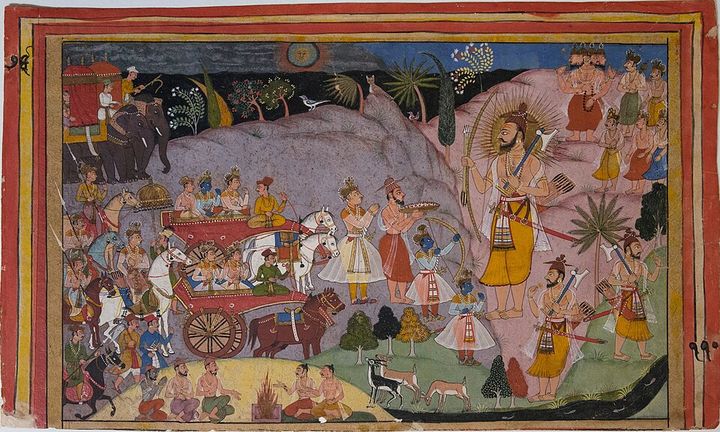
Narada describes the perfect man to Valmiki; the curlew and the birth of the sloka; Dasaratha's horse sacrifice and the birth of four princes; the gods plan Ravan's doom; Visvamitra takes Rama and Lakshman to the forest, where Rama slays the demoness Tadaka; the tale of Ganga's descent; at Mithila Rama breaks Siva's bow and marries Sita; the challenge of Parasurama on the road home (77 cantos).
- Book II: Ayodhya and the exile
Preparations for Rama's consecration; Manthara persuades Kaikeyi to claim her two boons; Rama accepts fourteen years of exile; Sita's speech insisting on going with him; Lakshman's loyalty; the departure and the people's lament; Dasaratha's confession of killing a hermit's son, and his death; Bharat's refusal of the throne; the meeting at Chitrakuta and the gift of the sandals (119 cantos).
- Book III: the forest and the abduction
Hermitages of the Dandak forest; the sage Agastya's gift of weapons; life at Panchavati; Surpanakha's advances and Lakshman's reprisal; the battle with Khara and his host; Maricha as the golden deer; Ravan, disguised as a mendicant, carries Sita away; Jatayus falls defending her; Rama's laments; Kabandha directs him to Sugriva (76 cantos).
- Book IV: Kishkindha and the Vanar alliance
Rama's grief beside Lake Pampa; Hanuman's first meeting with the brothers; friendship sworn with Sugriva; the combat of Sugriva and Bali and Bali's death by Rama's arrow; Tara's lament; the rainy season of waiting; the search parties sent to the four quarters; the vulture Sampati reveals that Sita is in Lanka (67 cantos).
- Book V: Hanuman in Lanka
Hanuman's leap across the sea; his night search of Ravan's city; Sita in the Asoka grove, scornful of Ravan's threats; Hanuman gives her Rama's ring and receives her jewel as a token; he wrecks the grove, is captured, has his tail set on fire and burns the city; his return with the news (66 cantos).
- Book VI: the bridge, the war and the return
Vibhishan's counsel to Ravan, his expulsion and his refuge with Rama; Nala's bridge to Lanka; the great battles with Kumbhakarna and Indrajit; Hanuman fetches the mountain of herbs; Ravan's death and Vibhishan's consecration; Sita's trial by fire and her restoration by the Fire-God; the flight home in Pushpak; reunion with Bharat and Rama's consecration in Ayodhya (130 cantos).
- Appendix: the Uttarakanda in summary
Griffith judged the seventh book a later supplement and gave it in prose, largely in the words of John Muir and Gaspare Gorresio: the ancestry of Ravan, Sita's banishment to Valmiki's hermitage, the birth of her sons Kusa and Lava, their singing of the poem, and Sita's return into the earth.
Characters
- Rama, hero
Eldest son of Dasaratha, prince of Ayodhya, who accepts exile to keep his father's word; in tradition an incarnation of Vishnu.
- Sita, heroine
Daughter of King Janak of Mithila and Rama's wife, who shares his exile and stays faithful as Ravan's captive.
- Lakshman, Rama's brother
Son of Sumitra, who leaves the palace to guard Rama and Sita throughout the exile.
- Bharat, Rama's brother
Kaikeyi's son, who refuses the throne won for him and rules as regent under Rama's sandals.
- Dasaratha, king of Ayodhya
Rama's father, bound by his promise to Kaikeyi, who dies of grief after the exile.
- Kaikeyi, queen
Dasaratha's younger queen, who claims two old boons to crown Bharat and banish Rama.
- Manthara, Kaikeyi's maid
Hunchbacked servant whose counsel turns Kaikeyi against Rama's consecration.
- Ravan, antagonist
Ten-headed king of the Rakshases of Lanka, made invulnerable to gods and demons, who abducts Sita.
- Hanuman, Vanar hero
Son of the Wind-God and minister of Sugriva, who leaps to Lanka, finds Sita and fetches the healing herbs.
- Sugriva, king of the Vanars
Exiled Vanar prince whom Rama restores to his throne in exchange for help in the search.
- Vibhishan, Ravan's brother
Rakshas prince who urges Ravan to return Sita and, rejected, seeks refuge with Rama.
- Jatayus, vulture-king
Aged friend of Dasaratha who dies fighting Ravan to save Sita.
Lessons
A promise kept at great cost
Rama gives up a kingdom on the morning of his consecration because his father's word, rashly given to Kaikeyi, must not be broken. When Bharat begs him to return, Rama answers that the moon and the ocean may change before he does. The epic treats faithfulness to one's given word as a pillar of the ordered world.
- Why does Rama refuse Bharat's offer of the throne even after Dasaratha has died?
- Was Dasaratha bound to keep a promise that harmed his kingdom and his son?
- What does Bharat's choice to rule under the sandals show about his own sense of duty?
Faithfulness in marriage and family
Sita argues her way into exile, claiming that a wife's place is beside her husband, and as Ravan's captive she rejects wealth and threats alike. Lakshman and Bharat show the same loyalty as brothers. The poem holds up these bonds as the true wealth of a royal house.
- What reasons does Sita give in Book II for following Rama to the forest?
- How do Lakshman and Bharat each serve Rama in different ways?
- Which act of loyalty in the poem seems to you the costliest, and why?
Help from unexpected allies
Rama recovers Sita with the aid of a vulture, a race of forest Vanars and a defector from Ravan's own family. His vow to protect any suppliant, even one who might be Ravan himself, turns Vibhishan from an enemy's brother into a loyal friend.
- Why do Sugriva and his counsellors distrust Vibhishan, and how does Rama answer them?
- What does Hanuman's leap across the sea reveal about the kind of servant he is?
Grief and the birth of poetry
The poem places its own origin in compassion: Valmiki, grieving for a curlew shot by a fowler, speaks in measured lines and finds he has made the sloka. Sorrow runs through the epic, from Dasaratha's death to Rama's laments for Sita, and the frame suggests that great poetry grows from pity.
- Why might Valmiki's story of the curlews be placed at the very beginning of the epic?
- How do the many laments in Books II and III shape the reader's sympathy?
Context
The Ramayana and the Mahabharata are the two great epics (itihasa) of Sanskrit literature. The Ramayana is set in the kingdoms of the Ganges plain, with Ayodhya in the region of Kosala, and imagines a world of hereditary kings, Brahman priests, forest hermitages and great sacrifices. Hindu tradition reveres it as sacred history and as the first poem (adi-kavya), and Rama is worshipped as the seventh incarnation of Vishnu.
Composition
Scholars generally hold that the poem grew over several centuries, with estimates commonly running from about the 5th century BC to the 3rd century AD; many regard Books II-VI as the oldest core and Books I and VII as later additions, though views differ and tradition ascribes the whole to Valmiki. The poem survives in several regional recensions. Ralph T. H. Griffith (1826-1906), principal of Benares College, translated Books I-VI into English rhymed verse, issued in five volumes in London and Benares from 1870 to 1874; he left some passages untranslated or in Latin and gave the seventh book only in prose summary.
Reception
The story has been retold across South and Southeast Asia for some two thousand years: in Kamban's Tamil Ramavataram (c. 12th century), in Tulsidas's Hindi Ramcharitmanas (16th century), in Thai, Javanese, Khmer and Malay versions, and in temple reliefs, dance and the yearly Ramlila performances of northern India. Rama's return to Ayodhya is celebrated in many regions at the festival of Diwali. Griffith's version introduced many nineteenth-century English readers to the epic.
Comparisons
- the-bhagavad-gita
The Gita, part of India's other great epic, the Mahabharata, makes duty (dharma) an explicit argument between Krishna and Arjuna; the Ramayana shows the same ideal acted out in Rama's acceptance of exile.
- journey-to-the-west-a-mission-to-heaven
The Monkey King Sun Wukong of the Chinese novel is often compared with Hanuman: both are divine monkeys of enormous strength who serve a holy master on a long journey.
- the-iliad
Both epics turn on the abduction of a queen and a war fought across the sea to recover her, but Homer centres on Achilles' wrath while Valmiki centres on Rama's righteousness.
- the-odyssey
Like Penelope, Sita stays faithful through a long separation while suitors press her, and like Odysseus, Rama wins home after years of wandering.
- the-aeneid
Aeneas and Rama are both heroes defined by duty to father and destiny, and both poems close on the founding or restoring of a righteous rule.
Quotes
Frequently cited
“With equal lines of even feet, With rhythm and time and tone complete, The measured form of words I spoke In shock of grief be termed a śloke.”
Frequently cited
“The moon his beauty may forgo, The cold forsake the Hills of Snow, And Ocean o’er his banks may sweep, But I my father’s word will keep.”
“So would a thousand seasons flee Like one sweet day, if spent with thee.”
“Dream not that wealth and power can sway My heart from duty’s path to stray. Linked like the Day-God and his shine, I am my lord’s and he is mine.”
“The suppliant will I ne’er forsake, Nor my protecting aid refuse When one in name of friendship sues. Though faults and folly blot his fame, Pity and help he still may claim.”
“Then the great bridge of wondrous strength Was built, a hundred leagues in length.”
“Four plants, of sovereign powers possessed, Spring from the soil, and flashing there Shed radiance through the neighbouring air. One draws the shaft: one brings again The breath of life to warm the slain; One heals each wound; one gives anew To faded cheeks their wonted hue.”
For Students
A reading companion for classical Christian high school students. See the student guide.
Reading Guide
Watch for
- The frame in Book I, Cantos I-II, where Narada describes the ideal man and Valmiki discovers the sloka beside the river Tamasa.
- Rama's immediate acceptance of exile in Book II and the way each family member responds to it: Kausalya, Lakshman, Sita, Dasaratha and Bharat.
- The golden deer in Book III, and how a moment of desire for a beautiful creature leads to Sita's abduction.
- Hanuman's leap and his search of Lanka in Book V, where the point of view shifts from Rama to his servant.
- Rama's speech about receiving Vibhishan in Book VI, Canto XVIII, and what it shows about his idea of kingship.
Key terms and names
- Sloka (śloke)
- The Sanskrit couplet metre that Valmiki discovers in Book I when his grief for the curlew takes measured form; the whole epic is composed in it.
- Duty
- Griffith's usual English for dharma, the right order of conduct that binds kings, sons, wives and brothers; Rama's acceptance of exile is the poem's chief example.
- Vanars
- The forest people of Kishkindha, monkey-like in form and born of the gods, who form Rama's army under Sugriva and Hanuman.
- Rakshases
- The shape-changing giants or demons of Lanka ruled by Ravan, who trouble the forest hermits.
- Ayodhya
- Dasaratha's capital in the kingdom of Kosala, which Rama leaves at the start of the exile and returns to as king.
- Lanka
- Ravan's golden island city across the southern sea, reached by Hanuman's leap and by Nala's bridge.
- Nandigram
- The village outside Ayodhya where Bharat lives in hermit dress and governs with Rama's sandals on the throne.
- Pushpak
- The flying car once seized by Ravan, in which Rama, Sita and their allies return to Ayodhya.
Seminar Questions
- Comprehension What two boons does Kaikeyi claim from Dasaratha in Book II, and why does the king feel bound to grant them?
- Comprehension How does Ravan separate Sita from Rama and Lakshman in Book III, and who tries to stop him?
- Comprehension What tokens do Hanuman and Sita exchange in the Asoka grove in Book V, and why do they matter?
- Interpretation Valmiki's poetry begins in pity for a bird. How does that opening shape the way we read the laments of Dasaratha and Rama later on?
- Interpretation Bharat could have kept the throne lawfully. Why does the poem give so much space to his refusal and to the sandals?
- Interpretation Rama's counsellors argue that Vibhishan may be a spy. Is Rama's vow to receive any suppliant wise, generous, or both?
- Big Question Should a promise be kept when keeping it brings suffering on the innocent?
- Big Question What makes a ruler worthy to rule: birth, virtue, or the love of the people?
Faith Connections
- Psalm 15:4 (Scripture)
The psalmist praises the one who swears to his own hurt and does not change; Rama's refusal to break his father's word, even to regain his kingdom, gives a vivid picture of this kind of steadfastness for comparison.
- Ruth 1:16-17 (Scripture)
Ruth's resolve to go wherever Naomi goes stands beside Sita's speech in Book II; both women choose hardship and exile out of loyalty, though the bonds and settings differ.
- Genesis 39:7-12 (Scripture)
Joseph refuses the advances of Potiphar's wife as a wrong against his master and God; Sita's refusal of Ravan in the Asoka grove offers a parallel study in fidelity under pressure.
- Augustine, City of God XIX.13-16 (Church Fathers)
Augustine describes peace as the tranquillity of order, reaching from the household to the city; his account gives students a Christian vocabulary for discussing the Ramayana's picture of a kingdom whose order depends on faithful sons, wives and brothers.
Logic and Rhetoric
Central argument: A righteous order rests on each person keeping faith with the duties of their station; Rama, Sita, Lakshman and Bharat keep faith at great personal cost, Ravan breaks it through lawless desire, and so the poem shows righteousness restored and lawlessness destroyed.
Rhetorical device: adynaton. In Book II, Canto CXII, Rama lists impossible things, the moon losing its beauty and the ocean breaking its bounds, to show that his promise will sooner outlast nature than fail.
Debate: Resolved: that Bharat's refusal of the throne is a greater act of virtue than Rama's acceptance of exile.
Memory Work
The moon his beauty may forgo, The cold forsake the Hills of Snow, And Ocean o’er his banks may sweep, But I my father’s word will keep.
So would a thousand seasons flee Like one sweet day, if spent with thee.
Writing Prompts
Essay: Using Sita's speech in Book II, her answer to Ravan in Book V and her trial in Book VI, argue what the Ramayana means by faithfulness.
Comparison with The Iliad: Both the Ramayana and the Iliad tell of a war fought to recover an abducted queen. Compare Rama and Achilles as heroes: what does each poem honour most?
Medical Lens
The Ramayana is not a medical text, but several episodes interest a historian of medicine and mind. Dasaratha's death is told as death from grief: after Rama leaves, the king recalls how he once killed a hermit's son by accident and was cursed to die mourning a son, and he sinks and dies in the night. The epic thus links remorse, a curse and bereavement in a single decline, which belongs to the poem's moral world rather than to any physiological account. In the war of Book VI the herbs of the Himalayan mountain draw out arrows, heal wounds and restore the dead and dying, a mythic picture of the healing plants prized in the Indian tradition later systematized in Ayurveda; it should be read as myth, not as evidence of battlefield practice. Kumbhakarna's monstrous sleep, from which he must be roused by force, and Bharat's ominous dream before he learns of his father's death, show the poem's use of sleep and dreams as signs. Retrospective medical readings of these scenes would be interpretive.
- Book II, Cantos LXIII-LXIV
Dasaratha tells Kausalya of the hermit's son he once shot by mistake and the parents' curse, then dies of grief for the exiled Rama.
- Book II, Canto LXIX (Bharat's Dream)
Bharat, far away in his grandfather's kingdom, is troubled by an evil dream on the night the messengers arrive.
- Book VI, Cantos LX-LXVII
Kumbhakarna, Ravan's giant brother, is roused with great effort from his long sleep to fight and is killed by Rama.
- Book VI, Canto LXXIV (The Medicinal Herbs)
Jambavan describes four healing plants on a Himalayan peak; Hanuman carries the whole mountaintop back and the wounded army revives.
Creative Prompts
- Essay
Compare Rama's refusal of the throne in Book II with Bharat's refusal of it. Which brother's sacrifice is greater?
- Fiction
Write the scene in Nandigram where Bharat sits beside Rama's sandals on the throne and hears a difficult case.
- Poetry
Following Valmiki's curlew episode, write a short poem in rhyming couplets that grows out of a moment of pity.
- Classroom
Map the route of the exile from Ayodhya through Chitrakuta, Panchavati and Kishkindha to Lanka, marking the episode that happens at each place.
Further Reading
- The Ramayana: A Shortened Modern Prose Version of the Indian Epic, R. K. Narayan
A short prose retelling (1972) by the Indian novelist, drawing chiefly on Kamban's Tamil version.
- Ramayana, C. Rajagopalachari
A widely read English prose retelling first published in the 1950s.
- The Rāmāyaṇa of Vālmīki: An Epic of Ancient India, Robert P. Goldman and others (trans.)
Complete scholarly translation of the critical edition, with extensive introductions and notes (Princeton University Press).
- Ramcharitmanas, Tulsidas
The 16th-century Hindi retelling that became the best-loved form of the story in northern India.
- Many Rāmāyaṇas: The Diversity of a Narrative Tradition in South Asia, Paula Richman (ed.)
Essays on the many regional and literary versions of the Rama story (1991).
Verification notes
The library text is Griffith's verse translation as printed in the Gutenberg file: an invocation, Books I-VI (77, 119, 76, 67, 66 and 130 cantos), an appendix with Latin, Italian and French renderings of one canto, a prose summary of the Uttarakanda drawn from Muir and Gorresio, and additional notes. The seven quotations were all found verbatim (curly apostrophes as in the file) by searching the stored text; canto numbers and titles are Griffith's and do not always match the numbering of the modern critical edition. Names in the record use simplified forms; Griffith writes Ráma, Sítá, Lakshmaṇ, Hanumán, Rávaṇ, Vibhishaṇ and so on. Composition dates are a scholarly range and remain debated.
- The exact publication sequence of Griffith's five original volumes (1870-1874) and the date of the one-volume edition followed by the Gutenberg text.
- Correspondence of Griffith's canto numbers with the Baroda critical edition sarga numbers for the quoted passages.