Work record
The Burgess Bird Book for Children
1919 · Early 20th Century · Collection · English
Abstract
Background. By 1919 Thornton W. Burgess had made Peter Rabbit and his neighbours familiar to American children through the Old Mother West Wind books. This volume turns that cast toward bird study and pairs the stories with plates by the ornithological painter Louis Agassiz Fuertes.
Narrative. Peter hurries to the Old Orchard at dawn, finds Jenny Wren newly returned from the South, and pesters her with questions. Through her and a long procession of others, from Welcome Robin and Bully the English Sparrow to woodpeckers, warblers, swallows and owls, he learns who nests where, what each eats and how each sings.
Structure. The chapters follow the calendar: spring arrivals and nesting fill most of the book, autumn brings farewells, honking geese and seed-eaters, and winter visitors come with the snow before Peter meets two fierce feathered hunters.
Method. Each bird talks in character, while field marks, nest sites, songs and diets are worked into the conversation, and Peter's mistaken guesses give occasion for gentle correction. Related birds are often grouped together, as with the blackbird family or Jenny Wren's cousins, so that likeness and difference can be compared.
Significance. Long used in homes and schools, it introduced generations of young readers to common North American birds and still serves as a first field guide in story form.
Main characters
- Peter Rabbit: Inquisitive rabbit who visits the birds to learn their ways
- Jenny Wren: Talkative House Wren, Peter's first and favourite informant
- Mr. Wren: Jenny's singing mate in the Old Orchard
- Welcome Robin: Cheerful robin, among the first returning neighbours
- Bully the English Sparrow: Quarrelsome sparrow who troubles the orchard's other nesters
- Scrapper the Kingbird: Bold kingbird who drives larger birds away
- Sammy Jay: Noisy, mischievous jay of the woods
- Spooky the Screech Owl: Small owl whose habits Peter learns late in the year
- Johnny Chuck: Woodchuck friend of Peter's from the wider Burgess world
- Old Mother Nature: Presiding figure behind the order of the seasons

Summary
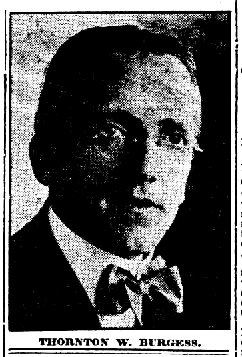
Thornton W. Burgess’s The Burgess Bird Book for Children (1919) teaches bird identification through Peter Rabbit’s visits in the Old Orchard, where Jenny Wren and neighbors speak in character while Burgess slips in real habits, songs, and looks. The method is story first, natural history second: children remember the House Wren because they met Jenny, then learn what to watch for outdoors. Its colour plates, painted by the bird artist Louis Agassiz Fuertes, let a child match each talking character to an accurate picture. Match Jenny Wren’s chapter to a real morning sighting before claiming the bird is known. Peter’s scampering along the stone wall models going out to look, not merely to name from a list. Burgess slips identification into talk so delight and accuracy arrive together in the Old Orchard. A week’s life-list beside chapter titles turns the book into outdoor practice rather than sofa fantasy. Peter Rabbit lives in the Old Briar-patch, and the book begins when spring sends him scampering to the Old Orchard to see who has come home. Jenny Wren, busy and sharp-tongued, scolds and teaches him by turns, and Welcome Robin, Winsome Bluebird and many other neighbors take up the lessons as the weeks go by. Peter's friend Johnny Chuck and the noisy Sammy Jay drift in and out of the conversations, while Redwing the Blackbird and his relatives show how members of one family can look and live differently. As the seasons turn, Peter hears Honker the Goose and his flock passing overhead, notices which birds stay through the cold, and learns which hunters the smaller birds fear. Each chapter is short enough for one sitting, and the talk is full of practical clues: where a nest is built, what food a bird seeks, how its song sounds and how to tell it from a look-alike. The book works best beside real walks, letting children check what Peter learns against what they can see and hear for themselves.
Virtues in this work
Plot or Argument
- Peter in the Old Orchard
Peter Rabbit meets bird neighbors chapter by chapter through the seasons.
- Stories that teach looking
Each encounter smuggles identification facts inside character and talk.
- From page to outdoors
Readers are nudged to match story-birds with living birds outside.
Characters
- Peter Rabbit, observer
Curious visitor who meets the birds.
- Jenny Wren, guide
House Wren who opens the orchard acquaintance.
Lessons
Attention as love
Naming and watching birds is already a form of care for the given world.
- What does Peter notice first?
- How does a name help seeing?
Story before list
Character memory makes facts stick without killing delight.
- Which bird do you remember and why?
- What would a bare list miss?
Neighbors, not trophies
Birds are treated as orchard neighbors rather than prizes.
- How does Jenny Wren talk?
- What manners does outdoor looking need?
Context
Early twentieth-century American nature story combining fiction with field facts for children. It remains a formative English-language classic for school and home in the public domain.
Composition
Published 1919 as a bird companion in Burgess’s animal series.
Reception
Long used in homes and schools for gentle natural-history reading.
Comparisons
- the-tale-of-peter-rabbit
Another animal outdoor world that teaches looking and manners.
- aesops-fables
Creatures as neighbors that instruct without modern scolding.
Quotes
“Lipperty-lipperty-lip scampered Peter Rabbit behind the tumble-down stone wall along one side of the Old Orchard.”
“It was early in the morning, very early in the morning.”
For Students
A reading companion for classical Christian high school students. See the student guide.
Reading Guide
Watch for
- Peter’s early-morning scampering to the orchard.
- Jenny Wren’s arrival and talk.
- One bully or quarrel among birds.
- A fact about song, nest, or look slipped into story.
- How a chapter pushes you outdoors to check.
Key terms and names
- Old Orchard
- Setting where Peter meets bird neighbors.
- Identification
- Learning a bird by look, song, and habit.
- House Wren
- Small active bird introduced as Jenny Wren.
- Life-list
- Simple record of birds actually seen.
Seminar Questions
- Comprehension Who guides Peter among the birds?
- Comprehension Name three birds from different chapters.
- Comprehension What time of day does Peter often visit?
- Interpretation Why teach birds through story characters?
- Interpretation How does affection help accuracy?
- Interpretation What habits of looking does the book form?
- Big Question What does it mean to know a living creature well enough to name it rightly?
Faith Connections
- Matthew 6:26 (Scripture)
Behold the fowls of the air—attention as care for creatures.
- Psalm 104:12 (Scripture)
Birds singing among the branches; orchard joy named.
- Natural history for children (Great Conversation)
Naming creatures as a first science of gratitude.
Logic and Rhetoric
Central argument: Story can train exact outdoor attention without extinguishing wonder.
Rhetorical device: personification. Birds speak as neighbors while facts remain real.
Debate: Resolved: that naming creatures is part of loving them.
Memory Work
Lipperty-lipperty-lip scampered Peter Rabbit behind the tumble-down stone wall along one side of the Old Orchard.
Writing Prompts
Essay: Choose one bird chapter and list three facts learned through the story.
Comparison with The Tale of Peter Rabbit: Compare Burgess’s orchard with Selborne’s parish letters: what does each age of reader need?
Medical Lens
Nature study without clinical focus.
Listen to the book
Public-domain audiobook from LibriVox, read by Various volunteers. Recording: Burgess Bird Book for Children on LibriVox (Internet Archive).
LibriVox recordings are volunteer readings released into the public domain. The reading may follow a different edition from the text in this library.
Creative Prompts
- Classroom
Keep a week’s bird life-list matched to Burgess chapters.
- Essay
How does Jenny Wren teach looking without a lecture?
- Fiction
A new orchard visit for a bird not yet in the book.
Further Reading
- The Natural History of Selborne, Gilbert White
Next step in attentive natural history.
Verification notes
Plot, characters, and publication facts for The Burgess Bird Book for Children follow standard sources. Quotes verified against the attached Gutenberg text.
No verification flags recorded.