Work record
Walden
1854 · 19th Century · Essays · English
Abstract
Background. A Harvard graduate and member of Emerson's Transcendentalist circle, Thoreau built a cabin on Emerson's woodlot, with his friend's leave, to write and to test whether a man could support himself with a few weeks of labor each year. He reworked his pond journals for nearly a decade before Ticknor and Fields issued the book.
Content. Opening with a ledger of lumber, nails and meal, the book moves through reading, the noise of the Fitchburg line, hoeing beans, a night in the Concord lockup, a sermon to an Irish neighbor, the morality of eating meat, a war among ants, and the sounding of the frozen pond. Winter memories of vanished settlers give way to the spring thaw and an exhortation to explore one's own interior.
Method. Exact natural observation, puns, paradox and classical allusion serve an argument conducted in the first person. Data such as costs and depths become evidence in a moral case.
Key Concepts. The cost of a thing as the life exchanged for it; the necessaries of life; deliberate living; solitude as society with nature; the higher laws of purity and temperance; the duty of conscience against unjust law.
Significance. Slow to sell at first, it became a cornerstone of American prose and of later conservation writing, and the accompanying essay shaped Gandhi's and King's ideas of nonviolent resistance.
Key figures
- Henry David Thoreau: Narrator, surveyor and naturalist conducting the experiment in plain living
- The Canadian woodchopper: Unnamed, contented woodcutter whom Thoreau admires as a natural man
- John Field: Irish laborer at Baker Farm, lectured on living cheaply
- Brister Freeman, Cato Ingraham and Zilpha: Freed slaves who once dwelt in the Walden woods
- The Poet and the old philosopher: Unnamed friends who visit through the snow

Summary
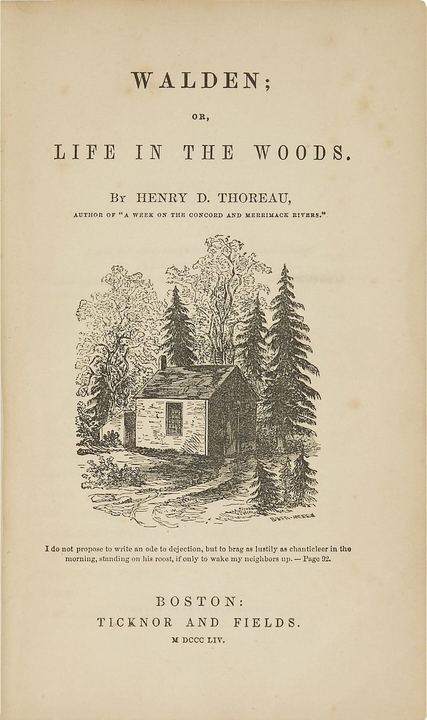
Walden; or, Life in the Woods is Henry David Thoreau's account of the two years and two months, from July 4, 1845, to September 1847, that he spent living alone in a one-room house he built himself beside Walden Pond, about a mile and a half south of the village of Concord, Massachusetts. He compresses the experiment into the cycle of a single year, moving from summer through winter to the thaw of spring, in eighteen chapters. The long opening chapter, "Economy," argues that most of his neighbors are enslaved by farms, houses and debts they never needed, and that the mass of men live in quiet desperation. Thoreau sets out the true necessaries of life (food, shelter, clothing and fuel), describes building his ten-by-fifteen-foot house with a borrowed axe and boards bought from an Irish railroad worker's shanty, and gives his accounts to the half-penny: the house cost $28.12½, and his food came to about twenty-seven cents a week. "Where I Lived, and What I Lived For" states his purpose, to live deliberately and simplify; "Reading" praises the classics read in their own tongues; "Sounds" sets the whistle of the Fitchburg Railroad against the songs of whip-poor-wills and owls; "Solitude" and "Visitors" weigh being alone against company, including a cheerful Canadian woodchopper and simple-minded paupers from the almshouse. In "The Bean-Field" he hoes two and a half acres of beans; in "The Village" he recounts being jailed overnight for refusing to pay a tax. "The Ponds" describes the purity and color of Walden and its neighbors, and "Baker Farm" his meeting with the poor Irish laborer John Field. "Higher Laws" wrestles with hunting, meat-eating, drink and chastity; "Brute Neighbors" stages a mock-epic battle of red and black ants and a game of hide-and-seek with a loon. The winter chapters recall the vanished former inhabitants of the woods, among them the freed slaves Cato Ingraham, Zilpha and Brister Freeman, follow foxes and owls, and record his survey of the frozen pond, which he sounded to a greatest depth of one hundred and two feet, disproving the legend that it was bottomless. "Spring" celebrates the thawing sand bank and the pond's return to life, and the "Conclusion" urges readers to explore their own inner territory and step to the music they hear, ending with the hope that there is more day to dawn. Ticknor and Fields published the book in August 1854. The library's Project Gutenberg text also includes Thoreau's essay "On the Duty of Civil Disobedience" (first published in 1849 as "Resistance to Civil Government"), which argues that a just man must refuse allegiance to a government that upholds slavery and wages an unjust war.
Virtues in this work
- Temperance: In "Higher Laws" Thoreau drinks only water and keeps a plain diet of bread, rice and potatoes, treating restraint in appetite as the path to a purer life.
- Industry: He hews his own timbers, digs his cellar, and hoes two and a half acres of beans, recording every hour and penny of his labor in "Economy" and "The Bean-Field."
- Fortitude: He goes to jail rather than pay a tax to a government that upholds slavery, and argues in the appended essay that a just man's place is in that prison.
- Prudence: His careful accounting of what shelter, food and clothing truly cost shows a practical wisdom about means and ends that most of his neighbors lacked.
Plot or Argument
- Economy
The longest chapter: an attack on the costly lives of Concord's farmers and tradesmen, an inventory of the true necessaries of life, the building of the house at the pond, and itemized accounts of its cost and of Thoreau's food and earnings.
- Where I Lived, and What I Lived For; Reading
Thoreau states the purpose of the experiment, to live deliberately and simplify, and moves into the house on July 4, 1845. He then argues for reading the great classics, Homer and Aeschylus among them, as heroic books written in a language above daily speech.
- Sounds; Solitude; Visitors
The railroad, church bells, owls, frogs and cocks fill the woods with sound. Thoreau denies that he is lonely, describes the three chairs he kept for company, and sketches the woodchopper and other callers.
- The Bean-Field; The Village
Hoeing two and a half acres of beans becomes a meditation on labor and husbandry. Walks into Concord bring gossip and his overnight arrest for not paying a tax.
- The Ponds; Baker Farm
Detailed portraits of Walden, Flint's, White and other ponds, praised for their clarity and color; caught in a rainstorm, Thoreau urges the Irish laborer John Field to give up tea, coffee and meat and live more simply.
- Higher Laws; Brute Neighbors
Thoreau weighs the wild and the spiritual in himself, defending temperance in food and drink and purity of life; then a dialogue of a Hermit and a Poet, the war of the ants, and the diving loon on the pond.
- House-Warming; Former Inhabitants and Winter Visitors; Winter Animals
He plasters the house and builds a chimney, recalls the vanished settlers of the Walden woods, receives a few winter visitors, and watches foxes, squirrels, jays and hares in the snow.
- The Pond in Winter; Spring
Thoreau surveys and sounds the frozen pond, watches crews cutting ice for distant markets, and then celebrates the thawing bank of sand and clay and the pond's breaking up as signs of renewed life.
- Conclusion
He explains why he left the woods, urges readers to explore themselves rather than distant lands, to live by the music they hear, and closes with the parable of the bug hatched from an old apple-wood table and the promise of more day to dawn.
- On the Duty of Civil Disobedience (appended in the library text)
A separate essay from 1849: government is at best an expedient; a man's conscience must not be surrendered to the majority; refusing taxes to a state that upholds slavery and wages the Mexican War is a peaceable revolution; Thoreau recounts his night in the Concord jail.
Characters
- Henry David Thoreau, narrator
The writer, living alone at the pond, who reports his experiment in plain living and argues with his readers.
- The Canadian woodchopper, visitor
A cheerful, unlettered French-Canadian woodcutter whom Thoreau admires for his animal contentment; Thoreau does not give his name.
- John Field, neighbor
Poor Irish laborer living at Baker Farm with his family, whom Thoreau urges to live more simply.
- Cato Ingraham, Zilpha and Brister Freeman, former inhabitants
Freed slaves who once lived in the Walden woods, remembered in the winter chapter by the cellar holes and apple trees they left.
- The Poet and the old philosopher, winter visitors
Two friends who brave the snow to talk with Thoreau; the book leaves them unnamed.
Key claims
The main steps of the argument, in order, and how they fit together.
- The cost of a thing is the amount of life that must be exchanged for it.How it is supported: Reasoning that hours of labor are hours of one's life.
- Most people spend their lives for farms, houses and fashions they do not need, and so live in quiet desperation.How it is supported: Observation of the burdened farmers and tradesmen of Concord.
- The true necessaries of life are few: food, shelter, clothing and fuel.How it is supported: An inventory of what a person actually needs to keep warm and alive.
- These necessaries can be secured by a few weeks' labor a year, leaving the rest of life free.How it is supported: Itemized accounts of the house, costing about twenty-eight dollars, and of food and earnings.
- Freed time should go to deliberate living: reading the classics, enjoying solitude, and attending closely to nature.How it is supported: The chapters on reading, sounds, solitude and the ponds.
- Higher laws call for temperance and purity in food, drink and the whole manner of life.How it is supported: Reflection on the wild and spiritual in himself and his counsel to John Field.
- Conscience must be followed even when it puts a person at odds with the state.How it is supported: His night in jail for refusing to pay a tax.
- Each person should explore their own inner life and follow their own calling rather than others' expectations.How it is supported: The Conclusion and the parable of the bug hatched from an old apple-wood table.
Argument map
Supported by
- 2Most people spend their lives for farms, houses and fashions they do not need, and so live in quiet desperation.
which rests on
- 1The cost of a thing is the amount of life that must be exchanged for it.
- 4These necessaries can be secured by a few weeks' labor a year, leaving the rest of life free.
which rests on
- 3The true necessaries of life are few: food, shelter, clothing and fuel.
- 5Freed time should go to deliberate living: reading the classics, enjoying solitude, and attending closely to nature.
which rests on
- 6Higher laws call for temperance and purity in food, drink and the whole manner of life.
- 8Each person should explore their own inner life and follow their own calling rather than others' expectations.
which rests on
- 7Conscience must be followed even when it puts a person at odds with the state.
Therefore
Plain-language summaries of the author's argument, not quotations.
Lessons
Counting the real cost
Thoreau measures the price of a thing in the amount of life exchanged for it, and he shows his own accounts down to the half-penny to prove that a decent shelter can cost $28.12½. The lesson is not that everyone should live in a cabin but that every possession and every debt should be weighed against the hours of life it consumes.
- Why does Thoreau print his accounts in such detail in "Economy"?
- Which of the things you own or want would Thoreau call a necessary of life?
- Is his calculation of cost in hours of life a fair one?
Living deliberately
In "Where I Lived, and What I Lived For" Thoreau goes to the woods to front the essential facts of life and to find out whether life is mean or sublime. Attention is the virtue he practices most: to the sound of the train, the color of the pond, the battle of the ants.
- What does Thoreau mean by living deliberately, and what prevents most people from doing it?
- How does the precision of his observations in "The Ponds" or "Brute Neighbors" serve his argument?
Solitude and society
Thoreau insists he was not lonely at the pond, yet he walked to the village often and kept three chairs for visitors. The book distinguishes chosen solitude, in which a person finds company in nature and thought, from the isolation of a crowd.
- Is Thoreau's solitude real, given how near Concord was and how many visitors came?
- What does the visit of the woodchopper teach Thoreau about contentment?
- When is solitude good for a person, and when does it become a danger?
Conscience and the state
The night in jail mentioned in "The Village" is argued out fully in "On the Duty of Civil Disobedience," printed with Walden in the library text. Thoreau holds that a man must not lend his support, even through taxes, to an injustice such as slavery, and must accept the penalty openly.
- Why does Thoreau think a just man belongs in prison under an unjust government?
- What are the limits of Thoreau's principle that conscience outranks the majority?
Context
Walden belongs to New England Transcendentalism, the movement around Ralph Waldo Emerson that sought truth in intuition, nature and the individual conscience. Thoreau lived at the pond on land owned by Emerson during years of railroad building, Irish immigration, the Mexican War and sharpening conflict over slavery, all of which leave marks on the book: the Fitchburg Railroad runs along the pond, Irish laborers appear as neighbors, and the tax he refused was tied to his opposition to slavery and the war.
Composition
Thoreau began drafting the book while still at the pond and revised it through several versions over about seven years, drawing heavily on his journal. Ticknor and Fields published it in Boston in August 1854 as Walden; or, Life in the Woods. The essay now called Civil Disobedience was delivered as a Concord Lyceum lecture in 1848 and printed in 1849 as "Resistance to Civil Government" in Elizabeth Peabody's Aesthetic Papers; the title "Civil Disobedience" dates from a posthumous collection.
Reception
The first printing sold slowly over several years, but Walden gradually became one of the central books of American literature, read as nature writing, as social criticism and as a manual of simple living. Civil Disobedience was later cited by Leo Tolstoy, Mohandas Gandhi and Martin Luther King Jr. among the sources of their thinking on nonviolent resistance. Walden Pond is now a state reservation, and the site of the house is marked.
Comparisons
- robinson-crusoe
Both men build their own shelters and keep careful inventories of their provisions, but Crusoe's solitude is forced by shipwreck and Thoreau's is chosen within walking distance of Concord.
- my-side-of-the-mountain
Sam Gribley's year alone in a hemlock tree in the Catskills is a boy's version of the Walden experiment: building, foraging and learning the seasons, with visitors who keep finding him.
- meditations
Marcus Aurelius and Thoreau both urge stripping life to its essentials and keeping the inner self free of opinion and luxury, though the emperor writes from duty and Thoreau from withdrawal.
- the-natural-history-of-selborne
Gilbert White's letters on the birds and seasons of one English parish anticipate Thoreau's close, local observation of the pond's ice, loons and ants.
- sermons-and-letter-from-birmingham-jail
King wrote from a jail cell that unjust laws must be broken openly and with willingness to accept the penalty, an argument he connected with Thoreau's essay on civil disobedience printed with Walden in the library text.
- the-rule-of-st-benedict
Benedict also orders a life of manual labor, simple food, reading and silence, but for a community under obedience, where Thoreau's simplicity is solitary and self-directed.
Quotes
Frequently cited
“The mass of men lead lives of quiet desperation.”
Frequently cited
“I went to the woods because I wished to live deliberately, to front only the essential facts of life, and see if I could not learn what it had to teach, and not, when I came to die, discover that I had not lived.”
Frequently cited
“If a man does not keep pace with his companions, perhaps it is because he hears a different drummer. Let him step to the music which he hears, however measured or far away.”
Frequently cited
“Under a government which imprisons any unjustly, the true place for a just man is also a prison.”
“Our life is frittered away by detail. An honest man has hardly need to count more than his ten fingers, or in extreme cases he may add his ten toes, and lump the rest. Simplicity, simplicity, simplicity!”
“I had three chairs in my house; one for solitude, two for friendship, three for society.”
“A lake is the landscape’s most beautiful and expressive feature. It is earth’s eye; looking into which the beholder measures the depth of his own nature.”
“Only that day dawns to which we are awake. There is more day to dawn. The sun is but a morning star.”
For Students
A reading companion for classical Christian high school students. See the student guide.
Reading Guide
Watch for
- The accounts in "Economy," from the $28.12½ house to the food costs, and how Thoreau uses numbers as an argument.
- Morning and awakening, from the purpose stated in "Where I Lived, and What I Lived For" to the last sentences of the "Conclusion."
- The railroad in "Sounds" and the ice-cutters in "The Pond in Winter": commerce reaching into the woods.
- The mock-epic battle of the red and black ants in "Brute Neighbors," told in the language of Homer and Concord's own battle of 1775.
- The thawing sand bank in "Spring," where Thoreau sees leaves, blood vessels and the whole earth in the shapes of flowing clay.
Key terms and names
- Economy
- Thoreau's opening chapter title, using the word in its old sense of household management. He asks what a life truly needs and what it costs in hours of living.
- Necessaries of life
- Food, shelter, clothing and fuel, the things Thoreau says a man in a New England climate truly needs. Most of what his neighbors buy he calls luxuries and hindrances.
- Transcendentalism
- The New England movement of Emerson and his circle, which looked for truth in intuition, conscience and nature. Thoreau's experiment at the pond tests its ideals in practice.
- Walden Pond
- A deep, clear pond about a mile and a half south of Concord, which Thoreau sounded to one hundred and two feet in "The Pond in Winter." He calls it earth's eye.
- Fitchburg Railroad
- The line that ran along the pond's edge, whose whistle and freight cars Thoreau describes in "Sounds" as both an intrusion and a marvel of enterprise.
- Former inhabitants
- The people who once lived in the Walden woods, including the freed slaves Cato Ingraham, Zilpha and Brister Freeman, remembered in the winter chapter by their cellar holes and apple trees.
- Civil disobedience
- Thoreau's principle, argued in the essay printed with Walden here, that a citizen should openly refuse to support an unjust government and accept the penalty, as he did with his night in jail.
Seminar Questions
- Comprehension What does Thoreau list as the necessaries of life in "Economy," and how did he build his house so cheaply?
- Comprehension Why was Thoreau arrested on his way to the cobbler's in "The Village," and how does he describe the night?
- Comprehension What happens in the battle of the ants in "Brute Neighbors," and what does Thoreau compare it to?
- Interpretation Thoreau says that he went to the woods to live deliberately. In what chapters does he actually show himself doing this, and where does his practice fall short of his statement?
- Interpretation At Baker Farm Thoreau urges John Field to live like him. Is the advice wise, or does it ignore the difference between a single Harvard man and a laborer with a family?
- Interpretation Why does Thoreau compress two years and two months into the cycle of one year, ending with "Spring"? What would be lost if the book ended in winter?
- Interpretation In the "Conclusion" Thoreau says he left the woods for as good a reason as he went there. What reason does he give, and does it change the meaning of the experiment?
- Big Question Thoreau says the mass of men lead lives of quiet desperation. Is he right, and if so, is simplicity the cure, or does the desperation have a deeper cause than too many possessions?
Faith Connections
- Matthew 6:25-34 (Scripture)
Jesus tells his hearers not to be anxious about food and clothing, for the Father feeds the birds and clothes the lilies. Thoreau's "Economy" also sets the necessaries of life against anxious accumulation, though Thoreau grounds his simplicity in self-reliance rather than trust in a heavenly Father.
- Acts 5:29 (Scripture)
Peter and the apostles tell the council that they must obey God rather than men. Thoreau's appended essay makes a similar claim for conscience against the state, and readers can ask whether conscience and the command of God are the same authority.
- Westminster Shorter Catechism, Question 1 (Great Conversation)
Thoreau quotes the catechism's answer that the chief end of man is to glorify God and enjoy him forever, saying men have somewhat hastily concluded it. The catechism's answer and Thoreau's experiment are two different accounts of what a life is for, and the book invites comparison between them.
- Ecclesiastes 2:4-11 (Scripture)
The Preacher built houses, planted vineyards and gathered silver, and found it all vanity. Thoreau's attack on the farms and houses that enslave his neighbors runs close to this passage, though the Preacher ends by turning to fear of God.
Logic and Rhetoric
Central argument: Life is measured in hours, and every possession costs some of them. Most men spend their hours for farms, houses and fashions they do not need, and so lead lives of quiet desperation. Thoreau's two years at the pond show that the true necessaries can be had for a few weeks' labor a year, leaving the rest free for thought, reading and attention to nature. Therefore a person who wants to live fully should simplify, live deliberately, and follow his own conscience and calling even when it puts him out of step with his neighbors or the state.
Rhetorical device: mock-epic. In "Brute Neighbors" Thoreau narrates a fight between red and black ants on his woodpile in the language of Homer's battles and of the Concord Fight of 1775, enlarging an insect war to make his readers see their own wars at the scale of ants.
Debate: Resolved: Thoreau's experiment at Walden Pond proves that a simpler life is a better life.
Memory Work
I went to the woods because I wished to live deliberately, to front only the essential facts of life, and see if I could not learn what it had to teach, and not, when I came to die, discover that I had not lived.
Only that day dawns to which we are awake. There is more day to dawn. The sun is but a morning star.
Writing Prompts
Essay: Using "Economy" and "Higher Laws," argue whether Thoreau's simplicity is chiefly an economic, a moral or a spiritual discipline.
Comparison with Robinson Crusoe: Crusoe and Thoreau both build houses, grow crops and keep accounts alone. Compare what each man learns about necessity, providence and himself, and argue which book makes a stronger case for the value of solitude.
Medical Lens
Walden is not a medical book, but it is one of the founding texts of a long tradition that treats nature, solitude and simplified living as remedies for the mind. Its famous diagnosis of quiet desperation, and the claim in "Solitude" that there can be no very black melancholy for one who lives in the midst of Nature with his senses still, are often cited in later writing on nature and mental health; such uses are modern readings, and Thoreau himself frames the matter morally and spiritually rather than clinically. "Economy" is also a study in diet: Thoreau records eating rye and Indian meal bread, rice, potatoes and a little pork and molasses for about twenty-seven cents a week. "Higher Laws" contains his argument for drinking only water, comparing the natural sky with an opium-eater's heaven and treating coffee, tea and wine as forms of intoxication, in the temperance climate of 1840s New England. "Visitors" includes half-witted men from the almshouse, described with more respect than was usual for the period. The "Conclusion" begins by noting that doctors prescribe a change of air and scenery for the sick, and turns the prescription inward. Thoreau's own death from tuberculosis in 1862 is biographical background, not a subject of the book.
- Economy
The diagnosis of quiet desperation among Concord's laboring men, followed by the inventory of necessaries and Thoreau's food accounts.
- Solitude
Thoreau argues that nature's society cures melancholy and that a gentle rain is good company for a man alone.
- Visitors
Simple-minded paupers from the almshouse visit the house, and Thoreau finds one of them more candid than most philosophers.
- Higher Laws
Thoreau's case for water as the only drink for a wise man, set against wine, coffee, tea and the opium-eater's heaven.
- Conclusion
The doctors' prescription of a change of air and scenery for the sick becomes a call to explore one's own inner world.
Listen to the book
Public-domain audiobook from LibriVox, read by Gord Mackenzie. Recording: Walden on LibriVox (Internet Archive).
LibriVox recordings are volunteer readings released into the public domain. The reading may follow a different edition from the text in this library.
Creative Prompts
- Essay
Thoreau prints his accounts in "Economy" to the half-penny. Keep your own accounts for one week, in money and in hours, and write an essay on what the experiment shows about your own necessaries of life.
- Dialogue
Write the conversation at Baker Farm from John Field's side: what does a poor Irish laborer with a family make of a Harvard man telling him to give up coffee and meat?
- Classroom
Map the eighteen chapters onto the seasons and show how Thoreau shapes two years into one year's cycle from summer to spring.
- Poetry
Spend twenty minutes beside one body of water and write a poem that, like "The Ponds," records exact colors and depths before saying what they mean.
Further Reading
- A Week on the Concord and Merrimack Rivers, Henry David Thoreau
Thoreau's first book, largely written at the pond.
- Nature, Ralph Waldo Emerson
Emerson's 1836 essay, the founding statement of Transcendentalism.
- Thoreau: A Life of the Mind, Robert D. Richardson Jr.
- Henry David Thoreau: A Life, Laura Dassow Walls
Verification notes
All eight quotations were matched with Grep against content/texts/walden.txt (Project Gutenberg #205), including curly apostrophes in the lake passage; chapter locators are the book's chapter titles. The house cost ($28.12½), the depth of one hundred and two feet, two and a half acres of beans, the two years and two months, July 4, 1845, and the names of the former inhabitants were all checked in the stored text. Publication by Ticknor and Fields in August 1854 and the 1849 first printing of the civil disobedience essay in Aesthetic Papers are standard facts.
- Exact date Thoreau left the pond (generally given as September 6, 1847).
- That Thoreau revised Walden through about seven drafts between 1847 and 1854.
- That the night in jail was in July 1846 and that the refused tax was a poll tax.
- Size of the first printing (often given as 2,000 copies) and how long it took to sell.