Work record
The Story of My Life
1903 · Early 20th Century · Memoir · English
Abstract
Background. Written by a Radcliffe undergraduate barely past twenty, the narrative was first printed in a popular women's magazine and then gathered into a volume with editorial matter by a young Harvard instructor.
Content. An Alabama girl loses sight and hearing in infancy, grows frustrated and wild, and is reached by a young teacher from Boston who spells words into her palm. From the pump in the garden onward, the narrator gains reading by touch, speech, schooling in New York and Massachusetts, and entrance to college, while describing the books, outings and friends who filled those years.
Supplement. Letters written from age seven to twenty show her prose maturing, and the teacher's own correspondence records the method from the inside, day by day, beginning with the stormy first weeks in Tuscumbia.
Themes. Language as the door to thought and conscience; gratitude to a devoted teacher; perseverance under heavy study; delight in nature known by touch and scent; and a trust in a loving God learned from Phillips Brooks.
Significance. Never out of print, the book gave the world a classic account of how a child without sight or hearing acquired words, and Sullivan's letters remain a key source on teaching. The garden pump scene became famous through a celebrated play and film.
Key figures
- Helen Keller: Author and narrator, deafblind from nineteen months
- Anne Mansfield Sullivan: Her teacher from 1887, whose letters form part of the book
- Kate Adams Keller and Arthur H. Keller: Her parents in Tuscumbia
- Alexander Graham Bell: Adviser who directed the family to Perkins; book's dedicatee
- Michael Anagnos: Director of the Perkins Institution
- Sarah Fuller: Horace Mann School principal who taught her speech
- Arthur Gilman and Merton S. Keith: Her schoolmaster and tutor in preparing for Radcliffe
- John Albert Macy: Editor who added the letters and supplementary account

Summary
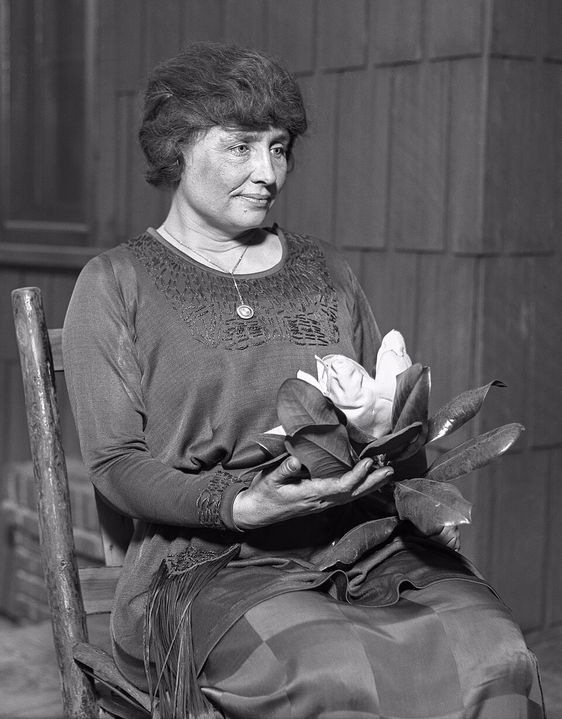
The Story of My Life is Helen Keller's account of her first twenty-two years, written while she was a student at Radcliffe College. She begins at Ivy Green, the family home in Tuscumbia, Alabama, where she was born on June 27, 1880. In February of her second year an illness the doctor called acute congestion of the stomach and brain left her unable to see or hear. She describes the years that followed: a child who explored the world with her hands, invented some sixty home signs, played and quarrelled with Martha Washington, the cook's daughter, and fell into fits of temper as her wish to communicate outgrew her signs. Her parents take her to Dr. Chisholm, an oculist in Baltimore, who sends them to Alexander Graham Bell, who directs them to Michael Anagnos of the Perkins Institution in Boston. On March 3, 1887, Anne Mansfield Sullivan arrives. She spells words into Helen's hand, and after weeks of struggle, including a broken doll, the breakthrough comes at the well-house, when cold water runs over one hand while Sullivan spells w-a-t-e-r into the other. Helen learns that everything has a name, and that evening feels sorrow for the doll for the first time. Later chapters tell of lessons out of doors, learning to read raised print, a terrifying thunderstorm in a wild cherry tree, the meaning of the word love, a first Christmas, visits to Boston and the sea at Brewster, and learning to speak in 1890 with Sarah Fuller of the Horace Mann School. In 1892 a story she wrote, The Frost King, proves to resemble Margaret Canby's The Frost Fairies, which had been read to her years before; a committee at Perkins questions her, and the episode leaves her afraid of her own thoughts for years. She visits the 1893 World's Fair with Dr. Bell, studies at the Wright-Humason School for the Deaf in New York and the Cambridge School for Young Ladies, prepares with the tutor Merton S. Keith, passes the Radcliffe examinations, and enters college in the fall of 1900. The final chapters describe her love of books, her pleasures in rowing, sailing, riding a tandem bicycle and visiting museums, and her friends, among them Phillips Brooks, Oliver Wendell Holmes, John Greenleaf Whittier, Edward Everett Hale and Mark Twain. The chapters first appeared in The Ladies' Home Journal in 1902 and were published as a book by Doubleday, Page in 1903. The editor, John Albert Macy, added a second part of her letters from 1887 to 1901 and a third part with Anne Sullivan's letters and reports on her teaching, and the library text includes all three.
Virtues in this work
- Fortitude: Helen keeps studying for the Radcliffe examinations even when her algebra and geometry books are not in braille.
- Charity: Anne Sullivan spells into Helen's hand for weeks, out of love, before her pupil understands a single word.
- Industry: Helen practises her first sounds again and again until she can speak to her little sister when she comes home in 1890.
- Friendship: Helen fills her last chapter with thanks to the friends who read to her and believed in her.
Plot or Argument
- Part I, Chapters I-III: Ivy Green and the silent years
Helen describes her birth in Tuscumbia, the illness at nineteen months, her home signs, her games with Martha Washington and the old setter Belle, her growing rages, and the journey to Dr. Chisholm in Baltimore and Dr. Bell in Washington that leads to Perkins.
- Part I, Chapters IV-VI: The teacher and the word
Anne Sullivan arrives on March 3, 1887. The doll, the struggle over mug and water, and the well-house moment open the world of names; Helen learns from the storm in the cherry tree that nature can be fearful, and from her teacher that love is felt though it cannot be touched.
- Part I, Chapters VII-XII: Reading, Boston and the sea
She learns to read raised print, keeps her first Christmas with surprises for others, visits Perkins in 1888, meets the sea at Brewster, spends summers at Fern Quarry, and enjoys winters in New England snow.
- Part I, Chapters XIII-XV: Speech and the Frost King
In 1890 she learns to speak from Sarah Fuller and comes home able to talk to her sister. The Frost King affair of 1892 brings a hearing at Perkins and a long fear of unconscious borrowing, followed by the World's Fair of 1893 with Dr. Bell.
- Part I, Chapters XVI-XX: Schools and college
She studies at the Wright-Humason School, enters the Cambridge School in 1896 under Arthur Gilman, takes the Radcliffe preliminary examinations, continues with Merton S. Keith after leaving the school, and enters Radcliffe in 1900, where she finds college both a joy and a hard climb.
- Part I, Chapters XXI-XXIII: Books, pleasures and friends
She names the books that formed her, from Little Lord Fauntleroy to the Bible and Shakespeare, describes her outdoor pleasures and museum visits, and gives thanks for friends including Phillips Brooks, Holmes, Whittier, Hale, the Huttons and Mark Twain.
- Part II: Letters, 1887-1901
Her own letters, from the first pencilled notes of 1887 to letters written in college, show her language growing year by year.
- Part III: A Supplementary Account by John Albert Macy
Macy explains how the book was written and describes Helen's personality, then prints Anne Sullivan's letters and reports on her teaching method, accounts of Helen's speech, and a study of her literary style with samples of her college writing.
Characters
- Helen Keller, author and narrator
Deafblind from infancy, she tells how language, books and friendship opened the world to her.
- Anne Mansfield Sullivan, teacher
Perkins graduate who arrives in 1887 and stays beside her pupil through college.
- Arthur H. Keller and Kate Adams Keller, parents
Her father, a former Confederate captain and newspaper editor, and her mother, who first sought help for her.
- Mildred Keller, younger sister
First resented, later Helen's dear companion and fellow student in Cambridge.
- Alexander Graham Bell, friend and adviser
Directs the family to Perkins and later guides Helen through the World's Fair.
- Michael Anagnos, director of the Perkins Institution
Finds a teacher for Helen and later doubts her during the Frost King affair.
- Sarah Fuller, speech teacher
Principal of the Horace Mann School who gives Helen her first lessons in speech.
- Phillips Brooks, friend
Boston bishop who teaches her the fatherhood of God and the brotherhood of man.
Lessons
A word can open a world
At the well-house Helen learns that the spelling in her hand means the water on her skin, and at once everything around her has a name. Her whole education follows from that day. The story shows how much of what we think and feel depends on having words.
- What happened at the well-house that had not happened before?
- Why did Helen want to fix the broken doll that evening?
- What words would you choose if you could learn only five?
A good teacher is patient and wise
Anne Sullivan spells into Helen's hand for weeks before Helen understands, teaches out of doors, and waits for the right moment. Helen writes that her teacher's sympathy and tact made learning a joy. The book honors teaching as a gift of love.
- How did Miss Sullivan teach Helen outside the classroom?
- Why did she keep spelling words even when Helen did not understand?
- Who has been a patient teacher in your life?
Every struggle is a victory
Learning to speak, preparing for Radcliffe, and studying with books that were not in braille all took Helen enormous effort. In Chapter XX she says she slips back and falls but keeps climbing. She treats hard work as part of the climb rather than a reason to stop.
- What made studying for college so hard for Helen?
- What does she mean when she says every struggle is a victory?
- Can you think of something hard that you kept working at?
Friends shape a life
Helen fills her last chapter with thanks to friends who read to her, wrote to her, and believed in her. She says such people make us feel that all is well. Her story suggests that no one becomes who they are alone.
- Which friends does Helen remember in Chapter XXIII?
- What did Bishop Brooks teach her?
- How can you be a good friend to someone who cannot do everything you can?
Context
Before the nineteenth century few people believed a child both deaf and blind could be educated. At the Perkins Institution in Boston, Samuel Gridley Howe had taught Laura Bridgman to read and write by touch in the 1830s and 1840s, and Charles Dickens's praise of her in American Notes (1842) prompted Kate Keller to seek help. Anne Sullivan, a Perkins graduate who had herself been nearly blind, learned the manual alphabet from Bridgman before going to Alabama. In the same decades teachers of the deaf debated signing against oral speech; Alexander Graham Bell championed speech and lip-reading, and Helen's speech lessons at the Horace Mann School belong to that movement.
Composition
Keller wrote the chapters as a Radcliffe student, partly as English composition work, and they were serialized in The Ladies' Home Journal in 1902. John Albert Macy, a Harvard instructor who helped her shape the manuscript and later married Anne Sullivan, edited the 1903 book for Doubleday, Page, adding her letters and a supplementary account built from Sullivan's letters to Sophia Hopkins and her reports to Perkins.
Reception
The book was widely read on publication and has never gone out of print. It made Keller famous as a writer as well as a student, and Sullivan's letters became a classic source on teaching. William Gibson's play The Miracle Worker (1959) and its 1962 film made the well-house scene one of the best-known moments in American life writing.
Comparisons
- up-from-slavery
Both books, published two years apart, tell of a hard-won education and a grateful debt to a great teacher: Washington's General Armstrong and Keller's Anne Sullivan.
- the-story-of-my-boyhood-and-youth
John Muir's boyhood memoir shares Keller's joy in the natural world learned through the senses, and her sense of learning as an adventure pursued against odds.
- the-true-story-of-my-life
Hans Christian Andersen's autobiography is another writer's story of rising from a poor start through the help of patrons and friends; Keller read and loved his tales.
- the-pilgrims-progress
Keller borrows Bunyan's Hill Difficulty in Chapter XX to describe her climb toward knowledge; both books picture life as a hard road toward light.
- twenty-years-at-hull-house
Jane Addams and Helen Keller were both women of the same generation who turned an education into public service; Keller later wrote and spoke for causes Addams also supported.
- heidi
Heidi's return to the mountains restores the sick Clara; both books show a child's joy in nature and how one person's love can open another's life.
Quotes
Frequently cited
“The most important day I remember in all my life is the one on which my teacher, Anne Mansfield Sullivan, came to me.”
Frequently cited
“That living word awakened my soul, gave it light, hope, joy, set it free!”
Frequently cited
“Everything had a name, and each name gave birth to a new thought.”
Frequently cited
“Every struggle is a victory.”
“You cannot touch love either; but you feel the sweetness that it pours into everything.”
“knowledge is happiness, because to have knowledge--broad, deep knowledge--is to know true ends from false, and lofty things from low.”
“God is love, God is our Father, we are His children; therefore the darkest clouds will break and though right be worsted, wrong shall not triumph.”
“My heart is singing for joy this morning. A miracle has happened!”
For Students
A reading companion for classical Christian high school students. See the student guide.
Reading Guide
Watch for
- How Helen describes the world before she had words, in Chapters II and III.
- The broken doll and the well-house in Chapter IV, and how Helen feels about the doll that evening.
- The storm in the cherry tree in Chapter V and how her teacher comes back for her.
- The day Helen speaks to her little sister in Chapter XIII.
- Anne Sullivan's own letters in Part III, and how they tell the same story from the teacher's side.
Key terms and names
- Manual alphabet
- A way of spelling letters with the fingers; Anne Sullivan spelled words into Helen's palm.
- Raised print and braille
- Letters or dots pressed up from the page so they can be read by touch.
- Perkins Institution
- The school for the blind in Boston where Anne Sullivan studied and where Helen later visited and learned.
- Ivy Green
- The Keller family home in Tuscumbia, Alabama, covered in ivy and roses.
- Radcliffe College
- The women's college connected with Harvard, which Helen entered in 1900.
- The Frost King
- A story Helen wrote as a child that turned out to be very like a story read to her years before.
Seminar Questions
- Comprehension What happened to Helen when she was a baby, and how did it change her life?
- Comprehension What word did Helen first understand, and where was she?
- Comprehension How did Helen learn to speak?
- Interpretation Why do you think Helen cried over the broken doll after the well-house, but not before?
- Interpretation Why did the Frost King trouble make Helen afraid to write for a long time?
- Interpretation Miss Sullivan said love is like clouds. What did she mean?
- Big Question Why do people need words to think and to love one another?
- Big Question What makes someone a truly good teacher?
Faith Connections
- Mark 7:32-37 (Scripture)
Jesus touches the ears and tongue of a deaf man and says, Be opened. Helen's hand-spelled word at the well-house opened her mind, and she describes it as a coming out of darkness into light.
- 1 John 4:7-8 (Scripture)
God is love. Helen says Bishop Brooks taught her that God is love and that we are His children, and she learned from her teacher that love is real though it cannot be touched.
- Genesis 2:19-20 (Scripture)
Adam gives names to the animals. Helen's discovery that everything has a name is a child's own joy in naming God's world.
- John Bunyan, The Pilgrim's Progress (Great Conversation)
Helen calls her hard climb toward learning the Hill Difficulty, the steep hill Christian must climb on his way to the Celestial City.
Logic and Rhetoric
Central argument: A child cut off from sight and sound seemed shut out from thought itself. Yet when a patient teacher joined a word to a felt thing, language came, and with language came thought, conscience, friendship and learning. Therefore Keller argues that the mind is not bound by the senses it lacks, and that love and teaching can open it.
Rhetorical device: extended metaphor. In Chapter IV Keller pictures herself before her teacher came as a ship groping through a dense fog without compass or sounding-line, longing for light.
Debate: Resolved: that Anne Sullivan deserves as much credit as Helen Keller for Helen's achievements.
Memory Work
Everything had a name, and each name gave birth to a new thought.
Every struggle is a victory.
Writing Prompts
Essay: Tell the story of the well-house in your own words, and explain why Helen called it the most important day of her life.
Comparison with Up from Slavery: Helen Keller and Booker T. Washington both had a great teacher. Compare what Anne Sullivan and General Armstrong taught them, and how each repaid that teacher.
Medical Lens
The Story of My Life is a central first-person document in the history of deafblindness and its education. Keller records the family's account of the illness of February 1882, called acute congestion of the stomach and brain, with high fever and an apparently sudden recovery; later writers have suggested meningitis or scarlet fever, but these are retrospective readings, not established diagnoses. The book traces the medical and educational network of the 1880s: the Baltimore oculist Dr. Chisholm, who found nothing to be done for her eyes but said she could be educated; Alexander Graham Bell; and the Perkins Institution, where Laura Bridgman's earlier education by touch supplied the method. Keller describes how she perceived through touch, smell and vibration, learned to speak by feeling the throat and lips of Sarah Fuller, and read speech from lips with her fingers. Her account of the Frost King hearing and the years of fear afterwards that her thoughts were not her own describes a lasting anxiety about memory and unconscious borrowing (cryptomnesia is the later term some use). Macy's supplementary account and Sullivan's letters are early documents in the psychology of language acquisition. A passage on dreams describes how a person who has been deafblind since infancy dreams in touch and feeling.
- Part I, Chapter I
The fever in her second year, the doctor's verdict, and her confused memory of turning her hot, dry eyes from the light.
- Part I, Chapter III
The visit to the oculist Dr. Chisholm in Baltimore and to Dr. Bell in Washington.
- Part I, Chapter XIII
Learning to speak in 1890 by feeling the position of Sarah Fuller's tongue and lips.
- Part I, Chapter XIV
The Frost King hearing and her long afterward fear that her ideas were not her own.
- Part III, Chapter IV
Macy and Sullivan on how Keller's speech was taught and how she reads lips with her fingers.
- Part III, Chapter V
Keller's description of her dreams and how the senses she lacks appear in them.
Creative Prompts
- Classroom
With a partner, try spelling a simple word into each other's palm with your eyes closed. Talk about what Helen had to understand before the spelling meant anything.
- Fiction
Write the well-house scene from Anne Sullivan's point of view, using what she says in her letter of April 5, 1887.
- Poetry
Write a short poem about something you know only by touch, smell or sound, the way Helen knew the roses at Ivy Green.
- Essay
Helen says knowledge is happiness, not power. Explain what she means and whether you agree.
Further Reading
- The World I Live In, Helen Keller
Her 1908 essays on touch, smell, and dreams.
- Teacher: Anne Sullivan Macy, Helen Keller
Her 1955 tribute to her teacher.
- Helen and Teacher: The Story of Helen Keller and Anne Sullivan Macy, Joseph P. Lash
- The Miracle Worker, William Gibson
The 1959 play based on Sullivan's letters and this book.
Verification notes
Names, dates and chapter contents (birth June 27, 1880; Sullivan's arrival March 3, 1887; Boston visit May 1888; speech lessons spring 1890; World's Fair 1893; Wright-Humason School October 1894; Cambridge School October 1896; Radcliffe fall 1900) were checked against the attached Gutenberg text, which includes Macy's preface of February 1, 1903, the letters, and the supplementary account. The 1902 serialization in The Ladies' Home Journal is acknowledged in Macy's preface; the Doubleday, Page publication of 1903 and the 1904 Radcliffe degree are standard facts of Keller's biography. Possible retrospective diagnoses of her childhood illness are given only as readings. Quotes were checked against the attached text.
- Whether Macy's role in shaping the manuscript and Keller's use of the chapters as Radcliffe composition work should be described more precisely.
- The 1892 date of the Frost King hearing (the book places the story in autumn 1891 and the hearing the following winter).