Work record
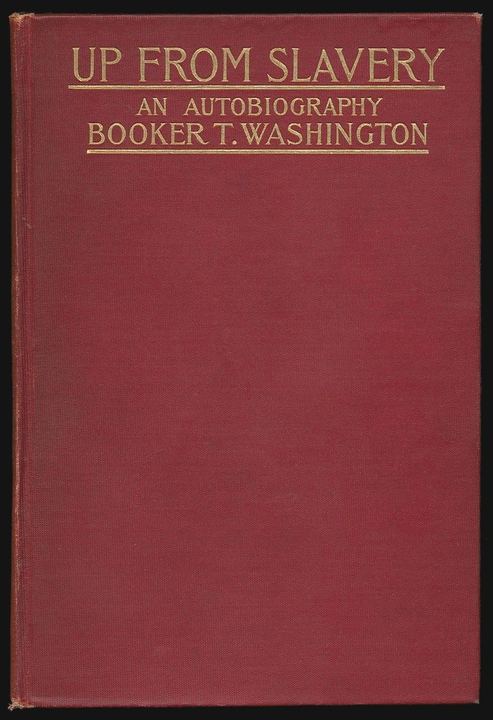
Up from Slavery
1901 (serialized 1900-01) · Early 20th Century · Memoir · English
Abstract
Background. Already famous after his 1895 Atlanta speech and pressed for constant fund-raising, Washington composed these chapters largely while travelling, with editorial help acknowledged in the preface, for a New York weekly.
Scope. The narrative runs from a dirt-floored cabin in Virginia, through mine and furnace labor in West Virginia and student years at Hampton, to the building of an Alabama school and a national platform.
Content. Washington recalls emancipation morning, the name he chose for himself, the room he swept to gain admission, the abandoned plantation bought on borrowed money, the collapsing kilns, and the cabins of the Black Belt. He reprints the Exposition speech with its responses and closes with Harvard's honor, a presidential visit and a return to Richmond.
Method. Plain, anecdotal and deliberately free of complaint, the book argues by example, letting each episode carry a maxim about labor, thoroughness, self-help or goodwill.
Themes. Self-reliance through skilled labor, cleanliness and order as moral disciplines, forgiveness toward former masters and their sons, practical cooperation between the races of the South, and gratitude to teachers and benefactors, above all Armstrong, whose example he credits for nearly every lesson.
Significance. A best seller translated widely in its author's lifetime, it defined his program for a generation, provoked Du Bois's reply in 1903, and holds a lasting place among American life stories.
Key figures
- Booker T. Washington: Narrator, former slave, founder and principal of Tuskegee
- His mother: Plantation cook who prayed for freedom and died at Malden
- Viola Ruffner: Strict Vermont-born employer who taught him order and cleanliness
- Samuel C. Armstrong: Union general and founder of Hampton, his chief mentor
- Mary F. Mackie: Hampton head teacher who set the sweeping test
- Olivia A. Davidson: Co-founder of Tuskegee's work and his second wife
- George W. Campbell and Lewis Adams: Tuskegee townsmen, one white and one formerly enslaved, who backed the school
- Grover Cleveland: President who praised the Atlanta address by letter
- Walter H. Page: Publisher and author of the introduction

Summary
Up from Slavery is Booker T. Washington's account of his rise from a slave cabin in Virginia to the leadership of Tuskegee Institute. He begins with what he does not know: the exact date of his birth, about 1858 or 1859 as he gives it, and the name of his white father. He remembers a one-room cabin with a dirt floor at Hale's Ford, his mother cooking for the plantation, the torment of a new flax shirt that his brother John wore first to break it in for him, and the schoolhouse door he could not enter. At the end of the Civil War the slaves gather at the big house to hear a proclamation read, and his mother kisses her children, weeping for joy. The family moves to Malden, West Virginia, where the boy packs salt and works in a coal mine, learns his letters from a Webster's spelling book, chooses the surname Washington on his first day of school, and learns order and thoroughness as a houseboy for the exacting Mrs. Viola Ruffner. Hearing miners speak of Hampton Institute, he travels some five hundred miles in 1872, sleeping under a board sidewalk in Richmond, and is admitted after the head teacher, Miss Mary F. Mackie, has him sweep a recitation room; he sweeps it three times and dusts it four. At Hampton he works as janitor, learns the use of the bath, the toothbrush and the bedsheet, and comes under the influence of General Samuel C. Armstrong. After teaching at Malden, study in Washington, D.C., and work as housefather to Native American students at Hampton, he is sent in 1881 to open a normal school at Tuskegee, Alabama, where he begins on July 4 with thirty students in a shanty and a church. With Olivia A. Davidson, later his second wife, he buys an abandoned plantation, teaches students to build their own buildings, fails three times to burn a kiln of bricks, pawns his watch, and at last succeeds. Later chapters describe fund-raising among Northern donors such as Collis P. Huntington and Andrew Carnegie, the deaths of his first two wives, the invitation to speak at the Cotton States and International Exposition in Atlanta on 18 September 1895, the full text of that address with its counsel to cast down your bucket where you are, and the response of Grover Cleveland and the press. He sets out his rules for public speaking and health, describes a rest cure in Europe in 1899 that included tea with Queen Victoria, an honorary degree from Harvard in 1896 and President McKinley's visit to Tuskegee in 1898, and closes in Richmond, where he once slept under a sidewalk, as the guest of both races. The chapters first ran in The Outlook in 1900 and 1901 and were published as a book in 1901, with a preface acknowledging the help of Max Bennett Thrasher and an introduction by Walter H. Page.
Virtues in this work
- Industry: Washington sweeps the Hampton recitation room three times and dusts it four to win admission.
- Fortitude: After three brick kilns fail at Tuskegee he pawns his watch to try again, and the fourth succeeds.
- Magnanimity: He resolves in Chapter XI never to let any man, of any color, make him hate.
- Humility: He corrects a correspondent who calls him Reverend, and treats janitor's work at Hampton as an honor.
- Hope: He closes the book in Richmond, where he once slept under a sidewalk, delivering a message of hope to both races.
Plot or Argument
- Chapters I-II: Slavery and boyhood
Washington describes plantation life at Hale's Ford, his mother, the coming of freedom, and the move to Malden, where he works in the salt furnace and coal mine, teaches himself to read, and names himself.
- Chapters III-IV: The struggle for an education
He serves Mrs. Ruffner, walks and begs his way to Hampton, passes the sweeping examination, works his way through as janitor, and learns from General Armstrong and the teachers that the happiest are those who serve others. His mother dies while he is home; he returns to teach at Malden.
- Chapters V-VI: Reconstruction and Hampton teaching
He reflects on the Reconstruction years and the hunger for book learning and office, studies in Washington, D.C., and returns to Hampton to supervise Native American students and a night school.
- Chapters VII-XI: Founding Tuskegee
Sent to Alabama, he opens the school on July 4, 1881, tours the cabins of the Black Belt, buys a plantation, teaches in a stable and a hen-house, builds Porter Hall, fails and succeeds with the brick kiln, and makes students build their own beds and keep the gospel of the toothbrush.
- Chapters XII-XIII: Raising money and speaking
He tells how he sought support from Northern donors and funds, how his first wife Fannie Smith and his second wife Olivia Davidson died, and how he travelled two thousand miles to give a five-minute speech.
- Chapter XIV: The Atlanta Exposition Address
He prints the address of 18 September 1895 with its image of the ship's crew told to cast down the bucket where they are, its call for dignity in labor, and its image of the races as separate fingers of one hand, followed by Grover Cleveland's letter and press reactions.
- Chapters XV-XVII: Public life and last words
He explains his method in public speaking and his habits of work, rest and health, describes the European trip and the meeting with Queen Victoria, prints the Harvard letter of 1896, recounts McKinley's visit, and ends in Richmond.
Lessons
Work done thoroughly is its own credential
Washington is admitted to Hampton not by examination papers but by sweeping a room three times and dusting it four. The lesson runs through the book: the brick kiln that fails three times, the students who build their own beds, and the habit of finishing each day's work. He argues that excellence in common tasks wins respect that argument cannot.
- Why does Washington call the sweeping of the recitation room his college examination?
- What did Mrs. Ruffner teach him that prepared him for that day?
- Why does he insist that Tuskegee students build the school's buildings themselves?
Refusing hatred
In Chapter XI Washington says that he learned from General Armstrong that great men cultivate love and little men cherish hatred, and resolved never to let anyone degrade his soul by making him hate. He treats the refusal of bitterness as a moral discipline, not a political tactic alone.
- Whom does Washington credit with teaching him not to hate?
- Why does he describe hatred as something that narrows the soul of the one who hates?
- Is it possible to refuse hatred and still demand justice?
Obstacles as a measure of success
Washington writes in Chapter II that success should be measured by the obstacles overcome, not the position reached. His own story, from a dirt floor to tea at Windsor Castle, is offered as evidence. He hopes the reader will judge others, and himself, by effort and growth rather than rank.
- Which obstacle in Chapters I-III seems hardest to you?
- Why does Washington say he no longer envies the white boy as he once did?
- Is his measure of success fair to those who start with every advantage?
Education of head, hand and heart
Tuskegee joins academic study with trades, farming, cleanliness and chapel. Washington argues that a people newly freed must learn to own land, build houses and earn a living, and that labor done with skill is dignified. The Atlanta address turns this conviction into a public program.
- What did Washington learn at Hampton besides book lessons?
- Why does he criticize students who wanted only Latin and Greek in Chapter VIII?
- What does he mean by saying there is as much dignity in tilling a field as in writing a poem?
Context
Washington's life spans slavery, the Civil War, Reconstruction and the years after 1877, when Southern states restricted Black voting and established legal segregation. Hampton Institute, founded in 1868 by Samuel Chapman Armstrong, son of missionaries to Hawaii, trained teachers through manual labor and moral discipline, and Tuskegee followed that model. The Atlanta Exposition Address of 1895, delivered at a fair meant to display the South's recovery, proposed that Black Southerners concentrate on education, labor and property while white Southerners offered economic cooperation, and it made Washington a national figure.
Composition
The chapters appeared serially in The Outlook, a New York weekly, from November 1900 into 1901, and were published as a book by Doubleday, Page and Company in 1901. In his preface Washington says much of it was written on trains and in railway stations, and thanks Max Bennett Thrasher for his assistance. Walter H. Page, a partner in the publishing firm, wrote the introduction included in the library text. Washington had published an earlier autobiography, The Story of My Life and Work, in 1900.
Reception
The book was a best seller, was widely translated, and brought Tuskegee new donors. Its program was soon debated within the Black community, most famously by W. E. B. Du Bois, whose The Souls of Black Folk (1903) argued for higher education and political rights alongside industrial training. Up from Slavery has remained one of the classic American autobiographies, often read beside Franklin's and Frederick Douglass's.
Comparisons
- atlanta-exposition-address
Chapter XIV prints the address in full and surrounds it with the story of its invitation, delivery and reception; reading the memoir supplies the life behind the speech's program of labor, property and cooperation.
- narrative-and-fourth-of-july
Douglass's narrative of a man who escaped slavery by learning to read is the great predecessor, and Washington quotes Douglass in Chapter VI; Douglass writes as an abolitionist orator, Washington as a builder of institutions after freedom.
- franklin-autobiography-and-poor-richard
Both are American success narratives of self-education, industry, thrift and rules for daily living; Washington's sweeping examination and Franklin's arrival in Philadelphia with his rolls are parallel founding scenes.
- amos-fortune-free-man
Yates's story of an African-born man who buys his freedom and others' through patient labor in New Hampshire shares Washington's faith in work, property and forgiveness.
- sermons-and-letter-from-birmingham-jail
King, like Washington, preaches the refusal to hate and appeals to white Southerners as neighbors; he differs sharply in urging that justice cannot wait, which makes the two a natural debate pairing.
- the-souls-of-black-folk
Du Bois's 1903 essays include Of Mr. Booker T. Washington and Others, a direct reply to the programme Washington describes here; reading the two together shows the debate over industrial education, civil rights and the higher training of Black leaders in each man's own words.
Quotes
Frequently cited
“I was born a slave on a plantation in Franklin County, Virginia.”
Frequently cited
“success is to be measured not so much by the position that one has reached in life as by the obstacles which he has overcome while trying to succeed.”
Frequently cited
“The sweeping of that room was my college examination”
Frequently cited
“great men cultivate love, and that only little men cherish a spirit of hatred.”
Frequently cited
“I would permit no man, no matter what his colour might be, to narrow and degrade my soul by making me hate him.”
Frequently cited
“No race can prosper till it learns that there is as much dignity in tilling a field as in writing a poem.”
“this was the day for which she had been so long praying, but fearing that she would never live to see.”
“those who are happiest are those who do the most for others.”
For Students
A reading companion for classical Christian high school students. See the student guide.
Reading Guide
Watch for
- The scenes of Chapter I: the cabin, the flax shirt, the schoolhouse door and the morning of freedom.
- How Washington names himself in Chapter II and what the name means to him.
- The sweeping examination at Hampton in Chapter III and every later scene where thoroughness opens a door.
- The failed brick kilns and the pawned watch in Chapter X.
- How the Atlanta address in Chapter XIV gathers up lessons from the earlier chapters.
Key terms and names
- Hampton Institute
- The Virginia normal and agricultural school founded by General Samuel C. Armstrong where Washington studied from 1872 to 1875 and later taught.
- Tuskegee Normal and Industrial Institute
- The Alabama school Washington opened on July 4, 1881, with thirty students in a shanty and a church.
- Normal school
- A school for training teachers, which is what Tuskegee was first chartered to be.
- Industrial education
- Training in trades, farming and household skills joined to academic study, which Washington believed the freedmen needed most.
- Gospel of the tooth-brush
- General Armstrong's phrase, adopted at Tuskegee, for the habits of cleanliness every student had to keep.
- Reconstruction
- The years after the Civil War, which Washington discusses in Chapter V, when the federal government sought to rebuild the South and secure freedmen's rights.
- Cast down your bucket where you are
- The refrain of the Atlanta address, drawn from a story of a ship's crew dying of thirst at the mouth of the Amazon, unaware they were in fresh water.
Seminar Questions
- Comprehension What does Washington not know about his own birth and family, according to Chapter I?
- Comprehension How does he get to Hampton, and how is he admitted?
- Comprehension What difficulties does he face in the first years at Tuskegee, and how does he meet them?
- Interpretation Why does Washington describe the freed people's joy turning to gloom on the very day of freedom in Chapter I?
- Interpretation What does the brick-kiln episode in Chapter X show about his method as a leader?
- Interpretation How does the Atlanta address in Chapter XIV apply what Washington learned at Malden and Hampton?
- Big Question Is refusing to hate those who have wronged you a strength, a duty, or a risk?
- Big Question What is education for: earning a living, forming character, or both?
Faith Connections
- Exodus 5:6-19 (Scripture)
Pharaoh orders the Israelites to make bricks without straw. Washington titles Chapter X A Harder Task Than Making Bricks Without Straw, and the failed kilns become his own trial of patience in the wilderness.
- Matthew 5:43-44 (Scripture)
Jesus commands love of enemies. Washington's resolve in Chapter XI never to let anyone make him hate is a practical answer to this command.
- Colossians 3:23 (Scripture)
Paul tells servants to work heartily, as to the Lord. Washington's sweeping of the Hampton classroom and his teaching that labor has dignity read as an outworking of this verse.
- Rule of St. Benedict, Chapter 48 (Church Fathers)
Benedict calls idleness the enemy of the soul and orders monks to fixed hours of manual labor and reading. Tuskegee's joining of work, study and chapel follows a similar conviction that hands and minds are formed together.
Logic and Rhetoric
Central argument: A people newly freed must first secure the means of independent life: skill, property, cleanliness and character. Such gains win respect that cannot be argued away, and they are within reach now. Therefore Washington argues that patient, thorough work and the refusal of bitterness are the surest road upward, and his own life is offered as proof.
Rhetorical device: exemplum. Washington argues chiefly through anecdote: the sweeping examination in Chapter III, the pawned watch in Chapter X and the ship's crew told to cast down their bucket in Chapter XIV each stand for a principle.
Debate: Resolved: that Washington's measure of success, the obstacles overcome, is truer than the measure of position reached.
Memory Work
success is to be measured not so much by the position that one has reached in life as by the obstacles which he has overcome while trying to succeed.
I would permit no man, no matter what his colour might be, to narrow and degrade my soul by making me hate him.
Writing Prompts
Essay: Washington tells his life as a series of tests: the flax shirt, the sweeping, the kilns, the Atlanta platform. Argue which test reveals most about his character and why.
Comparison with Narrative of the Life and What to the Slave Is the Fourth of July?: Compare how Douglass and Washington describe learning to read and what each believes education will do for a person who has been enslaved.
Medical Lens
Up from Slavery is a document of hygiene as moral and social reform. Washington says the bath, the toothbrush, the napkin and the bedsheet were among the most valuable things Hampton taught him, and at Tuskegee he made the gospel of the tooth-brush, a phrase he credits to General Armstrong, a condition of staying in school, along with regular bathing and sleeping between sheets. He describes the cornbread-and-pork diet and crowded one-room cabins of the Black Belt that he toured before opening the school. Olivia Davidson's history includes nursing a pupil with smallpox when no one else would and volunteering as a nurse in the Memphis yellow fever epidemic, presumably that of 1878, though she had never had the disease. Washington records the early deaths of his mother and of both his first wives, the second of whom he says wore herself out with work. In Chapters XV and XVI he sets out a layman's rules for health, such as tending small ills early, consulting a physician when sleep fails, short restorative naps, and finishing the day's work, and he describes the exhaustion that made him sleep fifteen hours a day on the voyage to Europe in 1899. These are personal observations, not clinical history.
- Chapter III
At Hampton he learns the use of the bath, the toothbrush and sheets, and explains their value for health and self-respect.
- Chapter VIII
Olivia Davidson's earlier service nursing a smallpox patient in Mississippi and offering herself as a yellow fever nurse in Memphis.
- Chapter XI
The gospel of the tooth-brush and the teaching of bathing and sleeping between sheets at Tuskegee.
- Chapter XV
Washington's rules for keeping body and nerves fit, his reliance on sleep as a warning sign, and his habit of short naps.
- Chapter XVI
On the voyage to Europe he sleeps fifteen hours a day and first realizes how tired he is after eighteen years of work.
Listen to the book
Public-domain audiobook from LibriVox, read by Andrew Kennedy. Recording: Up from Slavery: An Autobiography (version 3) on LibriVox (Internet Archive).
LibriVox recordings are volunteer readings released into the public domain. The reading may follow a different edition from the text in this library.
Creative Prompts
- Classroom
Make a timeline of Washington's life from the cabin at Hale's Ford to the Richmond address, placing each event beside the chapter that tells it.
- Essay
Washington says success is measured by obstacles overcome. Test the claim against his own story in Chapters I-X.
- Dialogue
Write a conversation between Washington and Frederick Douglass, whom he quotes in Chapter VI, on the best road for the freedmen.
- Fiction
Write Miss Mary F. Mackie's diary entry on the day the ragged young man from West Virginia swept her recitation room.
Further Reading
- The Souls of Black Folk, W. E. B. Du Bois
Includes the essay Of Mr. Booker T. Washington and Others.
- Working with the Hands, Booker T. Washington
His sequel on industrial training at Tuskegee.
- Booker T. Washington: The Making of a Black Leader, 1856-1901, Louis R. Harlan
- Up from History: The Life of Booker T. Washington, Robert J. Norrell
Verification notes
Contents, names, dates given in the text (Hampton 1872-1875, Tuskegee opened July 4, 1881, marriages of 1882, 1885 and 1893, the address of September 18, 1895, the Harvard letter of May 28, 1896, McKinley's visit in 1898) and chapter locators were checked against the attached Gutenberg text, which includes the preface and Walter H. Page's introduction. Serialization in The Outlook and the 1901 Doubleday, Page edition were confirmed at https://archive.org/details/upfromslaveryaut00wash_0/ and library catalog records. The usual modern birth date of 1856 differs from Washington's own 1858 or 1859. The 1878 date of the Memphis epidemic is an inference; the book does not give a year. Quotes were checked against the attached text.
- Exact months of the Outlook serialization (usually given as November 1900 to February 1901).
- Whether Washington's study in Washington, D.C., was at Wayland Seminary; the book does not name the school.