Work record
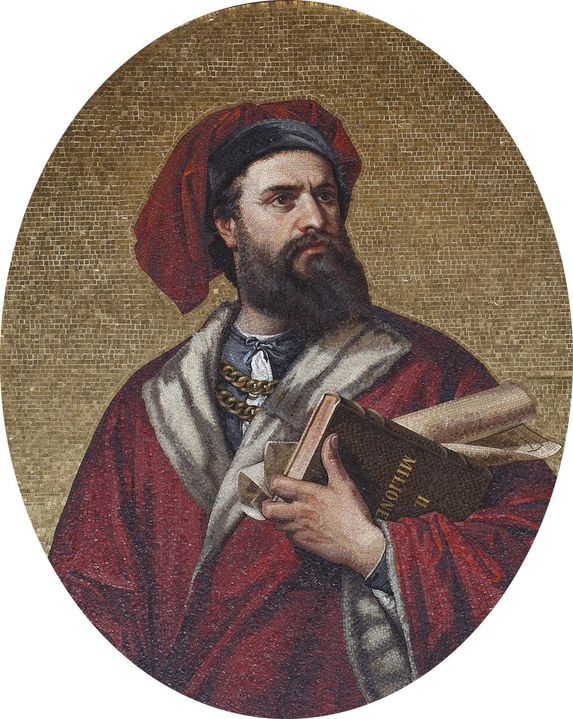
The Travels of Marco Polo
c. 1298–1300 · Medieval · Travel · Old French (Franco-Italian)
Abstract
Background. Two Venetian brothers reached the Mongol court in the 1260s and returned in 1271 with young Marco, who served Kublai for about seventeen years before the family sailed home with a princess bound for Persia. Imprisoned after a sea war with Genoa, he told his story to a Pisan romancer.
Scope. Province by province, the book covers the overland road through Persia and Central Asia, Kublai's capital and government, journeys into Yunnan, Burma and southern China, the sea lanes from Japan to Zanzibar, and dynastic wars among Chinggis's heirs.
Content. It reports products, coinage, customs, religions and wonders: paper currency, coal, the imperial post, the canals of Hangzhou, the failed invasion of Japan, pearl fisheries, the shrine of St. Thomas, and the legend of the Assassins, alongside griffins and a Christian king of the East that Marco knew only by report.
Sources and Text. Marco's own observation mixes with hearsay, and the many manuscripts differ widely; the Yule-Cordier version blends them, marking added passages in brackets. Rustichello's romance phrasing, with its appeals to lords and listeners, frames the merchant's facts throughout.
Significance. The most influential medieval description of Asia, it shaped maps and inspired Columbus, and its reliability remains a lively scholarly question, argued from Chinese tax records, Persian chronicles and the things the text leaves out. For students it opens the Mongol world from the inside of its court.
Key figures
- Marco Polo: Venetian merchant, envoy of the Great Kaan, and source of the account
- Rustichello da Pisa: Romance writer and fellow prisoner who wrote it down
- Niccolò and Maffeo Polo: Marco's father and uncle, the first Polos at the Mongol court
- Kublai (Cublay) Kaan: Great Khan of the Mongols and founder of the Yuan dynasty
- Chinghis Kaan: Founder of the Mongol empire, whose rise Book I recounts
- Cocachin: Mongol princess escorted by the Polos to Persia
- Caidu: Rebel Mongol prince warring against Kublai in Book IV
- Bayan: Kublai's general who conquered southern China

Summary
The book, known in Italy as Il Milione and in early French manuscripts as the Devisement du Monde (Description of the World), is less a diary than a geography of Asia as the Polos knew it, organized by route and region and told in the voice of Rustichello, who often addresses the reader directly. The Prologue tells how the Venetian brothers Niccolò and Maffeo Polo, trading in the Crimea and on the Volga in the 1260s, were carried by war farther and farther east until envoys brought them to Kublai, the Great Kaan of the Tartars, who questioned them about the Pope and the Christian faith and sent them back to Rome asking for a hundred learned Christians and oil from the lamp of the Holy Sepulchre. In 1271 the brothers set out again with Niccolò's son Marco and two friars, who soon turned back. Marco learned the languages of the court, was sent on missions across the empire, and pleased the Kaan with his reports; after seventeen years the Polos finally obtained leave by escorting the princess Cocachin by sea to the Mongol ruler Argon in Persia; Argon had died before they arrived, and she was given to his son Casan. Book I follows the overland road from Lesser Armenia through Turkey, Baghdad, Tabriz, Persia and Hormuz, the Old Man of the Mountain and his drugged Assassins, Badakhshan, the Pamirs, Kashgar, Samarkand and the desert of Lop, to Tangut, Karakorum, the rise of Chinghis Kaan against Prester John, Mongol customs, and Kublai's summer palace at Chandu. Book II describes Kublai himself: his victory over the rebel Nayan, his palace and city of Cambaluc (Beijing), his feasts, hunts, posts and runners, his paper money and his charity to the poor, the black stones burnt for fuel, and the great stone bridge over the Pulisanghin; then journeys west into Tibet, Carajan (Yunnan) and Mien (Burma), and south through the conquered Song lands of Manzi to the siege of Saianfu, the city of Kinsay (Hangzhou), and the port of Zayton. Book III turns to the sea route: Chipangu (Japan) and Kublai's failed invasion, Champa, Java, Sumatra, Ceylon and the story of Sagamoni Borcan, the pearl fisheries and tomb of St. Thomas in Maabar, the kingdoms of India, Socotra, Madagascar, Zanzibar, Abyssinia, Aden and the return to Hormuz. Book IV gives accounts of wars among the Mongol princes, including Caidu and his warrior daughter and the struggles for the throne of Persia, and of the far north, the Land of Darkness and Russia. A brief conclusion thanks God for the travellers' safe return. The library text is Sir Henry Yule's English translation as revised by Henri Cordier (1903), a composite of several manuscript versions with bracketed additions; Yule and Cordier's notes are omitted.
Virtues in this work
- Fortitude: The Polos cross the Pamirs and the desert of Lop and spend nearly two years at sea on the voyage to Persia, during which most of their company died.
- Prudence: Marco learns the languages and customs of the court and brings back careful reports from his missions that win the Kaan's trust.
- Honor: The three Polos guard the princess Cocachin on the long voyage as if she were their own daughter until they deliver her safely in Persia.
- Piety: The book ends by giving thanks to God for the travellers' safe return so that others might learn what the world contains.
Plot or Argument
- Prologue: The Polos and the Great Kaan
The address to princes and people; Niccolò and Maffeo's first journey; Kublai's questions about Christendom and his letter to the Pope; the second journey with Marco; Marco's missions; the leave-taking with the princess Cocachin; the dictation in a Genoese prison in 1298.
- Book I: From Armenia to Chandu
The Armenias, Turkey, Mosul and Baghdad, Tabriz and the tomb of the Three Magi at Saba, Persia and Hormuz; the Old Man of the Mountain; Badakhshan and its healing mountain air; the Pamir; Kashgar, Samarkand, Khotan and the desert of Lop; Tangut and the rhubarb mountains; Karakorum, Chinghis Kaan and Prester John; Tartar customs; the palace at Chandu.
- Book II, Part I: Kublai, his court and capital
The war against Nayan; the Kaan's person, wives and sons; the palace and city of Cambaluc; feasts, the birthday and New Year; hunting with leopards and gerfalcons; paper money; posts and runners; the black stones; charity to the poor; astrologers and religion of the Cathayans.
- Book II, Part II: West and south-west of Cathay
The stone bridge over the Pulisanghin; provinces toward Tibet; Carajan and its great serpents; the battle with the King of Mien and his elephants; Mien's gold and silver towers; Bangala and neighbouring lands.
- Book II, Part III: Through Manzi
The conquest of the Song kingdom of Manzi by Bayan; the siege of Saianfu and the Polos' mangonels; the Yangtze trade; the city of Kinsay, its lake, bridges, markets and revenue; the port of Zayton.
- Book III: The Indian seas
Chipangu and its gold, and the storm that destroyed Kublai's fleet; Champa, Java and Sumatra; Ceylon and Sagamoni Borcan; Maabar, its pearl-fishers, Brahmins and the shrine of St. Thomas; Malabar and Guzerat; Socotra, Madagascar, Zanzibar, Abyssinia, Aden and Hormuz.
- Book IV and Conclusion: Wars of the Tartars and the far north
Caidu's wars against Kublai and his daughter's prowess; the struggles of Argon and Acomat for Persia; the northern lands, the Land of Darkness and Russia; the wars of the western Tartars; a closing thanksgiving for the return.
Lessons
Things seen and things heard
The Prologue promises to set down things seen as seen and things heard as heard only. Readers can test this promise: some chapters are plainly first-hand, with distances, prices and customs, while others repeat stories of griffins, Prester John or the Land of Darkness. Learning to tell eyewitness report from hearsay is the first lesson of reading any traveller.
- Which chapters sound most like eyewitness reports, and which sound like stories Marco heard?
- Why does Rustichello insist so strongly that readers should believe the book?
- How does Marco correct the European legend of the salamander in Book I?
A merchant's eye on a great empire
Marco notices what a Venetian trader would: paper money, coal, salt, pepper, silk, the post-stations, the bridges and canals of Kinsay. His admiration for Kublai's government, wealth and order made Europe aware that a civilization larger and richer than its own lay at the far end of Asia.
- What surprises Marco most about the Great Kaan's paper money and why does he compare it to alchemy?
- Why do you think he describes Kinsay at such length?
- What does Marco admire in Kublai as a ruler?
Faith among the nations
The Polos meet Nestorian Christians, Muslims, Buddhists and others along their road. Kublai asks for a hundred learned Christians who can argue for their faith, and in Ceylon Marco says that Sagamoni Borcan led so pure a life that, had he been a Christian, he would have been a great saint. The book shows a medieval Christian taking other peoples' religions seriously as he describes them.
- Why did Kublai ask the Pope for learned Christian teachers, and what happened to the request?
- How does Marco speak about the holy man of Ceylon?
- What does the shrine of St. Thomas in Maabar tell us about Christianity in India?
Truth and doubt
From the beginning some readers thought the book exaggerated, and scholars still debate how much Marco saw himself. Some note that he omits the Great Wall, tea and the binding of women's feet, and that the Polos could not have helped at Saianfu, whose siege ended before they arrived; others point to his accurate details of salt production, paper currency and the princess Cocachin's voyage, confirmed by Persian and Chinese records. The debate is a good model of weighing evidence.
- What kinds of evidence would show that a medieval traveller really went where he says?
- Why might a writer like Rustichello add to or shape a merchant's story?
- Does it matter if a few episodes are borrowed or mistaken, if most of the book is accurate?
Context
In the thirteenth century the Mongol conquests created the largest land empire in history, from Korea to Hungary. Kublai Khan (r. 1260-1294), grandson of Chinggis Khan, ruled as Great Khan from Khanbaliq (Beijing), completed the conquest of the Song dynasty in southern China in 1279 and founded the Yuan dynasty; other branches of the family ruled Persia (the Ilkhanate), Central Asia and the Russian steppe. The relative security of the routes under Mongol rule allowed merchants, envoys and missionaries to cross Asia, and Venice and Genoa competed fiercely for the trade of the Black Sea and the Levant.
Composition
According to the Prologue, Marco dictated the book in 1298 to Rustichello da Pisa while both were prisoners of the Genoese. It was written in a French mixed with Italian forms, the language of romance and courtly reading in northern Italy, and was soon copied, translated into Tuscan, Venetian and Latin, and altered; about 150 manuscripts survive, no two alike. Giovanni Battista Ramusio's Italian edition of 1559 contains passages found in no earlier manuscript. Sir Henry Yule, a British officer and geographer, published his annotated English translation in 1871, combining several versions; Henri Cordier, a French scholar of China, revised it for the third edition of 1903.
Reception
The book became one of the most widely read works of the late Middle Ages and shaped European maps of Asia, including the Catalan Atlas of 1375. Christopher Columbus owned a printed Latin copy and annotated it, and Marco's distant Chipangu was among the lands he hoped to reach by sailing west. Since the nineteenth century scholars have tested the text against Chinese, Persian and Mongol sources; most accept that Marco knew China at first hand, though a minority have argued that he relied on others' reports, and the question of how much was added by Rustichello and later copyists remains open.
Comparisons
- the-histories
Herodotus also describes the customs, wonders and wars of peoples beyond his own world, distinguishing what he saw from what he was told, nearly eighteen centuries before Marco.
- journey-to-the-west-a-mission-to-heaven
Wu Cheng'en's novel retells the pilgrimage of the monk Xuanzang across Central Asia to India, the reverse of Marco's road, seen from the Chinese side.
- the-persian-expedition
Xenophon's march through Mesopotamia and Armenia covers some of the same lands that open Book I, as a soldier's narrative rather than a merchant's survey.
- the-voyage-of-the-beagle
Darwin's travel book, like Marco's, records natural products, peoples and landscapes for readers at home, but with a naturalist's method and a scientific question.
- gullivers-travels
Swift parodies the traveller's book of marvels that Marco's account helped to create, with its distances, customs and claims to be believed.
- the-arabian-nights
The Nights and Book III share the world of the Indian Ocean trade, Hormuz, Ceylon and the giant bird that Marco calls the Gryphon or rukh.
Quotes
Frequently cited
“And we shall set down things seen as seen, and things heard as heard only, so that no jot of falsehood may mar the truth of our Book”
Frequently cited
“you might say he hath the Secret of Alchemy in perfection, and you would be right!”
Frequently cited
“the city is beyond dispute the finest and the noblest in the world.”
“Now, being thereafter an inmate of the Prison at Genoa, he caused Messer Rusticiano of Pisa, who was in the said Prison likewise, to reduce the whole to writing; and this befell in the year 1298 from the birth of Jesus.”
“He begged that the Pope would send as many as an hundred persons of our Christian faith; intelligent men, acquainted with the Seven Arts”
“It is a fact that all over the country of Cathay there is a kind of black stones existing in beds in the mountains, which they dig out and burn like firewood.”
“Indeed, an he had but been so, he would have been a great saint of Our Lord Jesus Christ, so good and pure was the life he led.”
“But I believe it was God’s pleasure that we should get back in order that people might learn about the things that the world contains.”
For Students
A reading companion for classical Christian high school students. See the student guide.
Reading Guide
Watch for
- The Prologue's promise to separate things seen from things heard, and the places where the book keeps or bends it.
- Marco's comparisons with Venice and Europe whenever he describes a city, a coin or a custom.
- Kublai's questions about Christianity in the Prologue and the many Christians, Muslims and Buddhists Marco meets on the road.
- Practical details a merchant would care about: prices, products, distances and roads.
- The shift from land routes in Books I-II to the sea route in Book III.
Key terms and names
- Great Kaan
- The supreme ruler of the Mongols; in the book, Kublai (Cublay), grandson of Chinghis Kaan.
- Cathay and Manzi
- Marco's names for northern China and for the southern lands of the Song dynasty that Kublai conquered.
- Cambaluc
- The Kaan's capital, modern Beijing, described in Book II with its palace walls, gates and markets.
- Kinsay
- Hangzhou, the old Song capital, which Marco calls the City of Heaven and the finest city in the world.
- Chipangu
- Japan, which Marco never visited but describes from report as an island rich in gold.
- Tablet of gold
- The Kaan's tablet of authority that guaranteed the Polos food, horses and escort throughout his lands.
- Prester John
- A legendary Christian king of the East; Marco identifies him with a ruler defeated by Chinghis Kaan.
Seminar Questions
- Comprehension Why did Niccolò and Maffeo Polo first travel so far east, and what message did Kublai give them for the Pope?
- Comprehension How does Marco describe the Kaan's paper money and the black stones burned in Cathay?
- Comprehension How did the Polos finally get permission to leave Kublai's court?
- Interpretation Why do you think Marco admires Kublai so much? Does he ever criticize him?
- Interpretation How can you tell the chapters Marco saw himself from those he only heard about?
- Interpretation What does Marco's account of Sagamoni Borcan show about how a medieval Christian could speak of another religion?
- Big Question What do we owe to the people and places we visit when we describe them to others?
- Big Question Why does the desire to see the world, and to tell about it, seem to be part of human nature?
Faith Connections
- Psalm 104:24 (Scripture)
O Lord, how manifold are thy works. The book's closing thanks that God let the Polos return so that people might learn what the world contains echoes the psalmist's wonder at creation's variety.
- Acts 17:26-27 (Scripture)
Paul tells the Athenians that God made all nations of one blood so that they might seek him. Kublai's request for learned Christians, and the Christians Marco finds across Asia, show the nations of the book in contact over questions of faith.
- Matthew 2:1-12 (Scripture)
The Magi come from the East to worship the child. In Book I Marco visits Saba in Persia, where the three Magi are said to be buried, and records the local story of their journey.
- William of Rubruck, Itinerarium (c. 1255) (Great Conversation)
The Franciscan friar visited the court of Möngke Khan at Karakorum and took part in a religious debate there; his report shows the hopes and difficulties of the mission Kublai later asked the Pope to send.
Logic and Rhetoric
Central argument: No one has seen so much of the world as Marco, and the book carefully separates what he saw from what he heard. Therefore readers should trust its account of the lands of the Great Kaan, however marvellous they seem, and learn from it the variety and wealth of the world God made.
Rhetorical device: apostrophe and direct address. The Prologue opens by calling on great princes, emperors, kings and people of all degrees to have the book read to them, and throughout Rustichello addresses the reader with phrases like you must know and let me tell you, as in the quoted sentence on paper money.
Debate: Resolved: that the doubts about Marco Polo's travels do not reduce the book's value as a historical source.
Memory Work
And we shall set down things seen as seen, and things heard as heard only, so that no jot of falsehood may mar the truth of our Book
Writing Prompts
Essay: Choose three chapters, one from Book I, one from Book II and one from Book III, and argue what each shows about how a medieval Venetian merchant saw the wider world.
Comparison with Journey to the West (A Mission to Heaven): Compare Marco's journey to the court of Kublai with Tripitaka's pilgrimage to India in Journey to the West. What drives each traveller, and how does each book present the lands along the way?
Medical Lens
The book is a valuable source for the medieval drug trade and for medical practice as a merchant observed it, not a medical text. It records where rhubarb, ginger and spices came from and how they reached Europe; describes the healing air of the Badakhshan mountains, where Marco says he recovered from an illness of about a year; reports that in Carajan there were no physicians and the sick sent for spirit-conjurors, and that crocodile gall was prized as a remedy for rabies and difficult labour; notes physicians and astrologers in the squares of Kinsay; and tells of Indian ascetics who drank a potion of sulphur and quicksilver for long life. The story of the Old Man of the Mountain, who drugged young men into a sleep and woke them in an artificial paradise, is the source of the European legend of the Assassins; the potion is not named, and its identification with hashish is a later and debated interpretation. At the shrine of St. Thomas in Maabar, pilgrims gave red earth from the place of martyrdom to those sick with tertian and quartan fevers.
- Book I, Chapters XXIII-XXIV
The Old Man of the Mountain gives his young followers a sleeping potion and carries them into his garden paradise.
- Book I, Chapter XXIX
The pure air of the Badakhshan mountains cures fevers, and Marco's own year of illness ends there.
- Book I, Chapter XLIII; Book II, Chapter LXXV
Rhubarb in the mountains of Tangut and rhubarb and ginger near Suju, gathered for trade all over the world.
- Book II, Chapters XLIX-L
Crocodile gall used against rabies and in childbirth; in Carajan no physicians, and the sick consult spirit-conjurors.
- Book III, Chapter XX
Ascetics of India who live long on rice and milk and drink sulphur and quicksilver twice a month.
Creative Prompts
- Classroom
Plot the Polos' route on a modern map, chapter by chapter, from Layas to Cambaluc and home by sea through Java, Ceylon and Hormuz.
- Fiction
Write the report Marco might have delivered to Kublai after one of his missions, in the style that the Prologue says pleased the Kaan.
- Essay
Using the chapters on paper money, the posts and the black stones, argue what Marco thought Europe could learn from Cathay.
Further Reading
- Marco Polo: From Venice to Xanadu, Laurence Bergreen
- Did Marco Polo Go to China?, Frances Wood
The best-known statement of the sceptical case.
- Marco Polo Was in China: New Evidence from Currencies, Salts and Revenues, Hans Ulrich Vogel
A detailed reply drawing on Chinese administrative sources.
- Khubilai Khan: His Life and Times, Morris Rossabi
- The Mission of Friar William of Rubruck, William of Rubruck, trans. Peter Jackson
A Franciscan's account of the Mongol court at Karakorum a generation before Marco.
Verification notes
Book and chapter locators and the spelling of names follow the attached text of the Yule-Cordier translation (1903), which joins Project Gutenberg #10636 and #12410; all quotes were found in it. Bracketed passages in the text are Yule's insertions from other manuscript versions, chiefly Ramusio. Dates of the Polos' journeys follow the usual reconstruction (departure 1271, arrival c. 1275, departure c. 1291-92, return 1295); the Genoese capture is traditionally linked to the battle of Curzola in 1298, which some scholars doubt. The account of the scholarly debate over the book's reliability is summarized evenly from the works listed in furtherReading.
- The number of surviving manuscripts is usually given as about 150; confirm before citing.
- Columbus's annotated copy is generally identified as the Latin version of Francesco Pipino printed in the 1480s, now in Seville; confirm details before citing.