Work record
Journey to the West (A Mission to Heaven)
c. 1592 · Renaissance Early Modern · Novel · Chinese
Abstract
Background. The Ming novel turns the real 7th-century pilgrimage of the monk Xuanzang into a fantasy in which a monkey, a pig and a river ogre escort him to India. Richard, a Baptist missionary, issued his condensed version in Shanghai in 1913, calling it an epic and allegory.
Narrative. Hatched from stone, the Monkey learns magic, defies the Dragon King and the lords of death, wrecks the heavenly banquet, and is pinned beneath a mountain by Buddha. Freed by the monk five centuries later, he leads a quarrelsome band through eighty-one ordeals of demons, fire, poison and false doubles until the scriptures are won and every pilgrim is exalted.
Translation. Only parts are rendered in full; long stretches survive as outlines. Richard's captions name the Jade Emperor God and Maitreya the Messiah and set Mahayana teaching beside the Gospel, an interpretation that belongs to him rather than to the Chinese author. The OCR text keeps some scanning errors.
Themes. Pride humbled, discipline of an unruly mind, loyalty within a mismatched company, and the cost of sacred learning, set in a world where Buddhist, Daoist and Confucian powers share one comic cosmos.
Significance. Ranked among China's classic novels, it made the Monkey King a lasting hero of East Asian theater, print and screen.
Main characters
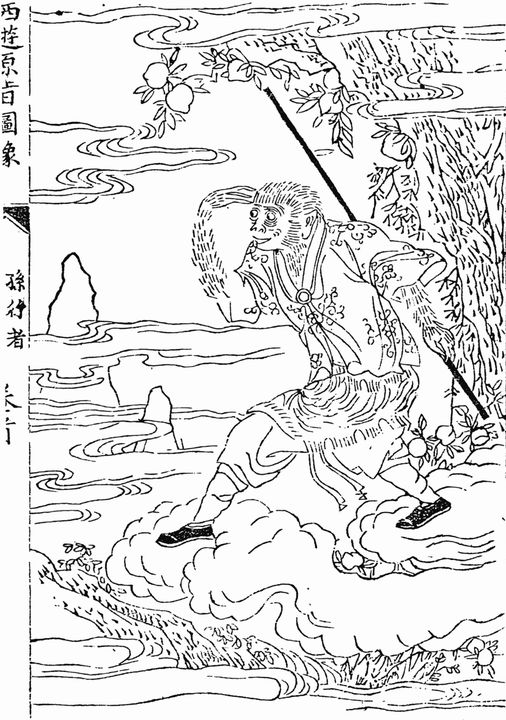
- Sun Wukong (Sun): Stone-born Monkey King, rebel against heaven, then guardian of the monk
- Xuanzang (Huen Chwang, the Master): Tang monk sent west for Buddhist scriptures
- Zhu Bajie (Pa Kiel): Pig-faced disciple ruled by appetite and sloth
- Sha Wujing (Sa Ho Shang): Former river ogre, steady carrier of the baggage
- The Dragon Horse: Dragon prince serving as the monk's white horse
- Guanyin (Kwanyin): Merciful bodhisattva who plans and protects the pilgrimage
- The Buddha (Julai): Lord of the Western Heaven who subdues the Monkey and grants the scriptures
- The Jade Emperor: Ruler of the heavenly court, called the Celestial Emperor by Richard

Summary
Journey to the West is the great Ming-dynasty comic and religious novel about the monk Xuanzang's pilgrimage from Tang China to India to bring back Buddhist scriptures, guarded by a band of supernatural disciples. The library text is not a full translation. It is Timothy Richard's A Mission to Heaven (Shanghai, 1913), which keeps the original's hundred numbered chapters but translates only some of them at length, reduces most of the rest to short outlines, and adds bracketed notes and chapter captions that read the Buddhist and Daoist story as an allegory close to Christian teaching. Richard's names are older romanizations: the monk is Huen Chwang, called the Master; the Buddha is Julai; the bodhisattva of mercy is Kwanyin; the pig is Pa Kiel; the river monk is Sa Ho Shang. The first seven chapters, the fullest in Richard's version, tell the story of the Monkey. A stone egg on the Flower and Fruit Mountain hatches a monkey who becomes king of the monkeys, then, afraid of death, crosses the sea to seek immortality. A Daoist master names him Sun and teaches him seventy-two transformations and cloud-somersaults. He takes an iron pillar from the Dragon King's sea as his shrinking and growing staff, strikes his name from the registers of death, is given a petty post in heaven as keeper of the horses, and, offended, proclaims himself the Great Holy One, Equal of Heaven. Set to guard the immortal peaches, he eats them, spoils the Peach Banquet and swallows Laozi's elixir pills, survives the eight-trigram furnace, and fights the heavenly armies until Buddha challenges him to leap out of his palm. He cannot, and is pressed under the Five Elements Mountain for five hundred years. The middle chapters prepare the pilgrimage: the Tang Emperor's visit to the underworld, the All Souls' festival, and Kwanyin's call for a monk to fetch scriptures. On the road the Master frees Sun, who must wear a cap of spikes that tightens when he disobeys, and gathers Pa Kiel, the river monk, and a dragon who becomes his white horse. Eighty-one trials follow, mostly summarized: demons who want to eat the monk's flesh, the corpse of a murdered king restored to life, a contest of two identical Monkeys, the Flaming Mountain quenched by an iron fan, a poisoning at a Daoist temple, a kingdom whose ruler is healed by pulse-taking. At last the pilgrims reach Buddha's mountain, receive blank scriptures from disciples who wanted a gift, exchange them for written ones, and return to China, where all five are raised to holy rank. The Chinese novel's earliest surviving edition is dated 1592; its attribution to Wu Cheng'en is traditional.
Virtues in this work
- Humility: The Monkey who called himself Equal of Heaven discovers he has never left Buddha's palm and must later serve a weak monk as his disciple.
- Fortitude: The pilgrims travel ten thousand li through eighty-one trials, and Kwanyin adds one more rather than let the count fall short.
- Friendship: After the Master dismisses Sun for killing the disguised demon, the horse and Pa Kiel fetch him back and Sun returns to rescue his master.
- Temperance: Pa Kiel's ravenous eating and the Monkey's theft of the peaches and pills set appetite against the discipline the pilgrimage requires.
Plot or Argument
- Chapters I–II: Birth and schooling of the Monkey
A stone on the Flower and Fruit Mountain bears an egg that becomes the stone Monkey, who finds the Water Curtain Cave and is made king. Fearing old age and death, he sails away to seek immortality, and a master of the Way names him Sun and teaches him transformations and cloud-travel before sending him home.
- Chapters III–IV: Dragon King, Hades and a heavenly post
Sun takes the iron pillar from the Dragon King's treasury, which shrinks to a needle he keeps in his ear, and erases his name and his monkeys' names from the book of the dead. Summoned to heaven, he is made keeper of the celestial horses, discovers the post has no rank, and returns home calling himself Equal of Heaven.
- Chapters V–VII: Havoc in heaven and Buddha's palm
Placed over the peach orchard, Sun eats the peaches of immortality, spoils the Queen of Heaven's banquet and steals the elixir pills. He defeats heavenly armies, is captured with help from the Emperor's kinsman and Kwanyin, survives forty-nine days in the eight-trigram crucible, and is finally trapped when he cannot leap out of Buddha's hand and is buried under the Five Elements Mountain.
- Chapters VIII–XII: Preparing the pilgrimage
Buddha announces scriptures for the eastern land, and Kwanyin goes to seek a pilgrim. The Tang Emperor visits the courts of the dead and returns to found a festival for lost souls, at which Huen Chwang preaches; Kwanyin asks for the teaching of Higher Buddhism, and the monk volunteers to travel west, while the court debates the merits of Buddhism.
- Chapters XIII–XXII: The company assembles
The Master frees Sun from the mountain, gives him a cap of spikes that tightens at a spoken charm, and rides a white horse that is a pardoned dragon prince. Pa Kiel, a greedy former heavenly officer reborn with a pig's face, and the river monk of the Quicksand River join them as disciples.
- Chapters XXIII–LVIII: Trials and quarrels on the road
Demons try to capture and eat the monk; a disguised demon three times deceives him into dismissing Sun, who is called back. A murdered king's body is recovered from a well and restored to life, and a false Monkey so like Sun that only Buddha can tell them apart is exposed as a six-eared monkey.
- Chapters LIX–XCVII: Fire, healing and the remaining kingdoms
The pilgrims cross the Flaming Mountain, whose fires fell from Laozi's upset furnace, by winning a magic fan. Sun diagnoses a grieving king by a string tied to his wrist, the travelers are poisoned at a Daoist temple and rescued by a bodhisattva, and Sun brings rain to a drought-stricken land; Richard summarizes most of these episodes in a few lines each.
- Chapters XCVIII–C: The scriptures and the canonization
The pilgrims bathe, climb the Spiritual Mountain and receive the scriptures, first as blank pages and then as written books, after offering the Master's golden bowl. Kwanyin adds one last mishap to make the trials eighty-one, and on their return the Master, Sun, Pa Kiel, the river monk and the horse are each given holy rank.
Characters
- Sun Wukong (the Monkey King; Richard's Sun, Searcher of Secrets, later Sun the Practical), protagonist
Stone-born monkey of immense magic who rebels against heaven, is imprisoned by Buddha, and becomes the pilgrim's quarrelsome and devoted protector.
- Xuanzang (Tripitaka; Richard's Huen Chwang, the Master), pilgrim
Gentle, timid Tang monk sent by the Emperor to fetch scriptures from the West, often misled by demons in disguise.
- Zhu Bajie (Pigsy; Richard's Pa Kiel), disciple
Former heavenly officer reborn with a pig's face, gluttonous, lazy and comic, who fights with a nine-pronged rake.
- Sha Wujing (Sandy; Richard's Sa Ho Shang, the river monk), disciple
Former heavenly officer banished to the Quicksand River, steady and quiet, who carries the luggage.
- The Dragon Horse, disciple
Third son of a Dragon King, spared by Kwanyin on condition that he carry the Master as a white horse.
- Guanyin (Richard's Kwanyin), patron
Bodhisattva of mercy who recruits the pilgrim and his disciples and rescues them in many trials.
- The Buddha (Richard's Julai), supreme authority
Tathagata of the Western Heaven, who subdues the Monkey and gives the scriptures.
- The Jade Emperor (Richard's Celestial Emperor), ruler of heaven
Head of the heavenly court whose offices and banquet the Monkey throws into disorder.
- Laozi (Richard's Ancient of Days), Daoist sage
Keeper of the elixir pills who tries to smelt the Monkey in the eight-trigram crucible.
- The Tang Emperor, patron
Chinese ruler who visits the underworld, founds the festival for lost souls and sends the monk west.
Lessons
Power without humility
Sun can cross eighteen thousand li in a leap, yet his boast that he can jump out of Buddha's palm ends with him writing his name on Buddha's finger. The early chapters show great gifts turned to disorder by pride, and the rest of the book shows the same gifts put to service.
- Why is Sun so angry about being made keeper of the horses?
- What does the scene on Buddha's palm show about the limits of Sun's power?
- How is the Sun of the pilgrimage different from the Sun who spoils the Peach Banquet?
A journey that trains the travelers
The scriptures could have been carried by cloud in an instant, but the pilgrims must walk, and Kwanyin even adds a final trial to make eighty-one. The book treats the hardships of the road as the real education of the monk and his disciples.
- Why is the Master not allowed to fly to the West on Sun's clouds?
- Which trial seems to change one of the pilgrims most?
Unlike companions on one road
The quick Monkey, the greedy Pa Kiel, the steady river monk and the timid Master quarrel constantly, and the Master twice sends Sun away. The company succeeds only when they need and forgive one another.
- What does each disciple contribute that the others lack?
- Why does the Master dismiss Sun after the demon's three disguises, and why does he need him back?
- Is Pa Kiel only comic, or does he help the journey too?
Reading a work through a translator's eyes
Richard calls the Jade Emperor God, Laozi the Ancient of Days, and the coming Buddha Maitreya the Messiah, and he labels his version a Christian allegory. Students learn to separate the Chinese novel's Buddhist and Daoist world from the frame a 1913 missionary translator placed around it.
- Find one bracketed note signed Tr. What does it add, and is it part of the original story?
- Why might a translator choose familiar words like angel or God for Chinese terms?
Context
The novel grows from the true journey of the Chinese monk Xuanzang (602–664), who travelled to India between 629 and 645, studied there, and returned to Chang'an with hundreds of Buddhist texts, which he spent the rest of his life translating under the Tang emperors. Over the following centuries his pilgrimage gathered legends, storytellers' versions and plays, and the Monkey disciple joined it long before the novel. The finished book mixes Buddhist teaching on karma, merit and the scriptures with Daoist ideas of immortality, alchemy and inner cultivation and with Confucian court life, and its comedy pokes at heavenly and earthly bureaucracies alike.
Composition
The earliest surviving edition of the hundred-chapter novel was printed in Nanjing in 1592 without an author's name. The attribution to Wu Cheng'en of Huai'an became standard in the 20th century, though some scholars still question it. Timothy Richard's A Mission to Heaven, published by the Christian Literature Society in Shanghai in 1913, was among the earliest substantial English versions. Richard followed the hundred-chapter numbering but translated some chapters fully, especially the opening Monkey chapters, and reduced many others to outlines. He believed that the Mahayana Buddhism he called Higher Buddhism shared deep ground with Christianity, and his captions and notes present the story in that light; this reading is his own and is not the novel's.
Reception
Journey to the West is counted among the classic novels of Chinese literature, and Sun Wukong is one of the best-known figures in East Asian storytelling, retold in opera, comics, film and television. In the West, Arthur Waley's abridged Monkey (1942) made it widely known, and Anthony C. Yu's complete four-volume translation (1977–1983) gave English readers the whole work with its poems. Commentators in China have long read it as an allegory of cultivating the mind, with the Monkey as the restless mind and the horse as the will, while others value it chiefly as comic adventure; both readings are old.
Comparisons
- the-pilgrims-progress
Both are allegorical pilgrimages to a holy goal through monsters, false guides and trials; Bunyan's Christian travels to the Celestial City in Protestant terms, while the Tang monk travels to Buddha's mountain for scriptures, and Richard's notes push the two closer together than the Chinese text does.
- the-odyssey
Each is a long homeward or outward journey built from episodes of enchantment, monstrous hosts and divine helpers; Odysseus relies on his own cunning, while the monk relies on Sun's cunning and Kwanyin's rescues.
- don-quixote
A serious-minded master and a comic, earthy companion travel together: Pa Kiel's appetite and complaints play against the Master's piety much as Sancho Panza's do against Don Quixote's ideals.
- the-travels-of-marco-polo
Marco Polo describes the lands between Venice and China as a traveller's report; the novel imagines the road from China westward to India as a sequence of fabulous kingdoms.
- the-faerie-queene
Spenser's Redcrosse Knight, like the pilgrim monk, travels with companions through allegorical dangers and false appearances toward holiness, and both works mix romance adventure with moral teaching.
Quotes
“Although I am happy now, I am not without fear of future shadow.”
“He found all men were in search of fame or riches, and none sought for everlasting life.”
“The above is a summary of the Author's version of the seven days of creation.”
“The five pillars became a mountain joined together, and were called the Five Elements mountain, and Buddha gently covered him up under the mountain.”
“Buddhism is purity and kindness. Though its God is unseen, the fruit of the religion is good.”
“From the heart come all sorts of evil spirits. By the heart you can overcome them.”
“To pacify a nation, first attend to the King's illness.”
“They had travelled 10,000 li, and crossed a thousand rivers, in the daily hope of seeing Buddha at last.”
For Students
A reading companion for classical Christian high school students. See the student guide.
Reading Guide
Watch for
- The first seven chapters, which Richard translates at length, tell the Monkey's whole life before the pilgrimage begins.
- Many later chapters are marked [outline.] and give only a summary; notice where the story speeds up.
- Bracketed notes ending in Tr. are Richard's own comments, not part of the Chinese novel.
- Each disciple keeps a habit from his old life: Sun's pride, Pa Kiel's appetite, the horse's dragon nature.
- The scriptures are first handed over as blank paper; watch what the pilgrims must give to get written ones.
Key terms and names
- Equal of Heaven
- The title the Monkey claims for himself after rejecting his post as keeper of the heavenly horses.
- Five Elements Mountain
- The mountain formed from Buddha's fingers, under which the Monkey is held for five hundred years.
- Kwanyin
- Richard's spelling of Guanyin, the bodhisattva of mercy who arranges the pilgrimage and rescues the travelers.
- Julai
- Richard's spelling of Rulai, the Tathagata, a title of the Buddha who rules the Western Heaven.
- Li
- A Chinese measure of distance, roughly a third of a mile; Sun can somersault eighteen thousand li.
- Higher Buddhism
- Richard's name for Mahayana Buddhism, the teaching Kwanyin asks the monk to fetch from the West.
- Cap of spikes
- Richard's term for the band Kwanyin gives the Master, which tightens on Sun's head when a charm is recited.
Seminar Questions
- Comprehension How is the Monkey born, and what makes the other monkeys choose him as king?
- Comprehension Why is the Monkey trapped under the Five Elements Mountain, and who sets him free?
- Comprehension Who are the Master's four companions on the road, and how did each come to join him?
- Interpretation The Monkey begins by fearing death. How does his search for immortality lead him into trouble with heaven?
- Interpretation Why does the Master need a way to control Sun, and is the cap of spikes fair?
- Interpretation The Master says that evil spirits come from the heart. How do the demons of the road test the heart of each pilgrim?
- Interpretation Richard calls his book a mission to heaven and adds Christian terms. Where does his frame help you understand the story, and where does it change it?
- Big Question Can a long, hard journey change who a person is in a way that a sudden gift cannot?
Faith Connections
- Proverbs 16:18 (Scripture)
Pride goeth before destruction: the Monkey's claim to be Equal of Heaven ends with his fall under the mountain, a pattern the Proverbs state plainly.
- Proverbs 4:23 (Scripture)
Keep thy heart with all diligence, for out of it are the issues of life; the Master's teaching that demons arise from the heart and are overcome by it can be read beside this verse, while noting that the novel's idea of the heart comes from Buddhist teaching on the mind.
- Hebrews 11:13-16 (Scripture)
The faithful confessed themselves strangers and pilgrims seeking a better country; Richard's title A Mission to Heaven invites this comparison, though the monk's goal is Buddha's mountain and its scriptures.
- John Bunyan, The Pilgrim's Progress (Great Conversation)
Bunyan's allegory of the Christian life as a road beset by giants, false guides and the Slough of Despond is the closest Christian parallel to the pilgrims' eighty-one trials, and reading the two together shows how different traditions picture spiritual growth as travel.
Logic and Rhetoric
Central argument: Great natural power, if ruled by pride, throws heaven and earth into disorder; the same power, disciplined by a vow and joined to companions on a long road, can carry sacred teaching to the world.
Rhetorical device: allegorical naming. In Chapter XIV the six robbers who attack the pilgrims are named Mr. Eye, Mr. Ear, Mr. Nose, Mr. Tongue, Mr. Thought and Mr. Sad, turning the senses and desires into enemies on the road.
Debate: Resolved: that the Master was right to dismiss Sun when Sun killed the disguised demon he could not see.
Memory Work
From the heart come all sorts of evil spirits. By the heart you can overcome them.
Although I am happy now, I am not without fear of future shadow.
Writing Prompts
Essay: Trace how Sun changes from the rebel of Chapters IV–VII to the protector of the pilgrimage, using the palm scene, his release in Chapter XIV and one later trial as evidence.
Comparison with The Pilgrim's Progress: Compare the Master's companions with Christian's companions Faithful and Hopeful: what does each book suggest about travelling to a holy goal with others?
Medical Lens
The novel draws on several traditions of Chinese medicine and longevity practice. The Monkey's search for immortality, the peaches and elixir pills of heaven, and Laozi's eight-trigram crucible belong to Daoist alchemy, in which refined substances and inner cultivation were believed to prolong life; Richard's English renders the crucible scene in the language of smelting dross. In Chapter LXIX (summarized by Richard) Sun takes the pulse of a sick king through a string tied to his wrist, a legendary form of the classical Chinese pulse diagnosis, and the chapter refers to a pharmacopoeia of hundreds of remedies; the king's illness is traced to grief at the loss of his wife. Chapter LXXIII heads its account of a poisoning with the maxim that long-nursed hatred produces illness, an idea of emotion acting on the body found in Chinese medical thought. A murdered king's preserved body is restored to life in Chapters XXXVII–XXXIX. These episodes are fantastic and allegorical, and Richard summarizes several of them, so they are pointers to the history of ideas rather than records of practice.
- Chapters V–VII
The immortal peaches, the elixir pills in Laozi's gourds, and the forty-nine days in the eight-trigram crucible, from which the Monkey emerges with smoke-reddened eyes.
- Chapter LXIX
Sun diagnoses a king's illness at a distance by a string attached to his wrist; the illness proves to be grief for an abducted wife.
- Chapter LXXIII
The pilgrims are poisoned with tea at a Daoist temple and saved by antidote pills from a bodhisattva; the chapter heading links hatred to illness.
- Chapters XXXVII–XXXIX
The body of a murdered king, preserved in a well, is carried to the Master and restored to life.
Creative Prompts
- Fiction
Write the scene on Buddha's palm from the Monkey's point of view, ending at the moment he sees his own writing on Buddha's finger.
- Classroom
Make a chart of the four disciples, listing each one's origin, weapon or task, chief weakness and best moment on the road.
- Essay
Collect three of Richard's notes or captions marked Tr. and explain how each one frames the Chinese story; then describe the same scene in terms the original Buddhist or Daoist reader would use.
- Dialogue
Write the argument between the Master and Sun after Sun kills the six robbers in Chapter XIV, giving each his strongest reasons.
Further Reading
- The Journey to the West, Wu Cheng'en, trans. Anthony C. Yu
The complete translation in four volumes (University of Chicago Press, 1977–1983; revised 2012).
- Great Tang Records on the Western Regions, Xuanzang
The historical monk's own account of the lands he crossed.
- Forty-Five Years in China, Timothy Richard
Richard's 1916 memoir of his missionary career.
- The Pilgrim's Progress, John Bunyan
Verification notes
The library text is Timothy Richard's 1913 A Mission to Heaven, an abridged and interpretive version; many chapters exist only as outlines, and Richard's long introduction and index are not included. Chapter locators follow Richard's chapter numbers, which follow the hundred-chapter novel. Richard's romanizations (Huen Chwang, Pa Kiel, Sa Ho Shang, Kwanyin, Julai) are given beside modern pinyin. The text is OCR and contains scanning errors; the quotations chosen were checked by exact search and avoid garbled passages. The 1592 date of the earliest edition, the traditional attribution to Wu Cheng'en, and Xuanzang's historical journey of 629–645 are standard; Richard's biographical facts (1845–1919, Shanxi famine relief, Christian Literature Society) are well documented.
- The heading of Chapter XII in the OCR text shows a caption that appears to call Kwanyin the Holy Spirit; the scanned image should be checked before quoting it.