Work record
The Story of the Volsungs (Volsunga Saga)
13th century · Medieval · Epic · Old Norse
Abstract
Background. A thirteenth-century Icelander turned the northern heroic poems, some now lost, into one continuous history of a family descended from Odin. Magnússon and Morris rendered it in deliberately archaic English in 1870, a decade before Morris composed his own epic on the subject.
Narrative. Four generations pass in sequence: Volsung's murder and his twin children's grim revenge; the life and battlefield death of Sigmund; Sigurd's fostering, his killing of Fafnir and his love for Brynhild; and the destruction of Gunnar's house at Atli's court, ending with Gudrun's sons stoned before Jormunrek's hall.
Sources. Wherever the Codex Regius preserves the matching lays, the saga follows them closely and often quotes them, and where that manuscript has lost leaves it remains the fullest witness to the story of Sigurd's betrothal and betrayal.
Themes. A cursed treasure, oaths undone by a potion, the rivalry of two queens, the obligation of blood-vengeance and the fixed shape of each life recur from the Branstock to the final stoning.
Significance. As the only complete Norse prose telling of the legend, it lay behind Wagner's Ring and Morris's epic and helped shape Tolkien's dragons and broken swords. Its translators' preface placed it beside the Tale of Troy as the great story of the North, and their appendix lets readers compare the prose with the older verse.
Main characters
- Sigmund: Volsung's son who draws Odin's sword from the oak
- Signy: his sister, who lives for vengeance on Siggeir
- Sigurd: dragon-slayer and winner of the cursed hoard
- Regin: smith and foster-father, plotting betrayal
- Brynhild: Valkyrie deceived into a loveless marriage
- Gudrun: Giuki's daughter, twice widowed, a relentless avenger
- Gunnar and Hogni: sworn brothers of Sigurd who die at Atli's hall
- Odin: one-eyed wanderer who shapes and ends the line

Summary
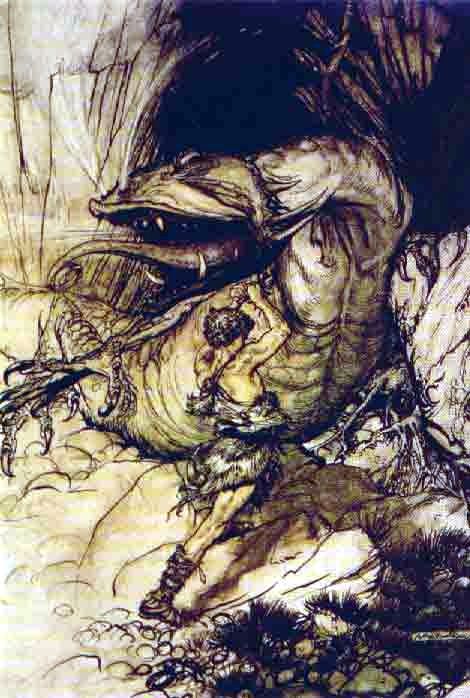
The Story of the Volsungs is a thirteenth-century Icelandic prose saga that tells, from beginning to end, the legend of the Volsung kindred, the dragon-slayer Sigurd and the fall of the Niflungs. The library text is the translation by Eiríkr Magnússon and William Morris, first published in 1870, in the 1888 edition, with an introduction, the translators' preface, notes, and an appendix of Morris and Magnússon's versions of related Eddic lays, from the Second Lay of Helgi Hundings-bane to the Lament of Oddrun. The saga begins with Sigi, a son of Odin, and his descendant Volsung, who builds his hall around the oak called the Branstock. At the wedding of Volsung's daughter Signy to King Siggeir of Gothland, a one-eyed stranger thrusts a sword into the tree; only Sigmund, Volsung's son, can draw it. Siggeir resents this, invites the Volsungs to visit, and kills Volsung and all his sons except Sigmund. Signy, bent on vengeance, takes another woman's shape and secretly conceives a son, Sinfjotli, by her brother. Sigmund and Sinfjotli live as outlaws, for a time in wolf-skins, before burning Siggeir in his hall; Signy chooses to die with her husband. Sinfjotli is later poisoned by Sigmund's queen Borghild, and Sigmund falls in his last battle when Odin breaks the sword. Sigmund's son Sigurd is raised at the Danish court of King Hjalprek and fostered by the smith Regin, who tells how the gods paid a ransom of gold for killing his brother Otter, and how Fafnir murdered their father for it and became a dragon. Regin reforges the shards of Sigmund's sword as Gram. Sigurd avenges his father, kills Fafnir from a pit, tastes the dragon's heart-blood and understands the birds, who warn him to kill the treacherous Regin. He wakes the Valkyrie Brynhild on Hindfell, who teaches him runes and counsel, and they pledge themselves to each other. At the court of King Giuki, Queen Grimhild gives Sigurd a drink that makes him forget Brynhild. He marries Gudrun and swears brotherhood with Gunnar and Hogni, then rides through the flames in Gunnar's likeness to win Brynhild for him. When the queens quarrel and the deception comes out, Brynhild demands Sigurd's death; the youngest brother Guttorm kills him, and Brynhild dies on his pyre. Gudrun, given a drink of forgetfulness, marries King Atli, who lures her brothers to his hall for the gold. Hogni laughs as his heart is cut out, and Gunnar, refusing to reveal the hoard, dies in the snake-pit playing his harp. Gudrun takes a terrible revenge on Atli. Her daughter Swanhild is later trampled to death by King Jormunrek, and her last sons, Hamdir and Sorli, die avenging her.
Virtues in this work
- Fortitude: Hogni laughs while his heart is cut out at Atli's command, and Gunnar plays his harp in the worm-close rather than reveal the gold.
- Prudence: Brynhild counsels Sigurd on Hindfell to bear and forbear with his kin, shun quarrels with fools and beware strong drink.
- Honor: Sigurd, dying, insists that he always held fast to his oath with Gunnar and never wronged him.
- Magnanimity: Sigurd tells Regin that a stout heart counts for more than a sharp sword when men meet their foes in fight.
Plot or Argument
- Introduction and translators' preface
The 1888 edition opens with an introduction on Iceland and the old Northern literature and the translators' preface, which explains which Eddic lays lie behind each part of the saga and sets the story beside the Tale of Troy.
- Chapters I-III: Sigi, Rerir, Volsung and the Branstock
Sigi, Odin's son, is outlawed for a killing and wins a kingdom; his son Rerir's wife conceives after eating an apple sent by the gods, and bears Volsung, who builds a hall around an oak; a one-eyed stranger sets a sword in the oak and only Sigmund can draw it.
- Chapters IV-VIII: Signy and Siggeir
Siggeir weds Signy unwillingly, then slays Volsung and his sons; Sigmund survives in the forest; Signy sends him her sons to test, conceives Sinfjotli in disguise, and the two men, after a season as wolves, burn Siggeir's hall while Signy goes back to die in it.
- Chapters IX-XII: Helgi, Sinfjotli's death and Sigmund's fall
Sigmund's son Helgi wins the Valkyrie Sigrun; Sinfjotli drinks poison from Borghild's horn; Sigmund weds Hjordis and falls against King Lyngi when Odin shatters his sword, leaving the shards for his unborn son.
- Chapters XIII-XIX: Sigurd, Regin and Fafnir
Sigurd grows up at Hjalprek's court, chooses the horse Grani, hears Regin's tale of Andvari's cursed gold, receives the reforged sword Gram, hears his fate from Grifir, avenges Sigmund, slays Fafnir, understands the birds and kills Regin.
- Chapters XX-XXIV: Brynhild
Sigurd rides up Hindfell and wakes Brynhild within her shield-wall; she gives him runes and wise counsel; they meet again at Heimir's hall in Hlymdale and plight their troth.
- Chapters XXV-XXIX: Gudrun, the potion and the wooing of Brynhild
Gudrun dreams of a hawk with golden feathers; Grimhild's drink makes Sigurd forget Brynhild; he marries Gudrun and, in Gunnar's shape, rides Grani through the flickering fire to win Brynhild for Gunnar; the queens quarrel in the river and Brynhild learns the truth and lies sick with grief.
- Chapters XXX-XXXII: The slaying of Sigurd and the end of Brynhild
Guttorm, not bound by the oath of brotherhood, stabs Sigurd in his bed; the saga inserts the First Lay of Gudrun on her grief; Brynhild foretells what is to come and has herself burned beside Sigurd.
- Chapters XXXIII-XXXIX: Atli and the fall of the Giukings
Gudrun is made to wed Atli; his messenger Vingi alters her warning runes; Kostbera and Glaumvor dream of disaster; the brothers ride anyway; Hogni's heart is cut out and Gunnar dies in the worm-close; Gudrun avenges them on Atli and burns his hall.
- Chapters XL-XLIII: Swanhild and the last of the kin
Gudrun's attempt to drown herself fails and she weds King Jonakr; Swanhild is betrothed to Jormunrek and trodden down by horses on Bikki's counsel; Hamdir and Sorli kill their brother Erp on the road, maim Jormunrek, and are stoned to death on the advice of a one-eyed old man.
- Appendix of Eddic lays
Morris and Magnússon's verse translations of related poems: part of the Second Lay of Helgi Hundings-bane, part of the Lay of Sigrdrifa, the Short Lay of Sigurd, the Hell-ride of Brynhild, the Fragments of the Lay of Brynhild, the Second or Ancient Lay of Gudrun, the Song of Atli, the Whetting of Gudrun, the Lay of Hamdir and the Lament of Oddrun.
Characters
- Volsung, king of Hunland, founder of the line
Great-grandson of Odin, who builds his hall around the Branstock and is slain by his son-in-law Siggeir.
- Signy, Volsung's daughter
Wedded against her will to Siggeir, she lives only for vengeance and dies in his burning hall.
- Sigmund, Volsung's son
Draws Odin's sword from the Branstock, survives as an outlaw, and dies when Odin breaks the blade.
- Sinfjotli, son of Sigmund and Signy
Fierce companion of Sigmund's outlaw years, poisoned at last by Queen Borghild.
- Sigurd Fafnir's-bane, son of Sigmund and Hjordis
Slayer of the dragon Fafnir and winner of the hoard, murdered through Brynhild's grief and the Giukings' fear.
- Regin, Sigurd's foster-father
A cunning smith who forges Gram and urges Sigurd against his brother Fafnir, meaning to betray him.
- Fafnir, dragon
Regin's brother, who killed their father for the gold and lies on it as a serpent; dying, he warns Sigurd that the gold will be his bane.
- Odin, god
Appears as a one-eyed old man in a slouched hat who gives the sword, chooses the horse and ends the line.
- Brynhild, Valkyrie, Budli's daughter
Woken by Sigurd and pledged to him, deceived into marrying Gunnar, she brings about Sigurd's death and dies beside him.
- Gudrun, Giuki's daughter
Sigurd's wife, later Atli's, who grieves, avenges her brothers, and outlives nearly all her kin.
- Grimhild, Giuki's queen
A fierce-hearted woman whose potions make Sigurd forget Brynhild and Gudrun forget her wrath.
- Gunnar, king of the Giukings
Sigurd's sworn brother and Brynhild's husband, who dies in the snake-pit keeping the secret of the gold.
- Hogni, Gunnar's brother
Laughs while his heart is cut out at Atli's command.
- Atli, king, Brynhild's brother
Gudrun's second husband, who lures the Giukings to his hall for their gold.
Lessons
The curse that follows the gold
Andvari's hoard passes from the dwarf to the gods, to Hreidmar, Fafnir, Sigurd and the Giukings, and each owner dies for it. Fafnir warns Sigurd that the gold will be his bane, and the saga bears him out. The story makes greed a force that binds generations into killing, though Gunnar's last refusal to give the gold to Atli turns the hoard into a point of honour.
- Why does Andvari curse the gold, and how does Loki's ransom for Otter start the chain of deaths?
- Sigurd answers Fafnir that each man must die once for all. Is this courage, or a refusal to listen?
- When Gunnar gives the gold to the Rhine rather than to Atli, is he still ruled by the treasure, or has he finally mastered it?
Oaths and the price of breaking them
Sigurd and Brynhild plight their troth; Sigurd, under Grimhild's potion, swears brotherhood with Gunnar and Hogni; the brothers then arrange his killing through Guttorm, who alone has sworn no oath. The saga shows how a society held together by sworn faith collapses when deception and pride set one oath against another.
- Is Sigurd guilty of breaking faith with Brynhild if the potion has made him forget her?
- Why do Gunnar and Hogni use Guttorm rather than kill Sigurd themselves?
- Sigurd insists as he dies that he always held fast to his oath with Gunnar. Does the saga agree with him?
Counsel for a hero: Brynhild's wise words
In Chapters XX-XXI Brynhild gives Sigurd a string of counsels: be kindly to kin and forgive their trespasses, avoid quarrels with fools, keep from strong drink and beguiling women, bury the dead with care. Her advice is the saga's clearest statement of a Northern ethic of prudence and restraint, and much of the later tragedy follows from its neglect.
- Which of Brynhild's counsels does Sigurd keep, and which does he or his companions break?
- Why might the saga place this wisdom just before Sigurd's entry into the Giuking court?
- How does her advice to bear and forbear compare with the code of revenge that drives Signy and Gudrun?
Courage facing a known fate
Grifir tells Sigurd his whole life in advance; dying, Sigurd says no one may fight against his fate and prevail; the Giukings ride to Atli despite runes and dreams of warning. The saga's heroes do not escape fate but meet it with steadiness, as Hogni's laughter and Gunnar's harp show.
- Why does Sigurd still want to hear Grifir's prophecy, and why does he act as he does afterward?
- What warnings do Kostbera and Glaumvor give, and why do Hogni and Gunnar ignore them?
- Is there freedom in the way these heroes face an ending they already know?
Context
The saga's legends reach back to the migration age of the Germanic peoples: Atli recalls Attila the Hun (d. 453), Gunnar the Burgundian king Gundaharius, whose people were crushed in 437, and Jormunrek the Gothic king Ermanaric (d. c. 375). Over centuries these memories were reshaped in song, and by the Viking age the Sigurd story was known across the Norse world; carvings of the dragon-slaying on the Ramsund rock in Sweden and on stave-church portals in Norway show its popularity. In Christian Iceland of the thirteenth century, when sagas were being written in great numbers, an author gathered the poems into a single prose history.
Composition
The saga is generally dated to about 1250-1270, though some place it earlier or later; scholars debate how far its author drew on lost poems as well as the surviving Codex Regius lays, whose gap of missing leaves the saga partly fills. It survives in one manuscript of about 1400 together with Ragnars saga. Magnússon and Morris published their translation in 1870; the stored text follows the 1888 edition, which adds an introduction and notes, and its appendix of Eddic lays carries the translators' own verse renderings.
Reception
The Volsung legend was widely retold in the nineteenth century. Richard Wagner drew on the saga and the Eddic poems, with the German Nibelungenlied, for Der Ring des Nibelungen, first performed complete at Bayreuth in 1876; Morris published his epic Sigurd the Volsung the same year. J. R. R. Tolkien lectured on the Eddic Sigurd poems and wrote his own versions, published in 2009 as The Legend of Sigurd and Gudrún, and the saga's dragon, cursed hoard and broken sword left marks on his fiction. Modern translations include those of R. G. Finch (1965) and Jesse L. Byock (1990).
Comparisons
- poetic-edda
The saga is largely a prose retelling of the Eddic heroic lays from Reginsmol through Hamthesmol; reading the two together shows what the saga author added, smoothed or invented, especially for the lost section on Sigurd's wooing of Brynhild.
- prose-edda
Snorri's Skaldskaparmal tells the story of the otter's ransom, Andvari's gold and Sigurd in brief prose; it is an older Icelandic summary of the same legend, written for poets.
- the-nibelungenlied
The German epic tells the same story of Siegfried, Kriemhild, Brunhild, Gunther and Hagen at a Christian court, with Kriemhild avenging her husband on her brothers, whereas the Norse Gudrun avenges her brothers on Atli.
- beowulf
The Old English poem sings briefly of Sigemund the dragon-slayer and his nephew Fitela, an English witness to Sigmund and Sinfjotli; both works end with a dragon, a hoard and a doomed people.
- the-iliad
The translators' preface sets the saga beside the Tale of Troy: both are heroic cycles of a quarrel over a woman, a doomed champion who knows his fate, and the laments of the women who survive.
- the-hobbit
Smaug on his hoard, the dragon's conversation and riddling self-description, and the curse of gold that divides allies recall Fafnir and Andvari's treasure, which Tolkien knew intimately.
Quotes
Frequently cited
“Whoso draweth this sword from this stock, shall have the same as a gift from me, and shall find in good sooth that never bare he better sword in hand than is this.”
Frequently cited
“Be kindly to friend and kin, and reward not their trespasses against thee; bear and forbear, and win for thee thereby long enduring praise of men.”
Frequently cited
“the Rhine river shall rule over the gold, rather than that the Huns shall bear it on the hands of them.”
“Whenas men meet foes in fight, better is stout heart than sharp sword.”
“that same gold which I have owned shall be thy bane too.”
“Many a man lives after hope has grown little; but my good-hap has departed from me, nor will I suffer myself to be healed”
“none may fight against his fate and prevail.”
For Students
A reading companion for classical Christian high school students. See the student guide.
Reading Guide
Watch for
- Every appearance of the one-eyed old man in the slouched hat, from the Branstock in Chapter III to the stoning of Hamdir and Sorli in Chapter XLIII.
- The path of Andvari's gold and the ring Andvaranaut from Regin's tale in Chapter XIV to the Rhine in Chapter XXXVIII.
- Brynhild's counsels to Sigurd in Chapter XXI, and which of them are later broken.
- The warnings the Giukings receive before riding to Atli: runes altered by Vingi, a wolf's hair knit into Gudrun's ring, and the wives' dreams.
- Places where the saga quotes verse, and the appendix lays that tell the same scenes again.
Key terms and names
- Branstock
- The great oak growing through King Volsung's hall, into which Odin thrusts the sword that Sigmund draws.
- Gram
- Sigmund's sword, broken by Odin and reforged by Regin for Sigurd, so sharp that it splits the anvil and cuts wool floating in the stream.
- Andvari's Hoard
- The dwarf's gold, taken by Loki to pay the ransom for Otter and cursed so that it will bring death to all who own it.
- Valkyrie
- A shield-maiden who chooses the slain for Odin; Brynhild is punished by Odin and sleeps on Hindfell until Sigurd wakes her.
- Giukings (Niblungs)
- The children of King Giuki and Grimhild: Gunnar, Hogni, Guttorm and Gudrun, who take Sigurd into their kin and then destroy him.
- Worm-close
- The snake-pit into which Atli casts Gunnar, who plays the harp with his toes until all the serpents but one fall asleep.
- Rede
- Morris's word for counsel or advice, used throughout the translation, as when Brynhild shows Sigurd more redes of great avail.
- Saga
- An Icelandic prose narrative; this one is a legendary saga, telling of heroes of the distant past rather than of Icelandic families.
Seminar Questions
- Comprehension How does Sigmund come to hold the sword from the Branstock, and why does Siggeir resent it?
- Comprehension What happens when Sigurd tastes Fafnir's heart-blood, and what do the birds advise him to do?
- Comprehension How is Brynhild deceived into marrying Gunnar, and how does she learn the truth?
- Interpretation Signy sacrifices her children, her honour and finally her life for vengeance. Does the saga present her as admirable, terrible, or both?
- Interpretation Grimhild's drink makes Sigurd forget Brynhild. How much responsibility for the tragedy belongs to Grimhild, to Sigurd, to Gunnar and to Brynhild herself?
- Interpretation Sigurd tells Regin that a stout heart is better than a sharp sword, yet the saga dwells on Gram's sharpness. Which does the saga honour more in its heroes?
- Big Question The saga's heroes know their fates and meet them anyway. Is courage that cannot change the outcome still a virtue?
- Big Question Brynhild counsels Sigurd to bear and forbear with his kin, yet nearly every character lives by revenge. Can a culture of honour survive without forgiveness?
Faith Connections
- 1 Timothy 6:9-10 (Scripture)
Paul warns that those who desire to be rich fall into a snare that drowns men in ruin, for the love of money is a root of all kinds of evil. Andvari's hoard gives a vivid pagan picture of that snare, passing from owner to owner and destroying each.
- Romans 12:17-21 (Scripture)
Repay no one evil for evil, and vengeance belongs to the Lord: the chain that runs from Signy's revenge on Siggeir to Hamdir and Sorli's ride against Jormunrek is the very cycle this passage breaks by commanding that evil be overcome with good.
- Proverbs 4:5-9 (Scripture)
Wisdom is to be sought above all things and will honour the one who embraces her. Sigurd climbs Hindfell because the birds say he will gain great wisdom there, and Brynhild's counsel in Chapter XXI reads like a Northern book of proverbs.
- J. R. R. Tolkien, Beowulf: The Monsters and the Critics (1936) (Great Conversation)
Tolkien argued that the Northern imagination admired courage in a war that the gods themselves would lose; the Volsung saga, with Odin ending the line he founded, is one of the purest expressions of that vision.
Logic and Rhetoric
Central argument: The saga argues by example: the gold is cursed; whoever takes it, whether by murder (Fafnir), courage (Sigurd) or treachery (the Giukings, Atli), dies; oaths and kinship cannot hold against the desire for the hoard and the demands of honour; therefore the whole line of the Volsungs and Giukings perishes, leaving only the fame of how they faced death.
Rhetorical device: Ironic repetition (parallel speeches). In Chapter XXXVIII the trembling heart of the thrall Hjalli and the unmoved heart of Hogni are shown to Gunnar in turn, and his reply reverses the earlier speech word for word before he declares that the Rhine shall rule over the gold.
Debate: Resolved: Brynhild is more wronged than wrongdoing in the death of Sigurd.
Memory Work
Whenas men meet foes in fight, better is stout heart than sharp sword.
Be kindly to friend and kin, and reward not their trespasses against thee; bear and forbear, and win for thee thereby long enduring praise of men.
Writing Prompts
Essay: Is Sigurd the hero of this saga, or is the curse of the gold its true subject? Use the chapters before his birth, his life, and the chapters after his death.
Comparison with The Nibelungenlied: Compare Gudrun's revenge in the Volsung saga with Kriemhild's in the Nibelungenlied. Whom does each woman avenge, on whom, and how does each work judge her?
Medical Lens
The saga is not a medical text, but it is full of poisons, potions, wounds and charms, and the 1888 edition's own note points readers to Cockayne's Leechdoms, Wortcunning, and Starcraft of the Anglo-Saxons for parallel beliefs about spells, dreams and drinks. Sigmund can drink venom unharmed while Sinfjotli dies of Borghild's poisoned horn; Sigmund heals Sinfjotli's bitten throat with a leaf he has seen a weasel use; Grimhild's mingled drinks make first Sigurd and then Gudrun forget, a literary picture of a drug acting on memory and will. Brynhild's rune-lore includes help-runes to loosen a child from its mother and bough-runes for those who love leech-lore, wound-healing charms comparable to Old English charm texts. Brynhild's lying abed as one dead after she learns of the deception, and Gudrun's dry-eyed grief over Sigurd, belong to the literature of grief; a modern reading of either as depressive illness would be an interpretation, not something the saga states. The wolf-skin episode of Sigmund and Sinfjotli shows the Norse idea of shape-changing warriors, later discussed by scholars alongside berserkers.
- Chapter VIII
Sigmund can eat venom without harm, while Sinfjotli can bear it only on his skin; later, after the wolf-skin fight, Sigmund sees a weasel heal its fellow with a leaf and uses the same herb on Sinfjotli's throat.
- Chapter X
Queen Borghild offers Sinfjotli the horn three times; Sigmund, by then very drunk, tells him to strain the venom out with his lip, and he dies at once.
- Chapter XII
Sigmund, mortally wounded on the battlefield, refuses Hjordis's offer of healing because his luck and Odin's favour have left him.
- Chapters XX-XXI
Brynhild teaches help-runes for childbirth and bough-runes for leech-lore and wound-searching, and counsels careful washing and burial of the dead.
- Chapter XXVI
Grimhild gives Sigurd a horn of drink, and he forgets Brynhild entirely and remains at the Giuking court.
- Chapter XXIX
Brynhild lies abed as one dead, will not answer Gunnar, and speaks only of her wrongs before she demands Sigurd's death.
- Chapters XXXV-XXXVI
Kostbera and Glaumvor recount ominous dreams to their husbands before the ride to Atli, and the men explain each one away.
Creative Prompts
- Dialogue
Rewrite the exchange between Sigurd and the dying Fafnir in Chapter XVIII as a modern-English dialogue, keeping every question and answer, then explain what Sigurd learns and what he refuses to learn.
- Poetry
Write the lament Gudrun cannot speak over Sigurd in alliterative half-lines, using the First Lay of Gudrun in Chapter XXXI as your model.
- Essay
Trace Odin's appearances from the Branstock to the stoning of Hamdir and Sorli. Is he the saga's protector of the Volsungs or the author of their ruin?
- Classroom
Draw a family tree from Sigi to Swanhild and mark who dies by whose hand, then discuss what the chart shows about vengeance in the saga.
- Adaptation
Compare a scene of the saga with the same scene in the appendix lays, such as Gunnar in the worm-close in Chapter XXXVIII and in the Song of Atli, and stage both versions side by side.
Further Reading
- The Saga of the Volsungs, trans. Jesse L. Byock
A modern prose translation with an introduction to the legend's history.
- The Story of Sigurd the Volsung and the Fall of the Niblungs, William Morris
Morris's 1876 epic poem retelling the saga in long rhyming couplets.
- The Legend of Sigurd and Gudrún, J. R. R. Tolkien; ed. Christopher Tolkien
Tolkien's English poems on the Volsung legend in Eddic metre, with his lecture notes.
- The Red Fairy Book, Andrew Lang (ed.)
Contains The Story of Sigurd, a short retelling for children drawn from Morris's translation.
- Gods and Myths of Northern Europe, H. R. Ellis Davidson
Verification notes
All quotations were checked by exact search against the stored Project Gutenberg text (#1152), which follows the 1888 Walter Scott edition of the Magnússon and Morris translation; line breaks were collapsed to single spaces and Morris's archaic spelling is kept. Chapter numbers are those of the stored text. The historical prototypes of Atli, Gunnar and Jormunrek are standard identifications; the saga's date (c. 1250-1270) and the extent of its debt to lost poems are matters of scholarly debate, and the record says so. The Gutenberg file's own front matter includes a reading list added by its producer, which is not part of the 1888 edition.
- The author of the introduction in the 1888 edition (often attributed to H. Halliday Sparling) is not named in the stored text and should be confirmed before citing it.
- The Codex Regius poems behind each chapter are as described in the translators' preface; individual correspondences should be checked against a modern edition.