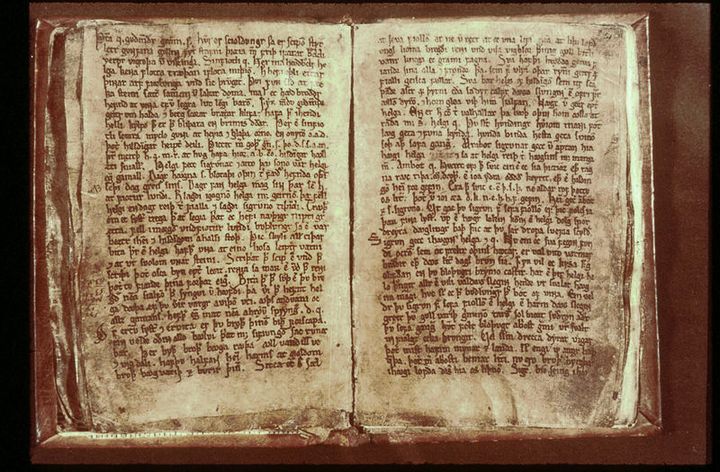
The poems of the Poetic Edda were composed by unknown Norwegian and Icelandic poets over several centuries, perhaps from the ninth or tenth century onward, and were transmitted orally before an Icelandic scribe gathered most of them in a single manuscript, the Codex Regius, around 1270. Some lays may have been composed in Norway or the Norse colonies, and the heroic poems carry legends that came north from the continental Germanic peoples. When the manuscript was found in 1643, Bishop Brynjólfur Sveinsson attributed the collection to the learned priest Sæmundr Sigfússon, an attribution scholars no longer accept.
“I ween that I hung | on the windy tree, Hung there for nights full nine; With the spear I was wounded, | and offered I was To Othin, myself to myself,”
“Whoso draweth this sword from this stock, shall have the same as a gift from me, and shall find in good sooth that never bare he better sword in hand than is this.”
The Poetic Edda is the collection of anonymous Old Norse poems about the gods and heroes of the North, preserved chiefly in the Icelandic manuscript known as the Codex Regius, written about 1270. The library text is the complete translation by Henry Adams Bellows, published in 1923 by the American-Scandinavian Foundation, which renders thirty-five poems in alliterative verse and adds a general introduction, an introductory note to each poem and extensive notes.
The Story of the Volsungs is a thirteenth-century Icelandic prose saga that tells, from beginning to end, the legend of the Volsung kindred, the dragon-slayer Sigurd and the fall of the Niflungs. The library text is the translation by Eiríkr Magnússon and William Morris, first published in 1870, in the 1888 edition, with an introduction, the translators' preface, notes, and an appendix of Morris and Magnússon's versions of related Eddic lays, from the Second Lay of Helgi Hundings-bane to the Lament of Oddrun.