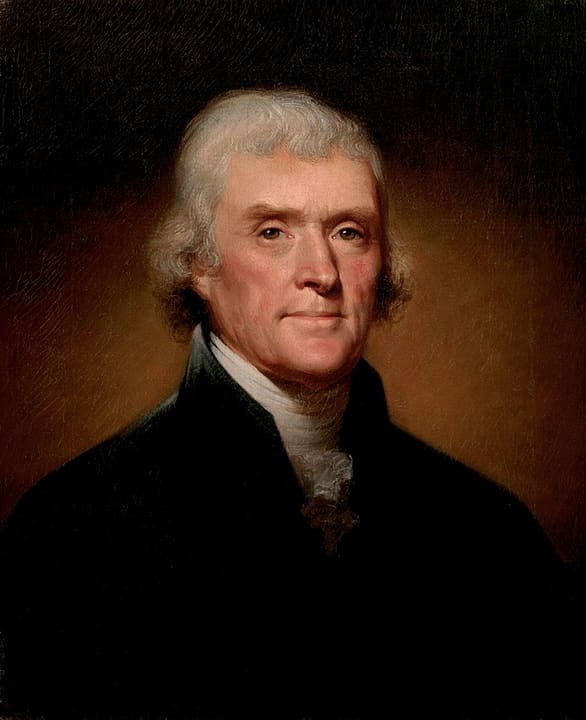
Thomas Jefferson (1743-1826) was an American planter, lawyer, revolutionary, diplomat, president, architect, and writer. He drafted the Declaration of Independence and later served as governor of Virginia, minister to France, secretary of state, vice president, and president. His ideals of liberty coexist with his lifelong slaveholding and racial hierarchy.
“though the will of the majority is in all cases to prevail, that will to be rightful must be reasonable; that the minority possess their equal rights, which equal law must protect, and to violate would be oppression.”
“But every difference of opinion is not a difference of principle. We have called by different names brethren of the same principle. We are all Republicans, we are all Federalists.”
“a wise and frugal Government, which shall restrain men from injuring one another, shall leave them otherwise free to regulate their own pursuits of industry and improvement, and shall not take from the mouth of labor the bread it has earned.”
“that Truth is great, and will prevail if left to herself, that she is the proper and sufficient antagonist to error, and has nothing to fear from the conflict, unless by human interposition disarmed of her natural weapons free argument and debate”
Jefferson's selected writings show the range and tensions of the revolutionary Enlightenment in America. Notes on the State of Virginia began as answers to questions from a French diplomat, but it became Jefferson's most sustained book: a survey of Virginia's geography, natural history, laws, economy, population, slavery, Indigenous peoples, education, religion, and politics.
1777 (enacted 1786) · 18th Century · Political Theory
An Act for establishing religious Freedom is a law of the Commonwealth of Virginia, passed by the General Assembly on 16 January 1786. Thomas Jefferson drafted it in 1777 as part of a committee's general revision of Virginia's laws after independence, and it was introduced in 1779, when it failed to pass.
Thomas Jefferson delivered his First Inaugural Address on 4 March 1801 in the Senate chamber of the unfinished Capitol, the first presidential inauguration held in the new federal city of Washington. Chief Justice John Marshall administered the oath.