Al-Khwarizmi
c. 780–850 · Persian mathematician in Baghdad whose books gave us the words algebra and algorithm.
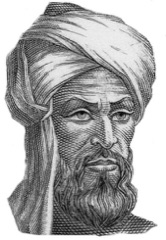
Muhammad ibn Musa al-Khwarizmi was a Persian scholar whose name suggests his family came from Khwarazm, a region south of the Aral Sea in Central Asia. He worked in Baghdad at the House of Wisdom, a center of learning and translation supported by the Abbasid caliph al-Mamun, where scholars translated Greek, Persian and Indian works into Arabic. Around 820 he wrote The Compendious Book on Calculation by Completion and Balancing, which explained systematic ways to solve linear and quadratic equations, using practical examples from inheritance, trade and land measurement. The Arabic word al-jabr in its title, meaning restoring or completion, became our word algebra. Another book explained the Hindu decimal number system, with nine digits and zero. When it was translated into Latin, his name was written Algoritmi, giving us the word algorithm, and it helped bring Arabic numerals to Europe. He also prepared astronomical tables and revised Ptolemy's geography, listing the coordinates of cities and places. He died around 850.
Faith: A Muslim mathematician and astronomer. Source: Encyclopaedia Britannica

Key dates
- c. 780 Born, probably in Khwarazm
- c. 820 Writes his book on algebra
- c. 825 Book on Hindu numerals
- 12th century His works translated into Latin
- c. 850 Dies
Fun facts
- A crater on the far side of the Moon is named after him. (Source: Al-Khwarizmi (Wikipedia))
Record-breaker
Firsts and records, worded as the sources give them ("first known", "at the time").
- He was the first known writer to treat algebra as a subject of its own, which is why he is often called the father of algebra. (Source: Al-Khwarizmi (Wikipedia))
Notes: Dates are approximate.